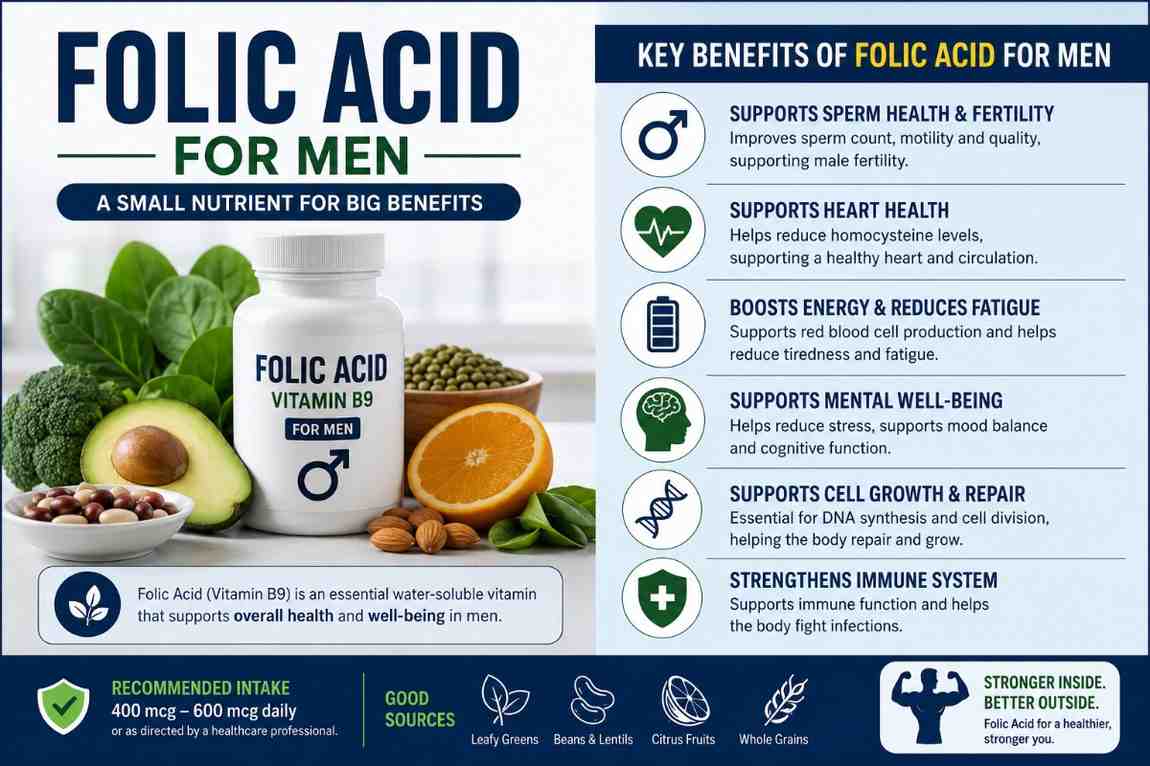
Folic acid is often discussed in connection with pregnancy and women’s health, but men need folate too. In fact, folate is involved in some of the body’s most basic processes, including DNA production, cell division, red blood cell formation, and normal tissue growth.
For men who are trying to improve their overall nutrition or preparing for fatherhood, folate is one nutrient worth understanding. However, there is an important distinction between getting enough folate and taking high-dose folic acid supplements specifically to improve fertility.
Research has shown that folate is essential for normal cellular function, but clinical evidence does not currently support high-dose folic acid supplements as a proven treatment for male infertility. A large randomized clinical trial involving 2,370 couples found that folic acid plus zinc supplementation in men did not significantly improve semen quality or live-birth rates compared with placebo.
This guide explains what folic acid does for men, how much they need, its potential connection with sperm health, food sources, supplementation, side effects, and important safety considerations.
What Is Folic Acid?
Folic acid is a form of vitamin B9, while folate is the broader term used for vitamin B9 found naturally in foods and in supplements or fortified foods.
The body needs folate to make DNA and other genetic material and to support normal cell division. Folic acid is the form commonly used in dietary supplements and fortified foods because it is stable and readily absorbed.
Folate is particularly important for tissues where cells are dividing rapidly, including blood-forming tissues and other growing or repairing cells.
For adult men aged 19 and older, the recommended intake is 400 mcg of dietary folate equivalents (DFE) per day.
Folate vs. Folic Acid: What Is the Difference?
Although the terms are often used interchangeably, they are not exactly the same.
| Nutrient | What it means |
|---|---|
| Folate | General term for vitamin B9, particularly forms naturally present in foods |
| Folic acid | A synthetic form of vitamin B9 used in supplements and fortified foods |
| 5-MTHF | A naturally occurring active form of folate also available in some supplements |
| Vitamin B9 | The general vitamin category that includes folate and folic acid |
Because folic acid is generally more bioavailable than naturally occurring food folate, nutritional labels use DFE (dietary folate equivalents) to account for these differences.
Why Do Men Need Folic Acid?
Folic acid is not a “male fertility vitamin” in the narrow sense. It is a basic nutrient required by both men and women.
1. Supports DNA Production
Folate participates in processes required to make and maintain DNA. Since DNA is present in virtually every cell, adequate folate is fundamental to normal cellular function.
2. Helps With Cell Division
Cells need folate to divide properly. This is particularly important in tissues that constantly produce new cells.
3. Supports Red Blood Cell Formation
Folate is involved in normal blood-cell production. Severe folate deficiency can contribute to megaloblastic anemia.
4. Supports Normal Tissue Growth
Because folate is involved in cell division and DNA synthesis, adequate intake helps support normal growth and maintenance of tissues.
5. Supports Normal Metabolism
Folate participates in one-carbon metabolism, a group of biochemical reactions involved in DNA synthesis and amino-acid metabolism.
6. Helps Maintain Adequate Folate Status
Getting enough folate through food helps prevent inadequate intake and supports the body’s normal vitamin B9 requirements.
7. Supports Reproductive Cell Development
Sperm production involves continuous cell division and DNA-related processes. This provides a biological reason researchers have investigated folate and male reproductive health.
However, this does not mean that taking extra folic acid automatically improves fertility.
Folic Acid and Male Fertility
This is one of the most common reasons men search for folic acid.
Folate has biological roles that are relevant to sperm production and DNA synthesis. Observational research has also investigated whether folate status is associated with semen characteristics.
But the important question is whether taking a folic acid supplement actually makes men more fertile.
The strongest clinical evidence is more cautious.
A large randomized clinical trial published in JAMA studied 2,370 couples undergoing infertility treatment. Men received either 5 mg of folic acid plus 30 mg of zinc daily or a placebo for six months. The researchers found no significant improvement in live-birth rates or most semen-quality measures. In fact, DNA fragmentation was statistically higher in the supplementation group. The authors concluded that these findings did not support folic acid and zinc supplementation as a treatment for male infertility.
So, Does Folic Acid Increase Sperm Count?
Not reliably based on current high-quality evidence.
Folate is necessary for normal cellular processes involved in sperm production, but there is insufficient evidence to recommend high-dose folic acid specifically as a sperm-count booster.
Men with poor semen results should not assume that taking more folic acid will solve the problem. A semen analysis and evaluation by a qualified healthcare professional are more appropriate when infertility is a concern.
10 Potential Benefits of Folic Acid for Men
Adequate folate intake may provide several important nutritional benefits.
1. Supports Healthy DNA
Folate contributes to DNA synthesis and maintenance, making adequate intake important for normal cellular function.
2. Supports Cell Division
Folate is required for normal cell division, which occurs throughout the body every day.
3. Supports Red Blood Cell Production
Adequate folate helps the body maintain normal blood-cell production.
4. Helps Prevent Folate Deficiency
Obtaining enough folate through food or appropriate supplementation can help prevent inadequate vitamin B9 intake.
5. Supports Normal Metabolic Processes
Folate is involved in one-carbon metabolism and several biochemical reactions required for normal health.
6. May Be Relevant to Sperm Health
Because sperm production requires cell division and DNA synthesis, adequate folate status is biologically relevant to male reproductive health, although supplementation has not been proven to improve fertility outcomes.
7. Supports General Cellular Health
Nearly every tissue relies on normal DNA synthesis and cell division, making folate an important basic nutrient.
8. Works With Other B Vitamins
Folate functions within interconnected metabolic pathways involving other B vitamins, including vitamin B12.
9. Supports Normal Blood Formation
Folate is particularly important for rapidly dividing blood-forming cells.
10. Supports a Balanced Nutritional Pattern
Folate-rich foods such as leafy greens, beans, asparagus, citrus fruits, and certain fortified grains can contribute to an overall nutrient-dense diet.
How Much Folic Acid Do Men Need?
For adult men aged 19 and older, the recommended intake is:
400 mcg DFE of folate per day.
This recommendation is for total folate intake and is not a recommendation for every man to take a 400-mcg folic acid supplement.
A man may meet his needs through a combination of naturally occurring folate from food and folic acid from fortified foods.
| Age | Recommended Folate Intake |
|---|---|
| 14–18 years | 400 mcg DFE/day |
| 19+ years | 400 mcg DFE/day |
The recommended intake is expressed as DFE because the body handles folic acid and naturally occurring food folate differently.
Folic Acid Dosage for Men
| Purpose | General Guidance |
|---|---|
| Daily folate requirement for adult men | 400 mcg DFE/day |
| Separate folic acid supplement | Not automatically necessary for every man |
| High-dose folic acid for fertility | Not proven to improve male infertility |
| Adult upper limit from supplements/fortified foods | 1,000 mcg/day folic acid |
| Folate from natural foods | No established UL |
| Fertility treatment | Discuss with a fertility specialist rather than self-prescribing high doses |
The 1,000-mcg upper limit applies to folic acid and other synthetic folate forms from supplements and fortified foods, not naturally occurring food folate.
What Foods Are High in Folate?
A food-first approach is a practical way for most men to obtain folate.
| Food | Folate Contribution |
|---|---|
| Spinach | Good natural source |
| Asparagus | Good natural source |
| Brussels sprouts | Good natural source |
| Beans | Good natural source |
| Peas | Good natural source |
| Peanuts | Natural source |
| Oranges | Natural source |
| Orange juice | Natural source |
| Beef liver | Very rich source |
| Fortified cereals | May contain added folic acid |
| Enriched breads | May contain added folic acid |
| Enriched pasta | May contain added folic acid |
NIH identifies dark green vegetables, asparagus, Brussels sprouts, beans, peas, nuts, citrus fruits, liver, and fortified grain products among useful sources of folate or folic acid.
Folic Acid-Rich Foods for Men
If you’re preparing for fatherhood, focus on your overall dietary pattern rather than relying on one supplement.
A fertility-conscious eating pattern can include:
- Spinach and other dark leafy greens
- Broccoli
- Asparagus
- Beans and lentils
- Peas
- Citrus fruits
- Nuts and seeds
- Eggs
- Fish and seafood
- Whole grains
- Fortified grain products
The goal is not to consume enormous amounts of one nutrient. Instead, aim for a varied diet that supplies folate along with protein, zinc, selenium, vitamin B12, iron, omega-3 fats, and other essential nutrients.
Should Men Take Folic Acid Supplements?
Not necessarily.
A supplement can be useful when dietary intake is inadequate or when a healthcare professional identifies a nutritional need. But taking a high-dose folic acid supplement simply because you are male or trying to conceive is not currently supported by strong evidence.
The large randomized trial of folic acid plus zinc found no meaningful improvement in semen quality or live birth.
Therefore, men should think of folic acid as an essential nutrient, rather than a guaranteed fertility enhancer.
If you are considering a fertility supplement, review the entire ingredient list. Some products contain several overlapping nutrients, which can unintentionally push total intake higher than intended.
Can Folic Acid Improve Sperm Quality?
The answer is more complicated than many supplement advertisements suggest.
Adequate folate is important for DNA synthesis and cell division, processes that are relevant to sperm development. This has made folate an interesting area of male-fertility research.
However, a large randomized trial did not show improvements in sperm concentration, motility, morphology, volume, or total motile sperm count after six months of folic acid and zinc supplementation.
So it is reasonable to say:
Adequate folate supports normal biology, but high-dose folic acid has not been proven to improve male fertility.
Folic Acid and Sperm DNA
Sperm DNA integrity is another area researchers have investigated.
The JAMA trial mentioned above did not find a fertility benefit from high-dose folic acid plus zinc. Interestingly, the study reported a statistically significant increase in sperm DNA fragmentation in the supplementation group.
This does not mean that ordinary dietary folate is harmful to sperm. Rather, it is an important reminder that more of a vitamin is not automatically better.
Folic Acid Deficiency in Men
Folate deficiency can occur when the body does not receive or absorb enough folate.
Potential contributors can include:
- Poor overall diet
- Heavy alcohol consumption
- Certain digestive or absorption problems
- Some medications
- Increased nutritional requirements
- Certain medical conditions
Symptoms of significant folate deficiency can include fatigue, weakness, difficulty concentrating, irritability, headaches, and anemia-related symptoms.
Because these symptoms can have many different causes, they should not automatically be attributed to folate deficiency.
A healthcare professional can determine whether blood testing or further evaluation is appropriate.
10 Side Effects and Safety Concerns
Folic acid is generally well tolerated at appropriate amounts, but taking unnecessary high doses is not a good strategy.
1. Nausea
Some people may experience nausea or digestive discomfort from supplements.
2. Bloating
Digestive symptoms can occasionally occur after taking vitamin supplements.
3. Abdominal Discomfort
Some people may notice stomach discomfort after supplementation.
4. Loss of Appetite
Changes in appetite can occasionally occur with supplements, although they are not among the most common effects.
5. Skin Reactions
Rarely, people may experience an allergic-type reaction to a supplement ingredient.
6. Excessive Intake Can Be Problematic
The adult upper limit for folate from supplements and fortified foods is 1,000 mcg per day, expressed as folic acid rather than DFE. This limit does not apply to naturally occurring folate from food.
7. High Intake Can Complicate Vitamin B12 Deficiency
Large amounts of folic acid can correct the anemia associated with vitamin B12 deficiency without correcting the underlying neurological damage, potentially allowing the deficiency to remain unnoticed.
8. Medication Interactions
Folate supplements can interact with certain medications, including methotrexate, some antiseizure medicines, and sulfasalazine.
9. Overlapping Supplements Can Increase Intake
Taking a multivitamin, B-complex supplement, fertility supplement, and separate folic acid product may unintentionally provide overlapping amounts.
10. High-Dose Fertility Supplementation Is Not Automatically Better
Research does not support assuming that a larger dose will produce better sperm or fertility outcomes.
Who May Need to Pay More Attention to Folate?
Certain men may benefit from discussing folate intake with a healthcare professional, particularly those who:
- Have a diagnosed folate deficiency
- Have a restricted or very limited diet
- Have conditions affecting nutrient absorption
- Consume substantial amounts of alcohol
- Take medications that affect folate metabolism
- Have been advised to take folate by a healthcare professional
- Have unexplained anemia being evaluated by a doctor
The appropriate dose depends on the reason for supplementation.
Folic Acid and Alcohol
Alcohol can interfere with folate status and may contribute to inadequate intake or lower blood folate levels.
NIH notes that chronic alcohol use is associated with low folate status and that alcohol can affect serum folate concentrations.
For men concerned about fertility, reducing excessive alcohol consumption is likely to be more sensible than simply adding a high-dose folic acid supplement.
Best Time to Take Folic Acid
There is no special time of day that all men need to take folic acid.
If your healthcare professional has recommended a supplement, taking it consistently according to the product instructions is generally more important than choosing a particular hour.
Some people prefer taking supplements with breakfast or another regular meal because it makes them easier to remember.
Always follow the specific instructions on your supplement label or from your healthcare professional.
Folic Acid With Food or on an Empty Stomach
Folic acid can be absorbed well, and NIH notes that its bioavailability is high, with absorption differing depending on whether it is taken with food.
For practical purposes, consistency is usually more important than trying to optimize a specific time.
If a supplement causes stomach discomfort, taking it with food may be more comfortable.
Can Men Take 400 mcg Folic Acid Daily?
A 400-mcg folic acid supplement is a common amount found in multivitamins, but whether an individual man needs a separate supplement depends on his diet, health status, medications, and other supplements.
The 400 mcg recommendation for adult men is 400 mcg DFE, not necessarily 400 mcg of supplemental folic acid.
For example, a supplement label may list 400 mcg folic acid, which provides approximately 667 mcg DFE under the labeling system used for folic acid taken with food.
This is one reason reading the Supplement Facts label carefully matters.
What About 5-MTHF or Methylfolate?
Some supplements contain 5-MTHF, also called methylfolate, instead of folic acid.
5-MTHF is a naturally occurring form of folate and is available in dietary supplements. NIH notes that conversion factors between 5-MTHF amounts and DFE have not been formally established in the same way as for folic acid.
There is no need for every man to automatically switch from folic acid to methylfolate. If you have questions about which form is appropriate, particularly because of a medical condition or medication, discuss it with your healthcare professional.
Folic Acid and the MTHFR Gene
MTHFR variants are frequently discussed online in relation to folic acid.
Having an MTHFR variant does not automatically mean that a person should avoid folic acid. Questions about genetic variants, folate metabolism, and supplementation are best interpreted in the context of individual medical history and nutritional status.
Avoid making major supplement decisions based solely on genetic testing sold directly to consumers without discussing the results with a qualified professional.
Folic Acid for Men Over 40
Men over 40 still need adequate folate. The adult recommendation remains 400 mcg DFE per day.
However, age can come with changes in diet, medication use, digestive health, and overall nutritional status.
Rather than automatically taking a high-dose supplement, men over 40 can benefit from reviewing their diet and medications and discussing any nutritional concerns with their healthcare provider.
Folic Acid for Men Trying to Have a Baby
If you are planning to become a father, folate is worth including as part of a broader preconception health strategy.
However, there is an important distinction:
The woman who may become pregnant has a specific evidence-based recommendation for 400 mcg of folic acid daily because it helps prevent neural tube defects.
That recommendation is directed at the person who may become pregnant, not at men.
For men, adequate folate is important for general health, but there is currently no equivalent recommendation that every man trying to conceive should take high-dose folic acid for fertility.
How to Support Male Fertility Naturally?
Folic acid should not be considered in isolation.
Men trying to conceive can focus on several evidence-based lifestyle foundations:
1. Eat a Nutrient-Dense Diet
Choose vegetables, fruits, legumes, whole grains, nuts, seeds, fish, eggs, and other minimally processed foods.
2. Maintain a Healthy Weight
Both undernutrition and excess body weight can be associated with reproductive health problems.
3. Exercise Regularly
Regular physical activity supports general metabolic and cardiovascular health.
4. Avoid Smoking
Smoking can negatively affect overall health and reproductive health.
5. Limit Excessive Alcohol
Heavy alcohol consumption can contribute to nutritional problems and may negatively affect reproductive health.
6. Get Adequate Sleep
Consistent, good-quality sleep is an important part of general health and healthy lifestyle habits.
7. Manage Chronic Health Conditions
Conditions such as diabetes, thyroid disorders, and other medical problems can affect reproductive health and should be appropriately managed.
8. Review Medications
Some medications can influence fertility or nutrient metabolism. Do not stop prescribed medication without medical advice.
Who Should Avoid Self-Prescribing High-Dose Folic Acid?
Speak with a healthcare professional before taking high-dose folic acid if you:
- Have unexplained anemia
- May have vitamin B12 deficiency
- Take methotrexate
- Take antiseizure medication
- Take sulfasalazine
- Are already taking multiple vitamin supplements
- Are undergoing fertility treatment
- Have a significant medical condition
- Have been advised to take a prescription-strength folate dose
This is particularly important because folate supplements can interact with certain medicines.
FAQs
Is folic acid good for men?
Yes. Folate, or vitamin B9, is essential for DNA production, cell division, and normal red blood cell formation. Adult men generally need 400 mcg of dietary folate equivalents (DFE) per day.
Can men take folic acid every day?
Yes, when appropriate. Men can get folate from foods and, when needed, supplements. However, taking a separate supplement every day is not necessary for everyone.
Is folic acid good for male fertility?
Folate is important for normal cell division and DNA-related processes involved in sperm production. However, current clinical evidence does not support high-dose folic acid as a proven treatment for male infertility.
Can folic acid improve sperm motility?
There is no strong evidence that folic acid supplements reliably improve sperm motility. The large JAMA trial found no significant improvement in sperm motility among men taking folic acid and zinc.
Is 5 mg folic acid safe for men?
Five milligrams is a high dose compared with normal nutritional requirements and should not be taken routinely without medical supervision. A clinical trial using 5 mg folic acid plus zinc in men did not demonstrate a fertility benefit.
Does folic acid help sperm DNA?
Folate is involved in DNA synthesis, so it has a biological role in sperm development. However, supplementation has not been established as a reliable treatment for abnormal sperm DNA.
Can folic acid help with male infertility?
Folic acid alone should not be considered a treatment for male infertility. In a large randomized trial, folic acid plus zinc did not improve live-birth rates or most semen-quality outcomes.
What is the difference between folate and folic acid for men?
Both provide vitamin B9, but they are different forms. Naturally occurring folate is found in foods, while folic acid is commonly added to fortified foods and dietary supplements.
Can folic acid increase testosterone?
There is not enough reliable evidence to recommend folic acid as a testosterone-boosting supplement. Men should not use high-dose folic acid specifically for this purpose.
Can folic acid help erectile dysfunction?
Folic acid is not an established treatment for erectile dysfunction. Persistent erectile problems should be evaluated because they can have several possible causes.
Can men take folic acid when trying to conceive?
Men need adequate folate as part of a healthy diet, but high-dose folic acid supplementation has not been shown to improve fertility outcomes. Men experiencing difficulty conceiving should consider a medical fertility evaluation rather than relying on supplements.
What happens if a man takes too much folic acid?
Excessive supplemental folic acid can be problematic. High intake can also mask some signs of vitamin B12 deficiency, potentially delaying diagnosis and treatment.
Should men take folic acid with zinc?
Not automatically. Although both nutrients are important, a large randomized trial found that high-dose folic acid plus zinc did not improve semen quality or live-birth rates in couples undergoing infertility treatment.
Is folic acid good for men over 50?
Yes, men over 50 still need adequate folate. Age does not eliminate the body’s requirement for vitamin B9. However, supplementation should be based on individual nutritional needs rather than age alone.
Can folic acid deficiency affect men?
Yes. Significant folate deficiency can interfere with normal red blood cell production and may contribute to megaloblastic anemia. Symptoms such as fatigue and weakness should be evaluated rather than automatically attributed to folate deficiency.
Is methylfolate better than folic acid for men?
There is not enough evidence to say that methylfolate is universally better for men. The appropriate form depends on individual nutritional and medical circumstances.
Can folic acid help with low sperm morphology?
Current evidence does not establish folic acid supplementation as an effective treatment for abnormal sperm morphology. Men with abnormal semen results should discuss the findings with a fertility specialist.
Can folic acid make sperm healthier?
Adequate folate supports normal cellular and DNA-related processes, but taking extra folic acid has not been proven to make sperm healthier or improve fertility outcomes in otherwise unselected men.
Can men get enough folate from food?
Yes. A varied diet containing leafy greens, legumes, vegetables, citrus fruits, nuts, and fortified grain products can provide significant amounts of folate.
When should a man see a doctor about fertility?
If pregnancy has not occurred after a period of regular unprotected intercourse, or if there are known reproductive concerns, a medical evaluation can help identify potential causes. A semen analysis is often an important part of evaluating male fertility.
Is folic acid a fertility medicine for men?
No. Folic acid is a vitamin, not a fertility medicine. Although it is biologically important for normal cellular processes, high-dose supplementation has not been proven to treat male infertility.
Can men take prenatal vitamins for folic acid?
Men generally do not need a prenatal vitamin simply because they are trying to conceive. Prenatal vitamins are formulated primarily around pregnancy-related nutritional needs.
How long should a man take folic acid for?
A man should take folic acid for as long as recommended by his healthcare professional, depending on his individual nutritional needs or medical condition.
Final Takeaway
Folic acid is important for men because vitamin B9 supports DNA production, cell division, blood formation, and normal cellular function. Adult men generally need 400 mcg DFE of folate each day, which can come from a varied diet containing vegetables, legumes, fruits, nuts, and fortified foods.
For men interested in fertility, the science is more nuanced. Folate has an important biological role in reproductive cells, but taking high-dose folic acid does not appear to reliably improve sperm quality or increase the chances of a live birth. A large randomized trial found no meaningful fertility benefit from 5 mg folic acid plus zinc compared with placebo.
The best approach is therefore not “more folic acid,” but adequate folate plus an overall healthy lifestyle. Men with infertility, abnormal semen analysis, nutritional deficiencies, or medical conditions should speak with a qualified healthcare professional before starting high-dose supplements.
About the Author:
Written by: Kirti Solanki (Health Content Researcher)
Kirti Solanki is a health content researcher focused on creating clear, reader-friendly articles based on reliable medical and nutritional information. Her work emphasizes evidence-based health education, practical guidance, and responsible communication of scientific research.
Sources / References:
- NIH Office of Dietary Supplements – Folate Fact Sheet for Consumers
- NIH Office of Dietary Supplements – Folate Fact Sheet for Health Professionals
- CDC – About Folic Acid
- CDC – Folic Acid: Sources and Recommended Intake
- JAMA – Effect of Folic Acid and Zinc Supplementation in Men on Semen Quality and Live Birth
Disclaimer:
This article is for general educational purposes only and does not replace professional medical advice, diagnosis, or treatment. Do not start high-dose folic acid or use supplements to treat infertility without discussing them with a qualified healthcare professional.
Also Read: