Have you ever wondered what the world looks like through your newborn baby’s eyes? When you hold a colorful toy in front of your little one, you may notice that your baby looks at it briefly or seems more interested in your face than the toy itself. This is completely normal because a newborn’s vision is still developing.
Many parents believe that newborn babies see everything only in black and white. However, the truth is a little more interesting. Babies can detect some colors from birth, but their ability to recognize and distinguish different shades is limited during the early weeks.
As your baby grows, their eyes and brain gradually learn to process colors, shapes, patterns, and movements. By around 3 to 5 months, most babies have developed much better color vision.
In this guide, we will explore what colors newborn babies can see, when babies start seeing colors clearly, how their color vision develops month by month, and how parents can support healthy visual development.
What Colors Can a Newborn Baby See?
Newborn babies can detect light, dark, and high-contrast patterns. Although their color vision is present in a limited form at birth, they cannot distinguish colors as clearly as older babies or adults.
Research suggests that newborns can detect certain highly saturated colors, particularly red, when the colors are bright and presented under suitable conditions. However, distinguishing subtle shades and less intense colors is much harder for them.
During the first few weeks, babies respond more easily to strong visual contrasts, such as:
- Black and white: High-contrast patterns are easier for newborns to notice.
- Red: Bright, saturated red may attract a newborn’s attention.
- Dark and light shades: Babies can notice differences between light and dark objects.
- Bright colors: Some vivid colors may begin attracting their attention as their vision develops.
Soft pastel shades and colors with little contrast are generally harder for young babies to distinguish.
Do Newborn Babies See Only in Black and White?
No, newborn babies do not necessarily see only in black and white.
This is a common misconception. Newborns have some ability to detect color, but their color vision is immature. Their eyes and visual pathways are still developing, which makes it difficult to distinguish different colors and shades.
During the first few weeks, babies are particularly responsive to strong contrasts. This is why black-and-white picture books, high-contrast cards, and simple patterns are popular choices for newborn visual stimulation.
As the retina and brain mature, babies gradually become better at recognizing a wider range of colors.
When Can Babies See Color?
Babies begin detecting some colors from birth, but their ability to distinguish different colors improves significantly during the first few months.
By around 3 months, many babies have developed the basic ability to distinguish a wider range of colors. By approximately 4 to 5 months, their color vision becomes much better, although it may not yet be as sensitive as an adult’s.
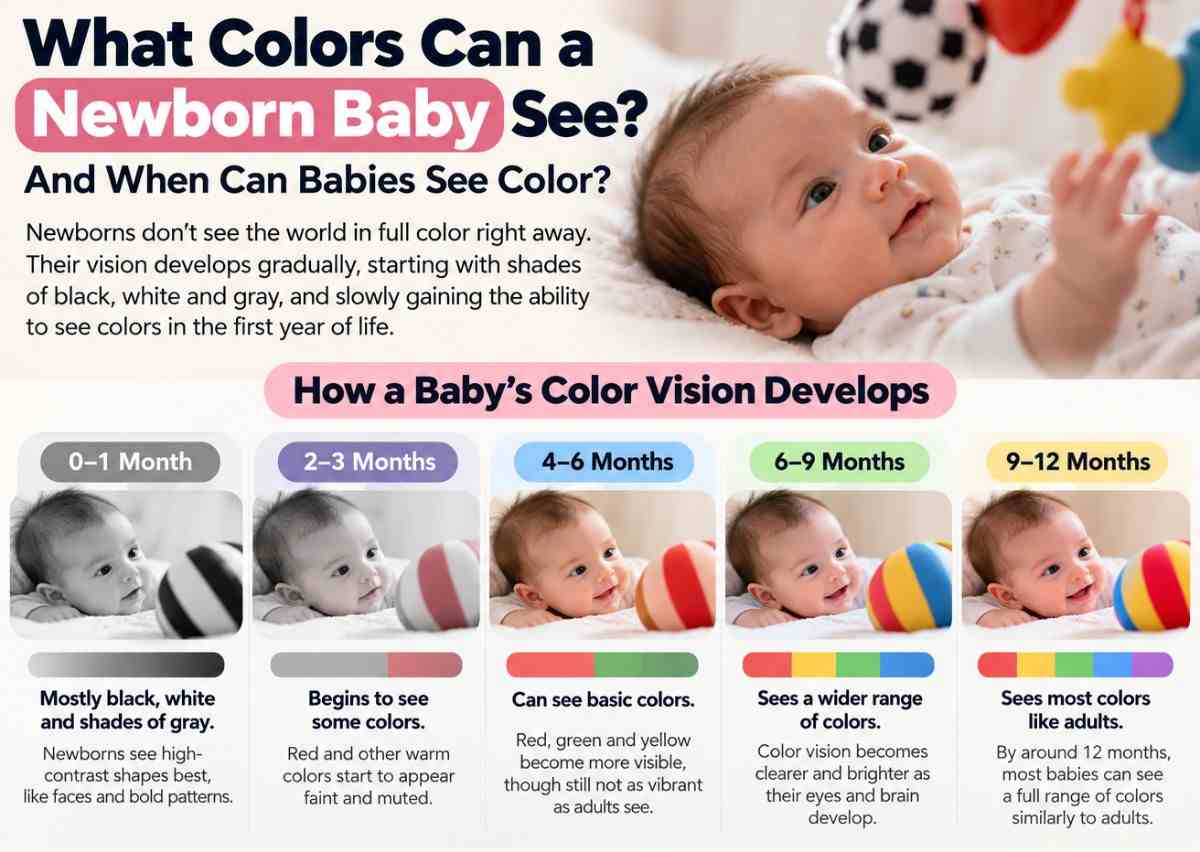
Here is a general timeline of how color vision develops:
| Baby’s Age | Color Vision Development |
|---|---|
| Birth to 1 month | Limited color perception; strong contrasts are easier to notice. |
| 2 months | Color discrimination begins improving. |
| 3 months | Babies become better at distinguishing different colors. |
| 4 months | Color vision improves, and different shades become easier to notice. |
| 5 to 6 months | Babies generally have good color vision, although it is still developing. |
| 7 to 12 months | Color perception and other visual skills continue improving. |
Remember that every baby develops at their own pace. These ages are general developmental guidelines, not strict deadlines.
How Does a Baby’s Color Vision Develop Month by Month?
A baby’s vision changes remarkably during the first year. Here is what parents can generally expect at different stages.
Birth to 1 Month: Seeing Light, Dark, and High Contrast
During the first month, your newborn’s vision is still blurry. Your baby can notice light, dark, shapes, and movement but cannot focus clearly on objects that are far away.
Newborns generally see best at a distance of around 8 to 12 inches (20 to 30 cm). This is approximately the distance between your face and your baby’s face during feeding.
At this stage:
- Babies respond to bright light and dark areas.
- High-contrast black-and-white patterns may attract their attention.
- They may briefly focus on a parent’s face.
- Their ability to distinguish different colors is limited.
2 Months: Beginning to Notice More Colors
Around 2 months, your baby’s visual system becomes more coordinated. Their eyes gradually become better at focusing, and they may start following moving objects.
Color perception is also developing. Brightly colored toys, especially those with strong contrasts, may attract your baby’s attention.
At this stage:
- Babies may show interest in bright red and other vivid colors.
- They become better at looking at familiar faces.
- Their ability to follow moving objects improves.
- They may spend more time looking at colorful objects.
3 Months: Better Color Recognition
At around 3 months, babies become much better at distinguishing colors and noticing differences between objects.
Their eyes also begin working together more effectively, helping them focus on nearby objects and follow movement.
You may notice your baby looking longer at colorful toys, patterned blankets, or picture books.
At this stage:
- Color discrimination improves.
- Babies become better at tracking moving objects.
- They show more interest in colorful surroundings.
- They may begin reaching toward nearby objects.
4 Months: Seeing More Colors and Shades
By 4 months, most babies have noticeably improved color vision. They can distinguish more colors and notice differences between shades.
Your baby may now show interest in toys with different colors, shapes, and patterns.
At this stage:
- Bright colors become easier to distinguish.
- Babies may show interest in colorful picture books.
- Their hand-eye coordination improves.
- They begin reaching for toys they can see.
5 to 6 Months: Developing Good Color Vision
Between 5 and 6 months, most babies have good color vision. Their ability to distinguish colors is much closer to that of an adult, although visual development is not complete.
They also become better at judging distances and recognizing familiar objects.
At this stage:
- Babies can distinguish a wider range of colors.
- They show interest in colorful toys and objects.
- They become better at recognizing familiar faces.
- Their depth perception improves.
7 to 12 Months: More Advanced Visual Skills
During the second half of the first year, your baby’s vision continues improving. They become better at recognizing objects, judging distances, and coordinating their eyes with their hands.
Their growing mobility also gives them more opportunities to explore their surroundings.
At this stage:
- Babies can recognize familiar objects from farther away.
- They become better at identifying different shapes and colors.
- They can reach for and pick up objects more accurately.
- Their visual attention and coordination continue developing.
Which Colors Are Best for Newborn Babies?
When choosing toys, books, and nursery decorations, parents often wonder which colors are most suitable for newborns.
During the early weeks, high-contrast colors are generally more useful than soft, similar-looking shades.
Here are some colors and patterns to consider:
1. Black and White: Black-and-white patterns create strong contrast, making them easier for newborns to notice.
2. Red: Bright red is a highly saturated color that may attract a newborn’s attention.
3. Yellow: Bright yellow can become more visually interesting as a baby’s color perception improves.
4. Blue: Blue objects can be introduced as babies become better at distinguishing different colors.
5. Green: Green toys and pictures provide additional opportunities to explore different colors as vision develops.
6. Orange: Bright orange objects can add variety to a baby’s visual environment.
You do not need to fill your baby’s room with brightly colored decorations. A few simple, age-appropriate toys and picture books are enough.
Why Do Babies Like Black-and-White Pictures?
Black-and-white pictures are popular in newborn toys and books because they create a strong contrast between light and dark areas.
A newborn’s visual system is still learning to process details. High-contrast patterns are often easier to notice than objects with similar shades.
These patterns may encourage babies to look, focus, and gradually develop their visual attention.
Parents can introduce:
- Black-and-white flashcards.
- High-contrast board books.
- Simple geometric patterns.
- Black-and-white soft toys.
- Age-appropriate visual activity cards.
Always supervise your baby during play and keep cards, toys, and other objects at a safe distance.
How Can Parents Help Develop a Baby’s Vision?
You cannot force your baby’s eyes to develop faster, but you can provide a safe and interesting environment that encourages healthy visual development.
Here are some simple ways to support your baby’s vision.
1. Talk Face-to-Face: Hold your baby close during feeding and talking. Your face is an interesting visual target at this age.
2. Use High-Contrast Toys: Introduce simple black-and-white toys and picture books during the newborn stage.
3. Introduce Bright Colors Gradually: As your baby grows, offer colorful toys with different shapes and patterns.
4. Encourage Eye Tracking: Slowly move a colorful toy from side to side while your baby is awake and alert.
5. Read Picture Books: Choose age-appropriate books with large pictures, simple designs, and contrasting colors.
6. Allow Supervised Tummy Time: Tummy time helps develop important physical and visual coordination skills. Always place your baby on their back for sleep.
7. Spend Time Outdoors: Enjoying outdoor environments during the day provides opportunities to experience different shapes, colors, and natural light. Keep your baby protected from direct sunlight.
8. Attend Regular Pediatric Checkups: Routine visits help your doctor monitor your baby’s overall growth and visual development.
When Should Parents Worry About a Baby’s Vision?
Most babies develop visual skills gradually, but it is important to recognize signs that may need medical attention.
Speak with your pediatrician or a pediatric eye specialist if you notice:
- Your baby does not seem to respond to light or visually interesting objects.
- Your baby does not begin following moving objects by around 3 months.
- One eye consistently turns inward or outward.
- Your baby’s eyes appear cloudy or have an unusual white reflection in photographs.
- Your baby has persistent excessive tearing, redness, or eye discharge.
- Your baby does not seem to make visual contact as expected.
Occasional wandering or crossing of the eyes can happen during the first 2 months. However, persistent eye turning or concerns about visual development should be evaluated.
A white pupil or white reflection in the eye should be checked promptly by an eye specialist.
Early evaluation is important because some childhood vision problems can be treated more effectively when identified early.
FAQ’s
Can newborn babies see red?
Yes, newborns may detect bright, highly saturated red, although their ability to distinguish colors is still limited.
Can babies see colors at 1 month?
Yes, babies have some color perception at 1 month, but they respond more easily to high-contrast patterns and bright objects.
When do babies start seeing red and green?
Babies generally become better at distinguishing colors such as red and green around 3 to 4 months of age.
Can a 2-month-old baby see colors?
Yes, a 2-month-old baby can detect some colors, and color discrimination gradually improves as the eyes and brain develop.
Why do babies like looking at bright colors?
Bright colors, strong contrasts, and interesting patterns can attract a baby’s attention as their visual skills develop.
Are black-and-white toys better for newborns?
Black-and-white toys can be useful because their strong contrast makes patterns easier for newborns to notice.
When can babies distinguish between different shades?
Babies become increasingly capable of distinguishing different shades around 3 to 5 months as their color vision improves.
Can newborn babies see pink and purple?
Newborns have limited color discrimination, so distinguishing pink, purple, and similar shades can be difficult. This ability improves during the first few months.
When do babies start recognizing colorful toys?
Babies may notice colorful objects during the first few months. By around 4 to 6 months, they generally become much better at distinguishing colors and visually exploring toys.
Do babies see colors differently from adults?
Yes. Newborns have less developed color vision than adults. Their ability to distinguish colors and shades improves significantly during the first six months.
Does a baby’s eyesight improve every month?
Yes. Babies gradually develop better focusing, color perception, eye coordination, depth perception, and the ability to track moving objects throughout the first year.
Can newborn babies see colors?
Yes. Newborn babies have limited color vision from birth. They can detect some highly saturated colors, but their ability to distinguish different shades improves over the first few months.
What is the first color a baby sees?
Newborns are particularly responsive to strong contrasts. They may also detect highly saturated colors, such as bright red, although color discrimination is still limited.
When do babies start seeing colors clearly?
Babies generally develop much better color vision between 3 and 5 months. By around 5 to 6 months, most have good color vision, although visual development continues.
When can babies see blue and green?
Babies gradually become better at distinguishing blue, green, and other colors during the first few months. Their overall color vision is generally much better by around 4 to 6 months.
Do newborn babies see everything upside down?
No. Although the images formed on the retina are inverted, the brain processes visual information so that babies do not experience the world as simply upside down.
Why do newborn babies prefer black-and-white pictures?
Black-and-white pictures have strong contrast, making their patterns easier for newborns to notice while their visual system is still developing.
Do premature babies develop color vision later?
Premature babies may follow a different developmental timeline. Eye specialists generally assess visual milestones using the baby’s corrected age, based on their expected due date.
What colors can babies see at 1 month?
At 1 month, babies have limited color vision. They may detect some bright, saturated colors, but high-contrast black-and-white patterns are generally easier to notice.
When can babies see at 1 week?
One-week-old babies can detect light, shapes, movement, and nearby faces. Their vision is blurry, and they see best at a distance of around 8 to 12 inches.
What colors can babies see at 3 months?
At 3 months, babies can distinguish a wider range of colors, including bright red, blue, green, and yellow. Their color vision continues improving.
How far can babies see at 1 month?
One-month-old babies can see most clearly at approximately 8 to 12 inches (20 to 30 cm), which is roughly the distance between a parent’s face and the baby during feeding.
Can my 3-week-old baby see me?
Yes. A 3-week-old baby can see your face when you hold them close, although details may appear blurry. Your baby may also begin focusing briefly on your eyes and facial features.
Can my baby see the TV at 2 months?
A 2-month-old baby may notice the bright lights, colors, and movement on a television screen, but screen time is not recommended. The American Academy of Pediatrics recommends avoiding screen media for children younger than 18 months, except video chatting.
Final Thoughts
A newborn’s world may look very different from an adult’s because their visual system is still developing. Although babies can detect some colors from birth, they initially respond more easily to light, dark, and high-contrast patterns.
During the first 3 to 5 months, their ability to distinguish colors improves significantly. By around 5 to 6 months, most babies have developed good color vision.
Parents can support this development through face-to-face interaction, age-appropriate toys, picture books, supervised tummy time, and regular pediatric checkups.
Sources / References::
Disclaimer:
This article is for informational purposes only and should not replace professional medical advice, diagnosis, or treatment. Consult your pediatrician or an eye specialist if you have concerns about your baby’s vision.
Also Read: