Sleep is not a passive state of rest. It is an active, complex biological process that supports memory, emotional balance, immune strength, and overall health. Among the different stages of sleep, REM sleep stands out as one of the most fascinating and essential. Short for Rapid Eye Movement sleep, REM sleep is the stage most closely associated with vivid dreams, brain activity, and mental restoration. In this guide, we will explore what Rapid Eye Movement Sleep is, how it works, why it matters, how much you need, what happens when you do not get enough, and practical ways to improve it.
What Is Rapid Eye Movement Sleep?
REM sleep is a distinct stage of sleep characterized by rapid eye movements, increased brain activity, vivid dreaming, and temporary muscle paralysis. It was first discovered in 1953 by researchers at the University of Chicago, where scientists observed unique patterns of brain waves and eye movement during sleep.
Unlike deep sleep, where brain activity slows significantly, REM sleep shows brain wave patterns that resemble wakefulness. This is why REM is often called “paradoxical sleep” — the body appears deeply asleep, yet the brain is highly active. Rapid Eye Movement Sleep typically begins about 90 minutes after you fall asleep and recurs in cycles throughout the night.
The Stages of Sleep: Where REM Fits In
To understand REM sleep better, it helps to look at the overall sleep cycle. Sleep is divided into two main types:
- Non-REM (NREM) sleep
- REM sleep
Non-REM Sleep
Non-REM sleep consists of three stages:
Stage 1 (Light Sleep)
This is the transition between wakefulness and sleep. It lasts only a few minutes.
Stage 2 (Light Sleep)
Heart rate slows, body temperature drops, and the body prepares for deeper sleep.
Stage 3 (Deep Sleep or Slow-Wave Sleep)
This is the most physically restorative stage. Tissues repair, growth hormone is released, and immune function strengthens.
REM Sleep
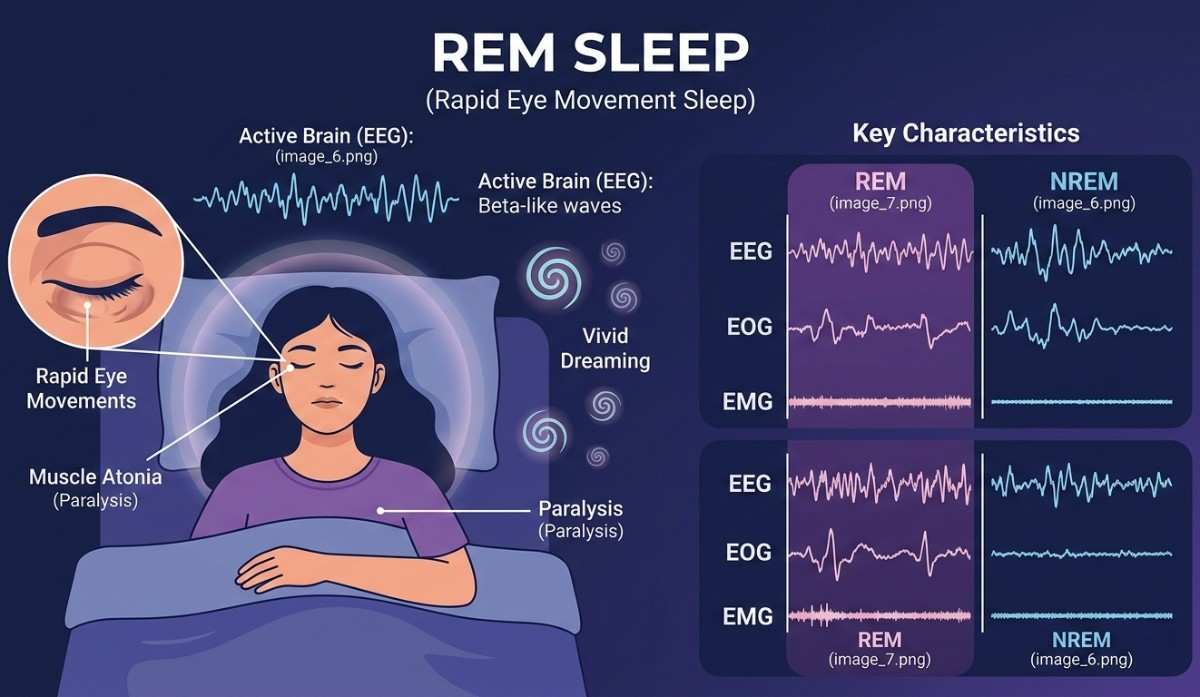
After progressing through these stages, the body enters Rapid Eye Movement Sleep. During this phase:
- Eyes move rapidly under closed eyelids
- Brain activity increases
- Breathing becomes irregular
- Heart rate fluctuates
- Muscles become temporarily paralyzed
A full sleep cycle lasts about 90–120 minutes, and REM sleep becomes longer with each cycle. Most Rapid Eye Movement Sleep occurs during the second half of the night.
What Happens During REM Sleep?
REM sleep is a period of intense neurological activity. Several important processes occur:
1. Vivid Dreaming
Most dreams happen during REM sleep. These dreams tend to be more emotional, visual, and story-like than those in other stages.
2. Memory Consolidation
The brain organizes and integrates information learned during the day. Rapid Eye Movement Sleep plays a crucial role in consolidating procedural memory (skills) and emotional memory.
3. Emotional Processing
The brain processes emotional experiences and reduces emotional reactivity. This is one reason poor sleep can lead to mood instability.
4. Brain Development
REM sleep is especially abundant in infants and children. Newborns spend about 50% of their sleep time in REM, supporting brain growth and neural development.
5. Muscle Atonia
During Rapid Eye Movement Sleep, most voluntary muscles are temporarily paralyzed. This protective mechanism prevents the body from acting out dreams.
How Much REM Sleep Do You Need?
In adults, REM sleep makes up approximately 20–25% of total sleep time.
If you sleep for 8 hours, you typically get about 90–120 minutes of REM sleep.
By Age Group:
- Newborns: 50% of total sleep
- Children: 30–40%
- Adults: 20–25%
- Older adults: Slightly reduced REM duration
REM sleep tends to decrease slightly with age but remains essential throughout life.
Why REM Sleep Is So Important?
REM sleep is not just about dreaming. It plays a vital role in multiple areas of health.
1. Cognitive Function
REM sleep supports:
- Learning
- Creativity
- Problem-solving
- Memory integration
Studies show that people perform better on creative tasks after REM sleep.
2. Emotional Stability
REM sleep helps regulate mood and emotional responses. Chronic REM deprivation is linked to anxiety, irritability, and depression.
Research from Harvard Medical School suggests that Rapid Eye Movement Sleep may help the brain process traumatic memories in a safer way.
3. Brain Plasticity
Neural connections are strengthened and reorganized during Rapid Eye Movement Sleep. This supports learning and adaptability.
4. Physical Health
While deep sleep is more closely tied to physical repair, Rapid Eye Movement Sleep still contributes to:
- Hormonal balance
- Immune regulation
- Stress response control
What Happens If You Don’t Get Enough REM Sleep?
REM deprivation can have noticeable effects, especially if it persists.
Short-Term Effects
- Difficulty concentrating
- Mood swings
- Increased stress
- Poor memory recall
- Reduced creativity
Long-Term Effects
Chronic lack of REM sleep has been associated with:
- Depression
- Anxiety disorders
- Cognitive decline
- Increased risk of neurodegenerative conditions
Interestingly, when someone is deprived of Rapid Eye Movement Sleep, the body often compensates with “REM rebound,” meaning longer and more intense REM periods on subsequent nights.
REM Sleep and Mental Health
Rapid Eye Movement Sleep is closely linked to emotional well-being. Disturbances in REM patterns are commonly observed in mood disorders.
For example:
- People with depression often enter REM sleep faster than usual.
- REM density (eye movement frequency) may increase in certain psychiatric conditions.
- Antidepressants often suppress Rapid Eye Movement Sleep, which may contribute to their therapeutic effects.
Ongoing research from institutions such as National Institute of Mental Health continues to explore the connection between Rapid Eye Movement Sleep and psychiatric health.
REM Sleep Behavior Disorder (RBD)
Rapid Eye Movement Sleep normally involves muscle paralysis. In REM Sleep Behavior Disorder (RBD), this paralysis does not occur properly.
As a result, individuals may:
- Act out dreams
- Talk, shout, or scream
- Punch or kick during sleep
RBD is more common in older adults and may be linked to neurodegenerative conditions such as Parkinson’s disease.
If someone frequently acts out dreams or causes injury during sleep, medical evaluation is important.
Factors That Affect REM Sleep
Several lifestyle and health factors can influence Rapid Eye Movement Sleep.
1. Alcohol
Alcohol suppresses Rapid Eye Movement Sleep in the first half of the night and can lead to REM rebound later, causing vivid dreams and fragmented sleep.
2. Sleep Deprivation
Chronic sleep restriction reduces REM time. The brain prioritizes deep sleep first, potentially limiting REM duration.
3. Stress
High stress levels can disrupt sleep cycles and reduce overall REM quality.
4. Medications
Certain medications affect REM sleep, including:
- Antidepressants
- Stimulants
- Beta blockers
- Some sleep medications
5. Sleep Disorders
Conditions such as:
- Insomnia
- Sleep apnea
- Narcolepsy
can disrupt normal REM cycles.
Narcolepsy, in particular, involves abnormal transitions into Rapid Eye Movement Sleep.
REM Sleep and Dreams
REM sleep is strongly associated with vivid, emotional dreams. During REM:
- The amygdala (emotional center) becomes active
- The prefrontal cortex (logical reasoning) becomes less active
This combination may explain why dreams feel intense yet illogical.
Some researchers believe dreams help simulate threatening situations, supporting emotional adaptation.
REM Sleep vs Deep Sleep: What’s the Difference?
Many people confuse REM sleep with deep sleep. They serve different but complementary roles.
| Feature | REM Sleep | Deep Sleep |
|---|---|---|
| Brain Activity | High | Low |
| Dreaming | Vivid dreams | Minimal |
| Muscle Activity | Paralyzed | Limited movement |
| Physical Repair | Moderate | High |
| Memory Processing | Emotional & procedural | Declarative memory |
Both stages are essential for complete rest and recovery.
How to Improve REM Sleep Naturally?
If you want to enhance Rapid Eye Movement Sleep, focus on improving overall sleep quality.
1. Maintain a Consistent Sleep Schedule
Go to bed and wake up at the same time daily. Regular schedules stabilize sleep cycles.
2. Get Enough Total Sleep
REM sleep increases in the later cycles. Cutting sleep short reduces REM disproportionately.
Adults should aim for 7–9 hours per night.
3. Reduce Alcohol Intake
Limiting alcohol improves REM consistency and reduces fragmented sleep.
4. Manage Stress
Techniques such as:
- Meditation
- Deep breathing
- Journaling
- Gentle yoga
can improve sleep quality and REM duration.
5. Create a Sleep-Friendly Environment
- Keep the room cool and dark
- Avoid screens 60 minutes before bed
- Reduce noise disturbances
6. Exercise Regularly
Moderate exercise improves sleep architecture, but intense workouts right before bed may disrupt sleep onset.
REM Sleep in Children and Infants
Infants spend a significant portion of sleep in REM. This supports:
- Brain maturation
- Neural network formation
- Cognitive development
Children also require more total sleep, ensuring sufficient REM cycles.
Disrupted Rapid Eye Movement Sleep in early development may impact learning and emotional regulation.
REM Sleep and Aging
As people age:
- Total sleep time often decreases
- REM sleep may become slightly shorter
- Sleep becomes lighter and more fragmented
However, Rapid Eye Movement Sleep remains crucial for cognitive function in older adults.
Maintaining good sleep hygiene is especially important in later life.
Can You Track REM Sleep?
Modern wearable devices and sleep trackers estimate Rapid Eye Movement Sleep using:
- Movement patterns
- Heart rate variability
- Breathing patterns
While these tools provide useful trends, they are not as accurate as a formal sleep study (polysomnography).
Sleep studies measure:
- Brain waves (EEG)
- Eye movement (EOG)
- Muscle activity (EMG)
- Oxygen levels
If persistent sleep issues exist, consulting a sleep specialist may help.
Signs You May Not Be Getting Enough REM Sleep
- Rarely remembering dreams
- Waking feeling emotionally unrefreshed
- Difficulty learning new skills
- Increased irritability
- Brain fog
Keep in mind that dream recall alone is not a reliable measure of REM quality.
REM Rebound: What It Means
When Rapid Eye Movement Sleep is suppressed (due to alcohol, stress, or sleep deprivation), the brain compensates later with longer REM periods.
This may cause:
- Intense, vivid dreams
- Nightmares
- Frequent awakenings
REM rebound is a natural recovery mechanism.
Final Thoughts: Why REM Sleep Deserves Attention
Rapid Eye Movement Sleep is not a luxury. It is a biological necessity. It supports memory, emotional resilience, creativity, and long-term brain health.
In today’s fast-paced world, sleep is often sacrificed for productivity. However, cutting sleep short reduces REM time disproportionately, affecting mental clarity and emotional balance.
Protecting your Rapid Eye Movement Sleep means protecting your brain. By prioritizing consistent sleep habits, managing stress, and maintaining a healthy lifestyle, you can support optimal REM cycles and wake up feeling mentally refreshed.
FAQ’s
When does REM sleep occur during the night?
Rapid Eye Movement Sleep first occurs about 90 minutes after you fall asleep. The longest REM periods happen in the second half of the night.
Is REM sleep the same as deep sleep?
No, Rapid Eye Movement Sleep and deep sleep are different stages with different functions. Deep sleep focuses more on physical repair, while REM sleep supports memory, emotional processing, and brain activity.
Why do we dream during REM sleep?
During Rapid Eye Movement Sleep, brain regions responsible for emotions and visual imagery are highly active, which makes dreams more vivid and emotional. Logical reasoning areas are less active, which explains why dreams often feel unrealistic.
Can alcohol affect REM sleep?
Yes, alcohol suppresses Rapid Eye Movement Sleep, especially in the first half of the night. This often leads to disrupted sleep and intense dreams later due to REM rebound.
Do sleep medications reduce REM sleep?
Some sleep medications and antidepressants can reduce or suppress Rapid Eye Movement Sleep. This effect varies depending on the type of medication and dosage.
What is REM rebound?
REM rebound occurs when the body increases Rapid Eye Movement Sleep after a period of deprivation. It may cause longer REM cycles and more vivid or intense dreams.
Is REM sleep important for memory?
Yes, RRapid Eye Movement Sleep plays a key role in consolidating emotional and procedural memories. It helps the brain process and organize information learned during the day.
Do children need more REM sleep than adults?
Yes, infants and children spend a higher percentage of sleep in REM. This supports brain growth and cognitive development.
Can stress reduce REM sleep?
Yes, chronic stress can disrupt sleep cycles and reduce overall Rapid Eye Movement Sleep quality. Managing stress can improve sleep balance and REM duration.
Does everyone dream during REM sleep?
Most people dream during Rapid Eye Movement Sleep, even if they do not remember it. Dream recall varies widely from person to person.
Is it bad if I rarely remember my dreams?
Not necessarily. Dream recall does not directly reflect how much Rapid Eye Movement Sleep you are getting.
Does aging affect REM sleep?
Rapid Eye Movement Sleep may decrease slightly with age, and sleep can become lighter and more fragmented. However, REM sleep remains important for cognitive and emotional health throughout life.
Can sleep trackers accurately measure REM sleep?
Wearable sleep trackers estimate Rapid Eye Movement Sleep using heart rate and movement data. While helpful for trends, they are not as accurate as a clinical sleep study.
What is the difference between REM and non-REM sleep?
Non-REM sleep includes light and deep sleep stages focused on physical restoration. Rapid Eye Movement Sleep is characterized by high brain activity, vivid dreaming, and emotional processing.
Is REM sleep essential for mental health?
Yes, healthy REM sleep supports emotional regulation and stress resilience. Disruptions in Rapid Eye Movement Sleep patterns have been linked to mood disorders and anxiety.
Also Read: