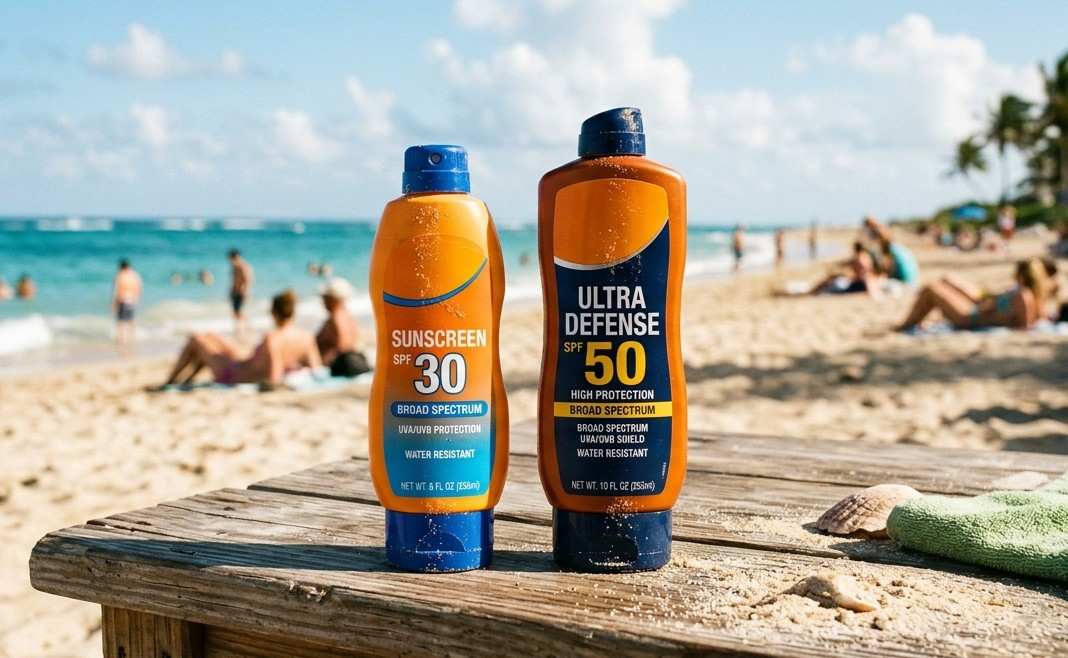
When standing in the sunscreen aisle, one of the most common questions people ask is: Should I choose SPF 30 or SPF 50? The numbers seem straightforward, but the difference between them isn’t always clear. Many assume SPF 50 offers almost double the protection of SPF 30. In reality, the truth is more nuanced.
In this guide, we’ll break down what SPF actually means, how SPF 30 and SPF 50 compare, who should use each one, and whether higher SPF truly gives better protection. By the end, you’ll know exactly which option suits your skin type, lifestyle, and sun exposure habits.
What Does SPF Mean?
SPF stands for Sun Protection Factor. It measures how well a sunscreen protects your skin from UVB rays, the type of ultraviolet radiation responsible for sunburn and a major contributor to skin cancer.
UV radiation from the sun includes:
- UVA rays – Cause premature aging, wrinkles, and long-term skin damage.
- UVB rays – Cause sunburn and play a key role in skin cancer.
- UVC rays – Blocked by the Earth’s atmosphere.
SPF specifically measures protection against UVB rays, not UVA. That’s why it’s essential to look for broad-spectrum sunscreen, which protects against both UVA and UVB rays.
How SPF Is Calculated
SPF is based on how long it takes for UVB rays to redden protected skin compared to unprotected skin.
For example:
- If your skin normally burns after 10 minutes in the sun, SPF 30 theoretically allows you to stay in the sun 30 times longer (300 minutes) without burning.
- SPF 50 would allow 50 times longer (500 minutes).
However, this calculation assumes:
- You apply enough sunscreen.
- You don’t sweat or swim.
- The sun’s intensity stays constant.
In real life, these factors change constantly, which is why reapplication is critical.
SPF 30 vs SPF 50: The Percentage Difference
This is where most confusion happens. Here’s how much UVB each level blocks:
| SPF Level | UVB Blocked | UVB Penetration |
|---|---|---|
| SPF 15 | 93% | 7% |
| SPF 30 | 97% | 3% |
| SPF 50 | 98% | 2% |
| SPF 100 | 99% | 1% |
The key takeaway:
- SPF 30 blocks 97% of UVB rays.
- SPF 50 blocks 98% of UVB rays.
That’s only a 1% difference in UVB protection.
However, that 1% can matter for certain individuals, especially those at high risk of sun damage.
Why SPF 50 Isn’t “Twice as Strong” as SPF 30
Many people assume SPF 50 offers 67% more protection than SPF 30 because 50 is much larger than 30. But SPF is not linear.
Instead, protection increases in smaller increments as numbers go higher. The jump from SPF 15 to SPF 30 is significant. The jump from SPF 30 to SPF 50 is much smaller.
In practical terms:
- SPF 30 allows 3% of UVB rays through.
- SPF 50 allows 2% of UVB rays through.
That means SPF 50 reduces UVB penetration by about one-third compared to SPF 30 (from 3% to 2%), not by half.
Who Should Use SPF 30?
SPF 30 is suitable for:
1. Daily Urban Use
If you’re commuting, working indoors, and spending limited time outside, SPF 30 is usually sufficient when properly applied.
2. Medium to Dark Skin Tones
People with more melanin have some natural protection against UVB. However, sunscreen is still essential to prevent hyperpigmentation and skin aging.
3. Short Outdoor Activities
For brief periods outdoors, like running errands or short walks, SPF 30 provides adequate protection if reapplied.
4. Everyday Skincare Routine
Many dermatologists recommend SPF 30 as the minimum daily sunscreen.
Who Should Use SPF 50?
SPF 50 may be better for:
1. Fair or Sensitive Skin
If you burn easily, SPF 50 gives an extra safety margin.
2. Extended Sun Exposure
Beach days, hiking, swimming, or outdoor sports demand stronger protection.
3. High UV Index Areas
If you live in tropical or high-altitude regions, the sun’s intensity is greater.
4. History of Skin Cancer
Individuals with a personal or family history of skin cancer benefit from higher SPF.
5. Photosensitive Conditions
Certain medications and skin conditions increase sun sensitivity.
The Importance of Proper Application
The biggest difference in protection often comes not from SPF 30 vs SPF 50—but from how you apply it.
Most people apply only 25–50% of the recommended amount.
Dermatologists suggest:
- About 1 ounce (a shot glass) for full body coverage.
- Two finger-lengths for the face and neck.
If you under-apply SPF 30, you might effectively be getting SPF 15 or less. In such cases, SPF 50 can compensate slightly for imperfect application.
Reapplication: The Real Key to Protection
Regardless of SPF level, sunscreen must be reapplied:
- Every 2 hours.
- Immediately after swimming.
- After excessive sweating.
- After towel drying.
Even SPF 50 wears off with time and exposure.
Does Higher SPF Cause More Breakouts?
Some people find SPF 50 thicker or greasier. However, modern formulations vary widely.
Look for:
- Non-comedogenic labels.
- Oil-free formulas.
- Gel-based sunscreens for oily skin.
- Mineral sunscreens for sensitive skin.
The SPF number itself does not cause breakouts—the formulation does.
Chemical vs Mineral Sunscreens
Both SPF 30 and SPF 50 are available in:
Chemical Sunscreens
Absorb UV rays and convert them to heat.
Common filters include:
- Avobenzone
- Octinoxate
- Oxybenzone
Pros:
- Lightweight
- Invisible finish
Cons:
- May irritate sensitive skin
Mineral Sunscreens
Contain zinc oxide or titanium dioxide.
Pros:
- Less irritating
- Good for sensitive or acne-prone skin
Cons:
- Can leave a white cast
SPF level does not determine whether a sunscreen is chemical or mineral.
Does SPF 50 Last Longer Than SPF 30?
No.
SPF measures intensity of protection, not duration.
Both SPF 30 and SPF 50 require reapplication every two hours.
A higher SPF does not mean you can skip reapplication.
Is SPF 100 Better?
SPF 100 blocks 99% of UVB rays, compared to 98% for SPF 50.
The difference is minimal. However:
- Higher SPFs may create a false sense of security.
- They may be thicker and more expensive.
Most dermatologists recommend SPF 30–50 for daily use.
UVA Protection Matters Too
SPF only measures UVB protection. UVA rays penetrate deeper into the skin and cause:
- Premature aging
- Collagen breakdown
- Pigmentation
- Skin cancer
Always choose broad-spectrum sunscreen.
In some countries, UVA protection is measured using PA ratings (PA+, PA++, PA+++).
The Role of UV Index
The UV Index measures how strong the sun’s radiation is on a given day.
- UV 0–2: Low
- UV 3–5: Moderate
- UV 6–7: High
- UV 8–10: Very High
- UV 11+: Extreme
On high UV days, SPF 50 may be a better choice, especially for prolonged exposure.
SPF and Skin Aging
Even if you rarely burn, daily sun exposure contributes to:
- Fine lines
- Wrinkles
- Dark spots
- Loss of elasticity
SPF 30 provides strong daily anti-aging protection when applied correctly.
Cost Comparison
SPF 50 sunscreens often cost slightly more than SPF 30.
However, price differences are usually minimal compared to the benefits of preventing sun damage.
Choose based on skin needs rather than price alone.
Common Myths About SPF
Myth 1: Higher SPF means all-day protection
False. Reapplication is still required.
Myth 2: You don’t need sunscreen on cloudy days
Up to 80% of UV rays penetrate clouds.
Myth 3: Dark skin doesn’t need sunscreen
All skin tones can develop skin cancer and hyperpigmentation.
Myth 4: Makeup with SPF is enough
You rarely apply enough makeup to achieve labeled SPF protection.
Dermatologist Recommendations
Most dermatologists agree on:
- Minimum SPF 30 daily.
- SPF 50 for prolonged outdoor exposure.
- Broad-spectrum coverage.
- Reapply every 2 hours.
Consistency matters more than choosing the highest SPF.
SPF 30 vs SPF 50: Quick Comparison
| Feature | SPF 30 | SPF 50 |
|---|---|---|
| UVB Protection | 97% | 98% |
| Best For | Daily use | Intense sun exposure |
| Fair Skin | Good | Better |
| Outdoor Sports | Moderate | Recommended |
| Reapplication Needed | Yes | Yes |
| Thickness | Usually lighter | Can be thicker |
So, Which One Should You Choose?
Choose SPF 30 if:
- You need daily protection.
- You work indoors.
- You apply sunscreen generously and reapply.
Choose SPF 50 if:
- You burn easily.
- You spend long hours outdoors.
- You’re at the beach or high altitude.
- You want a margin of safety due to under-application.
For most people, SPF 30 applied properly is sufficient. But SPF 50 provides a slightly higher cushion against UV exposure.
Final Verdict
The difference between SPF 30 and SPF 50 is smaller than most people think. SPF 30 blocks 97% of UVB rays, while SPF 50 blocks 98%. That 1% difference can be meaningful for high-risk individuals or during intense sun exposure, but for everyday use, both provide strong protection when applied correctly.
The real keys to effective sun protection are:
- Choosing broad-spectrum sunscreen.
- Applying enough.
- Reapplying every two hours.
- Wearing protective clothing.
- Avoiding peak sun hours.
Ultimately, the best sunscreen is the one you will use consistently.
FAQ’s
Does SPF 30 work as well as SPF 50?
SPF 30 works very well for daily use and blocks about 97% of UVB rays, while SPF 50 blocks about 98%. The difference is small, but SPF 50 offers slightly more protection, especially for very fair or sun-sensitive skin.
Is SPF 30 too low for the face?
No, SPF 30 is not too low for the face. It is generally considered the minimum recommended level for daily facial use. If you spend long hours outdoors or have sensitive skin, SPF 50 may provide extra protection.
Can my face still tan with SPF 30?
Yes, mild tanning can still occur with SPF 30. No sunscreen blocks 100% of UV rays, and UVA rays also contribute to tanning. Using a broad-spectrum sunscreen and reapplying regularly helps reduce tanning.
Is SPF 50 too much if I want to tan?
SPF 50 is not “too much,” but it significantly reduces UV exposure, which slows down tanning. However, tanning is a sign of skin damage. It’s safer to protect your skin and consider sunless tanning options if you want a darker tone.
Is SPF 30 enough for daily use?
Yes. SPF 30 is generally considered sufficient for everyday activities like commuting, working indoors, and short periods outside, as long as it is applied properly and reapplied when needed.
Should I use SPF 50 in summer?
SPF 50 is recommended during peak summer, especially if you spend extended time outdoors, visit the beach, or live in areas with a high UV index.
Does SPF 50 last longer than SPF 30?
No. Both SPF 30 and SPF 50 need to be reapplied every two hours, or immediately after swimming or sweating. Higher SPF does not mean longer-lasting protection.
Can SPF 30 prevent tanning?
SPF 30 reduces UVB exposure but does not completely prevent tanning. Some tanning may still occur because UVA rays also contribute to skin darkening.
Is SPF 50 better for sensitive or fair skin?
Yes. People with fair, sensitive, or easily sunburned skin may benefit from SPF 50 for added protection.
Do I need sunscreen on cloudy days?
Yes. Up to 80% of UV rays can penetrate clouds, so sunscreen is necessary even when it is overcast.
Is higher SPF always better?
Not necessarily. Very high SPF numbers (like SPF 100) offer only slightly more UVB protection and may create a false sense of security. Proper application and reapplication are more important.
Does makeup with SPF replace sunscreen?
Usually no. Most people do not apply enough makeup to achieve the labeled SPF protection. It is best to apply a separate broad-spectrum sunscreen underneath makeup.
Can dark skin tones use SPF 30?
Yes. SPF 30 is suitable for all skin tones for daily protection. Darker skin still needs sunscreen to prevent hyperpigmentation, premature aging, and skin cancer.
Does SPF protect against UVA rays?
SPF measures protection against UVB rays only. To protect against UVA rays, choose a sunscreen labeled “broad-spectrum.”
Is SPF 30 enough for the beach?
For long beach days or intense sun exposure, SPF 50 is usually recommended, along with frequent reapplication and protective clothing.
What is more important: SPF number or application amount?
Application amount and consistent reapplication are more important. Even the highest SPF will not work properly if applied too thinly or not reapplied.
Also Read: