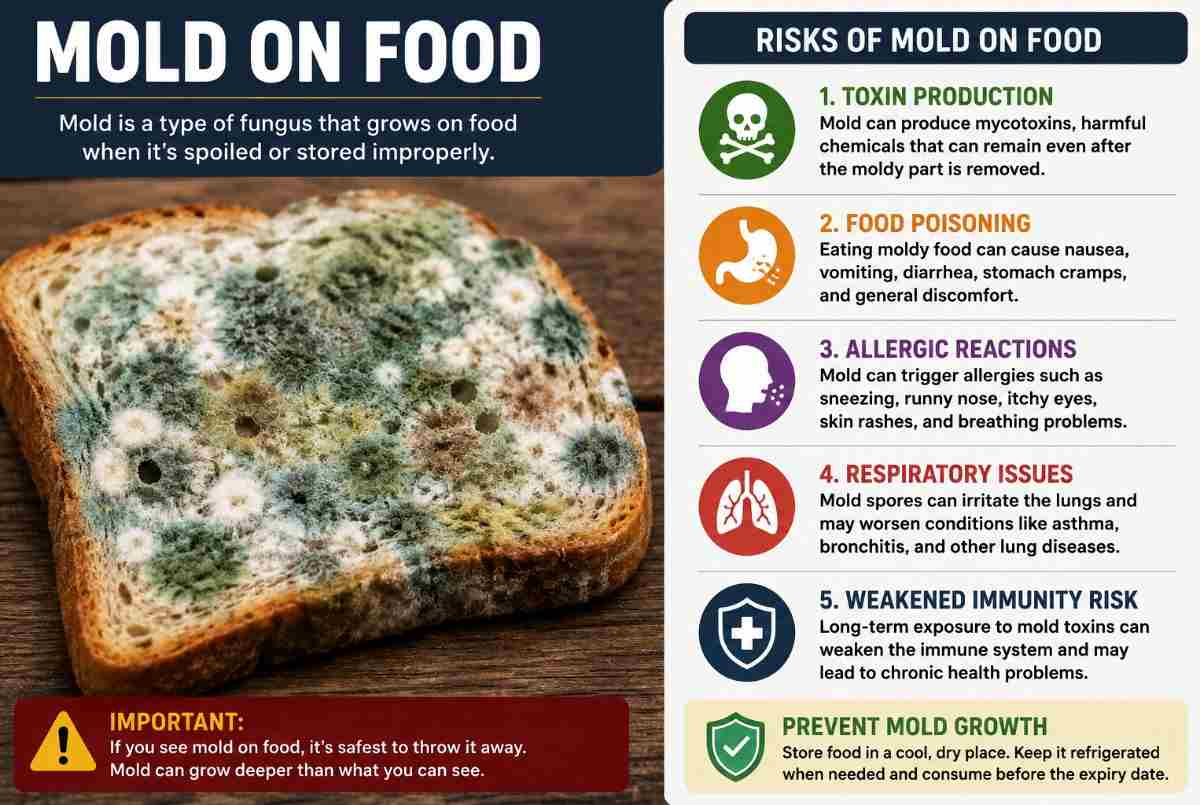
Finding mold on food can be unpleasant and confusing. You may notice a fuzzy green patch on bread, white spots on cheese, or a soft fruit covered with a grayish coating. The first question is usually simple: Can I just cut off the mold and eat the rest?
Sometimes, trimming mold from certain firm foods may be acceptable. However, many moldy foods should be thrown away because mold can grow below the visible surface, and some molds can produce substances called mycotoxins.
The safest approach depends on the type of food, how much moisture it contains, and whether the mold is intentionally part of the food’s production. Understanding these differences can help you avoid unnecessary food waste while protecting yourself from potential food-safety risks.
What Is Mold on Food?
Mold is a type of microscopic fungus that grows on organic materials, including many foods. It reproduces by producing spores that can travel through the air and settle on food.
The fuzzy or colored patch you see is only part of the mold. Mold can also develop microscopic root-like structures called hyphae that extend into food. This is particularly important in soft, moist foods because contamination can spread beneath the surface without being visible.
Some molds can cause allergic reactions and respiratory problems, while certain molds can produce mycotoxins under the right conditions.
Mold may appear in several colors, including:
- Green
- White
- Gray
- Black
- Blue
- Yellow
- Orange
Color alone does not tell you whether a particular mold is dangerous. The type of food and extent of contamination are more important considerations.
Why Does Mold Grow on Food?
Mold on food develops when microscopic mold spores land on food and find the right conditions to grow. Mold spores are naturally present in the air and environment, so they can easily reach food during handling, storage, or preparation.
Common causes of mold growth include:
- Moisture: Foods with high water content provide an ideal environment for mold.
- Warm Temperatures: Mold generally grows faster in warm conditions.
- Long Storage: Food becomes more likely to develop mold the longer it is stored.
- Poor Food Storage: Uncovered or improperly sealed foods have greater exposure to mold spores.
- Damaged Food: Bruises, cuts, and cracks can allow mold to enter fruits and vegetables more easily.
- Poor Refrigerator Hygiene: Mold spores can spread from one contaminated food to other foods and surfaces.
- Improper Handling: Dirty hands, utensils, containers, or surfaces can contribute to food contamination.
- High Humidity: Moist air can encourage mold growth, particularly on fresh produce and baked foods.
- Temperature Fluctuations: Repeated warming and cooling can create condensation and increase moisture around food.
Signs of Moldy Foods
Moldy food does not always look the same. Depending on the type of food and mold, you may notice one or more of these signs:
- Fuzzy Growth: A hairy, fuzzy, or cotton-like layer appears on the food.
- Unusual Colors: Mold may appear green, white, black, blue, gray, yellow, or orange.
- Spots or Patches: Small or spreading patches may develop on the surface.
- Unusual Smell: Moldy foods may have a musty, earthy, or unpleasant odor. However, do not intentionally smell moldy food.
- Changes in Texture: Food may become unusually soft, slimy, wet, or crumbly.
- Discoloration: Areas of the food may become darker or develop unusual color changes.
- Visible Spoilage: The food may look significantly different from its normal appearance.
- Mold Under the Surface: In soft or porous foods, mold may extend beneath the visible area even when only a small patch can be seen.
Important: Do not taste food to determine whether it is moldy or safe. For soft, moist, porous, or cooked foods with visible mold, the safest choice is generally to discard them.
Is Mold on Food Dangerous?
It can be.
Not every mold is harmful. Some molds are deliberately used in food production, particularly in certain cheeses and cured foods. However, mold growing unexpectedly on food should be treated cautiously.
There are two major concerns: allergic reactions and mycotoxins.
Some people may experience respiratory or allergic symptoms after exposure to mold. Certain molds can also produce mycotoxins, which are toxic compounds that can cause illness when consumed at sufficiently high levels.
The FDA monitors several mycotoxins associated with foods, including aflatoxins, deoxynivalenol, fumonisins, patulin, ochratoxin A, T-2/HT-2 toxins, and zearalenone.
This does not mean that every moldy food contains dangerous levels of toxins. It means that visible mold should not automatically be assumed to be harmless.
Can You Just Cut Mold Off Food?
It depends on the food.
This is one of the most important things to understand about moldy food.
Mold can penetrate deeply into soft, porous, or moist foods. Cutting away the visible spot may not remove all of the contamination.
On the other hand, mold generally has more difficulty penetrating dense, firm foods. For some firm foods, USDA guidance allows the moldy portion to be removed with an additional margin around and beneath the affected area.
Foods You Should Usually Throw Away When Moldy
According to USDA guidance, the following foods should generally be discarded if visible mold is present:
- Bread and baked goods
- Soft fruits and vegetables
- Cooked leftovers
- Cooked meat and poultry
- Soft cheeses
- Cottage cheese
- Cream cheese
- Yogurt
- Sour cream
- Jams and jellies
- Crumbled, shredded, or sliced cheeses
- Cooked grains and pasta
- Casseroles
- Peanut butter
- Nuts and legumes
These foods can allow mold to grow below the surface where you cannot see it.
Foods Where Mold Can Sometimes Be Trimmed
Certain firm, low-moisture foods may be salvageable when only a small area is affected.
Examples include:
- Hard cheeses
- Firm vegetables such as carrots, bell peppers, and cabbage
Cutting away at least 1 inch around and below the moldy area on suitable firm foods while keeping the knife away from the mold itself to prevent cross-contamination.
If you are unsure whether a particular food can safely be trimmed, throwing it away is the safer choice.
Mold on Bread: Should You Eat It?
No. Moldy bread should generally be discarded.
Bread is porous, meaning mold can spread beneath the surface even when only one small spot is visible.
For example, if you see a small green patch on one slice, removing that slice and eating the remaining slices may not eliminate the risk because microscopic mold growth can be present where you cannot see it.
USDA specifically recommends discarding bread and baked goods when mold is present.
Mold on Fruit: Is It Safe to Eat?
It depends on the fruit.
Soft Fruits
Soft, high-moisture fruits such as peaches, tomatoes, cucumbers, and similar produce should generally be discarded when mold develops.
Mold can penetrate their soft flesh more easily than it can penetrate dense foods.
Firm Fruits and Vegetables
Some firm, low-moisture produce may be salvageable if only a small area has mold. Cutting away at least 1 inch around and below the moldy area.
However, if the food is significantly moldy, soft, damaged, or leaking, discarding it is the safer option.
What If One Moldy Fruit Is Touching Other Fruits?
Mold can spread between pieces of produce, particularly when fruits are touching in a closed container.
USDA recommends throwing away moldy fruit and any pieces that were directly touching it. The remaining fruit should be inspected carefully and, if it is not moldy or excessively soft, thoroughly washed before eating.
Do not assume that every fruit in the container is automatically contaminated, but do inspect the surrounding produce carefully.
Mold on Cheese: Can You Still Eat It?
Cheese is one of the more complicated foods when it comes to mold.
Some cheeses are intentionally produced using specific molds. Examples include:
- Brie
- Camembert
- Roquefort
- Gorgonzola
- Stilton
- Blue cheese
The molds used as part of their normal production are different from unexpected mold growth.
For hard cheeses such as Cheddar, USDA recommends cutting away at least 1 inch around and below a small mold spot, taking care not to let the knife touch the mold before cutting into the unaffected portion.
Soft cheeses such as cottage cheese and cream cheese should generally be discarded if unexpected mold develops.
Mold on Jam and Jelly
It may be tempting to scoop mold from the surface of jam or jelly and eat what remains.
However, USDA recommends discarding moldy jams and jellies.
Because these foods can support mold growth, potentially harmful substances may be present beyond the visible mold.
Mold on Cooked Food and Leftovers
Moldy cooked food should generally be discarded.
This includes:
- Cooked rice
- Cooked pasta
- Casseroles
- Cooked vegetables
- Cooked meat
- Cooked poultry
- Soups and stews
- Other moist leftovers
Moist foods provide opportunities for mold and other microorganisms to grow below the surface.
It is also important not to rely solely on smell. Harmful microorganisms may sometimes be present without producing obvious changes in smell, taste, or appearance.
Using refrigerated leftovers within about 3 to 4 days and refrigerating perishable foods promptly.
What Are Mycotoxins?
Mycotoxins are toxic substances produced by certain molds.
They can occur in agricultural commodities and foods such as:
- Grains
- Corn
- Peanuts
- Tree nuts
- Dried beans
- Dried fruits
- Coffee
- Some fruits and fruit products
Not all molds produce mycotoxins, and the presence of mold does not automatically mean that a food contains a dangerous amount of a toxin.
However, certain mycotoxins are important food-safety concerns.
Aflatoxins
Aflatoxins are produced by certain Aspergillus molds. They can contaminate foods such as peanuts, corn, tree nuts, and some grains.
Long-term exposure to high levels of aflatoxins can increase the risk of liver cancer and can contribute to other serious health problems.
Patulin
Patulin is a mycotoxin associated particularly with moldy apples and apple products.
Using moldy apples for juice production can increase the risk of patulin contamination, and pasteurization does not eliminate patulin.
Ochratoxin A
Ochratoxin A is produced by certain Aspergillus and Penicillium molds and has been detected in foods including grains, coffee, and grapes.
Research has raised concerns about kidney effects and possible cancer risks, although the exact effects in humans continue to be studied.
What Happens If You Accidentally Eat Moldy Food?
Accidentally eating a small amount of mold does not necessarily mean that you will become sick.
However, some people can experience symptoms such as:
- Nausea
- Vomiting
- Stomach discomfort
- Diarrhea
- Allergic symptoms
- Respiratory irritation
The potential effects depend on the type and amount of mold, the food involved, and the individual’s sensitivity.
If you accidentally eat moldy food and develop significant or persistent symptoms, contact a healthcare professional or poison-control service for advice.
People with severe allergic reactions or difficulty breathing should seek urgent medical attention.
Should You Smell Moldy Food to Check It?
No. USDA specifically advises against sniffing moldy food because inhaling mold spores can cause respiratory problems.
Instead of smelling a moldy food to decide whether it is safe, use the food type and visible condition as your guide.
Does Cooking Kill Mold on Food?
Cooking is not a reliable way to make moldy food safe.
Some molds and their spores may be affected by heat, but certain mycotoxins can remain stable enough that simply cooking or reheating a moldy food should not be considered a safety solution.
This is why removing mold by heating, microwaving, baking, or frying is not a substitute for discarding foods that USDA recommends throwing away.
Can Mold Grow in the Refrigerator?
Yes. Refrigeration slows the growth of many microorganisms, but it does not completely prevent mold.
Some molds can grow at refrigerator temperatures and may tolerate conditions such as salt and sugar better than many other food microorganisms.
This is why refrigerator cleanliness and proper food storage are important.
How to Prevent Mold on Food?
A few simple habits can significantly reduce unnecessary mold growth.
1. Store Food Properly
Keep foods covered or sealed in appropriate containers to reduce exposure to airborne spores.
2. Refrigerate Perishable Food Promptly
Refrigerating perishable foods within 2 hours. If the surrounding temperature is above 90°F (32°C), the recommended limit is 1 hour.
3. Keep Your Refrigerator at 40°F or Below
A refrigerator temperature of 40°F (4°C) or below helps slow microbial growth.
4. Clean the Refrigerator Regularly
If a moldy food has leaked or touched a refrigerator shelf or drawer, clean the affected area.
5. Check Produce Before Buying It
Avoid visibly moldy or badly bruised produce.
6. Do Not Overbuy Fresh Food
Buying quantities you can realistically use before spoilage can reduce food waste and mold growth.
7. Use Clean Storage Containers
Dirty containers can introduce microorganisms and increase the likelihood of spoilage.
8. Keep Food Covered
Covering food reduces exposure to environmental mold spores and helps maintain food quality.
How to Safely Dispose of Moldy Food?
If a food needs to be discarded, avoid unnecessary handling.
USDA recommends not sniffing the moldy food. Place heavily moldy food in a small paper bag or wrap it before putting it into a covered trash container.
Afterward:
- Wash your hands.
- Clean the area where the food was stored.
- Check nearby foods for visible mold.
- Clean containers that came into contact with the moldy food.
- Wash reusable utensils or surfaces appropriately.
Moldy Food: Quick Safety Guide
| Food | What to Do if Mold Appears |
|---|---|
| Bread | Discard |
| Cakes and baked goods | Discard |
| Soft fruits | Discard |
| Soft vegetables | Discard |
| Hard vegetables | Small mold spot may be trimmed generously |
| Hard cheese | Cut away at least 1 inch around and below mold |
| Soft cheese | Discard |
| Yogurt | Discard |
| Sour cream | Discard |
| Cooked meat | Discard |
| Cooked poultry | Discard |
| Cooked rice or pasta | Discard |
| Casseroles | Discard |
| Jam and jelly | Discard |
| Nuts | Discard |
| Peanut butter | Discard |
| Mold-ripened cheese | Normal production mold may be safe |
This table is a general guide based on USDA recommendations. When food is heavily contaminated or you are uncertain about its condition, discarding it is the safer option.
Mold on Food vs. Food Made With Mold
It is important to distinguish between unexpected mold and intentional food cultures.
Some foods are made using carefully selected microorganisms under controlled conditions. Blue cheese, Brie, Camembert, and certain cured meats are examples.
The fact that a food contains mold does not automatically make it unsafe. What matters is whether the microorganism is intentionally used as part of production and whether the food is otherwise properly made and stored.
Unexpected mold appearing on a food that normally should not contain it is a different situation.
When Should You Throw Food Away Immediately?
Discard food rather than trying to save it when:
- The food is soft and visibly moldy.
- Mold covers a large portion of the food.
- The food is porous, such as bread.
- Mold is growing on cooked leftovers.
- Mold appears on yogurt or soft cheese.
- Mold appears on jam or jelly.
- The food smells abnormal or has an unusual texture in addition to visible mold.
- Multiple pieces of food are heavily contaminated.
- You cannot determine whether the food is safe to trim.
- The food has been stored improperly for an extended period.
When in doubt, throwing the food away is generally safer than taking a chance.
Common Mistakes People Make With Moldy Food
Mistake 1: Cutting Mold Off Bread
Bread is porous, so visible mold may not represent the full extent of contamination.
Mistake 2: Assuming Refrigeration Prevents Mold
Refrigeration slows many forms of spoilage but does not completely stop mold growth.
Mistake 3: Smelling the Mold
Sniffing mold can expose you to spores and is not a reliable safety test.
Mistake 4: Assuming Cooking Makes Moldy Food Safe
Heat should not be relied upon to neutralize all potential mold-related hazards.
Mistake 5: Eating Moldy Jam After Scraping the Surface
Mold can extend beyond what is visible, which is why USDA recommends discarding moldy jams and jellies.
Mistake 6: Ignoring Food Storage Times
Even food that looks normal may become unsafe when it has been stored improperly or for too long.
FAQ’s
Can mold on food make you sick?
Yes. Certain molds can cause allergic reactions, respiratory irritation, or produce mycotoxins that may be harmful when consumed.
Can you wash mold off fruits and vegetables?
Washing may remove surface contamination, but it does not reliably make soft or moldy foods safe to eat.
Why does food get moldy in the refrigerator?
Mold can grow even at refrigerator temperatures, especially when food is moist or has been stored for a long time.
Should I throw away moldy leftovers?
Yes. Moldy cooked foods such as rice, pasta, meat, casseroles, and vegetables should generally be discarded.
Is white mold on food dangerous?
Not necessarily. Some molds are intentionally used in foods, such as Brie and Camembert. Unexpected mold on other foods should be treated as spoilage.
Can mold spread from one food to another?
Yes. Mold spores can spread between foods, particularly when they are touching or stored together.
Should I smell moldy food before throwing it away?
No. Avoid sniffing moldy food because inhaling mold spores may cause respiratory irritation.
Does freezing prevent mold on food?
Freezing can slow or stop mold growth, but it does not make food that is already moldy safe to eat.
Is a little mold on food harmful?
It can be. Soft, moist, or cooked foods with mold are best discarded.
Is it safe to touch mold on food?
Usually, brief contact is not harmful. Wash your hands afterward.
What kills mold immediately?
There is no reliable way to make moldy food safe. When in doubt, throw it away.
How quickly can mold make you sick?
Symptoms can occur quickly in sensitive people, while other effects may take longer.
How can I flush mold out of my system?
There is no proven detox for mold. Stop eating the affected food and monitor for symptoms.
What organ does mold affect the most?
Mold commonly affects the respiratory system, but some toxins can affect other organs.
Can mold affect your liver?
Yes. Certain mycotoxins, such as aflatoxins, can damage the liver with prolonged exposure.
Is white fuzzy mold on food dangerous?
It can be. Unexpected white fuzzy mold may indicate spoilage, so soft or moist foods should generally be discarded.
Is food mold dangerous to breathe?
Breathing mold spores can irritate the nose and lungs and may trigger allergic reactions, especially in sensitive people. Avoid sniffing moldy food.
Is green fuzzy mold on food dangerous?
It can be. Green mold may grow beneath the surface of soft foods, so moldy bread, fruit, and other soft foods are best discarded.
Final Thought
Mold on food should not automatically be treated as harmless or dangerous; the right response depends heavily on the food.
Soft, moist, porous, cooked, or highly contaminated foods are generally best discarded because mold may extend below the surface. Certain firm, low-moisture foods may be salvageable by cutting away the mold and surrounding area according to food-safety guidance.
Remember that mold is only one part of food safety. Proper refrigeration, clean storage containers, timely consumption, and good kitchen hygiene all help reduce food spoilage and foodborne risks.
When you cannot confidently determine whether a moldy food can be safely salvaged, the safest choice is usually to throw it away.
Sources / References:
Disclaimer:
This article is for general educational purposes and does not replace professional medical or food-safety advice. If you become ill after consuming moldy food or develop severe symptoms, consult a qualified healthcare professional or appropriate poison-control service.
Also Read: