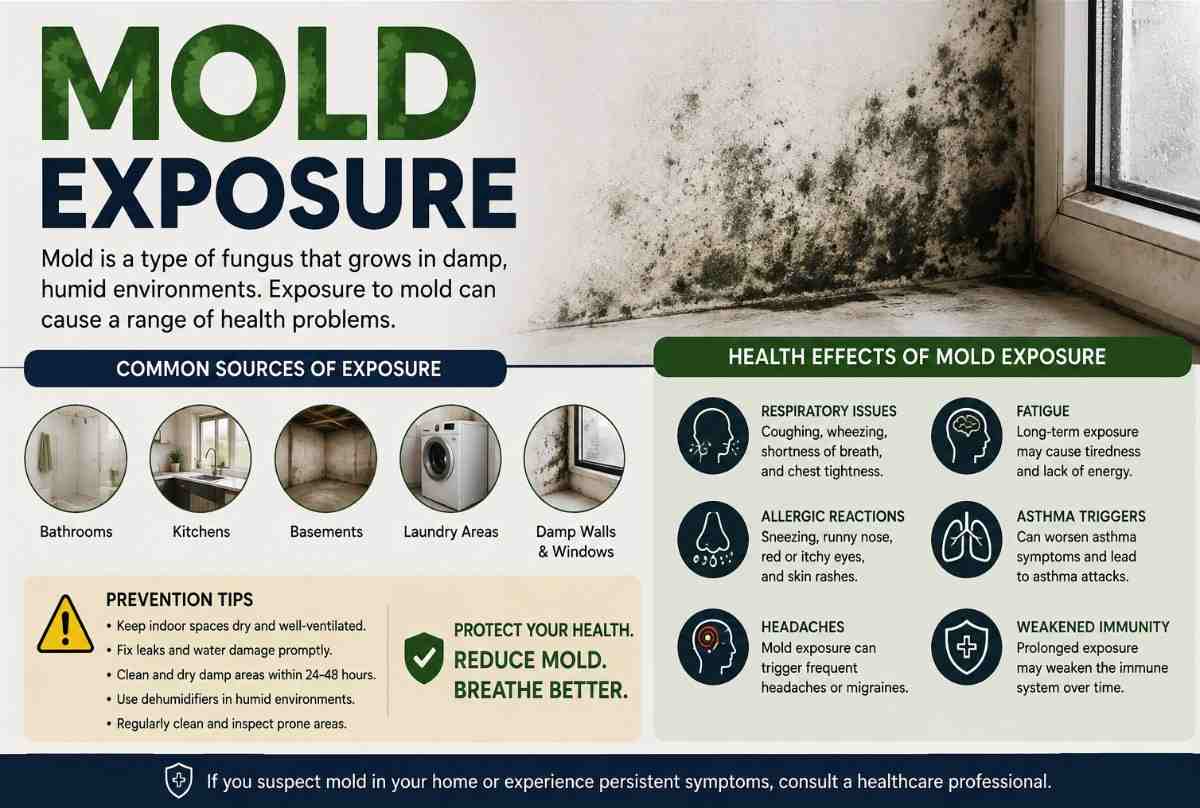
Mold is a natural part of the environment, but finding it growing inside your home can be concerning. It commonly appears in bathrooms, basements, kitchens, around leaking pipes, on damp walls, under carpets, or in areas affected by flooding. Sometimes, mold is easy to see. Other times, it can grow behind walls, under flooring, or in other hidden damp areas.
Mold exposure does not make everyone sick. However, breathing in or touching mold and mold spores can cause allergic reactions, irritation, and respiratory symptoms in some people. Individuals with asthma, mold allergies, certain chronic lung conditions, or weakened immune systems may be more vulnerable to complications.
The good news is that mold problems can often be addressed by controlling moisture, removing visible mold appropriately, improving ventilation, and fixing the underlying water problem.
This guide explains what mold exposure is, common symptoms, potential health effects, who is most vulnerable, how exposure is evaluated, treatment options, and practical ways to prevent mold from returning.
What Is Mold Exposure?
Mold exposure occurs when a person comes into contact with mold, mold spores, or substances produced by certain molds. Exposure can happen through breathing airborne spores, touching contaminated surfaces, or spending time in damp or moldy buildings.
Mold is a type of fungus that grows when moisture is present. Mold spores are tiny and can travel through indoor and outdoor air. When they land on a damp surface with suitable conditions, they can begin growing.
Common indoor molds include species from the Aspergillus, Cladosporium, and Penicillium groups. The color of mold does not reliably tell you how dangerous it is. Mold can appear black, green, white, brown, gray, or other colors.
Mold is not automatically harmful simply because it is present. Health effects vary depending on factors such as the amount and duration of exposure, the type of mold, the person’s sensitivity, and existing health conditions.
What Causes Mold to Grow Indoors?
Moisture is the main factor that allows mold to grow. Mold may develop after water enters a building or when indoor humidity remains high.
Common causes include:
- Leaking pipes: Slow plumbing leaks can keep walls, cabinets, floors, or ceilings damp.
- Roof leaks: Water entering through a damaged roof can create hidden areas of moisture.
- Flooding: Floodwater can saturate carpets, drywall, wood, and furniture.
- Condensation: Moisture can collect on cold windows, pipes, walls, and other surfaces.
- High indoor humidity: Excess humidity makes it easier for mold to grow.
- Poor ventilation: Bathrooms, kitchens, and laundry areas can accumulate moisture when ventilation is inadequate.
- Wet building materials: Damp drywall, carpeting, insulation, wood, and upholstery can support mold growth.
- Water-damaged belongings: Items that remain wet for too long can become moldy.
The U.S. Environmental Protection Agency recommends keeping indoor relative humidity ideally around 30–50% and below 60% to help control moisture and reduce mold growth.
Common Signs of Mold in a Home
Sometimes the first sign of a mold problem is the appearance of visible growth. Mold can look like spots, patches, or fuzzy areas on walls, ceilings, wood, fabrics, or other materials.
Other signs include:
- A persistent musty or earthy odor
- Dark or discolored patches on walls or ceilings
- Water stains
- Peeling paint or wallpaper
- Repeated condensation
- Damp carpets or furniture
- A history of flooding or water leaks
- Mold returning after cleaning
- Unexplained moisture around windows, pipes, or air-conditioning systems
A musty smell without visible mold may indicate that growth is occurring somewhere hidden, such as behind drywall, underneath flooring, or inside another damp area.
Mold Exposure Symptoms
Some people exposed to mold develop no noticeable symptoms. Others may experience symptoms similar to allergies or irritation.
Common symptoms can include:
1. Sneezing
Mold spores can trigger an allergic response, leading to repeated sneezing, particularly in people who are sensitive to mold.
2. Stuffy or Runny Nose
Nasal congestion and a runny nose are common symptoms associated with mold-related allergic reactions.
3. Coughing
Mold exposure can irritate the airways and may cause a persistent or recurring cough.
4. Wheezing
Some people may develop wheezing after exposure, particularly those with asthma or mold allergies.
5. Red or Watery Eyes
Mold can irritate the eyes and may cause redness, itching, burning, or excessive tearing.
6. Sore or Irritated Throat
Airborne mold particles can irritate the nose and throat, resulting in discomfort or a scratchy sensation.
7. Skin Rash
Touching mold or being exposed to allergens associated with mold may cause skin irritation or dermatitis in sensitive individuals.
8. Nasal and Sinus Congestion
Mold-related allergies can cause inflammation and congestion in the nasal passages and sinuses.
9. Shortness of Breath
People with asthma or other respiratory conditions may experience breathing difficulties following exposure.
10. Asthma Symptoms
For people with asthma who are sensitive to mold, exposure can worsen symptoms or contribute to asthma attacks.
The CDC and EPA recognize respiratory symptoms, allergic reactions, irritation, and asthma-related effects among the potential health effects associated with mold exposure.
Can Mold Exposure Make You Sick?
Yes, mold exposure can cause health problems in some people, although not everyone exposed to mold becomes sick.
Mold can produce allergens and irritants. Certain molds can also produce mycotoxins, but health effects depend on the specific circumstances and route of exposure. The strongest established concerns from typical indoor exposure involve allergic reactions, irritation, respiratory symptoms, and worsening asthma in susceptible individuals.
The World Health Organization has found that damp indoor environments are associated with increased respiratory symptoms, allergies, and asthma.
It is important not to assume that every unexplained symptom is caused by mold. Many symptoms associated with mold exposure can also occur because of allergies, infections, asthma, environmental irritants, or other medical conditions.
Health Effects of Long-Term Mold Exposure
Repeated or prolonged exposure to damp and moldy environments may be associated with ongoing respiratory problems, particularly in susceptible individuals.
Potential health effects include:
- Persistent allergy symptoms
- Chronic nasal congestion
- Recurrent coughing
- Wheezing
- Worsening asthma
- Respiratory irritation
- Allergic rhinitis
- Certain skin reactions
- Hypersensitivity pneumonitis in susceptible individuals
- Respiratory infections in some people with weakened immune systems
Research summarized by the CDC’s National Institute for Occupational Safety and Health reports associations between damp buildings and respiratory symptoms, infections, asthma development or worsening, allergic rhinitis, eczema, and hypersensitivity pneumonitis.
Long-term symptoms should not automatically be attributed to mold. A healthcare professional can help determine whether mold exposure is likely to be contributing to symptoms and whether another condition needs to be investigated.
Who Is Most Sensitive to Mold Exposure?
Mold can affect people differently. Certain groups may have a greater risk of experiencing significant symptoms.
1. People With Asthma
People with asthma may experience worsening coughing, wheezing, chest tightness, or breathing difficulty when exposed to mold, particularly if they are allergic to it.
2. People With Mold Allergies
People who are allergic to mold may develop sneezing, runny or stuffy nose, itchy eyes, skin reactions, or other allergy symptoms.
3. People With Chronic Lung Disease
Individuals with certain chronic respiratory conditions may be more vulnerable to complications from exposure.
4. People With Weakened Immune Systems
People with weakened immune systems may be at increased risk of certain mold infections, particularly involving the lungs. Immunocompromised individuals and people with chronic lung disease can develop lung infections from mold.
5. Young Children
Children may be particularly affected by poor indoor air quality and damp environments, especially if they have asthma or allergies.
6. People Working Around Large Amounts of Mold
Certain occupations can involve substantial mold exposure, including work involving farming, construction, restoration, or water-damaged buildings.
Black Mold Exposure: Is It More Dangerous?
The term “black mold” is often used to describe dark-colored mold, but color alone cannot determine whether a particular mold is dangerous.
One mold frequently discussed in relation to indoor environments is Stachybotrys chartarum. However, it is not accurate to assume that every black-colored mold is this species or that black mold is automatically more toxic than other molds.
The CDC explains that mold can appear in many colors and that health effects depend on several factors. More important than focusing on mold color is identifying and correcting the moisture problem and removing mold appropriately.
Can Mold Exposure Cause Headaches?
Headaches are sometimes reported by people who spend time in damp or moldy environments. However, headaches are nonspecific and can have many causes.
Mold exposure can clearly cause allergic and irritant symptoms, but a headache by itself does not establish that mold is responsible. NIEHS lists headache among symptoms that may occur with mold exposure, while also emphasizing that health effects vary between individuals.
If headaches persist, become severe, or occur with other concerning symptoms, it is better to speak with a healthcare professional rather than assuming mold is the cause.
Can Mold Exposure Cause Fatigue?
Fatigue is frequently discussed online in connection with mold exposure, but it is a nonspecific symptom with many possible explanations.
Poor sleep, infections, anemia, stress, medication effects, thyroid disorders, nutritional problems, and numerous other conditions can cause fatigue. Therefore, persistent tiredness should not automatically be diagnosed as “mold toxicity.”
If fatigue continues or interferes with daily activities, a healthcare professional can help identify the underlying cause.
Can Mold Exposure Cause Lung Problems?
Mold can affect the respiratory system. It may irritate the nose, throat, and lungs and can trigger allergic reactions or worsen asthma in susceptible individuals.
In certain susceptible people, exposure to mold can also be associated with hypersensitivity pneumonitis, an immune-mediated lung condition. People with weakened immune systems may be at risk of certain fungal infections.
New or worsening breathing problems should be medically evaluated rather than attributed to mold alone.
How Is Mold Exposure Diagnosed?
There is no single medical test that can simply confirm that all symptoms are caused by household mold exposure.
A healthcare professional may consider:
- Your symptoms
- When symptoms started
- Whether symptoms improve away from a particular building
- Your medical history
- History of asthma or allergies
- Environmental exposure
- Physical examination
- Lung function testing when appropriate
- Allergy evaluation when appropriate
- Additional testing based on symptoms
Doctors may also investigate other possible explanations for symptoms.
For people experiencing respiratory symptoms, identifying the environmental source of exposure can be just as important as evaluating the symptoms themselves.
Is There a Blood Test for Mold Exposure?
There is no general blood test that can determine that a person’s collection of symptoms is caused by indoor mold exposure.
Healthcare professionals may use specific tests in particular situations, such as allergy testing or investigations for certain medical conditions, but these tests do not provide a universal diagnosis of “mold toxicity.”
Be cautious of tests marketed as definitive proof that ordinary household mold exposure is responsible for a wide range of unexplained symptoms.
How Is Mold Exposure Treated?
Treatment depends on the health problem caused or aggravated by the exposure.
For allergy-related symptoms, a healthcare professional may recommend appropriate allergy treatment. People with asthma may need to follow their existing asthma management plan.
If a person develops a significant mold-related infection or another specific medical condition, treatment should be guided by a qualified healthcare professional.
However, medical treatment alone does not solve an ongoing environmental exposure. The source of moisture and mold should also be addressed.
The most important environmental step is to remove the mold and correct the moisture problem.
What Should You Do If You Find Mold at Home?
Finding mold does not necessarily mean you need to leave your home immediately. The appropriate response depends on the size and location of the problem, the underlying moisture source, and whether vulnerable people are living in the building.
Start by identifying where the moisture is coming from.
Step 1: Find the Moisture Source
Look for leaking pipes, roof leaks, condensation, flooding, damp foundations, plumbing problems, or excessive humidity.
Step 2: Fix the Water Problem
Cleaning mold without correcting the moisture source often allows the mold to return.
Step 3: Dry Wet Materials Quickly
The EPA recommends drying wet materials and areas within approximately 24–48 hours when possible to reduce the chance of mold growth.
Step 4: Clean Appropriate Surfaces
Small areas of visible mold on suitable surfaces may sometimes be cleaned using appropriate household methods.
Step 5: Remove Materials That Cannot Be Properly Cleaned
Porous materials such as heavily contaminated carpeting, drywall, or insulation may need removal when they cannot be adequately cleaned and dried.
Step 6: Consider Professional Remediation
Professional help may be appropriate for extensive mold growth, significant water damage, hidden mold, contaminated HVAC systems, or situations involving people who are particularly vulnerable.
Should You Use Bleach to Kill Mold?
Bleach is not automatically the best solution for every mold problem.
The EPA notes that routine use of biocides such as chlorine bleach is not generally recommended as a standard mold-cleanup practice. More importantly, simply killing mold does not necessarily remove the allergens that may remain after the mold dies.
Never mix bleach with ammonia or other incompatible cleaning products because dangerous fumes can form.
For significant mold problems, follow appropriate remediation guidance or hire a qualified professional.
How to Prevent Mold Exposure?
Preventing mold is mainly about controlling moisture.
1. Keep Indoor Humidity Under Control
Aim for indoor relative humidity around 30–50% when practical. A hygrometer can help monitor humidity.
2. Repair Leaks Quickly
Fix leaking roofs, pipes, faucets, windows, and appliances as soon as possible.
3. Improve Bathroom Ventilation
Use exhaust fans or appropriate ventilation during and after showers to reduce moisture accumulation.
4. Ventilate Kitchens
Cooking produces moisture. Use an exhaust fan or other suitable ventilation to reduce humidity.
5. Dry Wet Areas Promptly
Do not allow wet carpets, walls, fabrics, or furniture to remain damp for extended periods.
6. Control Condensation
Insulating cold surfaces and improving ventilation can help reduce condensation.
7. Check Problem Areas Regularly
Inspect bathrooms, basements, kitchens, windows, ceilings, and areas around plumbing for signs of dampness.
8. Keep Air-Conditioning and Ventilation Systems Maintained
HVAC systems can contribute to moisture problems when they are not properly maintained or when water accumulates.
9. Avoid Covering Up Mold
Painting over mold without addressing the moisture source does not solve the underlying problem.
10. Act Quickly After Flooding
Water-damaged areas should be dried as quickly as possible, ideally within 24–48 hours where feasible. Materials that cannot be adequately dried may need to be removed.
When Should You See a Doctor?
Consider speaking with a healthcare professional if you develop persistent or worsening symptoms after spending time in a damp or moldy environment.
Medical evaluation is especially important if you have:
- Persistent wheezing
- Difficulty breathing
- Repeated asthma symptoms
- Ongoing cough
- Severe or persistent allergy symptoms
- Symptoms that repeatedly worsen in a particular building
- A weakened immune system and possible mold exposure
- A chronic lung condition and worsening respiratory symptoms
Seek urgent medical attention for severe breathing difficulty, significant chest symptoms, confusion, fainting, or other potentially serious symptoms.
When Should You Hire a Mold Remediation Professional?
Professional assistance may be useful when:
- Mold covers a large area
- Mold is growing inside walls or other hidden locations
- There has been extensive flooding
- The HVAC system may be contaminated
- Building materials are heavily damaged
- The source of moisture cannot be identified
- Mold repeatedly returns after cleaning
- Someone in the household is particularly vulnerable to mold-related complications
- You are uncomfortable or unable to safely perform the cleanup
The goal is not to make a building completely sterile. Mold spores are naturally present in the environment. The practical goal is to eliminate active indoor mold growth and, most importantly, correct the moisture conditions that allow it to grow.
Mold Exposure vs. Mold Allergy
These terms are related but not identical.
Mold exposure means coming into contact with mold or mold spores.
Mold allergy occurs when the immune system reacts to mold allergens.
A person can be exposed to mold without developing an allergic reaction. Conversely, someone with a mold allergy may experience significant symptoms from relatively ordinary exposure.
Common allergy symptoms include sneezing, runny or stuffy nose, itchy or watery eyes, and skin reactions.
Mold Exposure vs. Mold Infection
A mold allergy and a mold infection are very different conditions.
An allergic reaction occurs because the immune system reacts to mold-related allergens.
A mold infection occurs when a fungus grows in the body and causes disease. These infections are uncommon in otherwise healthy people but can be more serious in individuals with weakened immune systems or certain underlying conditions.
The CDC notes that people with weakened immune systems and chronic lung disease may be at increased risk of lung infections from mold.
Does Leaving a Moldy Room Help Symptoms?
Some people notice that symptoms improve after leaving a particular damp or moldy environment. This can provide useful information, but it does not prove that mold is the cause.
If symptoms consistently occur in one building and improve elsewhere, discuss the pattern with a healthcare professional and investigate the building for moisture or mold problems.
Can Mold Grow Without Water?
Mold needs moisture to grow.
Mold spores are naturally present in air and on surfaces, but active mold growth generally requires suitable moisture conditions. This is why controlling leaks, condensation, humidity, and water damage is central to preventing indoor mold.
FAQ’s
How long does it take for mold exposure symptoms to appear?
Symptoms can vary. Allergic reactions may occur relatively quickly, while some symptoms can be delayed. The timing depends on the individual and type of exposure.
Can mold exposure cause breathing problems?
Yes. Mold can irritate the respiratory system and can worsen asthma in people who are sensitive to mold.
Can mold exposure cause sinus problems?
Mold can contribute to nasal and sinus symptoms, particularly in people with mold allergies. Persistent sinus problems should be evaluated because they can have many causes.
Should I sleep in a room with visible mold?
If possible, avoid spending prolonged time in a visibly moldy room until the moisture and mold problem has been properly addressed, especially if you have asthma, mold allergies, chronic lung disease, or a weakened immune system.
How can I tell if mold is making me sick?
There is no single symptom that proves mold is responsible. A healthcare professional can evaluate your symptoms while the building should be assessed for moisture and mold.
Does an air purifier remove mold?
Some air-cleaning devices can reduce airborne particles, but an air purifier does not remove established mold growth or fix a moisture problem. Source control and moisture management remain the most important steps.
Can mold exposure cause coughing?
Yes. Mold can irritate the airways and may cause coughing, particularly in people with allergies or asthma.
Is black mold more dangerous than other mold?
Not necessarily. Mold color does not reliably indicate how harmful it is. The type of exposure and a person’s health and sensitivity are more important.
Can mold exposure cause asthma?
Mold can trigger asthma symptoms and worsen asthma in people who are sensitive to mold. Some research also links damp indoor environments with asthma-related health effects.
Can mold exposure be dangerous for people with weakened immune systems?
Yes. People with weakened immune systems may have a higher risk of certain serious fungal infections and should take significant mold exposure seriously.
Can mold exposure symptoms go away?
Symptoms may improve when exposure is reduced or the underlying condition is treated, but the course varies depending on the individual and the health problem involved.
How long does it take to recover from mold exposure?
Recovery varies, but symptoms may improve after exposure is reduced or stopped.
How bad is mold exposure for you?
Mold can cause allergies, breathing problems, irritation, and worsen asthma in some people.
How long can you live in a house with mold?
There is no specific safe time limit. Mold should be removed and moisture problems fixed promptly.
How do I test myself for mold toxicity?
There is no single reliable test for “mold toxicity.” A doctor can evaluate your symptoms and possible causes.
How can I remove mold from my body?
There is no proven mold detox. Reducing exposure and getting medical advice for persistent symptoms are the main steps.
Final Thought
Mold exposure is common, but its health effects vary considerably from person to person. Mold can trigger allergies, irritate the eyes and respiratory system, and worsen asthma in susceptible individuals. People with weakened immune systems or certain lung conditions may face additional risks.
The most effective approach is not simply to focus on the type or color of mold. Instead, identify and eliminate the moisture source, remove mold appropriately, dry water-damaged materials promptly, and improve indoor moisture control.
If you develop persistent respiratory symptoms or other health concerns that you believe may be related to a damp or moldy environment, consult a healthcare professional for an appropriate evaluation.
Sources / References:
Disclaimer:
This article is for general educational purposes only and does not replace professional medical advice, diagnosis, or treatment. If you have persistent, severe, or worsening symptoms, consult a qualified healthcare professional.
Also Read: