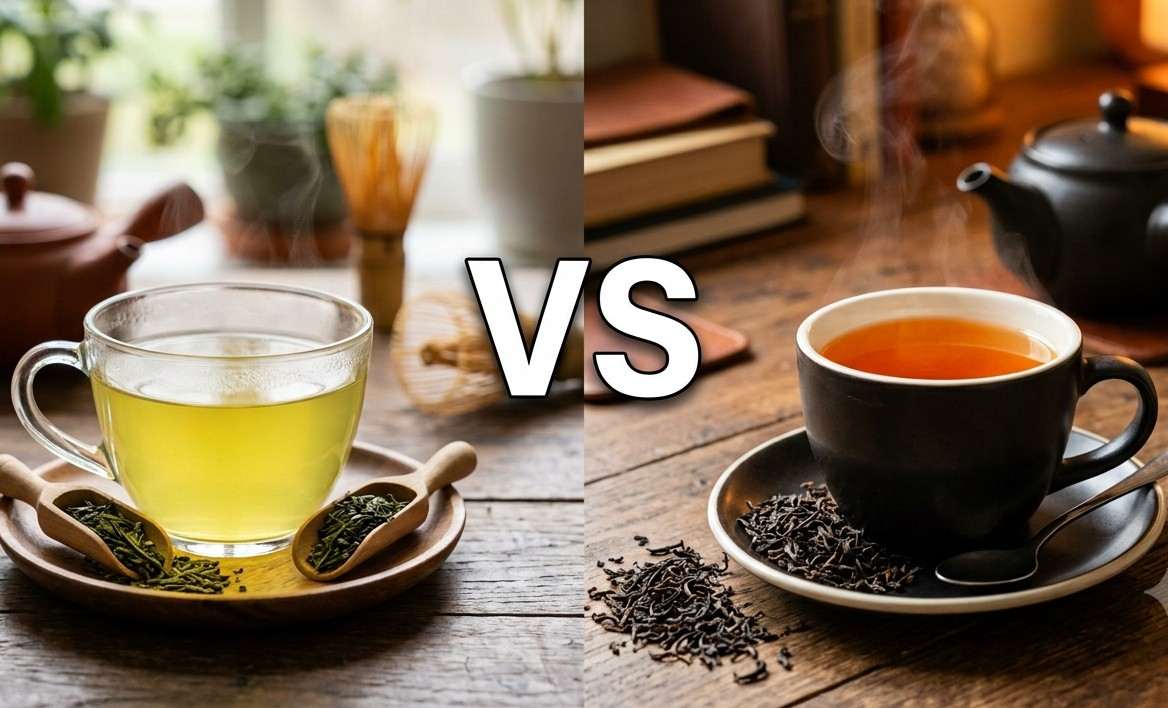
Green tea and black tea are two of the most popular traditional teas in the world. They are both made from the leaves of the same plant, Camellia sinensis, but they undergo different processing methods. This difference affects their color, flavor, caffeine content, antioxidant profile, and some of the health effects researchers have studied.
Green tea is often associated with antioxidants, weight management, and a lighter, fresher flavor, while black tea is known for its stronger taste, higher caffeine content, and naturally occurring compounds called theaflavins.
But is green tea actually healthier than black tea? Or does black tea offer similar benefits?
The answer depends on what you are looking for. Both can be part of a healthy diet when consumed as unsweetened beverages. Research suggests that both types provide polyphenols and other compounds that may support cardiovascular and overall health, although evidence does not establish that one is universally better for everyone. Human studies also have limitations, and many reported benefits are associations rather than proof that tea directly prevents disease.
This guide explains the differences between green tea and black tea, including nutrition, caffeine, antioxidants, potential benefits, side effects, and how to choose between them.
What Is Green Tea?
Green tea is made from the leaves of Camellia sinensis. Unlike black tea, the leaves are heated soon after harvesting to limit oxidation. They are commonly steamed or pan-fired and then dried.
Because oxidation is limited, green tea retains a higher proportion of catechins, a group of polyphenols that includes epigallocatechin-3-gallate (EGCG).
Green tea generally has a fresh, grassy, slightly bitter, or vegetal flavor. Its caffeine content can vary depending on the variety, amount of tea used, brewing method, and serving size. Green tea is commonly consumed plain, with lemon, or as part of beverages and food products.
What Is Black Tea?
Black tea also comes from Camellia sinensis, but the leaves undergo extensive oxidation before drying. This process changes the tea’s color, aroma, flavor, and polyphenol composition.
During oxidation, some catechins are converted into compounds known as theaflavins and related polyphenols. Black tea therefore has a different antioxidant profile from green tea rather than simply having “fewer antioxidants.” Black tea typically has a stronger, richer, and more robust flavor. Popular varieties include Assam, Darjeeling, Ceylon, English Breakfast, and Earl Grey.
Green Tea vs Black Tea: Key Differences
| Feature | Green Tea | Black Tea |
|---|---|---|
| Plant | Camellia sinensis | Camellia sinensis |
| Oxidation | Minimal | Extensive |
| Main polyphenols | Catechins, including EGCG | Theaflavins and other polyphenols |
| Flavor | Fresh, grassy, vegetal | Strong, malty, rich |
| Caffeine | Usually lower | Usually higher |
| Color | Green to yellow-green | Amber to dark brown |
| Common use | Morning, afternoon, wellness drink | Morning, breakfast, afternoon |
| Calories when plain | Very low | Very low |
| Antioxidant profile | Rich in catechins | Rich in theaflavins and other polyphenols |
| Can contain caffeine? | Yes | Yes |
The exact nutritional and caffeine content varies according to tea variety, brewing time, serving size, and preparation method.
Green Tea vs Black Tea: Nutrition Facts
Plain green tea and black tea are both very low in calories when consumed without sugar, syrups, cream, or milk.
Their main nutritional interest comes from bioactive compounds rather than vitamins and minerals.
| Nutrient/Compound | Green Tea | Black Tea |
|---|---|---|
| Calories | Very low when plain | Very low when plain |
| Caffeine | About 28 mg per 8 oz on average | About 47 mg per 8 oz on average |
| Polyphenols | High | High |
| Catechins | Particularly abundant | Reduced during oxidation |
| EGCG | Major catechin | Present in lower amounts |
| Theaflavins | Low | Characteristic of black tea |
| Carbohydrates | Very low when plain | Very low when plain |
| Added sugar | 0 if consumed plain | 0 if consumed plain |
Harvard’s Nutrition Source lists approximately 28 mg of caffeine in an 8-ounce cup of green tea and approximately 47 mg in an 8-ounce cup of black tea, although actual amounts can vary considerably.
What Is the Main Difference Between Green Tea and Black Tea?
The biggest difference is processing.
Green tea is heated and dried with little oxidation. Black tea is allowed to oxidize extensively before it is dried.
This changes the tea’s chemical composition.
Green tea tends to retain more catechins, particularly EGCG, while black tea contains more theaflavins and related oxidation products. Both groups of compounds are polyphenols with antioxidant activity.
Therefore, it is more accurate to say that green tea and black tea have different polyphenol profiles rather than saying that one contains all the antioxidants and the other does not.
Green Tea vs Black Tea: Which Has More Antioxidants?
This question is more complicated than it first appears.
Green tea is particularly rich in catechins, including EGCG. Black tea contains theaflavins and other polyphenols produced during oxidation.
It is therefore not accurate to simply label green tea as the “antioxidant tea” and black tea as having little antioxidant activity.
Harvard’s Nutrition Source notes that plain teas contain substantial polyphenols, although the specific types and proportions differ.
The practical takeaway is that both green and black tea can provide beneficial polyphenols, but their chemical profiles are different.
Green Tea vs Black Tea: Which Has More Caffeine?
Black tea generally contains more caffeine than green tea per typical 8-ounce serving.
Harvard estimates approximately:
- Green tea: about 28 mg caffeine per 8 ounces
- Black tea: about 47 mg caffeine per 8 ounces
These numbers are averages rather than fixed values. Tea variety, leaf quantity, water temperature, brewing time, and serving size can all change caffeine levels.
If You Want More Caffeine
Black tea may provide a stronger caffeine effect.
If You Prefer Less Caffeine
Green tea may be a better fit, although it is not caffeine-free.
Decaffeinated versions of either tea are also available.
Green Tea vs Black Tea: Which Tea is Better for Weight Loss?
Green tea is frequently marketed as a weight-loss drink, but the scientific evidence does not support treating it as a reliable weight-loss solution.
The National Center for Complementary and Integrative Health states that green tea has not been shown to be effective for weight loss. Catechins and caffeine may have modest effects on body weight in some studies, but results vary.
Black tea has also been studied in relation to body weight and metabolic health, but it should not be considered a weight-loss treatment.
For weight management, overall calorie intake, dietary quality, physical activity, sleep, and other lifestyle factors are much more important than choosing between green and black tea.
Green Tea vs Black Tea: Which Tea is Better for Heart Health?
Both types have been studied for cardiovascular health.
Some observational studies associate regular tea consumption with lower cardiovascular risk, while clinical trials have produced mixed results. A systematic review of randomized trials found that short-term tea consumption did not significantly change several blood pressure and lipid measures, although the evidence was limited by relatively small studies and short durations.
Other reviews have found favorable associations between tea consumption and cardiovascular outcomes.
Therefore, both green and black tea can reasonably be included in a heart-conscious dietary pattern, but neither should replace prescribed treatment, a balanced diet, exercise, or other evidence-based cardiovascular care.
Green Tea vs Black Tea: Which Tea is Better for Energy?
If your main goal is caffeine and alertness, black tea may provide more caffeine per typical cup.
Green tea generally contains less caffeine and also provides L-theanine, an amino acid naturally found in tea.
The combination of caffeine and other tea compounds can make the experience different from drinking coffee, although individual responses vary.
People who are sensitive to caffeine may prefer a weaker brew, a smaller serving, or a decaffeinated option.
Green Tea vs Black Tea for Digestion
Both beverages are traditionally consumed after meals, but evidence for treating digestive conditions with brewed tea remains limited.
Green tea and black tea contain caffeine and tannin-like compounds that may affect different people differently. Some people enjoy tea after meals, while others may experience stomach discomfort, especially when drinking strong tea on an empty stomach.
If tea consistently causes acidity, nausea, or stomach discomfort, reducing the strength or amount may help.
Green Tea vs Black Tea: Taste Difference
Green Tea
Green tea can taste:
- Fresh
- Grassy
- Vegetal
- Slightly bitter
- Mildly sweet
- Earthy, depending on the variety
Black Tea
Black tea can taste:
- Strong
- Malty
- Robust
- Woody
- Fruity
- Smoky, depending on the variety
Green tea is often preferred by people who enjoy lighter flavors, while black tea may appeal to those who want a stronger cup.
Who May Prefer Green Tea?
Green tea may be a practical choice for people who:
- Prefer a lighter flavor
- Want a lower-caffeine traditional tea
- Enjoy catechin-rich beverages
- Prefer unsweetened tea
- Want a refreshing afternoon drink
- Like adding lemon or other natural flavors
However, green tea still contains caffeine unless it is specifically decaffeinated.
Who May Prefer Black Tea?
Black tea may be a practical choice for people who:
- Prefer a stronger flavor
- Want somewhat more caffeine
- Enjoy tea with breakfast
- Like milk tea
- Prefer malty or robust flavors
- Want an alternative to coffee
Adding sugar, syrups, or large amounts of cream can significantly change the nutritional profile of the drink.
Green Tea vs Black Tea: Which One Is Better?
There is no single answer that applies to everyone.
Green tea provides a higher proportion of catechins such as EGCG and generally contains less caffeine per typical serving.
Black tea provides theaflavins and related polyphenols and generally contains more caffeine per typical serving.
Both are made from the same plant, both contain polyphenols, and both can be part of a healthy dietary pattern when consumed in moderation. Research has identified potentially beneficial associations for both types, particularly in cardiovascular health, but evidence is not strong enough to declare one universally superior.
A simple way to choose is:
| Your Preference | Tea to Consider |
|---|---|
| More caffeine | Black tea |
| Less caffeine | Green tea |
| Lighter flavor | Green tea |
| Stronger flavor | Black tea |
| Catechin-rich profile | Green tea |
| Theaflavin-rich profile | Black tea |
| Morning beverage | Either |
| Afternoon beverage | Either |
| Weight loss | Neither should be relied upon as a weight-loss treatment |
| Heart-conscious diet | Either, preferably unsweetened |
The best option is often the tea you enjoy drinking without excessive sugar and that fits comfortably into your overall diet.
How Much Green or Black Tea Can You Drink?
There is no universally appropriate number of cups for every person because caffeine tolerance, medications, pregnancy status, diet, and health conditions differ.
For many healthy adults, moderate tea consumption can fit into a balanced diet. Research on tea consumption frequently examines several cups per day, but these observational findings should not be interpreted as a prescription for a specific amount.
If you drink several cups daily, remember to consider your total caffeine intake from all sources, including coffee, chocolate, energy drinks, soft drinks, and supplements.
Green Tea vs Black Tea: Tips for a Healthier Cup
- Choose plain tea whenever possible.
- Limit added sugar and syrups.
- Avoid drinking tea extremely hot.
- Pay attention to your caffeine tolerance.
- Avoid relying on tea as a treatment for medical conditions.
- Choose brewed tea rather than concentrated supplements when possible.
- Consider tea timing if you have iron deficiency.
- If taking medications, ask your healthcare professional about possible interactions.
- If pregnant or breastfeeding, discuss your overall caffeine intake with your healthcare provider.
- Drink tea as part of an overall balanced diet rather than expecting a single beverage to provide major health benefits.
FAQ’s
Is green tea healthier than black tea?
Both can be part of a healthy diet. Green tea and black tea contain different types of polyphenols and may offer potential cardiovascular and antioxidant benefits when consumed as unsweetened beverages.
Can I drink green tea and black tea on the same day?
Yes, most healthy adults can consume both on the same day as long as their total caffeine intake remains appropriate for them.
Which tea is better in the morning: Green Tea vs Black Tea?
Either can be suitable. Black tea may appeal to people who prefer a stronger flavor and more caffeine, while green tea provides a lighter option.
Green Tea vs Black Tea: Which tea is better at night?
Decaffeinated green or black tea is generally more suitable at night because regular versions contain caffeine that may interfere with sleep.
Does black tea have more caffeine than coffee?
Typically, an 8-ounce serving of brewed coffee contains more caffeine than an 8-ounce serving of black tea, although the amount varies by preparation and product.
Can green tea and black tea help digestion?
Tea is commonly consumed after meals, but evidence that either tea directly improves digestion or treats digestive disorders is limited. Some people may also experience stomach discomfort from strong tea.
Is green tea naturally caffeine-free?
No. Regular green tea naturally contains caffeine. Decaffeinated green tea is available if you want to reduce caffeine intake.
Is black tea naturally caffeine-free?
No. Black tea naturally contains caffeine. Decaffeinated varieties contain substantially less caffeine.
Can green tea or black tea help lower cholesterol?
Some research suggests tea consumption may have favorable effects on certain cholesterol measures, but findings are inconsistent. Neither tea should replace prescribed cholesterol medication or dietary treatment.
Green Tea vs Black Tea: Which tea is easier on the stomach?
There is no universally gentler option. Both can cause stomach discomfort in some people, particularly when consumed strong or on an empty stomach.
Can I add milk to green tea?
Milk can be added, although it is more commonly paired with black tea. Adding milk changes the flavor, calories, and nutritional composition of the beverage.
Does green tea have more EGCG than black tea?
Generally, green tea contains substantially more catechins such as EGCG because it undergoes much less oxidation during processing.
Green Tea vs Black Tea: Which tea tastes stronger?
Black tea generally has a stronger, fuller, and more robust flavor, while green tea is often lighter, grassy, vegetal, or mildly bitter.
Can tea interfere with iron absorption?
Yes. Tea polyphenols can reduce the absorption of non-heme iron when tea is consumed with meals. People with iron deficiency may benefit from discussing tea timing with a healthcare professional.
Can green tea or black tea interact with medications?
Tea and concentrated tea products can interact with certain medications. If you regularly take prescription medicines, ask your healthcare professional or pharmacist whether your tea consumption could affect them.
Green tea or black tea: Which tea is better for beginners?
Green tea may appeal to people who prefer a lighter flavor, while black tea may be easier for those who enjoy stronger, more robust beverages. The choice is largely based on personal taste.
Can green tea and black tea be used for detox?
Tea can contribute to fluid intake, but there is no need for a special tea detox to remove toxins from the body. The liver and kidneys naturally perform these functions.
Green tea or black tea: Which tea has fewer calories?
Plain green tea and plain black tea are both very low in calories. Adding sugar, honey, milk, cream, or flavored syrups can substantially increase calories.
Can pregnant women drink green or black tea?
Pregnant women should monitor their total caffeine intake from all sources. Because individual circumstances differ, it is best to discuss appropriate caffeine intake with a healthcare professional.
How should I choose between green tea and black tea?
Consider caffeine, taste, preparation, and your personal dietary needs. Green tea generally has less caffeine and more catechins, while black tea usually has more caffeine and a stronger flavor. Both can be enjoyed unsweetened as part of a balanced diet.
Is green tea better than black tea for your stomach?
Green tea may feel gentler for some people, but both green and black tea can cause stomach discomfort, especially when consumed strong or on an empty stomach.
How much caffeine in green tea vs black tea vs coffee?
An 8-ounce cup typically contains about 28 mg of caffeine in green tea, 47 mg in black tea, and around 95 mg in brewed coffee. Caffeine levels can vary depending on the tea or coffee type, serving size, and brewing method.
Final Thought
Green tea and black tea are more similar than they are different: both come from Camellia sinensis, both contain caffeine and polyphenols, and both can be enjoyed as low-calorie beverages when served without added sugar.
Green tea stands out for its catechin content, particularly EGCG, while black tea is characterized by theaflavins produced during oxidation. Black tea generally contains more caffeine per typical cup, while green tea tends to have a lighter flavor and lower average caffeine content.
Rather than searching for one universally “better” tea, consider your caffeine tolerance, taste preference, dietary goals, and how you prepare your tea. For most people, either unsweetened green tea or black tea can be a sensible beverage choice as part of an overall balanced lifestyle.
Sources / References:
Disclaimer:
This guide is for general educational purposes only and is not a substitute for professional medical advice, diagnosis, or treatment. If you have a medical condition, take medication, are pregnant or breastfeeding, or have concerns about caffeine intake, consult a qualified healthcare professional.
Also Read: