A noticeable bump at the base of the neck can make you feel uncomfortable about your posture, especially when sitting at a desk, using a mobile phone, or looking at yourself in the mirror. This bump is commonly called a neck hump or dowager’s hump, although the appearance and underlying cause can vary from person to person.
The good news is that certain exercises may help improve posture, strengthen the neck and upper-back muscles, reduce stiffness, and make everyday movements more comfortable. However, exercises do not correct every type of neck hump, particularly when it is related to changes in the spinal bones, osteoporosis, or a buildup of fatty tissue. In this guide, you will learn about the best exercises for a neck hump, how to perform them safely, and when to seek medical advice.
What Is a Neck Hump?
A neck hump is a visible prominence around the base of the neck, near the upper back. It may be related to rounded shoulders, forward-head posture, an increased curve in the upper spine (kyphosis), or a collection of fatty tissue in that area.
Common contributing factors include:
- Poor posture: Frequently looking down at a phone or leaning forward while working may contribute to postural changes.
- Muscle weakness: Weak upper-back muscles can make it harder to maintain an upright posture.
- Spinal changes: Kyphosis, age-related changes, or vertebral compression fractures can cause increased rounding of the upper back.
- Fat accumulation: Certain medical conditions and medications can contribute to fat deposits around the base of the neck.
Identifying the cause matters because a posture-related hump may respond to exercise, while a hump caused by structural spinal changes or fat accumulation may require a different treatment approach.
8 Best Exercises to Reduce a Neck Hump
These exercises focus on gentle neck alignment, chest flexibility, and upper-back strength. Start slowly, move within a comfortable range, and avoid forcing your neck into an uncomfortable position.
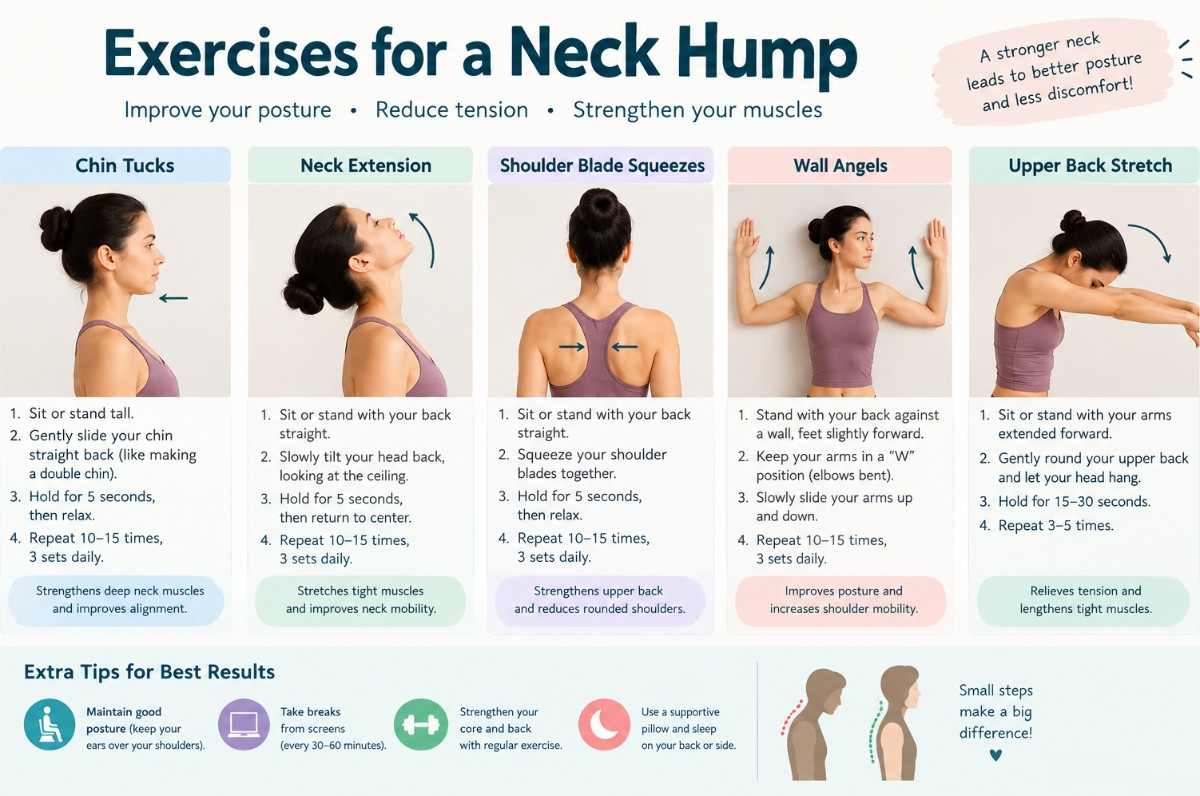
1. Chin Tucks
Chin tucks are among the simplest exercises for improving forward-head posture. They activate the deep neck muscles and encourage better head alignment.
How to do it:
- Sit or stand with your back comfortably straight.
- Look forward and gently draw your chin backward, as if making a double chin.
- Keep your eyes level and avoid tilting your head down.
- Hold for 3–5 seconds, then relax.
Repetitions: Start with 8–10 repetitions.

2. Shoulder Blade Squeezes
Rounded shoulders can make a neck hump appear more prominent. This exercise strengthens the muscles between the shoulder blades and helps support a more upright posture.
How to do it:
- Sit or stand with your arms relaxed.
- Gently draw your shoulder blades toward each other.
- Keep your shoulders down rather than lifting them toward your ears.
- Hold for 5 seconds before releasing.
Repetitions: 10 repetitions, gradually increasing as comfortable.

3. Doorway Chest Stretch
Tight chest muscles may pull the shoulders forward. A doorway stretch gently opens the chest and helps make an upright position more comfortable.
How to do it:
- Stand in an open doorway.
- Place your forearms against the doorframe, keeping your elbows comfortably bent.
- Step forward slightly until you feel a gentle stretch across your chest.
- Hold without arching your lower back.
Duration: Hold for 20–30 seconds and repeat 2–3 times.

4. Wall Angels
Wall angels work the upper-back and shoulder muscles while encouraging better shoulder mobility. They can be useful for people who spend long hours sitting.
How to do it:
- Stand with your back against a wall.
- Position your arms in a comfortable goalpost shape.
- Slowly slide your arms upward, keeping your ribs relaxed.
- Lower your arms slowly to the starting position.
Repetitions: Start with 5–8 controlled repetitions. Do not force your arms against the wall.

5. Upper-Back Extension
Gentle upper-back extension helps improve mobility in the thoracic spine, which can become stiff when you spend a lot of time bending forward.
How to do it:
- Sit on a stable chair with a supportive backrest that reaches your mid-back.
- Cross your arms over your chest.
- Gently lean your upper back backward over the chair’s backrest.
- Return to an upright position without throwing your head backward.
Repetitions: Perform 5–8 gentle repetitions.
Avoid this exercise if you have osteoporosis, a suspected spinal fracture, or significant spinal pain unless a healthcare professional approves it.

6. Resistance Band Rows
Resistance band rows strengthen the upper-back muscles that help stabilize the shoulder blades. Stronger muscles can make maintaining an upright posture easier.
How to do it:
- Secure a suitable resistance band according to its instructions.
- Hold the band with both hands and keep your elbows near your sides.
- Pull your hands toward your torso while gently drawing your shoulder blades together.
- Slowly return to the starting position.
Repetitions: Start with 8–12 repetitions using light resistance. Stop if you experience neck or shoulder pain.

7. Wall Posture Exercise
This simple exercise helps you become more aware of your head, shoulder, and trunk alignment without requiring special equipment.
How to do it:
- Stand with your back near a wall.
- Keep your feet slightly forward and your knees relaxed.
- Gently lengthen your spine and bring your head into a comfortable neutral position.
- Keep your shoulders relaxed and breathe normally.
Duration: Hold for 20–30 seconds and repeat 3 times.
Do not force the back of your head against the wall if doing so causes discomfort.

8. Gentle Neck Side Stretch
A gentle side stretch may help ease tightness around the neck and upper shoulders. It supports comfort and mobility, although it does not directly remove a neck hump.
How to do it:
- Sit upright with your shoulders relaxed.
- Slowly tilt one ear toward the same-side shoulder.
- Stop when you feel a mild stretch on the opposite side of your neck.
- Hold briefly, return to the center, and switch sides.
Duration: Hold for 15–20 seconds on each side. Never pull your head down with your hand.
The exercises above are consistent with general posture and strengthening approaches described by Cleveland Clinic and Nebraska Medicine. The appropriate routine depends on the underlying cause of the hump.

Simple Daily Exercise Routine for a Neck Hump
You do not need to perform every exercise for a long time to get started. Try this gentle routine if you can do the movements comfortably and have no medical restrictions.
| Exercise | Starting amount |
|---|---|
| Chin tucks | 8–10 repetitions |
| Shoulder blade squeezes | 10 repetitions |
| Doorway chest stretch | 2 holds of 20–30 seconds |
| Wall angels | 5–8 repetitions |
| Upper-back extension | 5–8 repetitions, if appropriate |
| Resistance band rows | 8–12 repetitions, if comfortable |
Start with a few exercises and gradually build up rather than pushing through the entire routine on your first day. Consistency is more important than intensity.
Tips to Help Improve a Neck Hump
Exercise is only one part of improving posture. Your everyday habits also influence how comfortably you hold your head and shoulders.
- Keep your screen at eye level: Adjust your computer monitor so you do not have to look down for long periods.
- Hold your phone higher: Bring the phone closer to eye level instead of repeatedly bending your neck forward.
- Take regular movement breaks: Stand up, walk around, or change position throughout the day.
- Strengthen your upper back: Gradually incorporate appropriate strengthening exercises into your routine.
- Avoid forcing a rigid posture: Aim for a comfortable, balanced position rather than holding your shoulders stiffly backward all day.
- Support your bone health: Discuss osteoporosis prevention and treatment with a healthcare professional if you have risk factors.
These habits may help manage posture-related problems, but they cannot prevent or reverse every cause of a neck hump.
Can Exercises Completely Remove a Neck Hump?
Not always. The outcome depends on the cause.
- Posture-related prominence: Exercises may improve head alignment, upper-back strength, and the appearance of a flexible postural curve.
- Structural kyphosis: Exercise and physical therapy may improve mobility and discomfort, but a fixed spinal curve may remain.
- Fat accumulation: Postural exercises do not directly remove a localized fat deposit.
- Osteoporosis-related changes: Medical evaluation and appropriate bone-health treatment may be needed alongside carefully selected exercises.
A healthcare professional can help determine which situation applies to you.
When Should You See a Doctor?
Arrange a medical assessment if the hump is new, getting larger, painful, or unexplained. A clinician can check whether the prominence comes from posture, spinal changes, fatty tissue, or another condition.
Seek prompt medical attention if you develop a hump after an injury, severe or rapidly worsening pain, new numbness or weakness, difficulty walking, or other neurological symptoms. Sudden weakness, difficulty breathing, or major neurological changes warrant emergency assessment.
Do not assume that every bump at the base of the neck is caused by poor posture. If you have osteoporosis, a history of spinal fractures, or a condition affecting your spine, ask a clinician or physiotherapist which exercises are safe before starting.
FAQ’s
Can neck hump exercises work at home?
Yes, many posture exercises can be performed at home without special equipment. Start gently and choose exercises that suit your physical abilities and the underlying cause of the hump.
How long does it take to reduce a neck hump by exercise?
Posture and comfort may improve over several weeks of consistent exercise, but visible changes can take longer. The results depend on the cause and severity of the hump.
Can chin tucks help reduce a neck hump?
Yes, chin tucks can help improve forward-head posture by strengthening the muscles that support the neck. However, they cannot remove every type of neck hump.
Can a neck hump disappear completely?
A posture-related prominence may improve with exercise and postural changes. A hump caused by spinal deformity, fractures, or fat accumulation may require other treatments and may not disappear completely.
Does walking help reduce a neck hump?
Walking supports general health and encourages regular movement, but it does not directly remove a neck hump. Combining walking with appropriate posture exercises may be more beneficial.
Can sleeping position make a neck hump worse?
An uncomfortable sleeping position may contribute to neck stiffness and discomfort, but it is not usually the only explanation for a persistent hump. A supportive pillow and comfortable neck alignment may help reduce stiffness.
Are neck hump exercises safe for older adults?
Gentle exercises may benefit older adults, but safety depends on bone health, mobility, and existing spinal conditions. People with osteoporosis or a history of spinal fractures should consult a healthcare professional before exercising.
Can stretching alone fix a neck hump?
Stretching may improve flexibility and reduce muscle tightness, but it may not be enough to improve posture. A suitable routine may also include strengthening exercises and changes to daily habits.
Can a neck hump be caused by osteoporosis?
Yes, osteoporosis can weaken the spinal bones and lead to compression fractures, which may increase the rounding of the upper back. A new or progressive hump should be evaluated by a healthcare professional.
Can neck hump return after exercise?
Yes, posture-related changes may return if the habits contributing to them persist. Maintaining a suitable exercise routine, taking movement breaks, and adjusting your workstation may help preserve improvements.
Is it possible to reduce a neck hump in 7 days?
A week of gentle exercise may help you become more aware of your posture or reduce some stiffness, but significant visible changes are unlikely to be guaranteed within seven days. Lasting improvement often requires consistent practice and appropriate treatment.
Should I use a neck hump corrector?
A posture brace or corrector is not a universal solution. Ask a healthcare professional whether a support device is appropriate for your situation, especially if you have spinal disease or osteoporosis.
Conclusion
The best exercises for a neck hump focus on improving head alignment, stretching tight chest muscles, strengthening the upper back, and supporting comfortable movement. Chin tucks, shoulder blade squeezes, doorway chest stretches, and wall angels are practical options for many people with posture-related changes.
Start gently, practise consistently, and give your body time to adapt. Most importantly, get the cause of a new or unexplained neck hump assessed instead of relying on exercises alone.
Sources and References:
Disclaimer:
This guide is for educational purposes only and does not replace professional medical advice, diagnosis, or treatment. Consult a qualified healthcare professional before starting a new exercise routine if you have neck pain, osteoporosis, a spinal condition, or other health concerns.
Also Read: