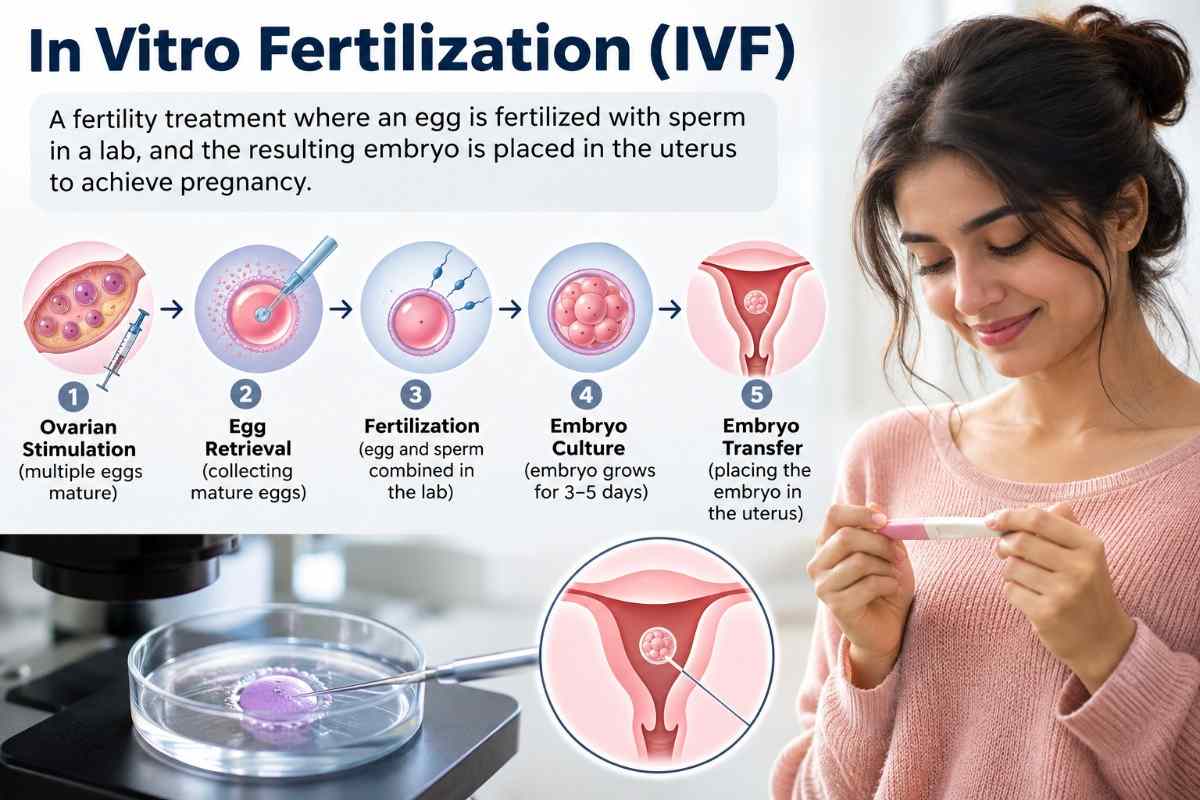
In Vitro Fertilization (IVF) is one of the most widely used fertility treatments for people who have difficulty getting pregnant naturally. It helps individuals and couples have a chance of becoming parents by combining an egg and sperm in a laboratory and transferring the resulting embryo into the uterus.
For many people, the journey toward parenthood can be emotionally and physically challenging. Fertility problems, blocked fallopian tubes, irregular ovulation, low sperm count, and unexplained infertility are some reasons people may consider IVF.
Although IVF has helped many families grow, it is not a guaranteed solution, and the experience can be different for everyone. In this guide, we explain everything you need to know about In Vitro Fertilization, including its stages, benefits, side effects, and what to expect during treatment.
What Is In Vitro Fertilization (IVF)?
In Vitro Fertilization (IVF) is an assisted reproductive technology (ART) in which an egg and sperm are combined outside the body in a laboratory to create an embryo.
Once an embryo develops, a fertility specialist may transfer it into the uterus, where it may implant and develop into a pregnancy.
The term “in vitro” means “in glass,” referring to the laboratory process in which fertilization takes place.
IVF can be used by people experiencing different fertility challenges, including blocked fallopian tubes, ovulation disorders, male-factor infertility, and unexplained infertility.
It may also help individuals who want to use donor eggs, donor sperm, or previously frozen embryos.
How Does In Vitro Fertilization Work?
IVF involves several carefully planned stages. The process usually takes several weeks for one fresh treatment cycle, although the overall timeline can be longer when frozen embryo transfers or additional testing are involved.
Here is how the IVF process generally works:
1. Fertility Testing and Consultation
The first step is a consultation with a fertility specialist. The doctor reviews medical history, previous pregnancy experiences, menstrual cycles, and reproductive health.
Both partners may undergo fertility testing. This can include blood tests, ultrasound examinations, ovarian reserve testing, and semen analysis.
These results help the specialist create an appropriate treatment plan.
2. Ovarian Stimulation
Normally, the ovaries release one mature egg during a menstrual cycle. During IVF, fertility medications containing hormones are used to encourage the ovaries to develop multiple mature eggs.
These medications are usually administered through injections over approximately 8–14 days, although the duration varies.
The doctor monitors follicle growth using ultrasound scans and sometimes blood tests.
3. Egg Retrieval
Once the eggs are mature, the doctor performs a procedure called egg retrieval.
It is generally performed under sedation or anesthesia. A thin needle guided by ultrasound passes through the vaginal wall to collect eggs from the ovarian follicles.
The procedure usually takes around 20–30 minutes, although individual experiences may differ.
The collected eggs are immediately taken to the laboratory for evaluation.
4. Sperm Collection
A sperm sample is collected from the male partner or obtained from a donor.
The laboratory processes the sample to identify suitable sperm for fertilization.
If sperm cannot be collected through ejaculation, a specialist may recommend a surgical sperm retrieval procedure in certain cases.
5. Fertilization
The collected eggs are combined with sperm in a laboratory.
There are two common fertilization methods:
- Conventional IVF: Eggs and sperm are placed together in a laboratory dish, allowing fertilization to occur naturally.
- Intracytoplasmic Sperm Injection (ICSI): A single sperm is injected directly into an egg. This technique is often considered in certain cases of male-factor infertility or previous fertilization problems.
Not every egg will fertilize successfully.
6. Embryo Development
After fertilization, the embryos are monitored in the laboratory as they develop.
Embryos are generally observed for several days, commonly until day 3 or day 5–6.
The embryology team evaluates their development and quality to help identify embryos suitable for transfer or freezing.
7. Embryo Transfer
During embryo transfer, a doctor places an embryo into the uterus using a thin, flexible catheter.
The procedure is usually relatively quick and does not generally require anesthesia.
Depending on the treatment plan, the embryo may be transferred during the same cycle or frozen and transferred in a later cycle.
8. Pregnancy Test
A blood pregnancy test is usually performed approximately 9–14 days after embryo transfer, depending on the clinic’s protocol.
The test measures human chorionic gonadotropin (hCG), a hormone produced during pregnancy.
If the test is positive, follow-up blood tests and an ultrasound are generally arranged to assess early pregnancy development.
Who Needs In Vitro Fertilization?
IVF may be recommended when natural conception is difficult or when other fertility treatments have not been successful.
Some common reasons include:
- Blocked or Damaged Fallopian Tubes: IVF can help bypass the fallopian tubes when they are blocked or severely damaged.
- Ovulation Disorders: People with conditions that affect regular egg release may benefit from IVF.
- Male-Factor Infertility: Low sperm count, poor sperm movement, or certain sperm-related problems may make In Vitro Fertilization or ICSI appropriate.
- Endometriosis: Moderate to severe endometriosis can affect fertility and may lead specialists to recommend In Vitro Fertilization.
- Unexplained Infertility: IVF may be considered when fertility testing does not identify a clear reason for difficulty conceiving.
- Age-Related Fertility Decline: IVF may be considered when ovarian reserve or egg quality has declined with age.
- Genetic Conditions: In Vitro Fertilization combined with preimplantation genetic testing may help reduce the risk of passing on certain inherited genetic conditions.
- Previous Unsuccessful Fertility Treatments: IVF may be recommended after other treatments have not resulted in pregnancy.
- Use of Donor Eggs or Sperm: In Vitro Fertilization can help individuals and couples who require donor reproductive cells.
- Family-Building for Same-Sex Couples: IVF may be one option for people who need donor eggs, sperm, or a gestational carrier.
A fertility specialist can determine whether In Vitro Fertilization is suitable based on individual circumstances.
What Are the Different Types of IVF?
IVF treatment is not exactly the same for everyone. Fertility specialists may recommend different approaches depending on reproductive health, age, medical history, and treatment goals.
- Conventional IVF: Eggs and sperm are combined in a laboratory dish to allow fertilization.
- IVF With ICSI: A single sperm is injected directly into an egg to assist fertilization.
- Natural Cycle IVF: The treatment uses an egg produced during the natural menstrual cycle, with little or no ovarian stimulation medication.
- Mild Stimulation In Vitro Fertilization: Lower doses of fertility medications are used to stimulate egg development.
- Fresh Embryo Transfer: An embryo is transferred into the uterus during the same treatment cycle.
- Frozen Embryo Transfer (FET): A previously frozen embryo is thawed and transferred during a later cycle.
- Donor Egg IVF: Eggs from a donor are fertilized with sperm and the resulting embryo is transferred into the recipient’s uterus.
- Donor Sperm IVF: Donor sperm is used to fertilize eggs during the In Vitro Fertilization process.
The best approach depends on medical needs rather than a single method being suitable for everyone.
What Is the IVF Success Rate?
The success rate of In Vitro Fertilization varies considerably from person to person. Age is one of the most important factors because both egg quantity and egg quality generally decline over time.
Other factors include:
- Age of the person providing the eggs.
- Ovarian reserve and egg quality.
- Sperm quality.
- Embryo development and quality.
- Uterine health.
- Previous fertility treatment history.
- Underlying reproductive conditions.
- Whether donor eggs or embryos are used.
It is also important to understand what a clinic means by “success rate.” Some clinics report pregnancy rates, while others report live birth rates. Results may also be calculated per embryo transfer, egg retrieval, or treatment cycle.
A pregnancy test alone does not mean that a treatment has resulted in a live birth.
For a more accurate estimate, ask your fertility specialist about the expected live birth rate for someone with your age and medical circumstances.
IVF Success Rates by Age
Age can influence the chances of achieving a successful pregnancy through IVF, especially when using a person’s own eggs.
The following table describes the general relationship between age and In Vitro Fertilization outcomes. It is not a numerical prediction or a substitute for clinic-specific statistics.
| Age group | General IVF outlook |
|---|---|
| Under 35 | Generally the most favorable age group for IVF using own eggs |
| 35–37 | Success rates may begin to decline |
| 38–40 | Lower average success rates compared with younger age groups |
| 41–42 | A more significant decline in success is generally seen |
| Over 42 | Success using own eggs is often considerably lower |
These are broad patterns, not guaranteed outcomes. Individual results vary, and donor eggs can change the expected success rate.
Benefits of In Vitro Fertilization
IVF offers several potential advantages for people experiencing fertility difficulties.
- Helps Overcome Certain Fertility Problems: In Vitro Fertilization can bypass blocked fallopian tubes and help address several reproductive conditions.
- Offers a Pregnancy Option After Other Treatments: It may provide another option when medications or less invasive fertility treatments have not worked.
- Allows the Use of Donor Eggs or Sperm: Donor reproductive cells can help individuals and couples build a family.
- Supports Embryo Freezing: Suitable embryos can be frozen for possible future use.
- Offers Genetic Testing Options: Certain embryos can be tested for specific genetic or chromosomal conditions when medically appropriate.
- Provides More Control Over Timing: Frozen embryo transfers may allow pregnancy attempts to take place at a later time.
- Can Help People With Male-Factor Infertility: ICSI may help in certain situations involving sperm-related fertility problems.
- Supports Different Family-Building Needs: In Vitro Fertilization can be used by single individuals and different types of couples.
Risks and Side Effects of IVF
Although IVF is commonly performed, it is not completely risk-free. Fertility medications, egg retrieval, and pregnancy itself can involve certain complications.
Some possible side effects and risks include:
- Bloating: Hormonal medications may cause abdominal bloating and discomfort.
- Breast Tenderness: Changes in hormone levels can make the breasts feel sensitive.
- Headaches: Some people experience headaches during ovarian stimulation.
- Mood Changes: Hormonal changes and the emotional demands of treatment may affect mood.
- Ovarian Hyperstimulation Syndrome (OHSS): The ovaries may become swollen and painful due to an excessive response to fertility medications.
- Abdominal Discomfort: Mild cramping and pelvic discomfort can occur after egg retrieval.
- Bleeding or Infection: Egg retrieval carries a small risk of bleeding, infection, or injury to nearby structures.
- Ectopic Pregnancy: In some cases, an embryo implants outside the uterus, most commonly in a fallopian tube.
- Multiple Pregnancy: Transferring more than one embryo increases the chance of twins or higher-order pregnancies, which carry additional risks.
- Emotional Stress: Treatment uncertainty, medication schedules, financial costs, and unsuccessful cycles can be emotionally difficult.
Severe abdominal pain, rapid weight gain, persistent vomiting, difficulty breathing, or reduced urination after ovarian stimulation should be reported to a medical professional immediately.
How Much Does IVF Cost?
The cost of IVF depends on the country, fertility clinic, medications, testing, and additional procedures required.
In the United States, a basic In Vitro Fertilization cycle commonly costs approximately $12,000–$20,000 or more before all additional expenses. Medication, genetic testing, embryo freezing, storage, and frozen embryo transfer may increase the total cost.
In India, IVF costs vary by city, hospital, and treatment plan. Patients should request an itemized estimate rather than relying only on an advertised starting price.
Before starting treatment, ask the clinic whether its quoted price includes:
- Initial fertility consultations.
- Hormonal medications.
- Ultrasound monitoring.
- Egg retrieval.
- Laboratory fertilization.
- Embryo culture.
- Embryo transfer.
- Embryo freezing and storage.
- Pregnancy testing.
- Additional procedures such as ICSI or genetic testing.
Some insurance plans cover certain fertility services, while others provide limited or no coverage. Check your insurance policy and clinic payment options before beginning treatment.
How Long Does the IVF Process Take?
A typical IVF cycle involving ovarian stimulation and a fresh embryo transfer may take approximately 4–6 weeks from the start of stimulation to the pregnancy test.
However, the exact timeline depends on the treatment protocol.
| IVF stage | Approximate duration |
|---|---|
| Initial consultation and testing | Varies |
| Ovarian stimulation | 8–14 days |
| Egg retrieval | Usually one procedure |
| Embryo development | 3–6 days |
| Fresh embryo transfer | During the same cycle |
| Pregnancy test | Around 9–14 days after transfer |
A frozen embryo transfer may require additional preparation and a separate treatment cycle.
What Should You Do Before Starting IVF?
Preparing for In Vitro Fertilization involves more than attending medical appointments. A few practical steps can help you approach treatment with better information and support.
- Choose a Qualified Fertility Specialist: Look for an experienced reproductive medicine specialist and a properly accredited fertility clinic.
- Complete Recommended Testing: Follow the doctor’s advice about hormone tests, ultrasound scans, and semen analysis.
- Discuss Your Medical History: Share information about previous pregnancies, surgeries, medications, and existing health conditions.
- Maintain a Balanced Diet: Eat a variety of fruits, vegetables, whole grains, protein-rich foods, and healthy fats.
- Avoid Smoking: Smoking can negatively affect reproductive health.
- Limit or Avoid Alcohol: Discuss alcohol use with your fertility specialist, particularly during treatment.
- Ask About Supplements: Take folic acid or other supplements as recommended by your doctor.
- Prioritize Sleep: Aim for consistent, adequate sleep.
- Prepare Financially: Understand the complete treatment cost, including possible additional cycles.
- Seek Emotional Support: Consider counseling, support groups, or conversations with trusted people.
Healthy lifestyle habits can support general health, but they cannot guarantee IVF success.
What Happens After Embryo Transfer?
After embryo transfer, the embryo may begin the process of attaching to the uterine lining. However, implantation does not happen in every treatment cycle.
Some people notice mild cramping, spotting, bloating, or breast tenderness. Others experience no noticeable symptoms.
It is important not to rely on symptoms to determine whether In Vitro Fertilization has worked. Early pregnancy symptoms can overlap with medication side effects and normal hormonal changes.
Follow your fertility clinic’s instructions, continue prescribed medications, and attend the scheduled pregnancy test.
Avoid taking an early home pregnancy test without discussing the timing with your clinic, as fertility medications containing hCG can sometimes affect results.
Is IVF Painful?
IVF is not usually described as one painful procedure, but some stages can cause temporary discomfort.
Hormonal injections may cause mild soreness or bruising. During egg retrieval, sedation or anesthesia is generally used to reduce discomfort.
After retrieval, mild cramping, bloating, and pelvic tenderness are common.
Embryo transfer is usually a quick procedure and often feels similar to a routine pelvic examination.
The level of discomfort varies between individuals. Speak with your doctor if you are worried about pain management.
Can IVF Guarantee Pregnancy?
No. IVF cannot guarantee pregnancy or a successful birth.
Even when fertilization and embryo development occur successfully, an embryo may not implant or a pregnancy may not continue.
Success depends on several factors, including egg quality, sperm quality, age, embryo development, and uterine health.
Some people achieve pregnancy after one IVF cycle, while others may need multiple attempts. A fertility specialist can explain realistic expectations based on your individual circumstances.
Is IVF Safe for the Mother and Baby?
IVF is an established fertility treatment, and many people have healthy pregnancies and babies after In Vitro Fertilization.
However, some risks may be higher depending on the individual’s health, age, fertility condition, and whether multiple embryos are transferred.
Potential pregnancy-related concerns include multiple pregnancy, premature birth, low birth weight, and complications associated with certain underlying medical conditions.
Single embryo transfer is commonly recommended when appropriate because it reduces the risk of multiple pregnancy.
Your fertility specialist and pregnancy care provider can explain the risks and recommend suitable monitoring.
FAQ’s
What is the best age for IVF?
IVF success rates using a person’s own eggs are generally highest before age 35. However, individual fertility, ovarian reserve, and medical history also influence outcomes.
How many IVF cycles are usually needed?
Some people achieve pregnancy after one IVF cycle, while others may need multiple attempts. There is no fixed number of cycles that guarantees pregnancy.
Does IVF increase the chance of twins?
Yes, transferring multiple embryos can increase the chance of twins or multiple pregnancies. Single embryo transfer reduces this risk.
Are IVF babies healthy?
Yes, most babies born through In Vitro Fertilization are healthy. However, certain pregnancy complications and risks, including premature birth and low birth weight, may be more common in some circumstances.
Can IVF work after 40?
Yes, IVF can work after 40, but success rates using one’s own eggs are generally lower because egg quantity and quality decline with age. Donor eggs may be another option.
What is the difference between IVF and IUI?
In Vitro Fertilization involves fertilizing an egg with sperm in a laboratory, while IUI involves placing prepared sperm directly into the uterus to help fertilization occur inside the body.
Can IVF be done without fallopian tubes?
Yes. In Vitro Fertilization can be performed without fallopian tubes because fertilization happens in a laboratory and the resulting embryo is transferred directly into the uterus.
How many injections are needed for IVF?
Most ovarian stimulation protocols involve daily injections for approximately 8–14 days. The exact number depends on the medications and individual treatment plan.
What should you avoid during IVF treatment?
Avoid smoking, recreational drugs, and alcohol, and do not take unapproved medications or supplements. Follow your fertility specialist’s advice about exercise, diet, and daily activities.
Does IVF affect the mother’s health?
In Vitro Fertilization medications may cause temporary side effects such as bloating, headaches, and mood changes. Rare complications include ovarian hyperstimulation syndrome and infection following egg retrieval.
Can frozen embryos be used for pregnancy?
Yes. Frozen embryos can be thawed and transferred into the uterus during a later treatment cycle. This procedure is called frozen embryo transfer (FET).
Is IVF successful on the first attempt?
Yes, some people become pregnant during their first In Vitro Fertilization attempt. However, success depends on age, embryo quality, reproductive health, and other fertility factors.
What causes IVF failure?
In Vitro Fertilization may be unsuccessful because of chromosomal abnormalities in embryos, poor egg or sperm quality, unsuccessful implantation, or other reproductive factors. Sometimes, no specific cause can be identified.
What is the main purpose of IVF?
The main purpose of In Vitro Fertilization is to help people achieve pregnancy when natural conception is difficult because of fertility-related problems.
Does IVF affect the baby’s gender?
In Vitro Fertilization itself does not determine a baby’s gender. In some countries, embryo testing may reveal chromosomal information, but the use of this information for sex selection is restricted or prohibited depending on local laws.
What are the 5 stages of IVF?
Ovarian stimulation, egg retrieval, sperm collection, fertilization, and embryo transfer.
How does IVF affect a woman?
In Vitro Fertilization may cause bloating, headaches, mood changes, breast tenderness, and abdominal discomfort.
Who should avoid IVF?
People with certain serious or untreated medical conditions may need to delay or modify In Vitro Fertilization treatment.
Can I get pregnant naturally after IVF?
Yes, natural pregnancy is possible after In Vitro Fertilization, depending on individual fertility health.
What gender is more common with IVF?
Some studies report slightly more male births with certain IVF techniques, but outcomes vary.
Why eat pineapple during IVF?
Pineapple contains bromelain, but there is no strong evidence that it improves In Vitro Fertilization implantation.
Is IVF more successful the second time?
A second IVF attempt may succeed, but success is not guaranteed to be higher.
Which round of IVF is most successful?
There is no universally most successful round. Outcomes depend on individual fertility factors.
How to make IVF successful the first time?
Follow medical advice, eat healthily, avoid smoking and alcohol, and attend all appointments.
Sources / References:
Disclaimer:
This article is for educational purposes only and should not replace professional medical advice, diagnosis, or treatment. Consult a qualified fertility specialist for personalized guidance about IVF.
Also Read: