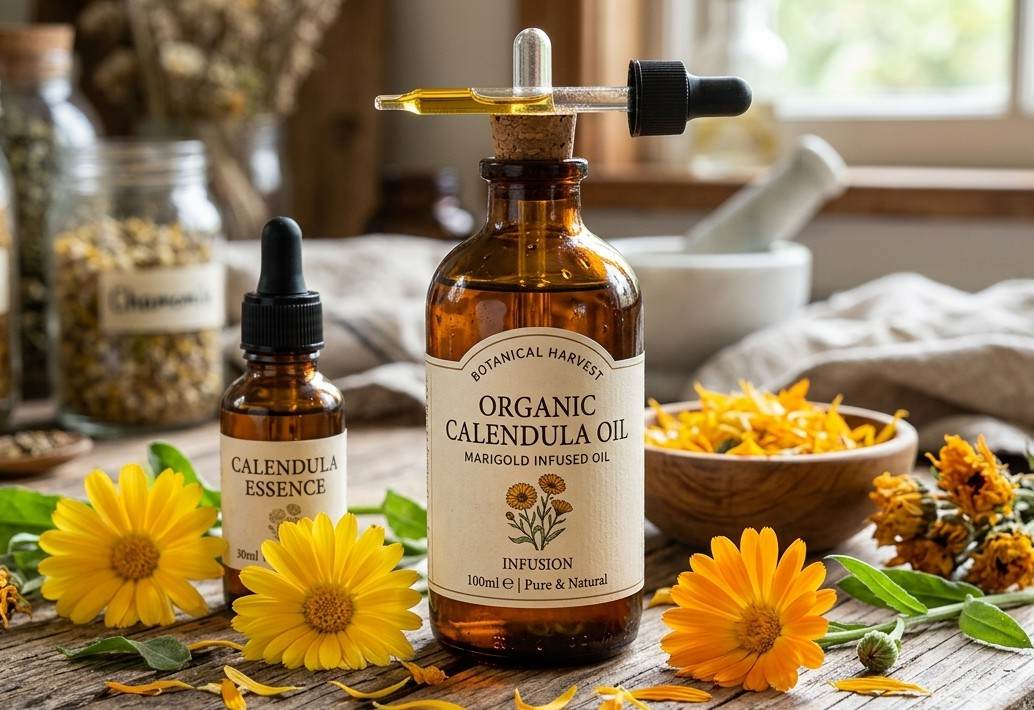
Calendula oil is a botanical oil preparation made by infusing calendula flowers, usually Calendula officinalis, in a carrier oil. It is widely used in skincare and traditional herbal preparations because calendula contains naturally occurring compounds such as flavonoids, triterpenoids, carotenoids, and essential oils.
Calendula has a long history of traditional topical use. The European Medicines Agency recognizes traditional use of calendula flower preparations for minor skin inflammation and minor wounds, while also noting that allergic skin sensitization can occur.
What Is Calendula Oil?
Calendula oil is typically made by soaking dried calendula flowers in a carrier oil such as sunflower, olive, jojoba, or another vegetable oil. Over time, oil-soluble compounds from the flowers are extracted into the carrier oil.
Calendula is also commonly called pot marigold, although it should not be confused with ornamental marigolds from the Tagetes genus.
The resulting oil is usually golden yellow to orange and may have a mild herbal aroma. It is commonly incorporated into creams, balms, lotions, massage oils, salves, and other personal-care products.
The potential benefits of calendula are thought to be associated with its naturally occurring plant compounds, including flavonoids, triterpenoids, carotenoids, and volatile constituents. However, evidence varies depending on the specific calendula preparation and the condition being studied.
Properties of Calendula Oil
| Nutrient/Property | Typical Information |
|---|---|
| Calories | Primarily derived from the carrier oil |
| Total Fat | Predominantly fatty acids from the carrier oil |
| Protein | Negligible |
| Carbohydrates | Negligible |
| Fiber | Negligible |
| Water | Usually very low |
| Vitamin E | May be present depending on the carrier oil |
| Plant Compounds | May contain calendula-derived flavonoids, carotenoids, and triterpenoids |
| Omega-3 Fatty Acids | Depends on the carrier oil |
| Omega-6 Fatty Acids | Depends on the carrier oil |
| Omega-9 Fatty Acids | Depends on the carrier oil |
| Cholesterol | None naturally |
Note: Calendula-infused oil should not be treated as nutritionally equivalent to calendula flowers or a standardized calendula extract.
Importantly, calendula oil is generally a topical product rather than a dietary cooking oil. Products sold as calendula oil can differ considerably in their concentration, extraction method, and carrier oil, so the label should always be checked before use.
20 Proven Benefits of Calendula Oil
1. Supports Minor Wound Care: Calendula preparations have traditionally been used topically for minor wounds and irritated skin.
2. May Soothe Irritated Skin: Its botanical compounds may help calm the feeling of mild skin irritation when used in appropriate topical preparations.
3. Provides Skin Moisturization: The carrier oil can help soften dry skin by reducing moisture loss from the skin surface.
4. Supports the Skin Barrier: Regular application of an appropriate oil-based product can help maintain a comfortable and supple skin barrier.
5. May Help With Minor Inflammation: Calendula contains compounds that have demonstrated anti-inflammatory activity in laboratory and experimental research.
6. May Soothe Minor Redness: A calendula-containing topical product may help make mildly irritated skin feel more comfortable.
7. Helps Dry Skin: The oil component can provide emollient properties that make rough or dry skin feel softer.
8. Supports Chapped Skin: Calendula oil can be incorporated into balms designed for dry, chapped areas of intact skin.
9. May Benefit Rough Skin: Regular moisturizing with a calendula-infused oil may improve the feel and appearance of rough skin.
10. Can Be Used in Massage: Its oil-based texture makes calendula oil suitable as a massage medium when the formulation is intended for topical use.
11. May Support Comfortable Skin After Minor Irritation: Calendula preparations have traditional topical applications for minor inflammatory skin conditions.
12. May Help Maintain Soft Skin: The carrier oil can leave the skin feeling smoother and more conditioned.
13. May Be Useful in Body Care: Calendula oil can be incorporated into homemade or commercial body oils, creams, and salves.
14. May Help Condition Dry Cuticles: A small amount can be massaged around dry cuticles and the surrounding intact skin.
15. May Help Soften Dry Hands: Applying a suitable calendula oil can provide an additional layer of emollient care for dry hands.
16. May Be Useful for Dry Elbows and Knees: Its rich oil texture can help soften areas that commonly become rough and dry.
17. Contains Plant Antioxidant Compounds: Calendula flowers contain flavonoids and carotenoids with antioxidant activity, although the amount transferred into an infused oil varies.
18. May Complement Gentle Skincare: Calendula oil can be included in a simple skincare routine focused on cleansing and moisturizing rather than aggressive treatments.
19. Has Traditional Herbal Use: Calendula flower preparations have been used medicinally for many decades, supporting their established traditional-use history.
20. Can Be Used in Natural Personal-Care Products: Calendula-infused oil is commonly incorporated into balms, salves, lotions, and other botanical formulations.
10 Side Effects of Calendula Oil
1. Skin Irritation: Some people may experience burning, stinging, redness, or discomfort after topical application.
2. Allergic Reaction: Calendula may cause an allergic response, particularly in people sensitive to plants in the Asteraceae family.
3. Contact Dermatitis: Repeated exposure can occasionally trigger an itchy or inflamed skin reaction in sensitive individuals.
4. Itching: An allergic or irritating response may cause localized itching.
5. Redness: Sensitive skin may become red after applying calendula-containing products.
6. Rash: A rash can develop if the skin does not tolerate calendula or another ingredient in the formulation.
7. Burning Sensation: Concentrated or fragranced formulations may cause temporary burning or stinging.
8. Breakouts: Oil-based products may contribute to clogged pores or breakouts in some acne-prone individuals, depending on the carrier oil.
9. Eye Irritation: Calendula oil should not be allowed to enter the eyes because oils and botanical extracts can cause irritation.
10. Worsening of Existing Skin Problems: If a product causes irritation, continuing to use it may make the skin condition worse.
How to Use Calendula Oil?
For topical use, start with a small amount on clean, dry skin. Massage a thin layer onto an area of intact skin and allow it to absorb.
Calendula oil can be used:
- On dry hands and elbows
- Around dry cuticles
- In body massage
- In homemade body balms
- On areas of mild dryness
- As an ingredient in creams and salves
Do not assume that every calendula oil is appropriate for broken skin, wounds, children, or facial use. Follow the manufacturer’s instructions for the specific product.
Other Uses of Calendula Oil
Calendula oil is primarily used in personal care and topical formulations. Common applications include:
- Body oils
- Moisturizing balms
- Hand creams
- Foot creams
- Cuticle oils
- Massage oils
- Facial oils
- Lip-care formulations
- Herbal salves
- Handmade soaps
- Hair and scalp formulations
- After-bath body care
Its suitability depends on the formulation and the other ingredients present.
Calendula Oil Homeopathy Uses
In homeopathic practice, Calendula officinalis is traditionally used in topical preparations and homeopathic remedies for concerns such as:
- Minor cuts and abrasions: Calendula preparations are traditionally used to support care of minor superficial skin injuries.
- Minor wounds: Calendula has a long history of traditional topical use for minor wounds.
- Skin irritation: Calendula preparations may be used to soothe mild skin irritation.
- Burns: Some homeopathic practitioners use calendula preparations for minor burns, although this should not replace appropriate burn treatment.
- Sore or irritated skin: Topical calendula products may be used for temporary soothing and moisturizing.
- Mouth and gum care: Certain calendula preparations are traditionally used for minor oral irritation, but products must be specifically formulated for oral use.
- Post-procedure skin care: Calendula is sometimes used in complementary care after minor procedures, but medical instructions should take priority.
Important: Evidence for homeopathy itself does not establish that highly diluted homeopathic remedies treat medical conditions beyond placebo effects. Calendula’s traditional topical use is a separate question from the claims made for homeopathic preparations. For Calendula oil specifically, use it according to the product label. Cosmetic calendula oil is generally intended for external use and should not automatically be considered a homeopathic medicine.
How to Make Calendula Oil at Home?
A simple calendula-infused oil can be prepared using dried calendula flowers and a suitable carrier oil.
Ingredients:
- Completely dried calendula flowers
- A clean, completely dry glass jar
- Carrier oil such as olive or sunflower oil
- Clean strainer or cheesecloth
- Dark glass bottle for storage
Method:
- Fill a clean, dry jar approximately halfway with dried calendula flowers.
- Pour the carrier oil over the flowers until they are completely submerged.
- Make sure the flowers remain covered by oil.
- Seal the jar and place it in a cool location away from direct sunlight.
- Allow the flowers to infuse for several weeks, shaking the jar gently from time to time.
- Strain the oil thoroughly through clean cheesecloth or a fine strainer.
- Transfer the finished oil into a clean, dry, preferably dark-colored bottle.
- Label the bottle with the preparation date and ingredients.
Important: Water or moisture entering an infused oil can increase the risk of spoilage. For longer storage, commercially prepared products may offer more consistent quality and preservation.
How Much Calendula Oil Can You Use Per Day?
For topical use, there is no universal daily amount. A thin layer applied to the intended area is generally more appropriate than repeatedly saturating the skin.
For oral use, do not establish a daily dose based on a topical calendula oil. Use only products specifically labeled for oral consumption and follow their directions or professional medical advice.
Calendula oil dosage depends on the product and intended route of use.
| Use | General Guidance |
|---|---|
| Facial skin | Use a small amount and patch test first |
| Dry body skin | Apply a thin layer as needed |
| Massage | Use an amount appropriate for the area being massaged |
| Cuticles | A small drop may be sufficient |
| Hair/scalp | Follow the product instructions and avoid excessive application |
| Oral use | Only use a product specifically labeled for oral use |
| Children | Ask a pediatric healthcare professional before medicinal use |
There is no standardized daily oral dose for generic calendula-infused oil.
Best Time to Use Calendula Oil
There is no medically established best time of day to apply calendula oil.
For skincare, many people prefer using it after bathing or cleansing, when the skin is clean. It can also be used before bedtime as part of a moisturizing routine.
If applying it to the face during the daytime, allow the oil to absorb before applying other skincare or sunscreen.
Who Should Use Calendula Oil?
- People With Dry Skin: People experiencing ordinary dryness may use a suitable calendula-infused oil as an emollient moisturizer.
- People With Rough Skin: It may be useful for softening rough areas such as elbows, knees, and heels.
- People Interested in Botanical Skincare: Calendula oil can be incorporated into simple plant-based personal-care routines.
- People Looking for Massage Oils: A suitable calendula-infused carrier oil can be used for massage.
- People With Dry Cuticles: Small amounts may be applied to intact, dry cuticles.
- People Using Herbal Balms: Calendula oil can be included in topical balms and salves designed for skin conditioning.
Who Should Not Use Calendula Oil?
- People Allergic to Asteraceae Plants: Individuals with known hypersensitivity to Asteraceae plants such as certain daisies, chrysanthemums, or ragweed should avoid calendula unless advised otherwise by a healthcare professional.
- People With a Previous Calendula Reaction: Anyone who has previously developed a rash or other reaction after using calendula should discontinue it.
- People With Severe Skin Reactions: Avoid applying it to severely inflamed or rapidly worsening skin without medical advice.
- People With Eye Problems: Calendula oil should not be applied directly to the eyes.
- People With Unknown Skin Sensitivity: Those with highly reactive skin should patch test a new product before wider use.
- People Considering Oral Use of Topical Oil: Cosmetic or skincare calendula oil should not be consumed.
- Children Without Professional Guidance: Medicinal use in young children should be discussed with an appropriate healthcare professional.
How to Store Calendula Oil?
Store calendula oil in a tightly closed container away from heat, humidity, and direct sunlight.
A dark-colored glass bottle can help reduce exposure to light. Keep water out of the bottle and use clean, dry hands or applicators when handling it.
Discard the oil if it develops an unusual smell, visible contamination, significant color change, or other signs of spoilage. Always follow the expiration or best-before date provided by the manufacturer.
Precautions and Interactions
- Patch Test First: Apply a small amount to a limited area before using calendula oil more extensively.
- Watch for Allergic Reactions: Stop using the product if you develop significant itching, redness, swelling, rash, or other signs of sensitivity.
- Consider Asteraceae Allergy: Calendula belongs to the Asteraceae family, and people with known hypersensitivity to this plant family should avoid calendula preparations.
- Avoid the Eyes: Keep calendula oil away from the eyes and mucous membranes.
- Do Not Apply to Serious Wounds: Deep, infected, heavily bleeding, or serious wounds require appropriate medical care rather than self-treatment with calendula oil.
- Check the Carrier Oil: A reaction may come from the carrier oil, fragrance, preservatives, or another ingredient rather than calendula itself.
- Be Careful With Homemade Products: Homemade oils do not undergo the same quality-control procedures as standardized commercial products.
- Do Not Confuse Preparations: Calendula oil, calendula extract, calendula tincture, calendula cream, and calendula tea are different preparations and cannot automatically be substituted for one another.
- Ask Before Oral Use: Consult a healthcare professional before taking calendula orally, particularly during pregnancy, breastfeeding, or when using medicines.
- Follow Product Directions: Use commercial calendula products according to their intended route and manufacturer’s instructions.
FAQ’s
What is Calendula Oil used for?
Calendula oil is mainly used topically to moisturize, soften, and soothe dry or mildly irritated skin.
Can Calendula Oil be used on the face?
Yes, a suitable calendula oil can be used on the face, but patch testing is recommended first, especially for sensitive or acne-prone skin.
Is Calendula Oil good for dry skin?
Yes, calendula-infused oil can help soften dry skin and support the skin’s moisture barrier.
Can Calendula Oil help wounds?
Calendula preparations have traditional use for minor wounds, but serious, deep, infected, or heavily bleeding wounds require medical attention.
Can Calendula Oil lighten skin?
Calendula oil is not a proven skin-lightening treatment and should not be relied upon to change natural skin tone.
Is Calendula Oil safe for children?
Topical use may depend on the child’s age and the specific product, so it is best to consult a pediatric healthcare professional before medicinal use.
Can you consume Calendula Oil?
Most calendula oils sold for skincare are intended for external use and should not be consumed unless the product is specifically labeled for oral use.
How long does Calendula Oil take to work?
For moisturization, skin may feel softer soon after application, while benefits for irritation or dryness may take longer and vary by person.
Can Calendula Oil be used every day?
A suitable topical calendula oil can generally be used regularly on intact skin if it does not cause irritation and the product instructions permit frequent use.
Can Calendula Oil be used overnight?
Yes, a small amount can be applied overnight as part of a moisturizing routine if the product is suitable for your skin.
Can Calendula Oil help with scars?
Calendula oil may help moisturize and soften the skin around a healed area, but strong evidence that it removes or significantly reduces established scars is limited.
Can Calendula Oil help acne?
Calendula oil is not an established acne treatment, and oil-based products may worsen breakouts in some acne-prone people.
Is Calendula Oil good for hair?
Calendula oil may be used as a conditioning ingredient for the hair or scalp, although evidence for specific hair-growth benefits is limited.
What is Calendula Oil made from?
Calendula oil is usually made by infusing calendula flowers, commonly Calendula officinalis, in a carrier oil such as olive, sunflower, or jojoba oil.
What does Calendula Oil smell like?
Calendula oil usually has a mild herbal or earthy smell, although its aroma can vary depending on the calendula concentration and carrier oil.
Is Calendula Oil safe for pregnant women?
Topical calendula oil should be discussed with a healthcare professional during pregnancy, especially before medicinal use, because safety depends on the specific preparation and formulation.
What is Calendula Oil good for?
Calendula oil is mainly used to moisturize and soothe dry or mildly irritated skin and is commonly found in creams, balms, salves, and other skincare products.
Does Calendula Oil remove dark spots?
Calendula oil is not proven to remove dark spots or significantly lighten hyperpigmentation, although it may help keep the surrounding skin moisturized.
How to apply Calendula on skin?
Apply a small amount of suitable calendula oil to clean, intact skin and gently massage it in; patch test first and avoid the eyes or areas that become irritated.
Disclaimer
This guide is for general educational purposes only and is not a substitute for professional medical advice. Calendula oil may cause allergic or skin reactions, and its safety depends on the specific preparation. Consult a qualified healthcare professional before using it medicinally, consuming it, or using it during pregnancy, breastfeeding, or alongside medications.
Also Read: