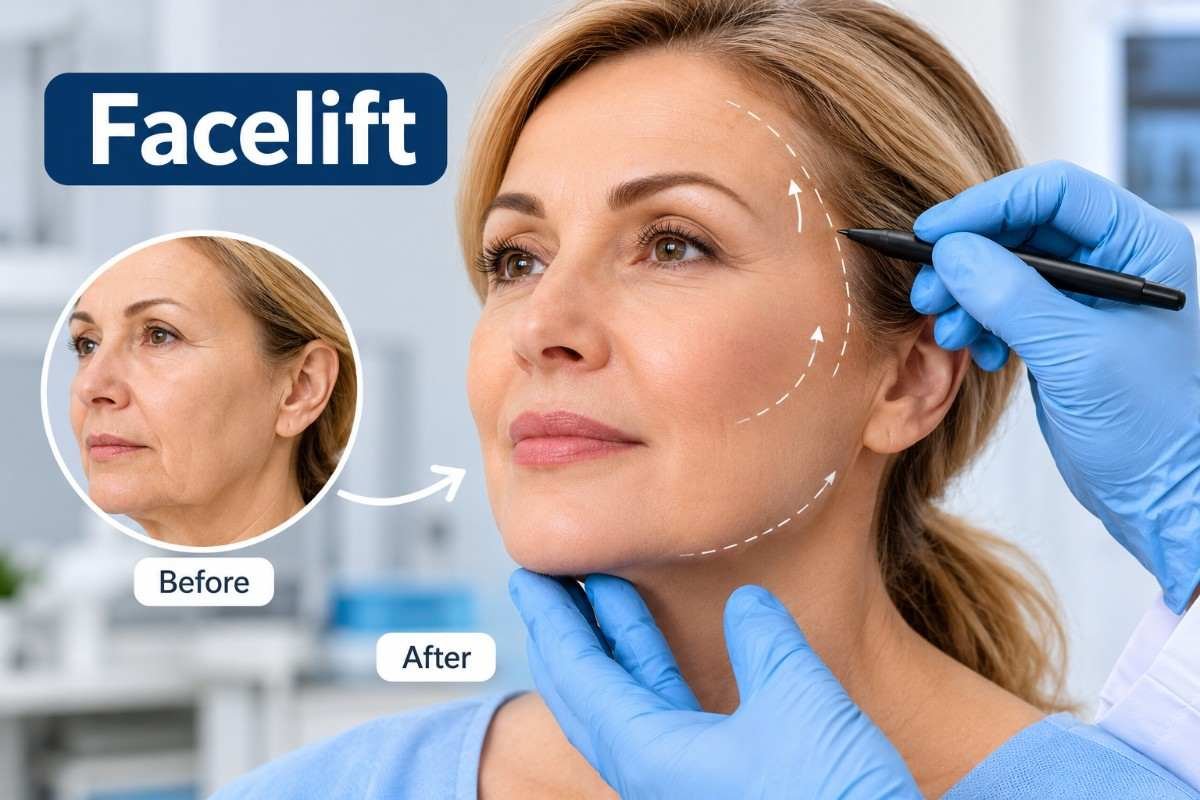
Aging is a natural part of life, but changes in facial appearance can sometimes affect how people feel about themselves. Loose skin, deep wrinkles, sagging cheeks, and jowls are common signs of aging that may become more noticeable over time. While skincare products and non-surgical treatments can improve some visible signs of aging, they cannot always address significant skin laxity.
A facelift, also known as rhytidectomy, is a cosmetic surgical procedure designed to reduce visible signs of facial aging. It works by lifting and repositioning facial tissues, tightening underlying structures, and removing excess skin to create a smoother and more youthful-looking appearance.
In this guide, we explain everything you need to know about facelifts, including what happens before, during, and after surgery.
What Is a Facelift?
A facelift is a cosmetic surgical procedure that improves visible signs of aging in the lower two-thirds of the face and sometimes the neck. It primarily targets sagging skin, loose facial tissues, deep folds, and jowls.
During surgery, a qualified plastic surgeon makes incisions around the ears and sometimes along the hairline. The surgeon then lifts or repositions underlying tissues, removes excess skin, and closes the incisions carefully.
The main purpose is to create a firmer, smoother, and more refreshed facial appearance without making the face look unnaturally tight.
A facelift may help improve:
- Sagging cheeks and facial skin.
- Deep lines between the nose and mouth (nasolabial folds).
- Loose skin around the jawline.
- Jowls along the lower face.
- Loose skin around the neck when combined with a neck lift.
- Loss of definition in the lower facial contour.
Important: A traditional facelift does not significantly improve forehead wrinkles, crow’s feet, or loose skin around the eyelids. These concerns may require different treatments.
Why Do People Get a Facelift?
The face naturally changes as people get older. Skin gradually loses collagen and elastin, which help maintain firmness and elasticity. Fat distribution also changes, and the underlying tissues may become less supportive.
These changes can contribute to:
- Reduced skin elasticity.
- Sagging cheeks.
- Deeper facial folds.
- Loose skin around the jawline.
- Formation of jowls.
- Changes in facial volume.
- A less defined neck and chin area.
Some people choose facelift surgery because they want to address these changes more noticeably than non-surgical treatments can.
A facelift is generally a personal cosmetic choice rather than a medical necessity.
Types of Facelift Procedures
Not every facelift uses the same surgical technique. The most appropriate option depends on facial anatomy, skin condition, aging concerns, and the results a person hopes to achieve.
1. Traditional Facelift
A traditional facelift addresses moderate to significant signs of aging in the middle and lower face. It typically involves incisions around the ears and sometimes into the hairline.
The surgeon repositions underlying tissues, removes excess skin, and improves the appearance of sagging cheeks and jowls.
2. Mini Facelift
A mini facelift is generally less extensive than a traditional facelift. It usually involves smaller incisions and focuses primarily on mild to moderate sagging around the lower face and jawline.
It may be suitable for people with earlier signs of facial aging, depending on their anatomy and expectations.
3. Deep Plane Facelift
A deep plane facelift works beneath the superficial musculoaponeurotic system (SMAS), allowing the surgeon to reposition deeper facial tissues and supporting structures.
It can address more noticeable sagging in the cheeks, midface, and lower face. It is a technically demanding procedure that requires an appropriately trained and experienced surgeon.
4. SMAS Facelift
A SMAS facelift targets the superficial musculoaponeurotic system, a layer of tissue beneath the skin that supports facial structures.
The surgeon lifts or tightens this layer along with the overlying skin to improve facial contours and reduce sagging.
5. Mid-Facelift
A mid-facelift focuses on the central area of the face, particularly the cheeks and tissues around the lower eyelids.
It may help improve cheek sagging and certain facial folds but does not provide the same correction as a full facelift.
6. Lower Facelift
A lower facelift concentrates on the lower third of the face, including the jawline, jowls, and lower cheeks.
It may be considered by people whose main concerns involve sagging around the mouth and jawline.
7. Short-Scar Facelift
A short-scar facelift uses shorter incisions than some traditional facelift techniques. It may be appropriate for selected patients with mild to moderate lower-face aging.
The suitability of this technique depends on the amount of skin laxity and the surgeon’s assessment.
Benefits of a Facelift
A facelift can improve facial contours and reduce several visible signs of aging. However, results vary depending on the surgical technique, individual anatomy, skin quality, and healing process.
Here are some potential benefits:
- Reduces Sagging Skin: A facelift removes excess skin and repositions tissues to improve facial firmness.
- Improves Jawline Definition: It can reduce jowls and create a more defined jawline.
- Softens Deep Facial Folds: Repositioning facial tissues may reduce the appearance of certain deep folds around the mouth and nose.
- Lifts Sagging Cheeks: The procedure can restore a more elevated appearance to drooping cheek tissues.
- Improves Facial Contours: It helps create smoother transitions between the cheeks, jawline, and lower face.
- Reduces Loose Neck Skin: When combined with a neck lift, it can improve loose skin and selected neck contours.
- Creates a Refreshed Appearance: Many patients seek surgery to look less tired or aged.
- Provides Longer-Lasting Results: Surgical improvements generally last longer than temporary injectable treatments, although aging continues.
- Addresses Multiple Aging Concerns: A facelift can target several areas of the lower face during one operation.
- May Improve Self-Confidence: Some people feel more comfortable with their appearance after achieving results that match their expectations.
Remember: A facelift does not stop the aging process or guarantee a particular appearance.
Who Is a Good Candidate for a Facelift?
A facelift may be appropriate for adults who have noticeable facial sagging and want a surgical approach to improve their appearance.
Good candidates generally:
- Have loose skin around the cheeks, jawline, or lower face.
- Have visible jowls or deep facial folds.
- Are in generally good physical health.
- Do not have medical conditions that significantly increase surgical risks.
- Have realistic expectations about the results.
- Understand the recovery process and possible complications.
- Do not smoke or are willing to stop smoking as advised by their surgeon.
There is no single ideal age for facelift surgery. Some people consider it in their 40s or 50s, while others may benefit from it later in life.
The decision should depend on individual facial anatomy and overall health rather than age alone.
Who Should Avoid or Delay Facelift Surgery?
Facelift surgery may not be suitable for everyone. A surgeon may recommend avoiding or postponing the procedure in certain situations.
- People With Uncontrolled Medical Conditions: Uncontrolled diabetes, high blood pressure, or certain heart conditions may increase surgical risks.
- People Who Smoke: Smoking can interfere with blood circulation and wound healing.
- People With Bleeding Disorders: Certain blood-clotting conditions may increase complications.
- People With Unrealistic Expectations: Surgery cannot completely eliminate wrinkles or restore a person’s original youthful appearance.
- People With Active Infections: An active infection may require treatment before elective surgery.
- People Unable to Follow Recovery Instructions: Proper aftercare is important for healing and reducing complications.
A qualified surgeon should review medical history, medications, allergies, and overall health before recommending surgery.
Facelift Procedure: How Is a Facelift Performed?
A facelift is usually performed in a hospital or accredited surgical facility by a qualified plastic surgeon. The procedure may take approximately 2–5 hours, depending on the surgical technique and whether additional procedures are performed.
The process generally involves the following steps.
1. Consultation and Facial Assessment
Before surgery, the surgeon examines your facial structure, skin elasticity, medical history, and areas of concern. You can discuss your expectations and ask questions about possible results.
2. Anesthesia
The procedure is commonly performed under general anesthesia or intravenous sedation with local anesthesia, depending on the surgical plan.
3. Making the Incisions
The surgeon makes incisions, commonly beginning near the temples, continuing around the ears, and sometimes extending into the lower scalp. The incision pattern depends on the facelift technique.
4. Repositioning Facial Tissues
The surgeon lifts and repositions the deeper facial tissues to improve sagging cheeks, jowls, and facial contours. In some cases, excess fat may also be removed or redistributed.
5. Removing Excess Skin
Once the underlying tissues are repositioned, the surgeon gently redrapes the skin and removes the extra skin.
6. Closing the Incisions
The incisions are closed using sutures or other appropriate methods. Dressings may be applied to protect the surgical areas and help manage swelling.
The patient is then monitored during the initial recovery period.
How to Prepare for Facelift Surgery
Preparing properly can help reduce avoidable complications and support a smoother recovery.
Consider these important steps before surgery:
- Choose a Qualified Surgeon: Verify the surgeon’s credentials, specialist training, and experience with facelift procedures.
- Discuss Your Medical History: Inform your surgeon about existing health conditions, allergies, previous surgeries, and medications.
- Review Your Medications: Ask whether blood-thinning medicines, supplements, or other medications need to be adjusted. Never stop prescribed medication without medical advice.
- Stop Smoking: Smoking and nicotine products can interfere with blood circulation and wound healing. Follow your surgeon’s instructions about stopping before and after surgery.
- Avoid Alcohol: Your surgeon may advise avoiding alcohol before surgery and during early recovery.
- Arrange Transportation: Arrange for someone to take you home after surgery.
- Prepare Your Recovery Space: Keep essential items, prescribed medications, comfortable clothing, and extra pillows within easy reach.
- Follow Fasting Instructions: If general anesthesia or sedation is planned, follow the medical team’s instructions about eating and drinking.
Facelift Recovery: What to Expect After Surgery
Recovery is an important part of facelift surgery. Although some improvements may become noticeable within a few weeks, complete healing takes longer.
Most people experience temporary swelling, bruising, tightness, and numbness after the procedure.
Here is a general recovery timeline:
| Recovery Period | What to Expect |
|---|---|
| First 24–48 hours | Swelling, bruising, tightness, and mild discomfort |
| First week | Swelling and bruising continue; follow-up appointments may take place |
| 7–14 days | Stitches may be removed, depending on the technique |
| 2–3 weeks | Many patients feel comfortable returning to light daily activities |
| 4–6 weeks | Most visible bruising and swelling improve |
| 3–6 months | Facial tissues continue settling and scars mature |
| 6–9 months | More complete results may become apparent |
These are general estimates, not guaranteed recovery times. Your recovery may be faster or slower depending on the procedure and individual healing.
Tips for a Smooth Facelift Recovery
- Keep your head elevated while resting, as recommended by your surgeon.
- Take prescribed medications according to instructions.
- Keep surgical incisions clean and follow wound-care guidance.
- Avoid strenuous exercise until your surgeon approves it.
- Do not smoke or use nicotine products during the healing period.
- Avoid unnecessary pressure or rubbing around the surgical areas.
- Attend all scheduled follow-up appointments.
- Contact your surgeon if you notice unusual swelling, increasing pain, or signs of infection.
Seek urgent medical attention for sudden severe swelling, difficulty breathing, chest pain, or other serious symptoms. Rapidly increasing swelling on one side of the face also requires immediate assessment.
Side Effects and Risks of Facelift Surgery
Like other surgical procedures, a facelift can cause temporary side effects. Most improve as the body heals, but some complications may require additional treatment.
Here are 10 possible side effects and complications:
- Swelling: Facial swelling is common during the initial recovery period.
- Bruising: Bruising may appear around the cheeks, jawline, and ears.
- Numbness: Temporary changes in skin sensation can occur near the surgical areas.
- Tightness: Some people experience a tight or stiff feeling in their face.
- Pain and Discomfort: Mild to moderate discomfort may occur after surgery.
- Scarring: Incisions leave scars, although surgeons generally place them in less noticeable areas.
- Infection: Bacterial infection can develop around surgical incisions.
- Hematoma: Blood can collect beneath the skin, sometimes requiring additional treatment or surgery.
- Nerve Injury: Damage to facial nerves can cause temporary or, rarely, permanent weakness.
- Poor Wound Healing: Delayed healing or skin loss can occur, particularly when blood circulation is impaired.
Other possible complications include anesthesia reactions, blood clots, persistent pain, hair loss around incision sites, and unsatisfactory cosmetic results.
How Much Does a Facelift Cost?
The cost of a facelift depends on several factors, including the surgeon’s experience, surgical technique, location, anesthesia, and facility fees.
In the United States, the total cost can range from several thousand dollars to more than $20,000. More complex procedures, including combined face and neck lifts, may cost more.
The overall price may include:
- Surgeon’s professional fee.
- Anesthesia charges.
- Hospital or surgical facility fees.
- Medical tests and consultations.
- Prescription medications.
- Postoperative appointments and aftercare.
- Additional procedures, if required.
A facelift performed purely for cosmetic reasons is generally not covered by health insurance.
It is advisable to request a complete written estimate rather than comparing clinics based only on their advertised starting prices.
How Long Does a Facelift Last?
Facelift results are long-lasting but not permanent. Many people enjoy their results for approximately 7–10 years or longer, although individual outcomes vary.
The results depend on several factors:
- Age at the time of surgery.
- Skin elasticity and quality.
- Genetics and natural aging.
- Sun exposure.
- Smoking habits.
- Weight fluctuations.
- Surgical technique.
A facelift does not stop the natural aging process. Your face will continue to change over time, even after successful surgery.
Facelift vs. Non-Surgical Facelift
Some people prefer non-surgical treatments because they want facial rejuvenation without traditional surgery.
However, non-surgical treatments and surgical facelifts work differently.
| Feature | Surgical Facelift | Non-Surgical Facelift |
|---|---|---|
| Treatment | Surgery | Non-surgical treatments |
| Anesthesia | Usually general anesthesia or sedation | Depends on treatment |
| Main purpose | Addresses significant skin and tissue sagging | Improves selected mild to moderate aging concerns |
| Incisions | Required | Usually not required |
| Recovery | Several weeks | Usually shorter |
| Results | Longer-lasting | Generally temporary |
| Skin removal | Possible | No surgical skin removal |
| Suitable for | Selected people with noticeable sagging | Selected people with earlier signs of aging |
Non-surgical options may include dermal fillers, botulinum toxin injections, radiofrequency treatments, ultrasound-based skin tightening, and thread lifts.
These treatments may improve certain facial concerns, but they cannot reproduce all the effects of surgical tissue repositioning and skin removal.
How to Maintain Facelift Results
Although you cannot stop aging completely, healthy habits may help maintain your results and support overall skin health.
- Use Sunscreen: Apply broad-spectrum SPF 30 or higher to protect your skin from ultraviolet damage.
- Maintain a Healthy Diet: Eat a balanced diet containing fruits, vegetables, protein, and healthy fats.
- Stay Hydrated: Drink enough water throughout the day.
- Avoid Smoking: Smoking can negatively affect skin health and circulation.
- Maintain a Stable Weight: Significant weight changes may affect facial contours.
- Follow a Skincare Routine: Use gentle cleansers, moisturizers, and sunscreen.
- Attend Follow-Up Visits: Keep your surgeon informed about your healing and any concerns.
Important Questions to Ask Your Plastic Surgeon
Before undergoing a facelift, it is important to understand the procedure and the surgeon’s experience.
Consider asking:
- Am I a suitable candidate for facelift surgery?
- Which facelift technique would be appropriate for me?
- What results can I realistically expect?
- Where will the surgical incisions be placed?
- How long will my recovery take?
- What complications should I know about?
- How many facelift procedures have you performed?
- What happens if I am unhappy with the results?
- What is included in the total surgical cost?
- What follow-up care will I receive?
Choose a surgeon who answers your questions clearly, explains the limitations of surgery, and does not pressure you into making a decision.
Is a Facelift Worth It?
A facelift may be worth considering for someone who wants to address significant facial sagging, jowls, and loose skin that cannot be adequately improved with skincare or non-surgical treatments.
However, it involves surgery, recovery time, financial costs, and potential complications.
The best results come from having realistic expectations and choosing a qualified, experienced surgeon. It is equally important to understand that looking younger is a personal choice, not a requirement of aging.
FAQ’s
What is the best age to get a facelift?
There is no perfect age for a facelift. Many people consider it in their 40s, 50s, or 60s, depending on skin laxity, facial aging, and overall health.
How painful is a facelift?
A facelift is performed under anesthesia, so patients do not feel the surgery itself. Some discomfort, tightness, and swelling may occur during recovery.
How many years does a facelift take off?
A facelift can create a younger-looking appearance, but the number of years varies between individuals. Results depend on facial anatomy, skin quality, and surgical technique.
Can a facelift look natural?
Yes. When performed appropriately by an experienced surgeon, a facelift can create a refreshed appearance while maintaining natural facial features.
Does a facelift remove wrinkles?
A facelift can soften certain deep folds and wrinkles caused by sagging tissues. However, it does not remove all fine lines, sun damage, or skin discoloration.
Is a facelift permanent?
No. A facelift provides long-lasting improvements, but the natural aging process continues after surgery.
Can a facelift be done without surgery?
Non-surgical treatments such as fillers, ultrasound, and radiofrequency may improve selected signs of aging. However, they cannot provide the same results as surgical tissue repositioning.
How long does facelift swelling last?
Most noticeable swelling improves over several weeks, although minor swelling and tissue changes can continue for several months.
Will there be visible scars after a facelift?
Yes. Facelift surgery involves incisions and leaves scars. Surgeons generally place them around the ears and hairline to make them less noticeable as they heal.
Can men get a facelift?
Yes. Men can undergo facelift surgery to improve sagging cheeks, jowls, and loose facial skin. Surgical techniques may be adjusted to accommodate male facial anatomy and hairline patterns.
How many years younger can a facelift make you look?
A facelift can create a noticeably refreshed and younger-looking appearance, but the results differ from person to person. There is no guaranteed number of years.
What is the difference between a mini facelift and a full facelift?
A mini facelift generally uses smaller incisions and addresses mild to moderate sagging around the lower face. A full facelift treats more extensive sagging and loose skin.
Is a facelift better than Botox?
A facelift is more effective for significant skin sagging and jowls, while Botox temporarily reduces wrinkles caused by repeated muscle movements. The better option depends on individual concerns.
What is the difference between a facelift and a neck lift?
A facelift primarily improves sagging cheeks, jowls, and lower facial contours. A neck lift focuses on loose neck skin, excess fat, and selected neck muscle concerns.
How long after a facelift can you sleep on your side?
Patients are generally advised to sleep on their backs with their heads elevated during early recovery. Ask your surgeon when it is safe to resume side sleeping.
Does insurance cover facelift surgery?
Health insurance generally does not cover facelifts performed for cosmetic reasons. Coverage may differ if a separate medically necessary procedure is involved.
Can a facelift change your facial shape?
A facelift can improve the appearance of the jawline, cheeks, and lower face by repositioning tissues and removing excess skin. It does not fundamentally change your bone structure.
How soon can you return to work after a facelift?
Many people return to work within 2–3 weeks, depending on swelling, bruising, job responsibilities, and recovery progress. Your surgeon should guide your return to normal activities.
What happens 10 years after a facelift?
Ten years after a facelift, the face continues to age naturally. Some sagging, wrinkles, and skin laxity may return, but many people still retain improvements from their surgery.
What can be done instead of a facelift?
Alternatives include Botox, dermal fillers, radiofrequency skin tightening, ultrasound treatments, laser resurfacing, and thread lifts. The best option depends on skin condition and aging concerns.
Does anyone regret a facelift?
Yes, some people regret facelift surgery because of unrealistic expectations, visible scars, complications, unnatural results, or dissatisfaction with the outcome. Choosing an experienced surgeon can help reduce risks.
Does skin age faster after a facelift?
No. A facelift does not make skin age faster. The natural aging process continues after surgery, just as it would without a facelift.
Sources / References:
- Mayo Clinic
- American Society of Plastic Surgeons
- NHS
- International Society of Aesthetic Plastic Surgery
- MedlinePlus
Disclaimer:
This article is for informational and educational purposes only. It does not replace professional medical advice, diagnosis, or treatment. Consult a qualified plastic surgeon to understand whether facelift surgery is appropriate for you.
Also Read: