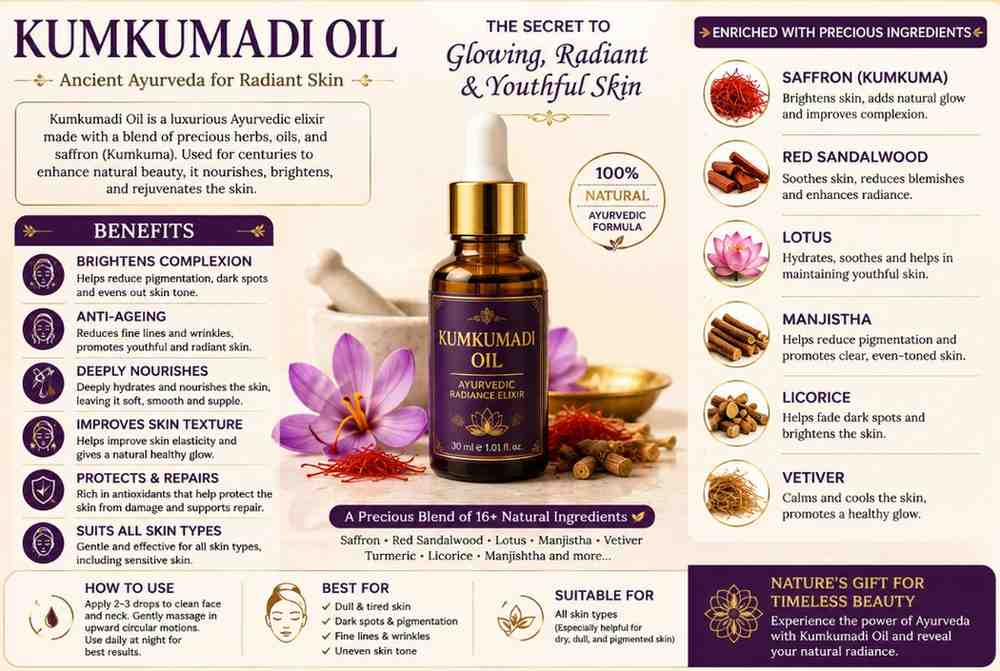
Kumkumadi Oil, also known as Kumkumadi Tailam or Kumkumadi Taila, is a traditional Ayurvedic herbal oil commonly used in skincare. It is particularly popular in India for facial massage and is traditionally associated with improving the appearance of dull, uneven, dry, and tired-looking skin.
The name “Kumkumadi” comes from kumkuma, meaning saffron, one of the traditionally recognized ingredients in the classical preparation. Depending on the Ayurvedic formulation or commercial product, Kumkumadi Oil may contain saffron along with herbs, roots, flowers, and an oil base such as sesame oil.
Today, Kumkumadi Oil is widely marketed as a natural facial oil for concerns such as uneven skin tone, dryness, pigmentation, and loss of radiance. This guide explains what Kumkumadi Oil is, its traditional and potential skincare benefits, how to use it safely, possible side effects, storage, precautions, and more.
What Is Kumkumadi Oil?
Kumkumadi Oil is a traditional Ayurvedic herbal oil preparation used mainly for external application to the skin.
Classical formulations can contain numerous botanical ingredients. Saffron is particularly associated with the formulation, while other versions may include ingredients such as sandalwood, licorice, manjistha, lotus, vetiver, turmeric, and other herbs. The exact ingredients and quantities can vary substantially between classical preparations and modern commercial products. Because formulations differ, there is no single universal ingredient list for every bottle labeled Kumkumadi Oil.
Traditionally, the oil is massaged onto the face and other areas of the skin. It is often used as part of an evening skincare routine because its rich texture can leave the skin feeling soft and moisturized.
Some of the claims surrounding Kumkumadi Oil include brighter-looking skin, improved appearance of uneven pigmentation, smoother skin texture, and a more radiant complexion. These claims are popular in traditional skincare practices, but they should not be confused with proven medical treatments for pigmentation disorders or skin diseases.
Properties of Kumkumadi Oil
| Property | Description |
|---|---|
| Ayurvedic Classification | Traditional Ayurvedic herbal oil preparation primarily used for external skincare |
| Primary Use | Facial and body skincare, particularly for dry, dull, or uneven-looking skin |
| Texture | Rich, smooth, and oil-based |
| Color | Usually golden to reddish-brown, depending on the formulation |
| Aroma | Herbal, aromatic, and sometimes mildly spicy due to its botanical ingredients |
| Base Oil | Traditionally sesame oil is commonly used, although commercial formulations may vary |
| Moisturizing Property | Helps soften and condition the skin by reducing moisture loss |
| Emollient Property | Helps make rough or dry skin feel smoother and more supple |
| Antioxidant Potential | Some botanical ingredients contain naturally occurring antioxidant compounds |
| Soothing Potential | Traditionally used to comfort and condition the skin |
| Skin-Conditioning Property | Helps improve the feel and appearance of dry or rough skin |
| Radiance-Enhancing Use | Traditionally used to promote a brighter and more radiant-looking complexion |
| Complexion-Supporting Property | Traditionally associated with improving the appearance of uneven skin tone |
| Facial Massage Property | Provides lubrication that allows gentle facial massage with less friction |
| Botanical Composition | May contain saffron, sandalwood, licorice, manjistha, turmeric, lotus, and other herbs depending on the formulation |
| Aromatic Property | Many formulations have a characteristic herbal fragrance from their botanical ingredients |
| Traditional Ayurvedic Use | Used as part of traditional beauty and skincare practices |
| Skin Barrier Support | The oil base can help reduce the feeling of dryness and support the skin’s protective outer layer |
| Absorption | Absorption varies depending on the carrier oil, herbal ingredients, and individual skin type |
| Evidence Level | Traditional use is well established, but clinical evidence specifically supporting all claimed benefits of Kumkumadi Oil remains limited |
Note: Properties can differ considerably between products because Kumkumadi Oil does not have one standardized commercial formulation. Individual ingredients may have research supporting certain properties, but this does not automatically prove that the finished Kumkumadi Oil produces the same effects.
20 Proven Benefits of Kumkumadi Oil
1. May Improve the Appearance of Dull Skin: Regular facial massage with a suitable oil may leave dry or dull-looking skin feeling softer and appearing more nourished.
2. May Support Skin Moisture: The oil base can help reduce the feeling of dryness by providing an emollient layer over the skin.
3. May Promote a Healthier-Looking Glow: Traditional use of Kumkumadi Oil focuses strongly on improving the overall radiance and appearance of the complexion.
4. May Improve the Appearance of Uneven Skin Tone: Some botanical ingredients traditionally included in Kumkumadi formulations are used in skincare aimed at improving the appearance of uneven pigmentation.
5. May Make Skin Feel Softer: Applying a small amount of facial oil can help make rough or dry skin feel smoother and more supple.
6. May Support a Smoother Skin Texture: Consistent moisturization can make flaky or dehydrated skin appear smoother.
7. May Help Reduce the Appearance of Dryness: The oil can provide a moisturizing effect that is particularly useful for people whose skin becomes dry or tight.
8. May Complement Facial Massage: Kumkumadi Oil can provide slip during gentle facial massage, reducing the friction that may occur when massaging dry skin.
9. May Give Skin a More Nourished Appearance: The combination of an oil base and botanical ingredients can give the skin a temporarily nourished and conditioned appearance.
10. May Support the Skin Barrier: Keeping the outer layer of skin moisturized is an important part of maintaining a healthy skin barrier.
11. May Be Useful for Dry Facial Areas: Small amounts can be applied to areas that frequently become dry, provided the product does not cause irritation.
12. May Improve the Appearance of Tired-Looking Skin: The moisturizing and massage aspects of a nighttime routine may make the complexion look fresher.
13. May Help With the Feeling of Tight Skin: People with dry skin may find that an appropriate facial oil reduces the uncomfortable sensation of tightness.
14. May Provide Antioxidant Botanical Compounds: Some herbs traditionally used in Kumkumadi preparations contain naturally occurring plant compounds with antioxidant activity, although this does not establish that the finished oil treats skin disease.
15. May Complement a Simple Nighttime Skincare Routine: Using a small amount of facial oil can be a convenient final step after cleansing and moisturizing.
16. May Be Suitable for Facial Massage: Its oily texture allows the fingertips to glide across the skin with less friction.
17. May Enhance the Appearance of Skin Softness: Regular moisturization can make skin feel more comfortable and supple.
18. May Be Helpful for Seasonal Dryness: People experiencing dry skin during colder or drier weather may appreciate the additional emollience of a facial oil.
19. May Support a More Even-Looking Complexion: With consistent skincare and sun protection, moisturizing products can contribute to a healthier overall appearance, although Kumkumadi Oil itself has not been established as a treatment for pigmentation.
20. May Add Botanical Ingredients to a Skincare Routine: For people who enjoy traditional Ayurvedic skincare, Kumkumadi Oil can be incorporated as a cosmetic product when tolerated by the skin.
10 Side Effects of Kumkumadi Oil
1. Skin Irritation: Some people may experience burning, stinging, redness, or discomfort after applying the oil.
2. Allergic Contact Dermatitis: Botanical ingredients or fragrance components can trigger an allergic skin reaction in susceptible individuals.
3. Acne or Breakouts: Rich facial oils may feel heavy or contribute to clogged pores or breakouts in some acne-prone individuals.
4. Increased Greasiness: People with oily skin may find the texture uncomfortable or excessively greasy.
5. Itching: An ingredient that does not agree with your skin may cause localized itching.
6. Redness: Sensitive skin may become temporarily red after application.
7. Burning or Stinging Around the Eyes: Accidental contact with the eyes can cause irritation.
8. Worsening of Existing Skin Irritation: Applying a complex botanical oil to already irritated or damaged skin may make symptoms worse.
9. Fragrance Sensitivity: Some formulations contain strongly aromatic botanical ingredients that may bother people sensitive to fragrance.
10. Product Contamination: Poor-quality, improperly stored, or adulterated products may create additional safety concerns, which is why choosing a reputable manufacturer is important.
The American Academy of Dermatology recommends testing new skincare products before using them extensively because ingredients can cause irritation or allergic contact dermatitis. (American Academy of Dermatology)
How to Use Kumkumadi Oil?
Kumkumadi Oil is generally used externally as a facial oil.
Basic facial application:
- Wash your face with a gentle cleanser.
- Pat the skin dry.
- Place approximately 2–4 drops of oil on clean fingertips.
- Gently spread the oil across the face.
- Massage using light, upward movements without excessive rubbing.
- Avoid the immediate eye area.
- Leave it on if your skin tolerates leave-on products well, or follow the instructions on your particular product.
- During the daytime, finish with a broad-spectrum sunscreen.
If you have sensitive skin, start with a small quantity and use it less frequently rather than immediately applying a large amount every day.
Other Uses of Kumkumadi Oil
Although facial application is the most common modern use, some people use Kumkumadi Oil as part of broader traditional skincare practices.
Possible cosmetic uses include:
- Facial massage
- Dry skin care
- Nighttime facial moisturization
- Dry areas around the face
- Traditional Ayurvedic beauty routines
- Massage of the neck and décolletage
- Conditioning dry areas of the skin
However, the product should be used according to its label. Not every Kumkumadi formulation is appropriate for every body area.
How to Make Kumkumadi Oil at Home?
Traditional Kumkumadi Taila can involve a complex preparation process with multiple herbs and a carefully controlled extraction or cooking process. A simplified homemade version should not be assumed to be equivalent to a classical Ayurvedic preparation.
For a basic cosmetic-inspired herbal oil, some people may infuse selected skin-compatible herbs into a carrier oil. However, this approach has limitations.
Basic home preparation concept:
- Select clean, correctly identified botanical ingredients.
- Use a suitable cosmetic-grade carrier oil.
- Avoid unknown or potentially irritating herbs.
- Prepare the herbal infusion using an appropriate low-temperature method.
- Strain the oil carefully through a clean filter.
- Store it in a clean, dry, airtight container.
- Label the container with the preparation date.
- Discard it if the smell, appearance, or texture changes unexpectedly.
A homemade infusion does not provide the same quality control, concentration, stability testing, microbial testing, or ingredient verification as a professionally manufactured product.
For regular facial use, a reputable commercially manufactured product may therefore be a more predictable option.
How Much Kumkumadi Oil Can You Use Per Day?
For facial skincare, a few drops are generally sufficient.
A practical starting amount is approximately 2–4 drops for the entire face, although the appropriate amount depends on the product, skin type, and formulation.
More oil does not necessarily mean better results. Applying a thick layer can leave the skin greasy and may be uncomfortable for people with oily or acne-prone skin.
If your skin is sensitive, start with one or two drops and observe how your skin responds.
A cosmetic-use routine commonly involves a small quantity applied to clean skin. The manufacturer’s directions should take priority because different products can have different concentrations and ingredient combinations.
For oral use, there is no universal safe dosage for ordinary cosmetic Kumkumadi Oil. Do not drink it unless the exact product is specifically intended for internal use and a qualified professional has advised you on its use.
Best Time to Use Kumkumadi Oil
Many people prefer using Kumkumadi Oil at night because it is an oil-based product and can feel heavy during the day.
A simple nighttime routine can be:
Cleanser → hydrating product/moisturizer if needed → Kumkumadi Oil
If you use several active skincare ingredients, avoid introducing multiple new products simultaneously. This makes it easier to identify the cause if irritation occurs.
During the daytime, sunscreen remains important, especially for people concerned about uneven pigmentation and sun-related skin changes.
Who Should Use Kumkumadi Oil?
Kumkumadi Oil may be considered by adults who want to incorporate a traditional herbal facial oil into their cosmetic skincare routine.
1. People With Dry Skin: Those experiencing facial dryness may appreciate the emollient feel of an oil-based product.
2. People Seeking a Traditional Skincare Routine: Individuals interested in Ayurvedic beauty practices may choose Kumkumadi Oil as a traditional facial oil.
3. People With Dull-Looking Skin: Those wanting to improve the appearance of dry or tired-looking skin may find an oil useful as part of a moisturizing routine.
4. People Who Enjoy Facial Massage: The oil provides lubrication that can make gentle facial massage easier.
5. Adults With Generally Tolerant Skin: People without known sensitivity to the product’s ingredients may be able to incorporate it gradually.
6. People With Seasonal Dryness: An oil may be useful when environmental conditions leave the skin feeling dry or tight.
7. People Looking for an Evening Facial Oil: Those who prefer richer nighttime skincare may find the texture suitable.
Who Should Not Use Kumkumadi Oil?
Not everyone will benefit from a complex botanical facial oil.
1. People With Known Ingredient Allergies: Avoid products containing ingredients to which you already know you are allergic.
2. People With Active Skin Reactions: Do not apply a new herbal oil to severely irritated, broken, or inflamed skin without professional advice.
3. People With Very Acne-Prone Skin: Rich oils may not suit everyone with acne-prone skin and can potentially worsen breakouts.
4. People With Fragrance Sensitivity: Choose carefully if you react to aromatic or fragranced skincare ingredients.
5. People With Unknown Facial Rashes: A rash should be evaluated rather than covered with a new cosmetic product.
6. Children Without Professional Advice: Children’s skin can be more sensitive, so adult facial oils should not automatically be used on children.
7. People Who Are Pregnant or Breastfeeding: Consult a healthcare professional before using complex herbal preparations, particularly if considering oral use.
8. People With Significant Skin Disease: Those with eczema, psoriasis, severe acne, rosacea, or another diagnosed skin condition should discuss new botanical products with a dermatologist.
NCCIH specifically advises people who are pregnant or nursing to consult a healthcare provider about Ayurvedic products because some preparations may contain ingredients that could be harmful. (NCCIH)
How to Store Kumkumadi Oil?
Proper storage can help preserve the quality of the oil.
- Keep the bottle tightly closed.
- Store it away from direct sunlight.
- Keep it away from excessive heat and humidity.
- Avoid storing it in a hot bathroom if possible.
- Use clean, dry hands when handling the product.
- Do not add water or other ingredients directly to the bottle.
- Follow the manufacturer’s expiration date.
- Discontinue use if the oil develops an unusual smell, color, texture, or visible contamination.
Dark or opaque packaging may help protect oil-based products from light exposure, depending on the formulation.
Precautions and Interactions
- Patch Test First: Apply a small amount to a limited area before using the product more broadly. The American Academy of Dermatology recommends testing new skincare products because allergic or irritating reactions can occur.
- Check the Ingredient List: Because formulations vary, read the label rather than assuming every Kumkumadi Oil contains the same herbs.
- Avoid the Eyes: Keep the oil away from the eyes and rinse with clean water if accidental contact causes irritation.
- Do Not Apply to Broken Skin: Avoid applying cosmetic oils to open wounds or significantly damaged skin unless advised by a healthcare professional.
- Be Careful With Sensitive Skin: Botanical ingredients can cause irritation or allergic reactions even when a product is marketed as natural.
- Do Not Mix Too Many Actives: Introducing an herbal oil at the same time as several strong skincare products can make irritation difficult to identify.
- Use Sun Protection: Kumkumadi Oil should not be considered a substitute for sunscreen.
- Do Not Assume Oral Safety: A topical facial oil is not automatically suitable for internal consumption.
- Choose Reputable Products: Quality and composition can vary among Ayurvedic products, so purchase from manufacturers that provide clear labeling and quality information.
- Seek Medical Advice for Persistent Symptoms: If pigmentation, acne, itching, redness, or a rash persists, consult a dermatologist instead of relying solely on cosmetic oils.
- Be Particularly Careful With Ayurvedic Products Taken Internally: NCCIH reports safety concerns involving some Ayurvedic preparations, including potential heavy-metal contamination.
Kumkumadi Oil vs. Modern Skincare
Kumkumadi Oil can be incorporated into a modern skincare routine, but it should complement rather than replace evidence-based skincare.
For example, someone concerned about uneven skin tone may use a gentle cleanser, moisturizer, sunscreen, and dermatologist-recommended treatment where appropriate. Kumkumadi Oil could potentially serve as an optional moisturizing or massage product if the individual’s skin tolerates it.
For persistent pigmentation, acne, melasma, eczema, or other skin conditions, professional diagnosis is more important than choosing a particular facial oil.
FAQ’s
What is Kumkumadi Oil made from?
Kumkumadi Oil is traditionally made from saffron, sesame oil, and a blend of Ayurvedic herbs such as sandalwood, licorice, manjistha, turmeric, lotus, vetiver, and other botanicals. The exact ingredients vary by formulation.
What does Kumkumadi Oil smell like?
Kumkumadi Oil usually has a rich herbal and aromatic smell, often with warm, earthy, slightly spicy, or floral notes depending on the herbs and essential oils used.
What is Kumkumadi Oil good for?
Kumkumadi Oil is traditionally used for facial skincare and may help moisturize dry skin, improve the appearance of dullness and uneven skin tone, soften the skin, and support a healthy-looking glow. Scientific evidence for specific skin-treatment claims remains limited.
What is Kumkumadi Oil used for?
Kumkumadi Oil is traditionally used as a facial oil to moisturize the skin and improve the appearance of dullness, uneven tone, and dryness.
Is Kumkumadi Oil good for the face?
Yes, it is primarily used as a facial oil and may help make the skin feel softer and more moisturized when properly tolerated.
Can I use Kumkumadi Oil every day?
You can use it regularly if your skin tolerates it, but beginners should start with a small amount a few times per week.
Is Kumkumadi Oil good for glowing skin?
Kumkumadi Oil is traditionally used to promote a brighter, more radiant-looking complexion, although strong clinical evidence is limited.
Can Kumkumadi Oil remove dark spots?
It may improve the appearance of uneven skin tone, but there is insufficient evidence that it can remove dark spots completely.
Is Kumkumadi Oil good for pigmentation?
Kumkumadi Oil is traditionally used for uneven pigmentation, but persistent pigmentation should be evaluated by a dermatologist.
Can Kumkumadi Oil reduce acne?
It is not a proven acne treatment, and rich oils may actually cause breakouts in some acne-prone individuals.
Can I leave Kumkumadi Oil on my face overnight?
Yes, some people use it overnight, provided their skin tolerates the product and the label allows leave-on use.
Can Kumkumadi Oil remove scars?
There is no strong evidence that Kumkumadi Oil can remove established scars. Scar treatment depends on the type and severity of the scar.
Is Kumkumadi Oil suitable for dry skin?
Its oil-based texture may help soften and condition dry skin, making it potentially suitable for people who tolerate facial oils.
Is Kumkumadi Oil suitable for oily skin?
People with oily skin can use it cautiously, but a heavy oil may feel uncomfortable or contribute to breakouts in some individuals.
Can I use Kumkumadi Oil on sensitive skin?
Sensitive skin may react to botanical or fragranced ingredients, so perform a patch test before applying it to the face.
Can I apply Kumkumadi Oil under my eyes?
Avoid applying it too close to the eyes because oils and botanical ingredients can cause irritation if they enter the eyes.
Can Kumkumadi Oil brighten dark skin?
It may make the skin look more radiant and moisturized, but it should not be considered a proven skin-lightening treatment.
Can I use Kumkumadi Oil after using vitamin C?
It may be possible to use them in the same routine if your skin tolerates both, but introducing products one at a time can help minimize irritation.
Can I use Kumkumadi Oil with retinol?
You may be able to use an oil alongside retinol, but sensitive skin may benefit from introducing them separately and gradually.
Can Kumkumadi Oil cause pimples?
Yes, it can potentially contribute to pimples or clogged pores in some people, particularly if the formulation is rich or your skin is acne-prone.
Can Kumkumadi Oil reduce wrinkles?
There is insufficient evidence to establish Kumkumadi Oil as an effective wrinkle treatment, although moisturizing can temporarily make fine lines appear less noticeable.
Can I use Kumkumadi Oil on my neck?
A small amount may be applied to the neck if the product is suitable for that area and your skin tolerates it.
Can I use Kumkumadi Oil during pregnancy?
Because formulations vary and may contain multiple botanical ingredients, pregnant women should consult their healthcare professional before using it, especially internally.
Can breastfeeding mothers use Kumkumadi Oil?
For topical use, discuss the specific product with a healthcare professional if you have concerns, particularly if it will be applied near the breast or nipple.
Can children use Kumkumadi Oil?
Children should not automatically use adult herbal facial oils. Consult a pediatrician or dermatologist before applying complex botanical products to a child’s skin.
Can Kumkumadi Oil be used on the body?
Some formulations may be suitable for areas beyond the face, but follow the manufacturer’s instructions because products differ.
How long should I leave Kumkumadi Oil on my face?
The appropriate duration depends on the product. If the label permits leave-on use, it can be left on overnight if your skin tolerates it.
How long does Kumkumadi Oil take to show results?
There is no scientifically established timeframe for specific benefits. Moisturizing effects may be noticed sooner than changes in overall skin appearance.
Can I massage my face with Kumkumadi Oil?
Yes, facial massage is one of the traditional ways to use the oil. Use gentle pressure rather than vigorous rubbing.
Should I wash my face after applying Kumkumadi Oil?
Not necessarily. If the product is designed as a leave-on facial oil, you can leave it on according to the manufacturer’s instructions.
Can I mix Kumkumadi Oil with moisturizer?
Some people may combine a few drops with moisturizer, but applying products separately can make it easier to determine which product your skin tolerates.
Can I use Kumkumadi Oil on lips?
Unless the product specifically states that it is suitable for lips, avoid using facial oil formulations on the lips.
How should I patch-test Kumkumadi Oil?
Apply a small amount to a limited area of skin and observe for signs of irritation or allergy before applying it more widely.
Final Thoughts
Kumkumadi Oil is a traditional Ayurvedic facial oil that continues to attract attention because of its botanical ingredients and long-standing place in Indian skincare traditions. Its oil-based texture may help soften and condition dry skin, while gentle facial massage can make it a pleasant addition to a nighttime routine.
However, it is important to keep expectations realistic. Kumkumadi Oil has not been sufficiently studied in high-quality clinical trials to establish it as a treatment for pigmentation, acne, scars, wrinkles, or other skin diseases.
If you want to try it, choose a reputable product, check the complete ingredient list, perform a patch test, use a small amount, and stop if irritation develops. Most importantly, remember that a cosmetic facial oil should not automatically be consumed orally.
For persistent pigmentation, severe acne, unexplained rashes, or other ongoing skin concerns, professional dermatological advice is more appropriate than relying solely on an herbal oil.
Sources / References:
- National Center for Complementary and Integrative Health (NCCIH) – Ayurvedic Medicine: In Depth
- American Academy of Dermatology – How to Test Skin Care Products
- American Academy of Dermatology – Patch Testing and Allergic Contact Dermatitis
- NCCIH – Safe Use of Complementary Health Products and Practices
- NCCIH – Be an Informed Consumer
About the Author:
Written by: Kirti Solanki (Health Content Researcher)
Kirti Solanki is a health content researcher focused on creating clear, reader-friendly content about wellness, nutrition, traditional health practices, skincare, and everyday health topics. Her work emphasizes accessible explanations, responsible health claims, and the importance of consulting qualified healthcare professionals when medical advice is required.
Disclaimer:
This article is for educational and informational purposes only and does not replace professional medical advice, diagnosis, or treatment. Kumkumadi Oil is primarily discussed here as a topical Ayurvedic skincare product. Always check the ingredients and product instructions, perform a patch test before use, and consult a qualified healthcare professional or dermatologist if you have a skin condition, are pregnant or breastfeeding, or are considering internal use of an Ayurvedic preparation.
Also Read: