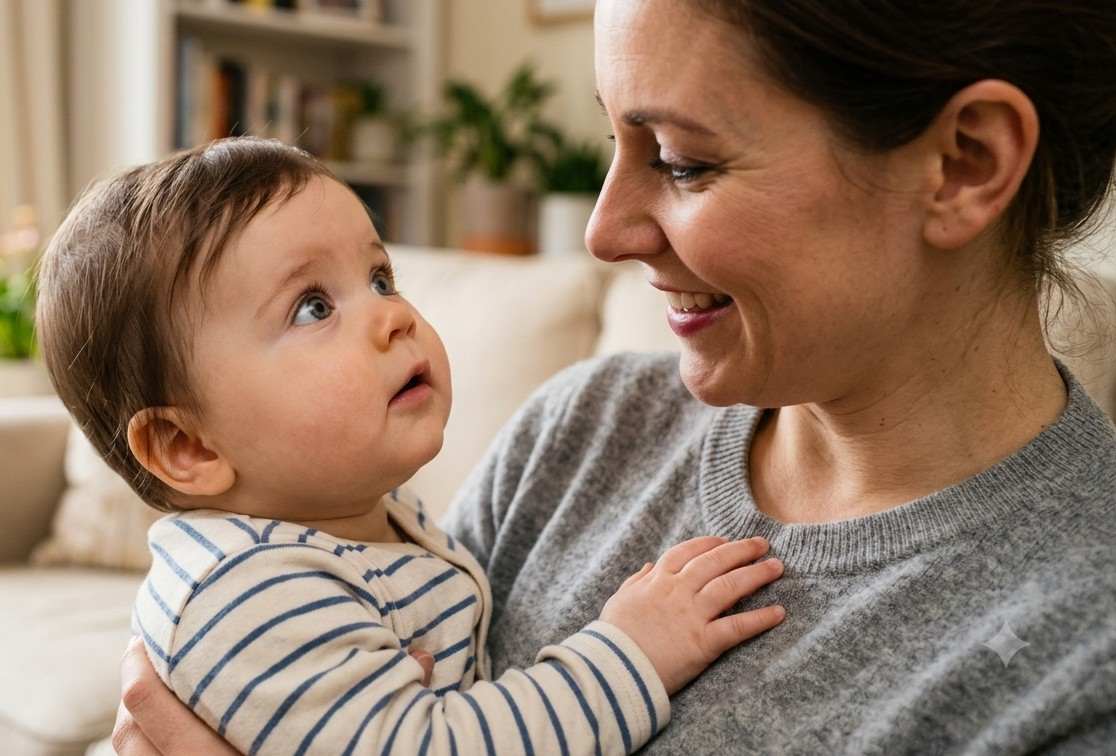
Have you ever noticed a baby staring at you with wide, curious eyes, even when you have never met before? Perhaps you smiled at the baby, but they continued looking at you without smiling back. Sometimes, babies stare at their parents, grandparents, strangers, or even people sitting across the room.
This behavior may seem funny, surprising, or a little awkward, but it is usually a normal part of infant development. Babies are learning about the world around them, and looking at people helps them explore faces, recognize familiar caregivers, and develop early social skills.
So, why do babies stare at people for so long? Let’s explore the common reasons behind this behavior, what it means at different ages, and when parents should discuss it with a pediatrician.
Why Do Babies Stare at People?
When babies stare at people, they are often paying attention to something that interests them. A person’s face, moving mouth, changing expressions, or familiar voice can capture their attention.
During the first year of life, babies develop their vision and learn to respond to the people around them. Young infants gradually become more comfortable making eye contact and responding to familiar caregivers.
Staring alone does not reveal exactly what a baby is thinking or feeling. It is best understood alongside other behaviors, such as smiling, cooing, turning toward voices, and following movement with the eyes.
20 Common Reasons Why Babies Stare at People
1. Babies Are Naturally Interested in Faces
Human faces are especially interesting to babies. From an early age, infants pay attention to facial features, including eyes, mouths, and the overall shape of a face.
A baby’s vision is still developing, so looking closely at a face gives them an opportunity to study its features. They may stare at your eyes, watch your mouth move, or observe how your expression changes when you smile.
For example, a baby may watch your face while you talk, even if they cannot understand your words. This simple interaction helps them become familiar with human expressions and early social communication.
2. They Are Learning to Recognize Familiar People
Babies gradually learn to distinguish familiar caregivers from unfamiliar people. They become accustomed to the faces, voices, smells, and routines of the people who care for them.
If your baby frequently stares at you, they may be paying attention to your familiar face and voice. Over time, babies often respond differently to parents and other regular caregivers than they do to strangers.
By around six months, many babies show clearer recognition of familiar people. However, recognition develops gradually and varies from child to child.
3. They Are Curious About Something New
For a baby, everyday experiences provide countless opportunities to learn. A new face, an unfamiliar hairstyle, a pair of glasses, or an animated expression may be enough to hold their attention.
Babies explore their surroundings largely through their senses. When they encounter something unfamiliar, they may look at it for several seconds as they take in its appearance.
This is why a baby might stare at a visitor, a shopkeeper, or someone sitting nearby. The person does not necessarily have to do anything unusual; simply being new to the baby’s experience can attract attention.
4. They Are Studying Facial Expressions
Babies gradually learn that faces change according to how people feel and interact. A smile looks different from a frown, and a talking mouth moves differently from a relaxed one.
When a baby stares at you, they may be observing these changes. They might watch your face as you smile, raise your eyebrows, speak, or laugh.
As babies grow, they become increasingly interested in social exchanges. They may respond to your smile with their own smile, make sounds when you speak, or move their arms and legs when you approach.
These early interactions help lay the foundation for social and emotional development.
5. They Find Your Voice Interesting
Babies do not rely on vision alone when learning about people. They also pay attention to sounds, especially familiar voices.
When you speak to a baby, they may look directly at your face to connect the sound with the person making it. They may watch your mouth move or turn toward you when they hear your voice.
As their hearing, attention, and communication skills develop, babies often begin responding more actively to conversations. They may coo, babble, smile, or make sounds back when someone talks to them.
Talking gently to your baby and allowing time for them to respond can support these early communication skills.
6. They Are Learning Through Observation
Babies learn by watching what happens around them. They observe how people move, interact, react, and use objects.
For example, a baby might stare at someone who is eating, waving their hands, laughing, or walking across the room. These actions provide visual information that the baby can gradually learn to understand.
As babies grow, their attention often shifts toward more complex activities and interactions. They may watch someone play with a toy or follow a familiar person moving from one side of the room to another.
Although babies do not understand every action they observe, these experiences contribute to their developing attention and learning abilities.
7. They Are Attracted to Movement and Contrast
Babies may stare at people because something about their appearance or movement catches their attention. Moving hands, expressive eyes, contrasting clothing, and changes in lighting can all attract a baby’s gaze.
Newborns have relatively limited visual clarity and see nearby objects more easily than distant ones. During the early weeks, a distance of approximately 8 to 12 inches is often comfortable for viewing a caregiver’s face.
As vision develops, babies become better at focusing on objects, following movement, and distinguishing visual details.
If a baby stares at someone wearing glasses, moving their hands, or wearing a bright outfit, it may simply be because those features stand out in the baby’s visual environment.
8. They Feel Comfortable Around You
A baby may look at a familiar caregiver because that person provides comfort, security, and reassurance.
Babies gradually build relationships through repeated experiences of being held, fed, soothed, and spoken to. Looking at a trusted caregiver can become part of these everyday interactions.
You might notice your baby watching you while you hold them, feed them, or speak softly. They may also relax when you approach or become more animated when they recognize your voice.
However, staring by itself cannot prove that a baby feels safe or attached to a particular person. Their overall behavior and responses provide a more meaningful picture of how they are feeling.
9. They Are Trying to Interact With You
Staring can be one of the early ways babies participate in social interaction. Before they can speak, they communicate through eye contact, facial expressions, body movements, and sounds.
A baby might look at you and then smile, kick their legs, make a cooing sound, or move their arms. These behaviors can be part of an early back-and-forth exchange.
As babies get older, they may look at someone to gain attention or encourage a response. For example, a four-month-old may look at a caregiver, smile, and make sounds when the caregiver responds.
You can encourage these exchanges by smiling, talking gently, copying your baby’s sounds, and giving them time to respond.
10. They Are Simply Taking in Their Surroundings
Sometimes, there is no complicated explanation for a baby’s stare. They may simply be looking at whatever is in front of them.
Babies often spend time quietly observing people and objects as they become familiar with their environment. They may appear especially focused when they are calm, rested, or interested in something they have noticed.
Occasionally, a baby may also seem to stare into space while resting or becoming sleepy. Brief periods of quiet observation are not usually concerning when the baby otherwise responds normally and continues developing as expected.
Nevertheless, a prolonged episode in which a baby becomes unresponsive is different from ordinary staring and should not automatically be dismissed as curiosity.
11. They Are Fascinated by Your Eyes
Babies may pay close attention to people’s eyes because they are an important part of facial expressions and social interaction. They may watch where you look, notice your blinking, or focus on your eyes while you speak. This helps them gradually learn how people communicate without words.
12. They Are Learning to Follow Eye Gaze
As babies develop, they begin noticing where other people are looking. If you look toward a toy, another person, or an object across the room, your baby may watch your face before shifting their attention in the same direction. This skill develops gradually and supports early social learning.
13. They Recognize Your Smell and Voice
Babies use more than their eyes to become familiar with people. They can learn to recognize familiar voices and, particularly in early infancy, familiar smells. When they hear a known voice or notice a familiar scent, they may look toward the person to connect these sensory experiences.
14. They Are Interested in Your Mouth Movements
Babies may stare at your mouth while you talk, sing, or make playful sounds. Watching mouth movements gives them visual information about communication and may help them learn how speech sounds are produced. As they grow, they become increasingly interested in the connection between sounds and facial movements.
15. They Are Experiencing Stranger Anxiety
During the second half of the first year, some babies become more cautious around unfamiliar people. Instead of smiling immediately, they may stare quietly while observing a stranger. This behavior can be part of their developing recognition of familiar caregivers and unfamiliar faces.
16. They Are Trying to Understand Your Emotions
Babies gradually learn to respond to emotional expressions. They may watch your face closely when you sound excited, look surprised, or speak in a soothing voice. Over time, these observations help them become more familiar with different emotional expressions, although they do not interpret emotions in the same way adults do.
17. They Are Responding to Your Facial Expressions
An exaggerated smile, raised eyebrows, or a surprised expression may quickly attract a baby’s attention. Babies often find expressive faces interesting because the changes are visually noticeable. You may see your baby stare more intently when you make a playful face or change your expression during a conversation.
18. They Are Practicing Their Visual Tracking Skills
Babies gradually learn to follow moving faces and objects with their eyes. They may stare at someone walking across the room or turn their head to follow a familiar person. These experiences help develop visual attention and coordination between the eyes and head.
19. They Are Tired or Overstimulated
Sometimes, a baby may appear unusually quiet or fix their gaze when they are tired or have experienced too much stimulation. They might look away from people, become less interactive, yawn, or rub their eyes. These behaviors can signal a need for rest, although staring alone does not establish that a baby is tired.
20. They Are Becoming More Socially Aware
As babies grow, they become increasingly interested in the people around them. They may observe conversations, watch interactions between family members, or look from one person to another. These experiences help them gradually learn about social attention and the back-and-forth nature of communication.
At What Age Do Babies Start Staring at People?
Babies can pay attention to faces from birth, but their ability to focus, recognize people, and interact socially develops over time.
- Newborn to 1 month: Babies can notice nearby faces, light, shapes, and movement, although their vision is blurry.
- Around 2 months: Many babies look at faces, smile when someone talks or smiles at them, and show increasing interest in familiar caregivers.
- Around 3 to 4 months: Babies generally become better at focusing on faces and following moving objects. Social interaction may include smiling, cooing, and responding to voices.
- Around 5 to 6 months: Many babies recognize familiar people more clearly and become increasingly interested in faces, activities, and their surroundings.
- Around 7 to 12 months: Babies often show more distinct preferences for familiar caregivers and may become cautious around unfamiliar people.
These are general developmental patterns rather than strict deadlines. Babies develop at different rates, and a single behavior should not be used to judge overall development.
How Can Parents Respond When a Baby Stares at Them?
If your baby frequently looks at you, you can use those moments to encourage connection and learning.
- Smile naturally: A gentle smile gives your baby an opportunity to observe your expression and may encourage them to smile back.
- Talk to your baby: Speak in a calm, natural voice and describe what you are doing throughout the day.
- Allow time for responses: Pause after speaking so your baby can respond with a look, smile, movement, or sound.
- Play simple interaction games: Try gentle peekaboo, copying facial expressions, or taking turns making sounds when your baby is ready.
- Follow your baby’s attention: If your baby looks toward an object or person, name what they are observing and let them explore visually.
- Respect signs of overstimulation: If your baby turns away, fusses, or becomes unsettled, reduce stimulation and give them a break.
- Keep routine checkups: Discuss vision, eye movements, social interaction, and developmental milestones during regular pediatric visits.
You do not need to make your baby maintain eye contact. Babies naturally look away when they need a break, and forcing prolonged eye contact is unnecessary.
When Should You Be Concerned About a Baby Staring?
Staring at people is usually a normal behavior, especially during infancy. However, the way a baby looks at people should be considered alongside their vision, responsiveness, and overall development.
Consider discussing your concerns with a pediatrician if your baby:
- Rarely looks at faces or does not seem to notice people approaching.
- Does not appear to respond to familiar voices or visual interaction as expected.
- Has persistent difficulty focusing on or following objects with their eyes.
- Has eyes that consistently appear misaligned or show unusual movements beyond the expected early developmental period.
- Loses a previously acquired developmental skill or shows other concerning developmental changes.
A baby who briefly looks away during interaction is not necessarily experiencing a problem. What matters is the overall pattern of behavior and whether the baby is meeting developmental milestones.
Seek prompt medical assessment if staring episodes involve a sudden loss of responsiveness, unusual repetitive movements, or other signs that suggest a seizure. If the baby has difficulty breathing, turns blue, or does not recover normally, seek emergency medical care.
A pediatrician can assess the baby’s history, eye movements, visual responses, and developmental progress to determine whether further evaluation is needed.
FAQ’s
Why do babies stare at people for a long time?
Babies may stare for a long time because they are curious about faces, learning to recognize people, or observing facial expressions and movements.
Why do babies stare at strangers and not smile?
Babies may quietly observe unfamiliar people before responding. Some become cautious around strangers as they develop recognition and social awareness.
Why do babies stare at certain people more than others?
Babies may be drawn to familiar faces, expressive facial movements, interesting voices, or features that catch their attention.
Do babies stare at people they find attractive?
Babies may prefer certain facial features or visual patterns, but their staring does not indicate adult-style physical attraction.
Can babies sense if someone is a good person?
There is no reliable evidence that babies can judge someone’s character simply by looking at them. Their reactions are more likely related to familiarity, expressions, voices, and behavior.
Why does my baby stare at me but not smile?
Your baby may be concentrating on your face, observing your expressions, or simply exploring their surroundings. Babies do not always smile during eye contact.
Why do babies stare at people’s eyes?
Babies may focus on eyes because they are an important part of facial expressions and social communication. Looking at eyes also helps them become familiar with faces.
Why do babies stare at people and then look away?
Babies may shift their attention, become distracted, or need a break from stimulation. Briefly looking away is common during early social interactions.
Is it normal for babies to stare at strangers?
Yes, staring at strangers is generally normal. Babies often observe unfamiliar people out of curiosity or while becoming familiar with new faces and voices.
Why does my baby stare at me when I talk?
Your baby may be watching your facial expressions and mouth movements while listening to your voice. These interactions support early communication and social development.
Should I worry if my baby stares into space?
Brief periods of quiet observation are often normal. However, consult a pediatrician if your baby becomes unresponsive during staring episodes, shows unusual repetitive movements, or has other concerning symptoms. Seek urgent medical care for severe or prolonged episodes involving impaired responsiveness.
Is it normal for a newborn to stare at faces?
Yes. Newborns can notice faces at close range, although their vision is still developing. They generally see most clearly at a distance of about 8 to 12 inches during the early weeks.
Why does my baby stare at the ceiling?
Babies may be watching changes in light, shadows, movement, or other visual details. They may also be resting or becoming sleepy. If these episodes involve unresponsiveness or unusual movements, seek medical advice.
Does staring mean my baby recognizes me?
It may be part of recognition, particularly as your baby becomes familiar with your face and voice. However, staring alone does not confirm recognition; responses such as smiling, calming when you speak, or showing excitement when you approach provide additional clues.
Why do babies stare without blinking?
Babies may stare without blinking for a few seconds because they are concentrating on a face or something interesting. Their blinking patterns differ from those of adults, but prolonged staring with unresponsiveness should be discussed with a pediatrician.
Why do babies stare at people at night?
Babies may stare at people at night because they recognize a familiar face, notice movement, or are quietly observing their surroundings. Dim lighting, tiredness, and nighttime feeding can also influence their attention.
Why do babies stare at their mothers?
Babies often stare at their mothers because they are becoming familiar with their faces, voices, and expressions. Looking at a familiar caregiver also supports bonding, recognition, and early social development.
What is the spiritual meaning of babies staring at you?
Some spiritual beliefs interpret a baby’s stare as a sign of innocence, positive energy, or a special connection. However, these interpretations are based on personal beliefs rather than scientific evidence. Babies usually stare because they are curious and learning about people.
Do babies staring at you mean you’re attractive?
Not necessarily. Babies may pay attention to faces with interesting features, clear contrasts, or expressive movements. Although research suggests that infants can prefer certain facial patterns, staring does not prove that a baby finds someone attractive.
How long before a baby forgets someone?
There is no fixed period after which a baby forgets someone. Memory develops gradually, and younger infants may have difficulty retaining memories of people for long periods. Older babies may remember familiar caregivers for longer, depending on their age, the strength of the relationship, and how frequently they see that person. Familiar voices, faces, and repeated interactions can help maintain recognition.
Conclusion
Babies stare at people for many ordinary reasons, including curiosity, developing vision, facial recognition, and an interest in social interaction. A long, serious gaze is often simply one of the ways a baby explores the people and experiences around them.
Parents can encourage this natural learning process by talking, smiling, playing, and responding to their baby’s cues without forcing eye contact. At the same time, paying attention to developmental milestones and unusual changes in responsiveness can help identify concerns early.
Sources and References
- American Academy of Pediatrics (HealthyChildren.org)
- Centers for Disease Control and Prevention (CDC)
- Nationwide Children’s Hospital
Disclaimer
This article is for educational purposes only and is not a substitute for professional medical advice, diagnosis, or treatment. Consult a qualified pediatrician if you have concerns about your baby’s vision, behavior, or development.
Also Read: