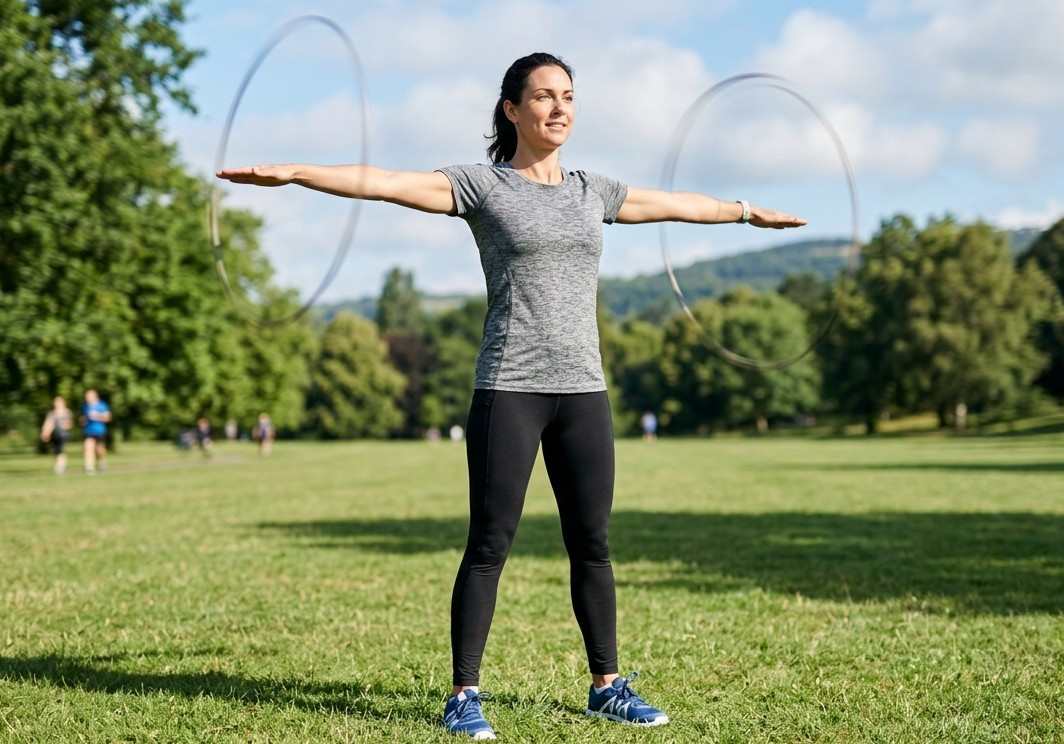
Arm circles are one of the simplest exercises you can add to a warm-up, mobility routine, or low-impact workout. You do not need weights, resistance bands, or a gym. All you need is enough space to move your arms comfortably.
Although arm circles look easy, performing them with control can help move the shoulder joints through a useful range of motion while gently engaging the muscles around the shoulders, upper back, chest, and arms. They are especially popular before workouts because they can help prepare the upper body for movement.
However, arm circles are not a complete strength-training exercise by themselves. They work best as part of a broader fitness routine that includes aerobic activity, resistance training, mobility work, and adequate recovery.
What Are Arm Circles?
Arm circles are a bodyweight exercise in which you extend your arms away from your body and move them in controlled circular motions.
You can perform them with your arms moving:
- Forward
- Backward
- In small circles
- In larger circles
- One arm at a time
- Both arms together
- In alternating directions
The exercise is commonly used as a warm-up because it involves repeated movement at the shoulder joint.
Arm circles can be performed standing or, with appropriate modifications, while seated.
How to Do Arm Circles Correctly?
You do not need to move quickly to get the most from arm circles. Controlled movement is more important than speed.
Step 1: Stand Tall
Stand with your feet about hip-width apart. Keep your spine neutral, chest relaxed, and shoulders away from your ears.
Step 2: Extend Your Arms
Raise both arms out to the sides until they are approximately parallel with the floor.
If raising your arms this high is uncomfortable, use a smaller range of motion.
Step 3: Make Small Circles
Begin making small circles with both arms. Keep the movement smooth rather than jerky.
Step 4: Gradually Increase the Circle
As your shoulders become more comfortable, gradually make the circles larger while maintaining control.
Step 5: Reverse Direction
After several repetitions, reverse the direction of the circles.
Step 6: Relax
Lower your arms slowly and allow your shoulders to relax before repeating or moving to another exercise.
How Many Arm Circles Should You Do?
For a warm-up, you can start with about 10–20 circles in each direction.
Beginners may prefer:
- 10 small forward circles
- 10 small backward circles
- 10 larger forward circles
- 10 larger backward circles
You can adjust the number according to your fitness level and comfort.
There is no need to perform hundreds of repetitions. If your shoulders become painful or unusually fatigued, stop and reassess your technique.
20 Proven Benefits of Arm Circles
- Improves Shoulder Mobility: Arm circles gently move the shoulder joints through a circular range of motion, supporting everyday movement and flexibility.
- Warms Up the Upper Body: They can increase movement and prepare the shoulders, arms, and upper back before exercise.
- Activates Shoulder Muscles: The movement engages the deltoids and other muscles that help stabilize the shoulder.
- Supports Upper-Body Flexibility: Regular controlled movement may help maintain comfortable shoulder and arm mobility.
- Improves Movement Control: Arm circles encourage you to coordinate the shoulders, arms, and upper body smoothly.
- Engages the Upper Back: Muscles around the shoulder blades and upper back contribute to controlled arm movement.
- May Improve Posture Awareness: Performing the exercise with an upright posture helps you become more aware of shoulder positioning.
- Requires No Equipment: Arm circle can be performed anywhere without weights, resistance bands, or gym equipment.
- Beginner-Friendly Exercise: The movement is simple to learn and can be modified by changing the circle size and speed.
- Easy to Add to Warm-Ups: Arm circles can be combined with other dynamic movements before strength training, walking, or sports.
- Supports Low-Impact Exercise: They provide upper-body movement without jumping or high-impact stress.
- Can Improve Shoulder Endurance: Repeated controlled movements can challenge the shoulder muscles’ ability to maintain arm position.
- Easy to Modify: You can perform small, large, forward, backward, alternating, or single-arm circle.
- Convenient for Home Workouts: Arm circles require very little space and can be incorporated into a home exercise routine.
- Supports Functional Movement: Better shoulder mobility can make movements such as reaching, lifting, and dressing more comfortable.
- Can Be Performed Seated: Seated arm circle provide an accessible modification for people who cannot comfortably exercise while standing.
- Encourages Controlled Movement: Slow circles help emphasize coordination and control rather than relying on momentum.
- May Help Reduce Warm-Up Stiffness: Gentle movement can help the shoulders feel less stiff after periods of inactivity.
- Works Both Shoulder Directions: Performing circles forward and backward allows you to practice different movement patterns.
- Complements Strength Training: Arm circles can prepare the shoulders for exercises such as rows, presses, and other upper-body movements.
10 Risks and Side Effects of Arm Circles
Arm circles are generally a low-impact exercise, but incorrect technique, excessive repetitions, or existing shoulder problems may cause discomfort.
- Shoulder Pain: Repeated arm movements may aggravate an already painful or irritated shoulder.
- Muscle Fatigue: Performing too many circles without rest can cause temporary fatigue in the shoulders and upper arms.
- Joint Discomfort: Making circles that are too large or forceful may place unnecessary stress on the shoulder joint.
- Overuse: Excessive daily repetitions may contribute to shoulder irritation, particularly when combined with other repetitive upper-body exercises.
- Poor Movement Control: Swinging the arms quickly or using momentum can increase discomfort and reduce the exercise’s effectiveness.
- Neck Tension: Shrugging the shoulders toward the ears during the movement may create unnecessary tension in the neck and upper shoulders.
- Worsening an Existing Injury: Arm circles may aggravate conditions such as a recent shoulder injury, instability, or inflammation.
- Reduced Range of Motion: People with significant shoulder stiffness may find large arm circle uncomfortable and should begin with a smaller range.
- Discomfort After Surgery: People recovering from shoulder or upper-body surgery should not perform arm circles unless cleared by their healthcare professional.
- Numbness or Tingling: Numbness, tingling, weakness, or unusual sensations during the exercise are reasons to stop and seek appropriate medical advice.
How to Reduce the Risks?
Start with small, slow circles and gradually increase the range of motion. Keep your shoulders relaxed, avoid forcing the movement, and stop if you experience sharp or persistent pain. If you have a shoulder injury or ongoing pain, consult a qualified healthcare professional before adding arm circle to your routine.
What Muscles Do Arm Circles Work?
Arm circles primarily involve the muscles responsible for moving and stabilizing the shoulder and upper limb.
These include:
| Muscle Area | Role During Arm Circles |
|---|---|
| Deltoids | Help move and hold the arms |
| Rotator cuff muscles | Help stabilize the shoulder joint |
| Trapezius | Supports shoulder-blade movement |
| Rhomboids | Assist with shoulder-blade control |
| Pectoral muscles | Contribute to shoulder movement |
| Upper back muscles | Help stabilize the upper body |
| Biceps and triceps | Assist in maintaining arm position |
The exact muscles involved can vary depending on the size and direction of the circles.
Are Arm Circles Good for the Shoulders?
Arm circles can be useful for gentle shoulder movement and mobility when performed within a comfortable range.
However, they should not be treated as a cure for shoulder pain or an injury.
If you experience persistent shoulder pain, weakness, numbness, instability, swelling, or a significant reduction in movement, it is better to seek advice from a qualified healthcare professional rather than repeatedly exercising through the discomfort.
Arm Circles as a Warm-Up
Arm circles are often more useful as part of a warm-up than as a standalone workout.
A simple upper-body warm-up could include:
- Small forward arm circle
- Small backward arm circle
- Larger arm circle
- Shoulder rolls
- Gentle torso rotations
- Light bodyweight movements
A good warm-up should gradually prepare your body for the activity you are about to perform.
For example, if you are preparing for an upper-body strength workout, arm circle can be followed by lighter versions of the exercises you plan to perform.
Arm Circles for Beginners
If you are new to exercise, start with small circles instead of immediately making large movements.
Try this beginner routine:
10 forward circles → rest → 10 backward circles → rest → repeat once
Keep your movements slow and controlled.
If holding your arms straight out to the sides is tiring, lower them slightly or perform one arm at a time.
Seated Arm Circles
People who have difficulty standing can modify arm circle by performing them while seated in a stable chair.
Sit upright with your feet supported. Extend one or both arms as comfortably as possible and make small circles.
The range of motion should remain comfortable. A seated version can be useful when standing exercises are not appropriate for someone’s current abilities.
Small Arm Circles vs. Large Arm Circles
Both variations have a place in a mobility routine.
| Feature | Small Arm Circles | Large Arm Circles |
|---|---|---|
| Range of motion | Smaller | Larger |
| Difficulty | Generally easier | Generally more demanding |
| Shoulder demand | Lower | Higher |
| Beginner-friendly | Yes | Start gradually |
| Best use | Gentle warm-up | Progression or mobility routine |
Larger circles are not automatically better. The appropriate range depends on your mobility, comfort, and exercise goals.
Forward vs. Backward Arm Circles
Forward and backward arm circles change the movement pattern around the shoulder.
You can include both directions in the same routine rather than focusing exclusively on one.
For beginners, start with smaller circles in each direction and gradually increase the range if it feels comfortable.
Variations of Arm Circle
1. Small Arm Circles
Keep the circles compact. This is a good starting point for beginners.
2. Large Arm Circles
Gradually make the circles wider while maintaining control.
3. Alternating Arm Circles
Move one arm forward while the other moves backward, if comfortable.
4. Single-Arm Circles
Perform the exercise with one arm at a time. This can make it easier to concentrate on shoulder movement.
5. Seated Arm Circles
Perform the exercise from a stable seated position.
6. Arm Circles With Light Weights
More advanced exercisers sometimes perform arm circle while holding very light weights. This substantially increases the demand on the shoulders, so it should be approached cautiously.
For many people, bodyweight arm circles are sufficient for a warm-up.
Can Arm Circles Build Muscle?
Arm circles can activate and fatigue the shoulder muscles, particularly when performed for longer periods or against resistance. However, traditional arm circles are generally not enough by themselves to produce substantial muscle growth.
Muscle-strengthening exercise requires sufficient resistance and progressive overload. The CDC recommends muscle-strengthening activities that work the major muscle groups on at least two days per week for adults.
For building stronger shoulders and arms, consider exercises such as:
- Push-ups
- Resistance-band exercises
- Dumbbell presses
- Rows
- Lateral raises
- Overhead presses
Arm circle can complement these exercises but should not replace them.
Can Arm Circles Help With Weight Loss?
Arm circles alone are unlikely to burn enough calories to make a meaningful difference in body weight.
They are better viewed as a mobility or warm-up exercise rather than a primary calorie-burning workout.
For weight management, combine regular physical activity with a balanced eating pattern and adequate recovery. Adults are generally advised to accumulate at least 150 minutes of moderate-intensity aerobic activity each week along with muscle-strengthening activities on at least two days.
Activities such as brisk walking, cycling, swimming, dancing, and other moderate-intensity exercises typically provide a greater cardiovascular stimulus than arm circles alone.
How Many Calories Do Arm Circles Burn?
Arm circles are a low-intensity exercise, so they generally burn fewer calories than activities such as brisk walking, jogging, or cycling. Calorie expenditure varies based on body weight, pace, duration, range of motion, and whether resistance is added.
| Body Weight | 5 Minutes | 10 Minutes | 15 Minutes | 30 Minutes |
|---|---|---|---|---|
| 50 kg (110 lb) | 10–15 kcal | 20–30 kcal | 30–45 kcal | 60–90 kcal |
| 60 kg (132 lb) | 12–18 kcal | 24–36 kcal | 36–54 kcal | 72–108 kcal |
| 70 kg (154 lb) | 14–21 kcal | 28–42 kcal | 42–63 kcal | 84–126 kcal |
| 80 kg (176 lb) | 16–24 kcal | 32–48 kcal | 48–72 kcal | 96–144 kcal |
| 90 kg (198 lb) | 18–27 kcal | 36–54 kcal | 54–81 kcal | 108–162 kcal |
| 100 kg (220 lb) | 20–30 kcal | 40–60 kcal | 60–90 kcal | 120–180 kcal |
Note: These are rough estimates, not exact calorie measurements. Traditional arm circles are usually performed for short periods as a warm-up, so actual calorie expenditure during a typical session will often be relatively small. Using weights or maintaining a higher-intensity movement can increase energy expenditure, but it also increases the demand on the shoulders.
Common Arm Circle Mistakes
1. Moving Too Fast
Fast movements can reduce control and may make the exercise uncomfortable.
2. Making the Circles Too Large
A larger range of motion is not necessarily better. Stay within a comfortable range.
3. Shrugging the Shoulders
Try not to constantly pull your shoulders toward your ears.
4. Locking the Elbows Aggressively
Keep the arms extended without forcing the elbows into a rigid position.
5. Using Momentum
The movement should come from controlled shoulder motion rather than swinging the arms.
6. Exercising Through Pain
Muscle fatigue can be normal, but sharp, severe, or persistent joint pain is a reason to stop.
Are Arm Circles Safe?
Arm circles are generally a simple, low-equipment movement, but they are not appropriate for everyone in every situation.
Use caution if you have:
- A recent shoulder injury
- Significant shoulder pain
- Shoulder instability
- Recent shoulder surgery
- Severe stiffness
- Numbness or tingling in the arm
- An unexplained loss of shoulder strength or movement
People with chronic health conditions or physical limitations should choose activities appropriate for their abilities and may benefit from professional guidance.
When Should You Do Arm Circles?
Arm circle can be performed:
- Before an upper-body workout
- Before resistance training
- During a general warm-up
- During a mobility routine
- During an office movement break
- As part of a low-impact workout
- After prolonged periods of sitting
If you are using arm circle specifically for warming up, perform them before the main activity rather than relying on them as your entire warm-up.
Arm Circles vs. Shoulder Rolls
Arm circle and shoulder rolls are similar in that both involve shoulder movement, but they are different exercises.
Arm circles: The arms move through circular patterns while generally extended away from the body.
Shoulder rolls: The shoulders themselves move in a circular pattern while the arms remain closer to the body.
You can use both in the same warm-up.
How Often Should You Do Arm Circles?
There is no universal requirement for how many days per week you should perform arm circles.
If you are using them as a warm-up, they can be included whenever they are appropriate for your workout.
For a simple mobility routine, a few controlled sets several times per week may be reasonable if the movement remains comfortable.
Remember that arm circle do not replace the broader weekly physical activity recommendations. Adults should combine aerobic activity with muscle-strengthening exercises for overall fitness.
Tips for Better Arm Circles
- Start with small movements.
- Keep your posture upright.
- Move slowly and smoothly.
- Keep your neck relaxed.
- Avoid shrugging your shoulders.
- Breathe normally.
- Gradually increase the range of motion.
- Practice both forward and backward directions.
- Stop if you experience pain.
- Use arm circle as part of a balanced exercise routine.
FAQ’s
What are arm circles good for?
Arm circles are useful for warming up the upper body, promoting shoulder mobility, and activating the muscles around the shoulders and upper back.
Do arm circles reduce arm fat?
Arm circle can strengthen and activate the arm and shoulder muscles, but they cannot specifically target arm fat. Overall fat loss requires regular physical activity and appropriate nutrition.
Should I do arm circles forward or backward?
Both directions can be included. Performing circles forward and backward provides different movement patterns for the shoulders.
Can I do arm circles every day?
Many people can perform gentle arm circle regularly, especially as part of a warm-up, as long as the movement is comfortable and does not cause pain.
Do arm circles burn calories?
Yes, but generally only a small number of calories because arm circle are usually a low-intensity exercise.
Are arm circles good before a workout?
Yes. They can be included in a dynamic warm-up to prepare the shoulders and upper body for exercise.
Can beginners do arm circles?
Yes. Arm circle are beginner-friendly and can be performed with small movements before gradually increasing the range of motion.
Can I do arm circles while sitting?
Yes. Seated arm circles are a useful modification for people who prefer or need to exercise from a chair.
Are arm circles good for stiff shoulders?
Gentle arm circle may help with movement when stiffness is mild, but they should not be forced. Persistent or painful shoulder stiffness should be evaluated by a healthcare professional.
Can arm circles make your arms slimmer?
Arm circle alone cannot specifically make the arms slimmer. They can help keep the shoulder and arm muscles active, while overall fat loss depends on total energy balance and physical activity.
What happens if you do 100 arm circles a day?
Doing 100 arm circles may increase shoulder-muscle endurance and movement practice, but more repetitions are not necessarily better. Technique and comfort are more important than reaching a specific number.
Can arm circles improve posture?
Arm circle may support upper-body movement and shoulder awareness, but they should be combined with strengthening and posture-focused exercises for broader benefits.
Do arm circles strengthen shoulders?
They can provide light muscular endurance work, but progressive resistance exercises are generally more effective for developing shoulder strength.
How long should I do arm circles?
For a warm-up, a few minutes or several sets of controlled circles are usually sufficient. Stop if you develop pain or unusual discomfort.
Can arm circles replace a warm-up?
Arm circle can be one part of a warm-up, but a complete warm-up should gradually prepare the muscles and movements needed for the activity you plan to perform.
Do arm circles really work?
Yes. Arm circle can help improve shoulder mobility, warm up the upper body, and activate the shoulder and upper-back muscles, but they are not a substitute for strength training.
Do arm circles help flabby arms?
Arm circle can strengthen and tone the muscles around the shoulders and arms to some extent, but they cannot specifically burn arm fat. Reducing overall body fat requires regular physical activity, strength training, and a balanced diet.
Are arm circles dynamic stretching?
Yes. Arm circles are generally considered a form of dynamic movement because they take the shoulders through a controlled range of motion without holding a prolonged static stretch. They are commonly used during warm-ups.
Bottom Line
Arm circles are a simple and accessible exercise that can help incorporate controlled shoulder movement into a warm-up or mobility routine. They require no equipment and can be modified for different fitness levels.
They can engage the shoulders and upper-body muscles, improve movement awareness, and help prepare the upper body for exercise. However, arm circle should not be considered a replacement for strength training or cardiovascular exercise.
For the best overall results, combine them with regular aerobic activity, resistance training, mobility work, and adequate recovery. Current physical activity guidance recommends that adults get at least 150 minutes of moderate-intensity aerobic activity each week and perform muscle-strengthening activities on at least two days per week.
Sources / References:
Disclaimer:
This guide is for general educational purposes only and does not replace professional medical advice. If you have an injury, persistent pain, or a medical condition, consult a qualified healthcare professional before starting or modifying an exercise routine.
Also Read: