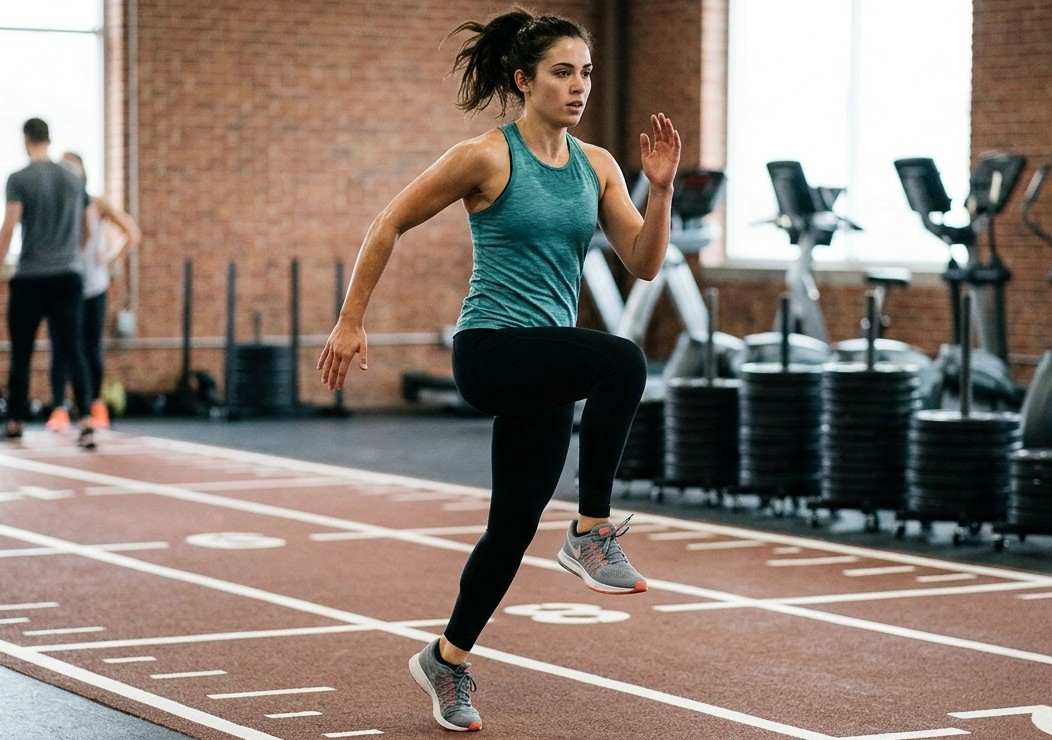
High knees are a simple bodyweight exercise that can quickly raise your heart rate while working several muscles in your legs and core. You can perform them almost anywhere without equipment, making them useful for home workouts, warm-ups, cardio circuits, and short exercise breaks.
The movement looks simple: stand tall and repeatedly lift one knee toward your chest while switching legs. However, your pace, posture, knee height, arm movement, and landing technique all affect how challenging the exercise becomes.
This guide explains what high knees are, how to perform them correctly, their potential benefits, muscles worked, calorie expenditure, variations, common mistakes, and who should use caution.
What Are High Knees?
High knees are a dynamic cardio and bodyweight exercise in which you alternate lifting your knees toward your waist or chest while standing in place.
The movement can be performed slowly as a marching exercise or quickly as a running-in-place movement. At higher speeds, high knees can become a vigorous cardiovascular exercise.
They are often included in:
- Cardio workouts
- HIIT routines
- Warm-ups
- Athletic conditioning
- Home workouts
- Bodyweight circuits
- Sports training
- Fat-loss workout routines
High knees require no special equipment and can be modified according to your fitness level.
How to Do High Knees Correctly?
Good technique is more important than simply moving as fast as possible.
Step 1: Stand Tall
Stand with your feet about hip-width apart. Keep your chest lifted, shoulders relaxed, and abdominal muscles gently engaged.
Step 2: Lift One Knee
Raise your right knee toward your waist while keeping your upper body relatively upright.
Step 3: Switch Legs
Lower the right foot and immediately lift the left knee.
Step 4: Move Your Arms
Swing your arms naturally in opposition to your legs, similar to running.
Step 5: Continue Alternating
Keep switching knees at a controlled pace. As you become more comfortable, gradually increase your speed.
Step 6: Maintain Control
Avoid leaning excessively backward or collapsing your posture. Your goal is controlled, rhythmic movement rather than simply getting your knees as high as possible.
15 Proven Benefits of High Knees
When performed regularly and at an appropriate intensity, high knees can contribute to cardiovascular fitness and overall physical activity.
1. Raises Your Heart Rate
High knees involve continuous movement from multiple muscle groups, which can make your heart beat faster and increase breathing.
2. Supports Cardiovascular Fitness
When performed at moderate or vigorous intensity, high knees can be incorporated into aerobic workouts. Adults are generally advised to get at least 150 minutes of moderate-intensity aerobic activity or 75 minutes of vigorous activity per week.
3. Works the Core
Your abdominal muscles help stabilize your torso while your legs move rapidly.
4. Strengthens the Hip Flexors
Repeatedly lifting the knees requires the hip flexors to work actively.
5. Works the Quadriceps
The muscles at the front of your thighs contribute to lifting and controlling your legs.
6. Engages the Hamstrings
The hamstrings help control the movement of your legs as you alternate between sides.
7. Activates the Calves
Your calves help you push off and control your feet during repeated steps or jumps.
8. Can Improve Coordination
Alternating your arms and legs requires coordination between the upper and lower body.
9. Can Improve Movement Speed
Faster high knees can help develop the ability to move your legs quickly.
10. Supports Calorie Expenditure
Because high knees can be performed at relatively high intensity, they can increase energy expenditure compared with resting or very light activity.
11. Requires No Equipment
You can perform high knees without dumbbells, machines, resistance bands, or a gym.
12. Works Well in Small Spaces
A small clear area is usually enough because you remain in approximately the same location.
13. Can Be Used in HIIT Workouts
High knees can be alternated with recovery periods or other exercises in interval-style workouts.
14. Provides a Convenient Cardio Option
They can be useful when you want a short burst of movement without going outdoors or using exercise equipment.
15. Can Be Modified for Beginners
You do not have to start with fast, explosive movements. A slower high-knee march can help you learn the pattern.
What Muscles Do High Knees Work?
High knees primarily involve the lower body and core.
| Muscle Group | Role During High Knees |
|---|---|
| Hip flexors | Help lift the knees |
| Quadriceps | Help control leg movement |
| Hamstrings | Assist with leg control |
| Glutes | Help stabilize the hips |
| Calves | Assist with pushing off and landing |
| Abdominal muscles | Stabilize the torso |
| Lower back muscles | Help maintain posture |
| Shoulders and arms | Assist with coordinated arm movement |
The exact muscular demand varies depending on whether you perform high knees as a march, run, or jumping movement.
High Knees vs. High-Knee Marching
These exercises look similar but differ in intensity.
| Feature | High Knees | High-Knee March |
|---|---|---|
| Speed | Usually faster | Slower |
| Impact | Moderate to high depending on technique | Low |
| Heart-rate demand | Higher | Lower |
| Difficulty | Moderate to high | Beginner-friendly |
| Equipment | None | None |
| Suitable for beginners | With modification | Yes |
A high-knee march can be a useful starting point if jumping or rapid movements feel uncomfortable.
How Many High Knees Should You Do?
There is no single number that works for everyone.
Beginners can start with 15–30 seconds, followed by a short recovery period. More experienced exercisers may use intervals such as 30–60 seconds.
A simple beginner workout could look like:
| Exercise | Duration |
|---|---|
| Warm-up march | 2 minutes |
| High knees | 20 seconds |
| Rest | 40 seconds |
| High knees | 20 seconds |
| Rest | 40 seconds |
| High knees | 20 seconds |
| Cool-down | 2–5 minutes |
Start conservatively and increase duration or speed gradually.
How Many Calories Do High Knees Burn?
Calories burned during high knees depend on body weight, exercise intensity, duration, and fitness level. The following table provides approximate calorie estimates for continuous high knees at a moderate-to-vigorous pace.
| Body Weight | 5 Minutes | 10 Minutes | 15 Minutes | 20 Minutes | 30 Minutes |
|---|---|---|---|---|---|
| 50 kg (110 lb) | 40–50 | 80–100 | 120–150 | 160–200 | 240–300 |
| 60 kg (132 lb) | 48–60 | 96–120 | 144–180 | 192–240 | 288–360 |
| 70 kg (154 lb) | 56–70 | 112–140 | 168–210 | 224–280 | 336–420 |
| 80 kg (176 lb) | 64–80 | 128–160 | 192–240 | 256–320 | 384–480 |
| 90 kg (198 lb) | 72–90 | 144–180 | 216–270 | 288–360 | 432–540 |
| 100 kg (220 lb) | 80–100 | 160–200 | 240–300 | 320–400 | 480–600 |
Note: These are estimates, not exact calorie counts. Actual calorie expenditure can be lower or higher depending on pace, knee height, rest periods, technique, and individual metabolism.
Can High Knees Help With Weight Loss?
High knees can contribute to calorie expenditure and cardiovascular activity, but doing high knees alone does not guarantee weight loss.
Weight loss generally depends on maintaining an overall energy deficit over time. High knees can be one component of a broader exercise routine that may also include walking, running, cycling, resistance training, or other activities.
Current physical activity recommendations emphasize combining aerobic activity with muscle-strengthening exercise rather than relying on one movement alone.
Variations of High Knees
Different variations allow you to adjust the exercise according to your fitness and goals.
1. Basic High Knees
Alternate lifting each knee while remaining in place.
2. High-Knee March
Perform the same movement slowly without running or jumping.
3. Fast High Knees
Increase the speed while maintaining good posture and control.
4. High Knees With Arm Drive
Use a stronger opposite-arm movement to make the exercise more dynamic.
5. Lateral High Knees
Move slightly from side to side while maintaining the alternating knee action.
6. Low-Impact High Knees
Keep one foot on the floor at all times and use a brisk marching rhythm.
7. High Knees With a Pause
Lift one knee and briefly pause before switching sides. This emphasizes control and balance.
Common High-Knee Mistakes
1. Going Too Fast Too Soon
Speed should come after you have learned the movement. Starting too quickly can make your technique deteriorate.
2. Leaning Back
Excessive backward leaning can reduce control and place unnecessary stress on your lower back.
3. Slouching
Keep your chest open and torso relatively upright.
4. Landing Heavily
If you are performing a bouncing or running version, try to land with control rather than repeatedly pounding the floor.
5. Lifting the Knees Without Control
A high knee is not simply about throwing your leg upward. Control the movement on both the way up and down.
6. Ignoring Pain
Muscle fatigue and increased breathing can be normal during exercise, but sharp or persistent pain is not something to push through.
Are High Knees Safe?
For many healthy adults, high knees can be a useful bodyweight exercise when performed with appropriate technique and intensity.
However, the exercise can become demanding because of its repetitive knee and hip movements and, in faster versions, repeated impact.
People with existing joint problems, injuries, balance difficulties, or certain medical conditions may need a lower-impact alternative. People with chronic health conditions or disabilities to discuss appropriate types and amounts of activity with a healthcare professional when needed.
Risks and Side Effects of High Knees
High knees may cause problems when performed with poor technique, excessive intensity, or insufficient recovery. Potential issues include:
- Knee discomfort
- Ankle discomfort
- Calf or shin soreness
- Hip-flexor soreness
- Muscle fatigue
- Loss of balance
- Increased joint impact during jumping versions
- Overuse discomfort from excessive repetition
Suddenly increasing exercise intensity can increase injury risk, particularly when your body has not adapted to the activity.
Stop exercising and seek appropriate medical advice if you experience significant pain, dizziness, fainting, chest pain, or unusual shortness of breath.
Who Should Avoid or Modify High Knees?
High knees may need modification if you:
- Have an acute knee, ankle, hip, or lower-leg injury
- Experience significant joint pain during impact exercise
- Have difficulty maintaining balance
- Have not exercised for a long time and are starting at a very low fitness level
- Have a medical condition that affects your ability to exercise safely
A low-impact high-knee march may be a better starting point for some people.
If you have a health condition or have been inactive for a long time, the intensity and type of exercise should be appropriate for your individual circumstances.
Tips for Better High Knees
- Warm up before performing fast high knees.
- Start slowly and increase your pace gradually.
- Keep your torso upright.
- Engage your core without holding your breath.
- Land softly during higher-impact versions.
- Keep your movements controlled.
- Wear supportive footwear when exercising on hard surfaces.
- Use a slower variation if your joints become uncomfortable.
- Give your body time to recover between demanding workouts.
- Combine cardio with strength training for a more balanced exercise routine.
Can You Do High Knees Every Day?
You can perform low-intensity high-knee marching regularly if it feels comfortable. However, fast or vigorous high knees do not necessarily need to be performed every day.
Your overall exercise routine should include variety and adequate recovery. Adults are generally encouraged to include both aerobic activity and muscle-strengthening activities each week.
High Knees for Beginners
If you are new to exercise, start with a high-knee march rather than immediately performing rapid high knees.
Try:
- March slowly for 30 seconds.
- Rest for 30–60 seconds.
- Repeat 2–3 times.
- Gradually increase the duration.
- Increase the speed only when you can maintain good form.
This approach allows you to become familiar with the movement before adding more intensity.
High Knees vs. Running
High knees and running both involve repetitive leg movement and can increase heart rate, but they are not identical.
Running involves forward movement and generally requires more space. High knees allow you to stay in one place, making them convenient for indoor workouts.
High knees can therefore be useful when you want a running-like movement without actually traveling across a distance.
High Knees vs. Jumping Jacks
Both exercises can be used for cardio workouts, but their movement patterns differ.
High knees emphasize alternating knee lifting and involve substantial hip-flexor activity. Jumping jacks involve repeated movement of the arms and legs away from and toward the body’s center.
Choosing between them can depend on your goals, coordination, available space, and how your joints respond to the movements.
How to Add High Knees to a Workout?
High knees can be included at different points in a workout.
- As a warm-up: Use a slower high-knee march to gradually increase body temperature.
- As cardio: Perform faster high knees for short intervals.
- In a circuit: Alternate high knees with exercises such as squats, lunges, push-ups, or planks.
- As an active break: Perform a brief low-impact version after sitting for an extended period.
Remember that short periods of activity can still contribute to your overall movement. Current guidance emphasizes that some physical activity is better than none.
Final Thoughts
High knees are a convenient bodyweight exercise that can increase your heart rate while engaging your hip flexors, thighs, calves, glutes, core, and upper body through coordinated arm movement.
Their biggest advantage is simplicity: you need very little space and no equipment. However, faster high knees can be demanding, so proper form and gradual progression matter more than simply trying to move as quickly as possible.
For a well-rounded fitness routine, combine high knees with other aerobic activities and muscle-strengthening exercises rather than relying on them as your only workout.
FAQ’s
What are high knees good for?
High knees can improve cardiovascular fitness, coordination, core stability, leg strength, and calorie expenditure.
Can high knees help lose belly fat?
High knees can increase calorie expenditure, but they cannot specifically target belly fat. Overall fat loss depends on your diet, activity level, and energy balance.
Do high knees burn a lot of calories?
High knees can burn a meaningful amount of calories when performed quickly and at high intensity, but the amount varies based on body weight, duration, and exercise intensity.
Are high knees good for cardio?
Yes. Performing high knees continuously at moderate or vigorous intensity can raise your heart rate and provide a cardiovascular workout.
Are high knees bad for your knees?
High knees are not inherently bad for healthy knees, but fast or high-impact versions may cause discomfort in some people, particularly when performed with poor technique.
Can beginners do high knees?
Yes. Beginners can start with a slow high-knee march and gradually progress to faster high knees.
Are high knees better than running?
Neither is universally better. High knees are convenient for small spaces, while running provides continuous forward movement and can be performed for longer periods.
How long should I do high knees?
A beginner can start with 15–30-second intervals, while more experienced exercisers may perform 30–60-second intervals depending on their workout.
Can high knees strengthen your legs?
Yes. High knees repeatedly engage the thighs, hip flexors, glutes, and calves, although traditional strength exercises are generally better for building maximal muscle strength.
Do high knees strengthen the core?
Yes. Your abdominal and other trunk muscles help stabilize your body while your legs move rapidly.
Can high knees reduce thigh fat?
High knees can help increase overall calorie expenditure, but they cannot specifically reduce fat from the thighs.
Are high knees good for the stomach?
They engage the abdominal muscles and can provide cardiovascular exercise, but they do not specifically burn stomach fat.
Can high knees improve stamina?
Yes. Regularly performing high knees as part of a progressive cardio routine may help improve cardiovascular endurance and exercise tolerance.
How many high knees should I do a day?
Beginners can start with 2–3 sets of 15–30 seconds and gradually increase the duration as their fitness improves. More experienced people may perform 30–60-second intervals, depending on their workout and recovery needs.
Are high knees better than walking?
Neither is universally better. High knees are more intense and can raise your heart rate quickly, while walking is lower impact and easier to perform for longer periods. Both can contribute to cardiovascular fitness and overall physical activity.
Will high knees give you abs?
High knees engage your core muscles, but they will not automatically give you visible abs. A defined abdomen generally requires overall fat loss, adequate nutrition, and a combination of cardio and strength exercises that train the abdominal muscles.
Sources / References:
About the Author:
Written by: Kirti Solanki (Health Content Researcher)
Kirti Solanki creates research-based health and wellness content designed to make fitness and health information clear, practical, and easy to understand.
Disclaimer:
This guide is for general educational purposes only and does not replace professional medical advice. If you have an injury, chronic health condition, or exercise-related symptoms, consult a qualified healthcare professional before starting or changing your workout routine.
Also Read: