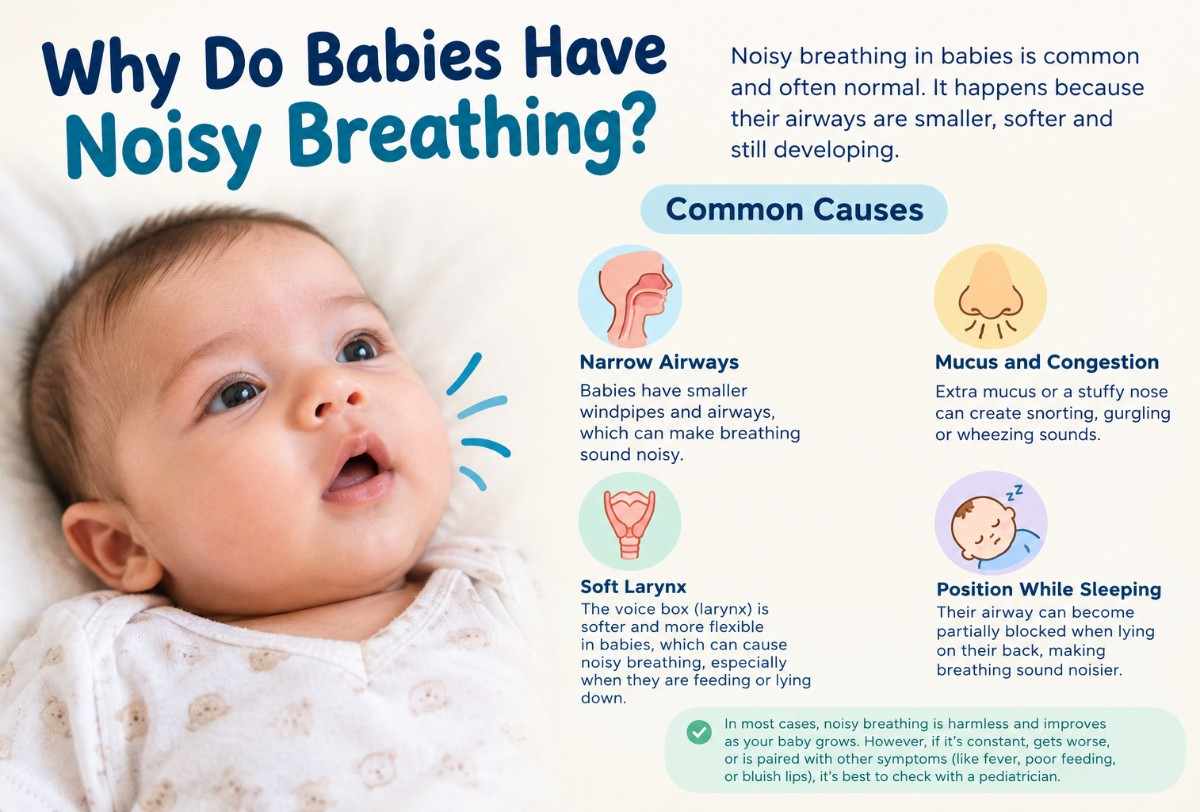
Noisy breathing in babies can be surprising, especially for first-time parents. You might hear your baby making snorting, whistling, rattling, or squeaky sounds while sleeping, feeding, or simply resting. Sometimes, these noises are completely normal. In other cases, they may indicate nasal congestion, irritation, or a breathing problem that needs medical attention.
Babies often make more breathing noises than adults because their nasal passages and airways are small and still developing. Even a small amount of mucus can make their breathing sound louder than expected.
Understanding the different types of breathing sounds can help parents recognize what is normal and when to seek medical care. This guide explains the common causes of noisy breathing in babies, simple ways to help, and warning signs that should never be ignored.
Why Do Babies Have Noisy Breathing?
Babies often have noisy breathing because their airways are narrow, their nasal passages can become blocked easily, and their breathing patterns are still developing. Common causes include normal newborn breathing, mucus buildup, dry air, and temporary nasal congestion.
However, persistent squeaking, harsh breathing sounds, or noises accompanied by difficulty breathing may indicate a condition that needs medical evaluation.
Is Noisy Breathing Normal in Babies?
Yes, noisy breathing can be normal in newborns and young babies, particularly when they are sleeping. Babies primarily breathe through their noses during the first months of life, so even a little mucus can create noticeable sounds.
You may hear your baby:
- Snorting or sniffing while sleeping.
- Making soft grunting sounds occasionally.
- Breathing irregularly, with brief pauses followed by faster breaths.
- Making gurgling noises because of saliva or mucus in the throat.
- Snuffling when the nose is slightly congested.
These sounds are generally less concerning when your baby has normal skin color, feeds comfortably, appears alert when awake, and breathes without visible effort.
Important: Noisy breathing should not automatically be considered normal. The type of sound, your baby’s age, and any accompanying symptoms all matter.
10 Common Causes of Noisy Breathing in Babies
1. Narrow Nasal Passages
Narrow nasal passages are one of the most common reasons babies make noisy breathing sounds. A newborn’s nose is small, so a tiny amount of mucus, dried secretions, or swelling can make airflow noisy.
You may notice snorting, snuffling, or a congested sound, even when your baby does not have a cold. If your baby is otherwise comfortable and feeding normally, the sound may be temporary.
2. Normal Newborn Breathing Patterns
Immature breathing patterns can make a newborn’s breathing seem irregular. Some babies briefly breathe faster, then more slowly, or have short pauses in their breathing.
This can occur during sleep. However, prolonged pauses, pauses associated with a color change, or breathing accompanied by gasping require immediate medical attention.
3. Nasal Congestion
Nasal congestion can develop when mucus builds up during a cold or because of irritation. Since babies cannot blow their noses, even mild congestion may make breathing sound loud or rattly.
Other symptoms may include sneezing, a runny nose, coughing, and difficulty feeding because the baby needs to pause to breathe.
4. Laryngomalacia
Laryngomalacia is a condition in which the soft tissues above a baby’s voice box are more flexible than usual and move into the airway during inhalation. It is a common cause of high-pitched, squeaky breathing in infants.
The noise may become louder during feeding, crying, or lying on the back. Many babies improve as their airways develop, but a pediatrician should evaluate persistent high-pitched breathing, particularly if feeding, weight gain, or breathing is affected.
5. Mucus and Saliva in the Throat
Mucus and saliva buildup can cause gurgling or rattling sounds when a baby breathes. These secretions may collect around the back of the throat and produce noises that seem to come from the chest.
The sound alone cannot tell you whether the problem is harmless. If it persists, worsens, or occurs alongside coughing, choking, or feeding difficulties, contact your baby’s doctor.
6. A Common Cold or Respiratory Infection
Respiratory infections can inflame the lining of the nose and airways, making breathing noisier than usual. A baby may develop a stuffy nose, cough, fever, wheezing, or a change in feeding.
Some infections, including bronchiolitis, can make breathing faster or more difficult. Babies younger than three months need particular attention when they become ill. A temperature of 38°C (100.4°F) or higher in a baby under three months requires urgent medical assessment.
7. Reflux and Feeding Difficulties
Milk reflux or swallowing difficulties may contribute to coughing, choking, gulping, or noisy breathing around feeding time. Small amounts of milk commonly come back up in babies, but repeated choking or breathing problems during feeds should not be dismissed as ordinary reflux.
A healthcare professional can assess whether the baby has reflux, difficulty coordinating swallowing and breathing, or another underlying problem.
8. Wheezing
Wheezing is usually a musical, whistling sound heard when air moves through narrowed lower airways, often during breathing out. In babies, it can occur with viral respiratory infections and other airway conditions.
Wheezing accompanied by rapid breathing, poor feeding, or visible effort to breathe needs prompt medical evaluation. Severe breathing difficulty is an emergency.
9. Croup or Swelling Around the Voice Box
Croup is a viral illness that causes swelling around the voice box and upper airway. It may produce a barking cough, hoarse cry, and a harsh, high-pitched sound when breathing in, called stridor.
Stridor while a baby is resting, especially with chest retractions or difficulty breathing, needs urgent medical assessment. Do not wait for the symptoms to improve on their own if your baby is struggling to breathe.
10. Other Airway Problems
Structural airway conditions can sometimes cause ongoing noisy breathing. These include vocal cord problems, narrowing of the airway, or tracheomalacia, in which part of the windpipe is softer than usual.
Persistent noisy breathing from birth, repeated choking, poor weight gain, or symptoms that become worse over time should be evaluated by a pediatrician. Some conditions are mild, while others require specialist care.
Types of Noisy Breathing in Babies and What They May Mean
The sound your baby makes can offer clues about where the noise originates, although it cannot confirm a diagnosis on its own.
| Breathing sound | What it may sound like | Possible explanation |
|---|---|---|
| Snorting or snuffling | Noisy air moving through the nose | Nasal congestion or narrow nasal passages |
| Gurgling | Wet, bubbly sounds | Saliva or mucus in the throat |
| Snoring | Low-pitched, rumbling noise | Narrowing in the nose or upper throat |
| Stridor | Harsh, high-pitched sound, often when breathing in | Narrowing of the upper airway |
| Wheezing | Musical whistling, often when breathing out | Narrowed lower airways |
| Grunting | Short, repeated sounds with breaths | Possible respiratory distress, especially in a newborn |
These descriptions are general clues, not a substitute for an examination. A baby can have more than one type of breathing sound at the same time.
Why Does My Baby Have Noisy Breathing While Sleeping?
Noisy breathing during sleep is common in babies because their nasal passages and airways are small. Mild congestion, saliva, and the position of the soft tissues in the upper airway can make sounds more noticeable when your baby is quiet.
If the noise is persistent or high-pitched, a condition such as laryngomalacia may be responsible. Parents should pay attention to whether the baby is breathing comfortably, feeding normally, and maintaining normal skin color.
Always place your baby on their back for every sleep, on a firm, flat, non-inclined sleep surface. Do not use pillows, wedges, positioners, or an inclined mattress to try to quiet noisy breathing. If your baby seems unable to breathe comfortably while lying down, seek medical advice rather than changing the sleep position.
How to Help a Baby With Mild Noisy Breathing
If your baby has mild nasal congestion but is breathing comfortably, the following steps may help.
- Use plain saline nasal drops: Infant-appropriate saline drops may help loosen mucus inside the nose.
- Gently clear nasal mucus: If needed, use a baby nasal aspirator gently, following the product instructions. Avoid frequent or forceful suctioning, which can irritate the nasal lining.
- Offer regular feeds: Continue breast milk or formula, as appropriate, and allow breaks if congestion makes feeding difficult. Seek medical advice if your baby cannot feed comfortably.
- Keep the air free of irritants: Avoid cigarette smoke, vaping aerosols, strong fragrances, and other airborne irritants.
- Consider a clean cool-mist humidifier: It may help if the air is dry. Clean it according to the manufacturer’s directions to prevent mold and microbial growth.
- Observe the breathing pattern: Notice whether the noise happens during inhalation, exhalation, feeding, crying, or sleep. A short recording may help the pediatrician assess intermittent sounds, provided recording does not delay urgent care.
Do not give over-the-counter cough and cold medicines to a baby without medical advice. Avoid hot steam treatments because they can cause burns.
When Should You Worry About Noisy Breathing in a Baby?
Noisy breathing deserves immediate attention when it is accompanied by signs that your baby is struggling to get enough air.
Seek emergency medical help immediately if your baby:
- Has blue or gray lips, tongue, or face.
- Is struggling to breathe or has deep pulling-in of the skin between or beneath the ribs.
- Has pauses in breathing, gasps, or stops breathing.
- Makes grunting sounds with each breath or has severe breathing difficulty.
- Develops sudden noisy breathing after choking or a possible allergic reaction.
Arrange prompt medical assessment if your baby:
- Has persistent or new high-pitched breathing sounds.
- Breathes noticeably faster than usual.
- Has repeated wheezing, coughing, or choking during feeds.
- Feeds less than usual or has fewer wet diapers.
- Seems unusually sleepy, weak, or difficult to wake.
- Has a temperature of 38°C (100.4°F) or higher and is younger than three months.
If your baby is showing signs of severe breathing difficulty, do not wait to see whether home remedies help. Call your local emergency number or go to the nearest emergency department. In India, you can call 112.
How Is Noisy Breathing in Babies Diagnosed?
A pediatrician will usually ask when the noise began, whether it happens during inhalation or exhalation, and whether it becomes louder during sleep, feeding, or crying.
The examination may include:
- Listening to the breathing: The doctor assesses the sound and checks whether it comes from the nose, throat, or chest.
- Checking breathing effort: The doctor looks for rapid breathing, chest retractions, and other signs of respiratory distress.
- Assessing feeding and growth: Feeding difficulties and poor weight gain can provide important clues.
- Checking oxygen levels: A pulse oximeter may be used when clinically indicated.
- Ordering additional tests if needed: Persistent stridor or suspected structural airway problems may require examination by a pediatric ear, nose, and throat specialist.
Not every baby needs testing. The appropriate evaluation depends on the symptoms, examination findings, and medical history.
FAQ’s
Why does my baby sound congested but have no mucus?
A baby’s narrow nasal passages can make even small amounts of mucus or mild swelling sound like congestion.
Why does my baby make a squeaking noise when breathing?
A high-pitched squeaking sound may be stridor, sometimes caused by laryngomalacia. Persistent or worsening sounds should be evaluated by a pediatrician.
Why does my baby grunt while breathing?
Occasional sounds may occur during normal newborn activity, but grunting with every breath can indicate breathing distress and requires urgent medical assessment.
Can nasal congestion cause noisy breathing in babies?
Yes, nasal congestion can make breathing sound snuffly, rattly, or blocked because babies have small nasal passages.
Why is my baby’s breathing noisy after feeding?
Mucus, saliva, reflux, or swallowing difficulties may contribute to noisy breathing after feeding. Repeated choking or coughing during feeds should be assessed by a doctor.
How can I help my baby breathe more quietly?
For mild congestion, plain saline drops and gentle nasal suction may help. Keep your baby’s sleep surface firm, flat, and level, and always place your baby on their back.
When will babies outgrow noisy breathing?
It depends on the cause. Mild congestion may resolve within days, while conditions such as laryngomalacia often improve as the airway develops. Persistent symptoms should be checked by a pediatrician.
Can a stuffy nose make it hard for a baby to sleep?
Yes. Nasal congestion can make breathing uncomfortable and disrupt sleep. Plain saline drops and gentle nasal suction may help mild congestion, but breathing difficulty should never be treated as simple nasal blockage without medical evaluation.
How to Treat Noisy Breathing in Babies?
Noisy breathing caused by mild nasal congestion may improve with plain saline drops and gentle nasal suction. Persistent or worsening noises should be assessed by a pediatrician.
What Does Unhealthy Breathing Sound Like?
Unhealthy breathing may sound like persistent grunting, harsh high-pitched noises when breathing in, or wheezing. These sounds are especially concerning when accompanied by visible breathing difficulty.
What Are Three Possible Signs of Difficulty Breathing?
Three possible signs are rapid breathing, pulling in of the skin around the ribs, and flaring nostrils. Seek emergency help if your baby is struggling to breathe.
What Are Some Signs That My Baby Is Breathing Abnormally?
Signs include unusually fast or labored breathing, persistent wheezing or stridor, repeated pauses in breathing, blue or gray lips, and difficulty feeding because of breathlessness.
What Are Some Home Remedies for Breathing Problems at Night?
For mild nasal congestion, try plain saline drops, gentle nasal suction, and a clean cool-mist humidifier. Always place your baby on their back on a firm, flat sleep surface. Do not rely on home remedies if your baby has difficulty breathing; seek urgent medical care.
Final Thoughts
Noisy breathing in babies can result from normal newborn breathing patterns, narrow nasal passages, mucus, or conditions affecting the upper or lower airway. Many causes are manageable, but the sound alone cannot determine whether your baby is healthy.
Pay attention to changes in breathing, feeding, skin color, and alertness. If the noise persists or concerns you, contact your pediatrician. If your baby struggles to breathe, seek emergency help immediately.
Sources and References:
- American Academy of Pediatrics
- Centers for Disease Control and Prevention
- NHS
- Nationwide Children’s Hospital
Disclaimer:
This article is for informational purposes only and does not replace professional medical advice, diagnosis, or treatment. Seek medical attention promptly if your baby has concerning breathing symptoms.
About the Author: Written by Kirti Solanki (Health Content Researcher):
Kirti Solanki creates health and wellness content focused on making medical information easier for readers to understand. This article is intended for general education and is not a substitute for an individual medical assessment.
Also Read: