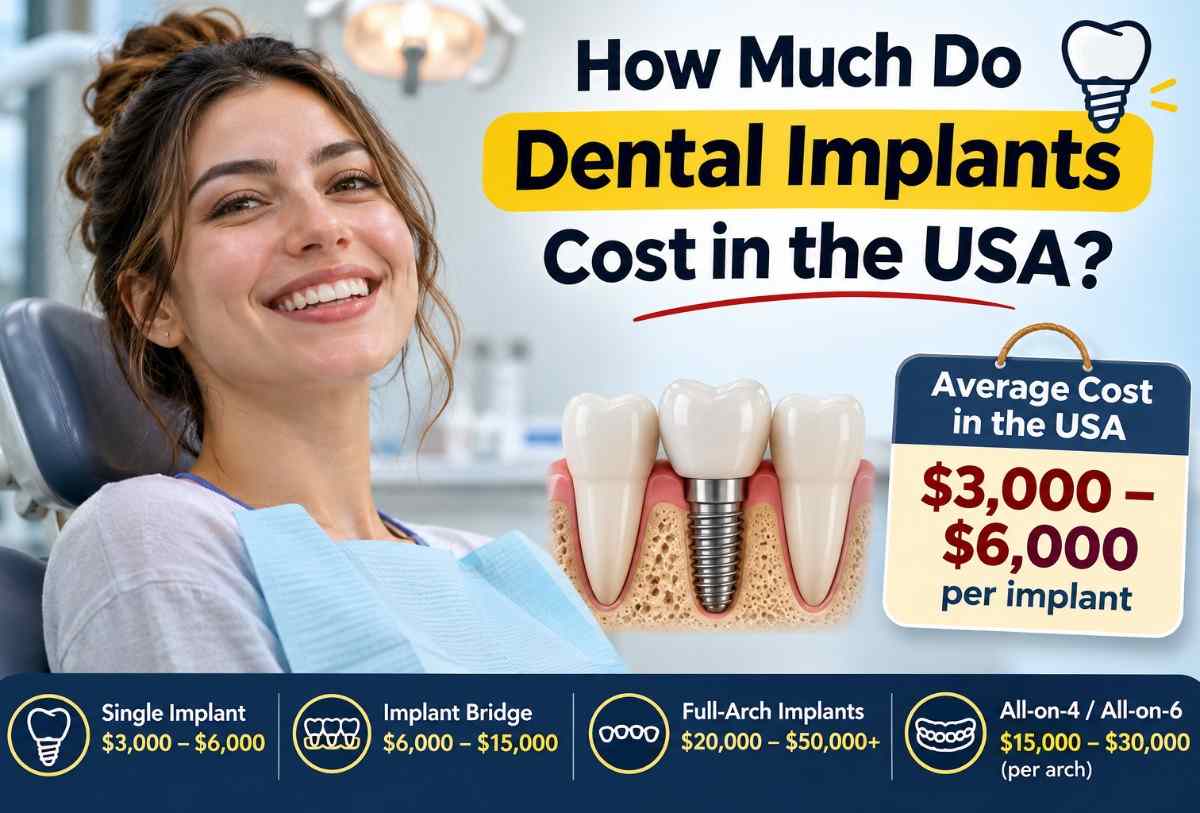
Dental implants are one of the most effective ways to replace missing teeth, restore your smile, and improve chewing ability. However, the cost can be a major concern for people considering this treatment. Unlike traditional dentures or dental bridges, implants involve a surgical procedure and several components, which can make the overall treatment expensive.
So, how much do dental implants cost in the USA?
In 2026, a single dental implant typically costs around $2,800 to $5,600, including the implant, abutment, and crown. However, some complex treatments can cost more. Full-mouth dental implants may range from approximately $20,000 to $90,000 or more, depending on the treatment method, number of implants, dental condition, and location.
Understanding the different costs can help you plan your dental treatment and avoid unexpected expenses. Here is everything you need to know about dental implant prices in the United States.
What Are Dental Implants?
Dental implants are artificial tooth roots that are surgically placed into the jawbone to replace missing teeth. They usually consist of three main components:
- Implant Post: A small titanium or ceramic screw placed inside the jawbone to act as an artificial tooth root.
- Abutment: A connector that attaches the implant post to the replacement tooth.
- Dental Crown: A custom-made artificial tooth placed on top of the abutment to restore the appearance and function of a natural tooth.
Dental implants can replace one missing tooth, several missing teeth, or an entire set of teeth. They are designed to provide a stable foundation for replacement teeth and can last for many years with proper care.
How Much Do Dental Implants Cost in the USA in 2026?
The average cost of dental implants in the USA depends on the number of teeth being replaced and the complexity of the procedure.
Here are estimated national price ranges for common dental implant treatments:
| Type of Dental Implant | Estimated Cost |
|---|---|
| Single tooth implant | $2,800–$5,600 |
| Multiple dental implants | $6,000–$15,000+ |
| Implant-supported bridge | $4,000–$16,000 |
| Implant-retained dentures | $2,000–$13,300 per arch |
| All-on-4 dental implants | $11,600–$35,000 per arch |
| All-on-6 dental implants | $24,000–$38,000 per arch |
| Full-mouth dental implants | $38,600–$90,000+ |
Note: These are approximate price ranges, not guaranteed treatment quotes. Some advertised prices cover only the implant post or surgical placement, while others include the abutment, crown, and additional services. Always request a complete treatment estimate.
How Much Does a Single Dental Implant Cost?
A single dental implant generally costs around $2,800 to $5,600 in the United States when the complete replacement tooth is included.
The final price depends on the dentist’s fees, implant material, crown type, location, and whether additional procedures are required.
For example, replacing a missing front tooth may involve a customized crown designed to match the surrounding teeth. A back tooth may require a different crown material because it experiences greater chewing pressure.
The total price may also increase if you need a tooth extraction, bone graft, or other preparatory treatment.
How Much Do Full-Mouth Dental Implants Cost?
Full-mouth dental implants are designed for people who have lost most or all of their natural teeth.
Depending on the technique, materials, and number of implants, full-mouth treatment can cost approximately $38,600 to $90,000 or more in the USA.
Some patients may qualify for implant-supported dentures, while others may need fixed full-arch restorations.
The most common treatment options include:
1. All-on-4 Dental Implants
All-on-4 is a treatment approach that uses four strategically positioned dental implants to support a full arch of replacement teeth.
The estimated cost is approximately $11,600 to $35,000 per arch.
It may be suitable for patients who need to replace most or all teeth in the upper or lower jaw. However, not everyone is a suitable candidate.
2. All-on-6 Dental Implants
All-on-6 uses six dental implants to support a full arch of replacement teeth.
The estimated cost is approximately $24,000 to $38,000 per arch.
The additional implants may provide greater support in certain cases, depending on bone quality and the patient’s dental condition.
3. Implant-Supported Dentures
Implant-supported dentures use dental implants to hold dentures in place. Depending on the design, they may be removable or fixed.
The estimated cost can range from $2,000 to $13,300 per arch.
This option may be less expensive than some fixed full-arch restorations, but the final price depends on the number of implants, attachment system, and type of denture.
What Factors Affect the Cost of Dental Implants?
Dental implant prices are not the same for everyone. Two patients receiving implants in the same city may receive very different treatment estimates.
Several factors influence the total cost.
1. Number of Missing Teeth
The number of teeth being replaced is one of the biggest cost factors. A single implant generally costs less than replacing multiple teeth or an entire arch.
2. Dentist’s Experience and Qualifications
The experience and qualifications of the dental professional can influence treatment fees. Complex procedures may require an oral and maxillofacial surgeon, periodontist, or prosthodontist.
3. Location of the Dental Clinic
Dental implant treatment may cost more in areas with higher living expenses and operating costs. Prices can differ between major metropolitan areas and smaller cities.
4. Type of Implant Material
Titanium is commonly used for dental implants because of its established clinical use and compatibility with bone. Zirconia implants are another option and may have different pricing.
5. Bone Density and Jaw Health
Patients with insufficient jawbone may need additional procedures before implant placement. Bone grafting or a sinus lift can increase the overall treatment cost.
6. Type of Dental Crown
The crown is the visible replacement tooth. Its cost depends on the material, design, laboratory work, and customization required.
7. Additional Dental Procedures
Tooth extractions, gum treatment, bone grafting, imaging, and sedation can increase the total expense.
Additional Costs Associated With Dental Implants
One important thing to understand is that the advertised implant price may not include every part of the treatment.
Here are some additional expenses you may encounter:
| Additional Procedure | Estimated Cost |
|---|---|
| Initial dental examination and X-rays | $200–$450 |
| Tooth extraction | $75–$650+ |
| Bone grafting | $600–$3,500+ |
| Sinus lift | $1,500–$4,500 |
| Sedation or anesthesia | $50–$200+ |
| Temporary dental crown | Varies by provider |
These are broad planning estimates, and actual fees depend on the procedure and dental practice.
Before starting treatment, ask your dentist whether the estimate includes consultations, imaging, surgery, temporary teeth, the final crown, and follow-up appointments.
Dental Implant Cost by State in the USA
Dental implant prices vary across the United States depending on location, dental clinic fees, cost of living, and the dentist’s experience.
According to 2026 state-level price estimates published by 97 Smiles, the average cost of a complete single dental implant is approximately $4,507 nationally. California has the highest reported average, while Alabama has the lowest.
Here is a comparison of selected states:
| State | Average Single Implant Cost |
|---|---|
| Alabama | $3,759 |
| Arkansas | $3,833 |
| Kentucky | $3,948 |
| West Virginia | $3,969 |
| Iowa | $3,990 |
| Texas | $4,410 |
| Arizona | $4,490 |
| Florida | $4,515 |
| Colorado | $4,538 |
| Oregon | $4,725 |
| Washington | $4,935 |
| New Jersey | $5,040 |
| Massachusetts | $5,145 |
| Hawaii | $5,460 |
| New York | $5,565 |
| California | $5,733 |
Note: These are reported state-level average estimates, not guaranteed dental clinic prices. Your actual cost may differ based on the procedure, dentist, materials, insurance, and additional treatment requirements.
According to these estimates, Alabama is among the most affordable states for dental implants, while California is among the most expensive.
Dental Implant Cost With and Without Insurance
The biggest difference between getting dental implants with and without insurance is how much you pay out of pocket.
Without insurance, you generally pay the full treatment cost. With insurance, your plan may cover eligible portions of the procedure, reducing your personal expenses.
| Cost Factor | With Insurance | Without Insurance |
|---|---|---|
| Implant coverage | Depends on the policy | No insurance benefits |
| Implant procedure | May be partially covered | Usually self-paid |
| Dental crown | May be covered | Self-paid |
| Bone grafting | Coverage varies | Self-paid |
| Annual benefit limit | Usually applies | Not applicable |
| Out-of-pocket expenses | Potentially lower | Generally higher |
Example: How Much Can You Save With Dental Insurance?
Suppose your complete dental implant treatment costs $4,500.
If your dental insurance covers eligible treatment expenses but has a maximum annual benefit of $1,500, your estimated payment could look like this:
| Description | Amount |
|---|---|
| Total dental implant cost | $4,500 |
| Maximum insurance benefit available | $1,500 |
| Your estimated out-of-pocket cost | $3,000 |
This is an illustrative example, not a guaranteed insurance payment. Actual benefits depend on covered procedures, deductibles, coinsurance, annual limits, and any benefits already used during the year.
Important: Always confirm your coverage before beginning treatment. Ask your insurance provider for a written explanation of benefits and your dentist for a complete treatment estimate.
Does Dental Insurance Cover Dental Implants?
Dental insurance may cover some dental implant expenses, but coverage varies significantly between insurance companies and individual plans.
Some plans cover certain parts of the procedure, such as the crown, while excluding the implant post or surgical placement.
Before scheduling treatment, check the following:
- Whether your insurance plan specifically covers dental implants.
- Whether there is a waiting period for major dental procedures.
- How much the insurance company will pay annually.
- Whether your dentist is an in-network provider.
- Whether bone grafting and tooth extraction are covered.
- Whether there are exclusions for missing teeth before enrollment.
Some dental insurance plans have annual benefit limits, which means you may still need to pay a significant portion of the treatment cost yourself.
Does Medicare Cover Dental Implants?
Original Medicare generally does not cover routine dental services, including most dental implants, dentures, and other dental treatments.
However, certain dental services may be covered when they are directly connected to specific Medicare-covered medical treatments or hospital procedures.
Some Medicare Advantage plans offer additional dental benefits, but implant coverage and annual limits vary by plan.
If you have Medicare, contact your insurance provider before beginning treatment to confirm your benefits.
How to Save Money on Dental Implants in the USA
Dental implants can be expensive, but there are several ways to make treatment more affordable without compromising your dental health.
1. Compare Multiple Dental Clinics
Get written treatment estimates from at least two or three qualified dental professionals. Compare the complete treatment plans rather than choosing a clinic based only on its advertised implant price.
2. Check Your Dental Insurance
Review your insurance policy to see whether it covers the implant, crown, extraction, or other related procedures.
3. Consider Dental Schools
Some accredited dental schools offer treatment at reduced prices through supervised student clinics. Treatment may take longer, but it can be an option for people looking to reduce expenses.
4. Ask About Payment Plans
Many dental clinics offer financing options or installment payment plans. Ask about interest rates, repayment periods, and additional fees before signing an agreement.
5. Explore Dental Discount Plans
Certain dental discount programs provide reduced fees at participating dental clinics. These are not traditional insurance policies, so check the participating providers and actual savings.
6. Avoid Choosing Only the Cheapest Option
An unusually low price may exclude important services or additional procedures. Always verify the dentist’s qualifications, implant materials, treatment plan, and total cost.
Are Dental Implants Worth the Cost?
Dental implants can be a worthwhile investment for people who want a stable, long-term replacement for missing teeth.
Unlike removable dentures, implants are anchored in the jawbone. They can help restore chewing function, improve speech, and provide a natural-looking appearance.
Some potential advantages include:
- Natural Appearance: Dental crowns are customized to resemble natural teeth.
- Improved Chewing: Implants provide a stable foundation for replacement teeth.
- Jawbone Support: Implants stimulate the surrounding jawbone through functional loading and can help reduce bone loss associated with missing teeth.
- No Support From Neighboring Teeth: A single implant does not usually require reshaping adjacent healthy teeth, unlike a traditional tooth-supported bridge.
- Long-Term Use: Dental implants can last for many years with proper oral hygiene and regular dental visits.
However, implants are not suitable for everyone. They require surgery, healing time, ongoing maintenance, and a sufficient foundation of healthy bone and gum tissue.
Your dentist can help determine whether implants are appropriate for your dental condition and budget.
Dental Implants vs. Dentures vs. Dental Bridges: Which Is More Affordable?
If you have missing teeth, dental implants are not your only option. Dentures and dental bridges may provide more affordable alternatives.
| Feature | Dental Implants | Dental Bridges | Dentures |
|---|---|---|---|
| Average initial cost | Higher | Moderate | Lower |
| Surgical procedure | Usually required | Usually not required | Usually not required |
| Removable | Usually fixed | Fixed | Usually removable |
| Jawbone support | Helps maintain bone through loading | Does not replace the tooth root | Does not provide implant-like bone stimulation |
| Maintenance | Daily cleaning and dental checkups | Daily cleaning and dental checkups | Regular cleaning and adjustments |
| Longevity | Can last many years | May need replacement | May need replacement or adjustment |
The most affordable option depends on your dental condition, treatment needs, and long-term budget. Discuss the advantages and disadvantages of each option with your dentist before making a decision.
How Long Do Dental Implants Last?
Dental implants can last 15–25 years or longer with proper oral hygiene and regular dental checkups. The crown may need replacement sooner.
However, the implant post and the visible crown do not necessarily have the same lifespan. The crown may need replacement due to normal wear, damage, or changes in your bite.
You can help maintain your dental implants by:
- Brushing twice daily with a soft-bristled toothbrush.
- Cleaning between your teeth and around the implant every day.
- Visiting your dentist regularly.
- Avoiding smoking and tobacco products.
- Avoiding chewing excessively hard objects.
- Following your dentist’s aftercare instructions.
Good oral hygiene is important because infections around dental implants can damage the surrounding tissues and affect implant stability.
Who Is a Good Candidate for Dental Implants?
Dental implants may be suitable for adults who have one or more missing teeth and want a stable replacement.
A dentist may consider the following factors before recommending treatment:
- Healthy gums without untreated periodontal disease.
- Adequate jawbone density or the ability to undergo bone grafting.
- Good overall oral hygiene.
- Ability to follow dental aftercare instructions.
- Medical conditions that are appropriately managed.
Smoking, uncontrolled diabetes, certain medications, and some medical conditions may affect healing and implant success. A dental professional must evaluate your individual circumstances before treatment.
FAQ’s
What is cheaper than dental implants?
Traditional dentures and dental bridges are generally less expensive upfront than dental implants. However, each option has different maintenance requirements, benefits, and long-term costs.
How long does the dental implant procedure take?
The entire treatment can take several months because the implant needs time to heal and integrate with the jawbone. Additional procedures, such as bone grafting, may extend the treatment timeline.
Are dental implants painful?
The implant placement procedure is generally performed with local anesthesia, so patients should not feel significant pain during surgery. Some soreness, swelling, and discomfort may occur afterward.
Can I get dental implants with bone loss?
Some people with insufficient jawbone can still receive dental implants after procedures such as bone grafting or a sinus lift. Your dentist must evaluate your jawbone and determine whether these treatments are appropriate.
Are cheap dental implants safe?
Lower-cost dental implants are not automatically unsafe, but patients should carefully evaluate the dentist’s qualifications, implant materials, treatment plan, and included services. Do not make your decision based on price alone.
What is the cheapest way to replace missing teeth?
Removable dentures are generally among the least expensive ways to replace missing teeth. Dental bridges may also cost less than implants, depending on the number of teeth involved.
Can I get dental implants without insurance?
Yes. You can pay for dental implants without insurance using personal funds, dental financing, payment plans, or dental school clinics.
Why are dental implants so expensive in the USA?
Dental implants are expensive because treatment may involve surgery, specialized materials, diagnostic imaging, laboratory work, crowns, and follow-up care.
Which country is the cheapest to get dental implants?
Countries such as Turkey, Mexico, India, and Hungary are often more affordable for dental implant treatment than the USA.
What US state has the cheapest dental implants?
Dental implant prices vary by city and clinic, but states with lower living and operating costs may offer more affordable treatment. Compare local dental quotes before choosing a provider.
What is the best country to get dental implants?
Turkey, Mexico, Hungary, Costa Rica, and India are popular dental tourism destinations. The best choice depends on dentist qualifications, treatment quality, safety standards, and follow-up care.
What is the downside of dental implants?
Potential disadvantages include high upfront costs, surgery, healing time, infection risks, nerve injury, and possible implant failure.
Final Thoughts
Dental implants in the USA can cost anywhere from a few thousand dollars for a single replacement tooth to tens of thousands of dollars for full-mouth restoration. The final price depends on the number of implants, dental health, materials, location, and additional procedures.
Before choosing a dental implant treatment, compare complete written estimates, check your insurance benefits, and discuss all available replacement options with a qualified dental professional.
Sources / References:
- American Association of Oral and Maxillofacial Surgeons (AAOMS)
- Delta Dental – Understanding Dental Implant Costs and Insurance Coverage
- CareCredit – Single Tooth Dental Implants Cost and Procedure Guide
- National Institute of Dental and Craniofacial Research (NIDCR) – Oral Health in America
- Medicare.gov – Your Medicare Benefits
- GoodRx
Disclaimer: This article is for informational purposes only and does not replace professional dental advice. Consult a qualified dentist for personalized treatment recommendations and cost estimates.
Also Read: