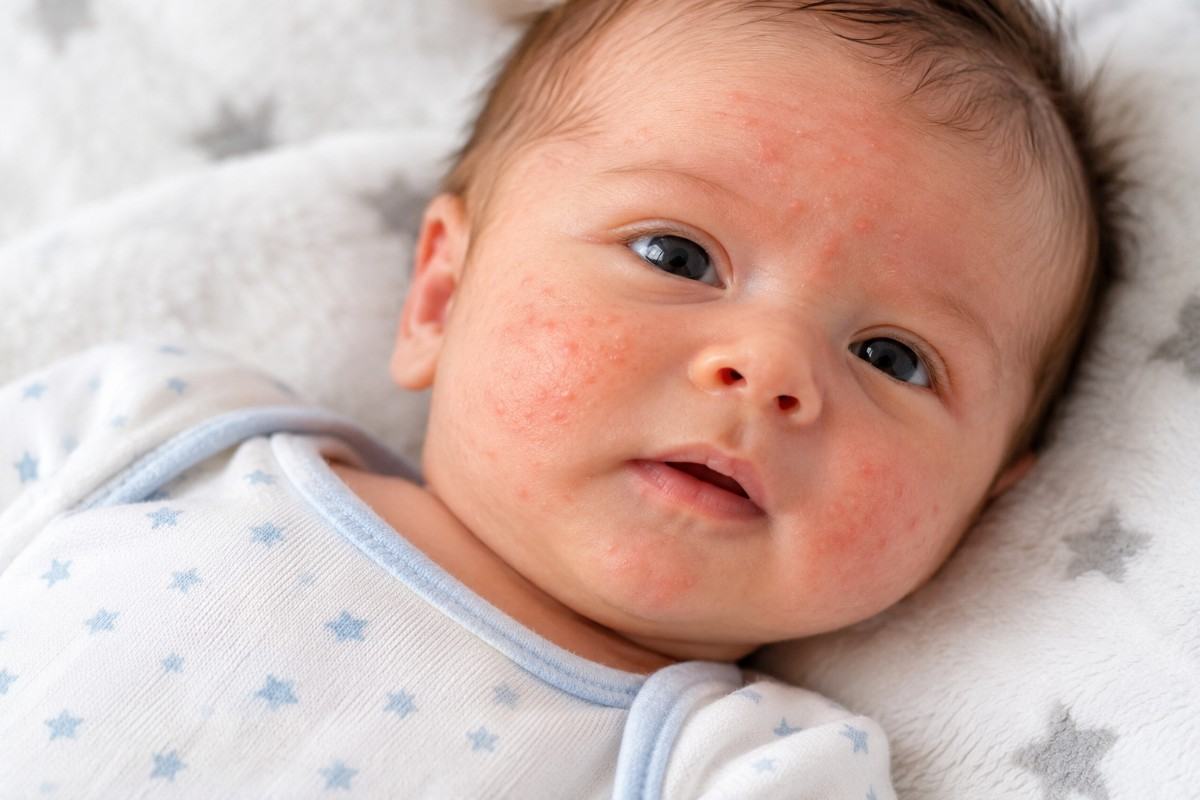
You are enjoying those first few weeks with your newborn when you suddenly notice tiny red or white bumps on your baby’s cheeks. At first, you might think they are mosquito bites, an allergic reaction, or a sign that something is irritating your baby’s skin.
But those little bumps could be baby acne.
Baby acne is quite common in newborns. It often appears on the cheeks, forehead, nose, and chin, sometimes making your baby’s otherwise smooth skin look rough or spotty. Although it can be surprising to see pimples on such a tiny face, the condition is usually harmless and goes away on its own.
Many parents wonder whether baby acne is caused by breastfeeding, heat, skincare products, or something they ate during pregnancy. The good news is that you generally do not need to do much about it.
Let’s look at what causes baby acne, how to recognize it, what you can safely do at home, and when it is worth asking your pediatrician for help.
What Is Baby Acne?
Baby acne is a common skin condition that causes small pimples or red bumps on a newborn’s skin. Doctors often call it neonatal acne.
It usually appears when a baby is around 2 to 4 weeks old, although some babies develop it shortly after birth. You will most often notice it on the cheeks, but the forehead, nose, chin, scalp, neck, and upper body can also be affected.
The bumps may look similar to the acne that teenagers experience, but newborn acne is a little different. It is generally linked to hormonal changes around birth and usually disappears without special treatment.
If your baby has a few small pimples but is feeding normally, sleeping comfortably, and behaving as usual, there is generally no reason to panic.
What Does Baby Acne Look Like?
Baby acne can look different from one newborn to another. Some babies have only a few tiny bumps, while others develop noticeable clusters across their cheeks.
You might see:
- Small red or pink bumps scattered across the cheeks.
- Tiny white or yellowish pimples.
- Several bumps close together on the forehead.
- Slight redness around the affected areas.
- Acne-like bumps around the nose and chin.
The skin may look a little uneven, but baby acne usually does not cause discomfort.
One thing worth remembering is that not every small bump on a newborn’s face is acne. Milia, heat rash, and other newborn skin conditions can look similar.
What Causes Baby Acne?
There is no single explanation for every case of baby acne, but hormones are believed to play an important role.
During pregnancy, a baby is exposed to maternal hormones. These hormones can influence the baby’s oil glands, which may contribute to acne-like bumps after birth.
A few other factors may also affect how your baby’s skin looks.
1. Hormonal Changes: Hormones passed from mother to baby before birth can stimulate the oil glands and contribute to newborn acne.
2. Active Oil Glands: Your baby’s skin naturally produces oil. Changes in oil production may contribute to clogged pores and small bumps.
3. Developing Skin: Newborn skin is still adjusting to life outside the womb. Its protective barrier and oil-producing glands continue to mature.
4. Skin Irritation: Milk, saliva, spit-up, and friction around the cheeks and chin can irritate delicate skin. These factors may make an existing breakout look worse.
5. Skin Microorganisms: Natural microorganisms living on the skin may contribute to some newborn acne-like conditions.
Baby acne is not a sign of poor hygiene. You have not caused it by eating the wrong food during pregnancy or failing to clean your baby’s face often enough.
When Does Baby Acne Start?
Most parents first notice baby acne during the second or third week after birth. It can also appear at birth or develop anytime during the first six weeks.
The timing is different for every baby.
If your baby’s first acne-like breakout appears after six weeks of age, it may be infantile acne rather than neonatal acne. This distinction matters because infantile acne sometimes needs medical evaluation and can carry a greater risk of scarring.
How Long Does Baby Acne Last?
Baby acne generally clears up within a few weeks to several months. Some babies develop clear skin quite quickly, while others have bumps that take longer to disappear.
You may notice that the pimples become less noticeable gradually rather than disappearing overnight.
Try not to compare your baby’s skin with another newborn’s. Every baby develops differently.
If the acne is getting worse, leaving scars, or not gradually improving, speak with your pediatrician.
How to Treat Baby Acne?
The first thing many parents want to do is find a cream or home remedy to clear the pimples. However, baby acne usually does not need an acne treatment.
In fact, applying too many products can irritate your baby’s delicate skin.
A simple skincare routine is usually enough.
1. Wash Your Baby’s Face Gently: Use lukewarm water and a soft, clean washcloth. There is no need to scrub or wash the face repeatedly.
2. Keep Milk and Saliva Away: After feeding, gently wipe milk or spit-up from your baby’s cheeks and chin with a clean, damp cloth.
3. Pat the Skin Dry: After washing, use a soft towel and gently pat the skin. Rubbing can make the irritation worse.
4. Avoid Heavy Creams and Oils: Thick lotions, greasy ointments, and oily products can aggravate some acne-like breakouts. Avoid applying them directly to affected areas unless your doctor recommends them.
5. Choose Gentle Baby Products: If you need a cleanser, ask your pediatrician about a mild product suitable for newborn skin.
6. Keep Clothing Soft: Rough fabrics can rub against your baby’s face and neck. Choose comfortable, soft clothing.
7. Change Dirty Towels and Bedding: Wash your baby’s towels, blankets, and bedding regularly, especially when they become wet with milk or saliva.
8. Avoid Picking the Pimples: It may be tempting to remove a white bump, but squeezing can damage your baby’s skin and increase the risk of infection.
9. Keep Your Baby Comfortable: Avoid overheating and dress your baby appropriately for the weather.
10. Give the Skin Time: This is probably the most useful advice. Baby acne usually improves naturally, so avoid experimenting with different treatments.
What Are the Stages of Baby Acne?
Baby acne does not follow a fixed set of stages. However, it often develops and improves through the following phases:
- Early Appearance: Small red or skin-colored bumps begin appearing, usually on the cheeks, forehead, nose, or chin.
- Visible Pimples: Some bumps develop white or yellowish centers, while the surrounding skin may look slightly red.
- More Noticeable Breakouts: The bumps may become more visible or spread across the face. This does not necessarily mean the condition is getting worse.
- Gradual Improvement: The pimples slowly become less noticeable as your baby’s skin develops.
- Clearing: Most cases disappear on their own without leaving scars, often within a few weeks to a few months.
Important: These are general phases, not a medically recognized staging system. Baby acne can look different from one infant to another.
How to Prevent Baby Acne?
Baby acne cannot always be prevented because it often develops naturally as a newborn’s skin adjusts to life outside the womb. However, gentle skincare can help prevent irritation and keep your baby’s skin comfortable.
- Wash Gently: Clean your baby’s face once a day with lukewarm water and a mild, fragrance-free baby cleanser.
- Avoid Heavy Products: Do not apply thick creams, oily lotions, or greasy products to acne-prone areas.
- Clean Milk and Saliva: Gently wipe away milk, drool, and food residue from your baby’s face.
- Pat the Skin Dry: Use a soft, clean towel instead of rubbing the skin.
- Avoid Scrubbing: Do not use exfoliants, acne washes, or rough washcloths.
- Do Not Squeeze Pimples: Picking or squeezing bumps can irritate the skin and increase the risk of infection.
- Choose Gentle Detergents: Wash your baby’s clothes and bedding with fragrance-free detergent if their skin is easily irritated.
Baby Acne vs. Milia vs. Heat Rash
A few tiny bumps on a newborn’s face can leave parents confused. Is it acne? Milia? Or perhaps a heat rash?
These conditions can look similar, but there are some differences.
| Skin condition | What it looks like | Where it appears |
|---|---|---|
| Baby acne | Small red or white pimples | Cheeks, forehead, chin |
| Milia | Tiny white bumps | Nose, cheeks, around the eyes |
| Heat rash | Small red or clear bumps | Neck, chest, skin folds |
| Eczema | Dry, red, sometimes itchy patches | Cheeks, arms, legs |
| Cradle cap | Greasy yellow or white scales | Scalp and eyebrows |
Milia are especially common in newborns. They look like tiny white dots and usually disappear without treatment.
Heat rash is more likely to appear when your baby gets too warm. You may notice small bumps around the neck, chest, or areas where sweat collects.
Eczema is different because the skin often looks dry, rough, and irritated.
If you are unsure which condition your baby has, let your pediatrician take a look.
What Should You Avoid When Your Baby Has Acne?
Newborn skin is sensitive, so some products that seem harmless can cause unnecessary irritation.
Here are a few things you should avoid:
- Adult Acne Creams: Do not use benzoyl peroxide, salicylic acid, or retinoid products unless a pediatrician or dermatologist specifically prescribes them.
- Coconut Oil and Heavy Oils: Avoid applying oils directly to acne-prone areas because they may worsen some breakouts.
- Toothpaste: Toothpaste is not a safe treatment for newborn pimples.
- Lemon Juice: Its acidity can irritate or damage delicate skin.
- Baking Soda: It can disturb the skin’s natural protective barrier.
- Essential Oils: These can cause irritation and should not be used as newborn acne treatments.
- Rough Scrubbing: Scrubbing will not remove baby acne and may make the skin more irritated.
- Frequent Washing: Washing your baby’s face several times a day is unnecessary and can dry out the skin.
You do not need a collection of skincare products to manage baby acne. Keeping things simple is usually best.
When Should You See a Doctor?
Most newborn acne is harmless, but it is still worth paying attention to changes in your baby’s skin.
Contact your pediatrician if:
- The acne first appears after your baby is six weeks old.
- The pimples become swollen, painful, or filled with pus.
- The affected skin develops blisters or open sores.
- Redness spreads around the bumps.
- The acne appears to be leaving scars.
- Your baby’s skin is getting worse instead of gradually improving.
- You are unsure whether the bumps are acne or another skin condition.
One important warning: If your baby is younger than three months and has a temperature of 100.4°F (38°C) or higher, seek immediate medical evaluation. Do not assume the fever is related to baby acne.
FAQ’s
Is baby acne normal?
Yes. Baby acne is common during the first few weeks after birth. It usually disappears naturally without treatment.
Does breast milk help baby acne?
There is not enough reliable scientific evidence to recommend breast milk as a baby acne treatment. Gently cleaning the face with water is a safer option.
Can breastfeeding cause baby acne?
No convincing evidence shows that breastfeeding causes baby acne. Hormonal changes around birth are considered an important factor.
Is baby acne contagious?
No. Baby acne cannot spread from your baby to another person.
Can baby acne leave scars?
Newborn acne rarely leaves permanent scars. Picking or squeezing the pimples can increase the risk of skin damage.
Should I put lotion on baby acne?
Avoid heavy or greasy lotions on affected areas. If your baby’s skin is dry, ask your pediatrician about a suitable moisturizer.
Can baby acne appear on the body?
Yes. Although it usually appears on the face, acne-like bumps can also develop on the neck, scalp, chest, and back.
Is baby acne a sign of an allergy?
Usually not. Newborn acne is generally associated with hormonal changes rather than an allergy.
Can baby acne get worse before it gets better?
The number and appearance of bumps can change during the first few weeks. However, rapidly spreading redness, swelling, or painful bumps should be checked by a doctor.
When should baby acne disappear?
Most newborn acne improves within several weeks to a few months. If it persists or does not gradually improve, consult your pediatrician.
How do I clear up baby acne?
Gently wash your baby’s face with lukewarm water, avoid heavy skincare products, and allow the acne to clear naturally.
Is baby acne caused by poor hygiene?
No. Baby acne is not caused by dirty skin or poor hygiene.
Is coconut oil good for baby acne?
Coconut oil is not a proven treatment for baby acne. Avoid applying heavy oils to affected areas.
Is baby acne good or bad?
Baby acne is generally harmless and usually disappears without treatment.
At what age is baby acne normal?
Newborn acne commonly develops between 2 and 4 weeks after birth and usually appears within the first 6 weeks.
Does baby acne mean a milk allergy?
No. Baby acne is not generally associated with milk allergies. Milk allergies may cause hives, swelling, vomiting, or other symptoms.
Can my breast milk make my baby break out?
Breastfeeding does not normally cause baby acne. Hormonal changes around birth are a more likely explanation.
Is baby acne caused by mother’s hormones?
Maternal hormones passed to the baby during pregnancy may stimulate oil glands and contribute to newborn acne.
How do I know if milk is causing acne?
Baby acne alone is not a reliable sign of a milk allergy. A pediatrician can evaluate other symptoms, such as hives, vomiting, or swelling.
Can baby acne be prevented?
Unfortunately, there is no guaranteed way to prevent baby acne. It is often related to normal hormonal changes that happen around birth. However, you can avoid unnecessary irritation by keeping your baby’s skincare routine simple.
Sources / References:
Disclaimer:
This article is for educational purposes only and does not replace professional medical advice, diagnosis, or treatment. Always consult your pediatrician about your baby’s skin concerns.
Also Read: