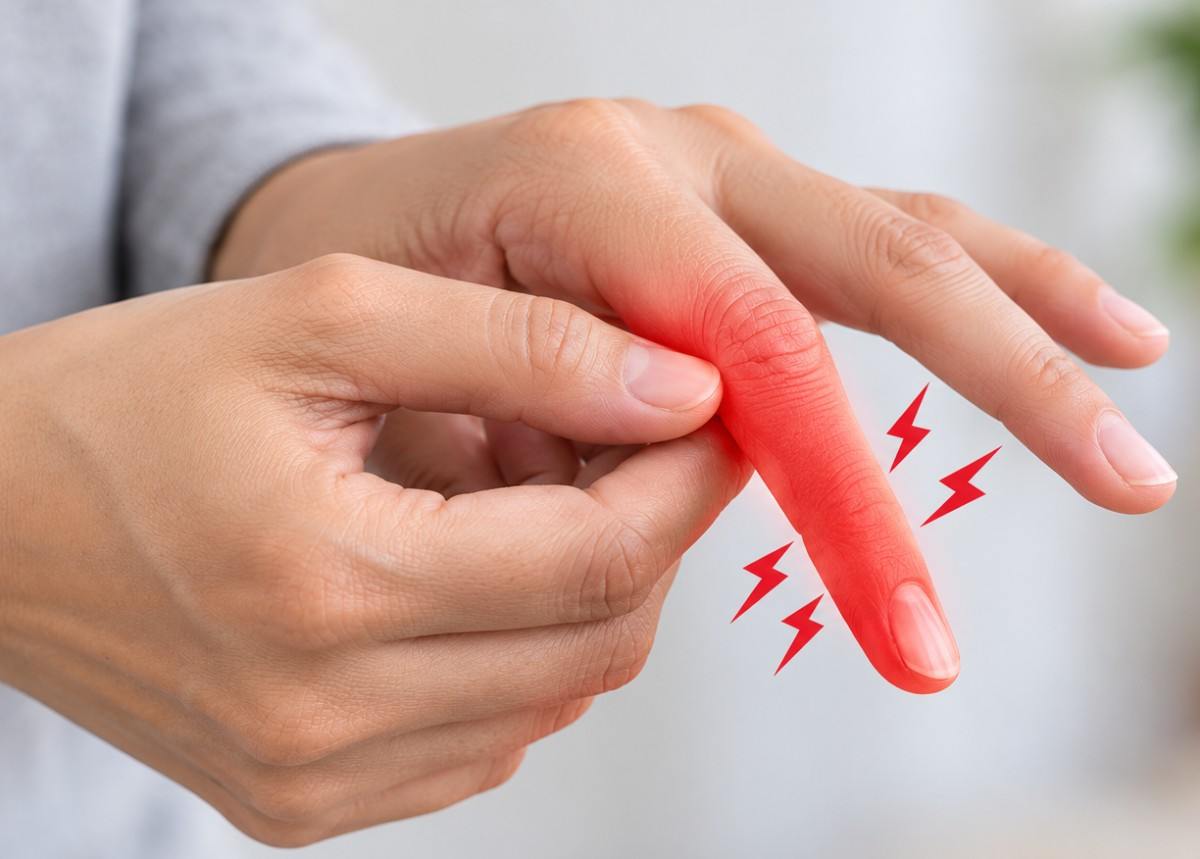
Finger pain can be surprisingly disruptive. A sore or stiff finger may make it difficult to type, write, cook, open a jar, exercise, or even hold a phone. Sometimes the cause is obvious, such as a minor injury or overuse. In other cases, finger pain may be related to arthritis, tendon problems, nerve irritation, infection, or another underlying condition.
Finger pain can affect one finger, several fingers, or the entire hand. It may feel like aching, throbbing, burning, tenderness, or sharp pain and may occur with swelling, stiffness, numbness, tingling, or reduced movement.
This guide explains common causes of finger pain, symptoms to watch for, home-care options, medical treatments, prevention tips, and when professional evaluation is important.
What Is Finger Pain?
Finger pain refers to discomfort in one or more fingers or in the joints, tendons, ligaments, nerves, or tissues surrounding them.
The pain can develop suddenly after an injury or gradually over days or weeks. It can also come and go depending on how much you use your hand.
Common symptoms associated with finger pain include:
- Aching or throbbing
- Sharp or shooting pain
- Swelling
- Stiffness
- Tenderness
- Redness or warmth
- Numbness
- Tingling or pins and needles
- Difficulty bending or straightening a finger
- Weakness or difficulty gripping
- Clicking or popping
- Changes in finger color or temperature
The specific symptoms often provide clues about the possible cause.
Common Causes of Finger Pain
Finger pain has many possible causes. Some are temporary and improve with rest, while others require medical treatment.
1. Finger Injury
A fall, sports injury, accident, or direct blow can cause bruising, sprains, strains, dislocations, or fractures. Pain may be accompanied by swelling and difficulty moving the finger.
2. Arthritis
Arthritis can cause pain, stiffness, swelling, and reduced movement in the finger joints. Osteoarthritis can develop as joints change over time, while inflammatory forms such as rheumatoid arthritis can affect multiple joints.
3. Overuse
Repeated movements such as typing, gripping tools, playing an instrument, gaming, or certain sports can place stress on the fingers and surrounding tissues.
4. Tendinitis
Tendinitis occurs when a tendon becomes irritated or inflamed. It may cause tenderness and pain that becomes worse with movement or activity.
5. Trigger Finger
Trigger finger occurs when movement of a finger tendon becomes restricted. A person may experience stiffness, clicking, popping, or catching when bending or straightening the finger.
6. Nerve Compression
Conditions such as carpal tunnel syndrome can cause pain, numbness, tingling, or weakness affecting the hand and fingers.
7. Infection
An infection around the finger, nail, or deeper tissues can cause pain, redness, warmth, swelling, and sometimes fever.
8. Gout
Gout can cause sudden, intense pain and inflammation in a joint. Although it commonly affects the big toe, other joints can also be affected.
9. Raynaud Phenomenon
Raynaud phenomenon can cause fingers to change color and become painful or numb, particularly when exposed to cold.
10. Ligament or Tendon Injury
A stretched or torn ligament or tendon may cause pain, swelling, weakness, or difficulty moving the affected finger.
Symptoms of Finger Pain
Finger pain can present differently depending on its underlying cause.
1. Pain With Movement
Pain that becomes worse when bending, straightening, gripping, or lifting may occur with an injury, tendon problem, or arthritis.
2. Finger Stiffness
Stiffness is common with arthritis, inflammation, and some tendon disorders.
3. Swelling
Swelling can develop after an injury or with inflammation, arthritis, or infection.
4. Numbness or Tingling
Numbness or tingling may indicate nerve irritation or problems involving blood flow.
5. Clicking or Catching
Clicking, popping, or catching during finger movement can occur with trigger finger.
6. Redness and Warmth
A red, warm, swollen finger can indicate inflammation or infection and should not be ignored, particularly when accompanied by fever.
Finger Pain According to Location
The location of the pain can sometimes provide useful clues.
| Location | Possible Causes |
|---|---|
| Finger joint | Arthritis, injury, sprain |
| Fingertip | Injury, infection, nail problems |
| Base of finger | Trigger finger, arthritis, tendon problems |
| Thumb | Arthritis, tendon problems, injury |
| Several fingers | Arthritis, nerve problems, systemic conditions |
| Finger with numbness | Nerve compression or irritation |
| Finger with sudden swelling | Injury, inflammation, or gout |
These are only general possibilities. Location alone cannot establish a diagnosis.
Finger Pain After an Injury
If finger pain started after an accident, fall, sports activity, or direct impact, the injury may involve a bone, ligament, tendon, or joint.
A fracture may cause significant pain, swelling, bruising, deformity, or difficulty moving the finger. Some tendon injuries can also make it difficult to straighten or bend a finger.
What You Can Do Initially
For a minor injury:
- Rest the affected finger.
- Avoid activities that increase pain.
- Apply a wrapped cold pack for short periods.
- Keep the hand elevated if it is swollen.
- Remove rings or jewelry before swelling becomes significant.
- Avoid forcing the finger into a position that causes pain.
If you suspect a fracture or the finger looks deformed, seek medical evaluation rather than attempting to straighten it yourself.
Finger Pain From Arthritis
Arthritis is one of the important causes of persistent finger pain.
Osteoarthritis may cause pain, stiffness, swelling, and changes around the joints. Inflammatory arthritis can cause prolonged joint inflammation and may affect several joints.
Finger arthritis may make everyday activities such as opening containers, writing, typing, or gripping objects uncomfortable.
Treatment depends on the type and severity of arthritis and may include activity modification, exercises, splints, medications, physical or occupational therapy, and other treatments recommended by a healthcare professional.
Finger Pain From Trigger Finger
Trigger finger can cause a finger to catch or lock while moving. Some people notice clicking or popping, while others experience tenderness near the base of the affected finger.
Symptoms may be particularly noticeable after periods of inactivity or in the morning.
Mild cases may improve with reducing aggravating activities and allowing the tendon to rest. A healthcare professional may recommend splinting, medication, an injection, or another treatment depending on severity.
How to Relieve Finger Pain at Home?
The appropriate home treatment depends on the cause.
1. Rest Your Hand
Temporarily reduce activities that make your symptoms worse, especially repetitive gripping or forceful movements.
2. Apply Cold After an Injury
For a recent minor injury, a cold pack wrapped in a cloth may help reduce pain and swelling. Avoid placing ice directly on the skin.
3. Keep the Finger Elevated
If swelling is present, keeping the hand elevated may help reduce it.
4. Use Gentle Movement
Once an acute injury has settled and movement is safe, gentle finger movements may help prevent excessive stiffness. Do not force painful movements.
5. Consider a Splint
Depending on the condition, a healthcare professional may recommend a splint to limit movement and support healing.
6. Avoid Tight Gripping
Temporarily avoid heavy lifting, forceful gripping, or repetitive activities that increase symptoms.
7. Consider Appropriate Pain Relief
Over-the-counter pain medicines may help some people, but they are not appropriate for everyone. Follow the product directions and ask a healthcare professional or pharmacist if you are unsure which medicine is safe for you.
7 Best Exercises for Finger Pain Relief
Gentle finger exercises can help maintain flexibility, reduce stiffness, and improve hand movement. They are generally most appropriate for mild stiffness or discomfort. Do not exercise through sharp or severe pain, and seek medical advice first if you have a recent fracture, dislocation, significant injury, infection, or severe swelling.
1. Finger Bends
Slowly bend your fingers toward your palm, then gently straighten them.
How to do it:
- Keep your wrist relaxed.
- Slowly curl your fingers into a loose fist.
- Hold for 3–5 seconds.
- Slowly straighten your fingers.
- Repeat 5–10 times.
2. Finger Spreads
This exercise gently stretches the muscles between your fingers.
How to do it:
- Place your hand comfortably on a table or hold it in front of you.
- Slowly spread your fingers apart.
- Hold for about 3–5 seconds.
- Relax.
- Repeat 5–10 times.
3. Thumb-to-Finger Touch
This helps maintain thumb and finger coordination.
How to do it:
- Hold your hand comfortably with your palm facing upward.
- Touch your thumb to the tip of your index finger.
- Continue with the middle, ring, and little fingers.
- Repeat 5–10 times.
4. Tabletop Exercise
This exercise works on controlled finger movement.
How to do it:
- Place your hand palm-down on a flat surface.
- Keep your fingers straight.
- Slowly lift one finger at a time while keeping the others on the surface.
- Hold each lift for 2–3 seconds.
- Repeat 5 times per finger.
5. Hook Fist
A hook fist gently moves the finger joints without making a full fist.
How to do it:
- Start with your fingers straight.
- Bend the middle and end joints while keeping the large knuckles relatively straight.
- Hold for 3–5 seconds.
- Return to the starting position.
- Repeat 5–10 times.
6. Gentle Fist Exercise
This can help with general finger mobility.
How to do it:
- Slowly curl your fingers into a loose fist.
- Do not squeeze tightly.
- Hold for 3–5 seconds.
- Open your hand and straighten your fingers.
- Repeat 5–10 times.
7. Finger Extension Stretch
This can help gently stretch stiff fingers.
How to do it:
- Place your palm on a flat surface.
- Keep your fingers relaxed and straight.
- Gently press the fingers toward the surface without forcing them.
- Hold for 10–15 seconds.
- Repeat 2–3 times.
How Often Should You Do Finger Exercises?
For mild stiffness, you can usually perform gentle exercises once or twice a day, provided they do not increase your pain. Start slowly and gradually increase repetitions as your fingers become more comfortable.
When to Stop Finger Exercises?
Stop exercising and seek medical advice if you develop:
- Increasing or severe pain
- Significant swelling
- New numbness or tingling
- Weakness
- Finger deformity
- Redness or warmth
- Loss of normal finger movement
If your finger pain followed an injury, especially if you suspect a fracture or tendon injury, it is better to have the finger assessed before beginning exercises.
Medical Treatment for Finger Pain
Treatment depends on the underlying cause.
1. Medication
A doctor may recommend pain relievers or anti-inflammatory medicines when appropriate.
2. Splinting
Splints can help protect an injured finger or limit movement when necessary.
3. Physical or Occupational Therapy
Therapy may help restore movement, strength, flexibility, and hand function.
4. Steroid Injections
Certain inflammatory tendon or joint conditions may sometimes be treated with corticosteroid injections.
5. Surgery
Severe fractures, significant tendon or ligament injuries, persistent trigger finger, or certain other structural problems may require surgery.
When Should You See a Doctor for Finger Pain?
Consider medical evaluation if:
- Finger pain is severe.
- Pain continues or repeatedly returns.
- You cannot properly bend or straighten the finger.
- The finger appears deformed.
- There is significant swelling.
- You develop numbness or tingling.
- The finger becomes red, hot, or increasingly swollen.
- You develop a fever.
- Pain interferes with normal activities.
- Symptoms do not improve with appropriate home care.
Persistent pain, sensory changes, severe injury, deformity, and inability to move the finger can require professional assessment.
Finger Pain That Needs Urgent Attention
Seek urgent medical care if a finger:
- Becomes blue, pale, or unusually cold.
- Has suddenly changed shape.
- Becomes completely numb.
- Cannot be moved after an injury.
- Has severe pain following trauma.
- Has a deep wound or significant bleeding.
- Becomes severely swollen and painful.
- Is accompanied by fever and signs of infection.
A severe injury accompanied by deformity, loss of sensation, inability to move the hand or finger, or color changes can indicate a serious problem.
How Is Finger Pain Diagnosed?
A healthcare professional will usually begin with a medical history and physical examination.
They may ask:
- When did the pain begin?
- Was there an injury?
- Which finger is affected?
- Is the pain constant or intermittent?
- Is there swelling?
- Do you have numbness or tingling?
- Does the finger click or lock?
- What activities make the pain worse?
Depending on the suspected cause, imaging such as an X-ray may be needed. Other tests may be considered when a tendon, nerve, inflammatory condition, or another problem is suspected.
How to Prevent Finger Pain?
You cannot prevent every cause of finger pain, but several habits may reduce your risk.
1. Take Breaks From Repetitive Activities
If you type, write, play an instrument, or perform repetitive hand movements, take regular breaks.
2. Use Proper Ergonomics
Keep your wrists and hands in comfortable positions when working at a computer.
3. Avoid Excessive Gripping
Use tools and equipment appropriately and avoid unnecessary force.
4. Protect Your Hands During Sports
Use appropriate protective equipment when participating in activities where hand injuries are possible.
5. Warm Up Before Exercise
Gentle warm-up movements can prepare the hands and fingers for activities that require repeated use.
6. Treat Minor Injuries Properly
Ignoring an injury and immediately returning to demanding activities can prolong symptoms.
Finger Pain: When Is It Probably Minor?
Finger pain is more likely to be minor when it follows a small injury or period of unusual activity, remains relatively mild, and gradually improves with rest.
However, pain that persists, worsens, keeps returning, or occurs without an obvious explanation deserves attention.
It is also important not to assume that persistent finger pain is simply due to aging or overuse. Conditions such as arthritis, nerve problems, tendon disorders, and other medical issues can produce similar symptoms.
FAQ’s
Is finger pain related to heart problems?
Usually, no. But finger or hand pain with chest pain, breathing trouble, sweating, or dizziness needs emergency care.
Why is only one finger hurting?
One-finger pain can result from injury, overuse, arthritis, trigger finger, tendon problems, or infection.
How can I relieve finger pain at night?
Rest your finger, avoid overuse, and try a warm or cold compress. See a doctor if nighttime pain persists or causes numbness.
Why does my finger hurt without an injury?
Pain without an obvious injury may be related to arthritis, tendon irritation, nerve compression, inflammation, or repetitive hand movements.
Can arthritis cause finger pain?
Yes. Arthritis can cause finger joint pain, stiffness, swelling, and reduced range of motion.
Why does my finger hurt when I bend it?
Pain while bending a finger can occur due to arthritis, tendon problems, trigger finger, sprains, or other injuries.
Can typing cause finger pain?
Yes. Repetitive typing and other activities involving repeated finger movements can contribute to overuse and discomfort.
Why is my finger swollen and painful?
Swelling and pain may result from an injury, arthritis, inflammation, gout, or infection.
What causes finger pain with numbness?
Finger pain with numbness or tingling may be caused by nerve irritation or compression, such as carpal tunnel syndrome.
Should I massage a painful finger?
Gentle massage may help some mild discomfort, but avoid massaging a severely injured, swollen, infected, or possibly fractured finger.
Can finger pain be a sign of nerve problems?
Yes. Nerve irritation or compression can cause pain, burning, tingling, numbness, or weakness in the fingers.
How long does finger pain take to heal?
Healing time depends on the cause. Minor overuse or mild injuries may improve within days or weeks, while arthritis, fractures, or tendon problems may take longer.
What kind of doctor treats finger pain?
A primary-care doctor can evaluate finger pain and may refer you to an orthopedic specialist, hand specialist, rheumatologist, or neurologist depending on the cause.
Final Thought
Finger pain can result from something as simple as overuse or a minor injury, but persistent or severe pain should not be ignored. Arthritis, tendon disorders, trigger finger, nerve problems, fractures, infections, and other conditions can all cause finger symptoms.
Pay attention to accompanying signs such as swelling, numbness, weakness, deformity, color changes, fever, or difficulty moving the finger. These symptoms can help determine whether you need routine or urgent medical evaluation.
Sources / References:
About the Author:
Written by: Kirti Solanki (Health Content Researcher)
Kirti Solanki creates research-based health content designed to make common medical topics easier to understand. Health information is reviewed against reliable medical and government sources where appropriate.
Disclaimer:
This article is for general educational purposes and does not replace diagnosis or treatment from a qualified healthcare professional. Seek medical care for severe, persistent, or unexplained finger pain.
Also Read: