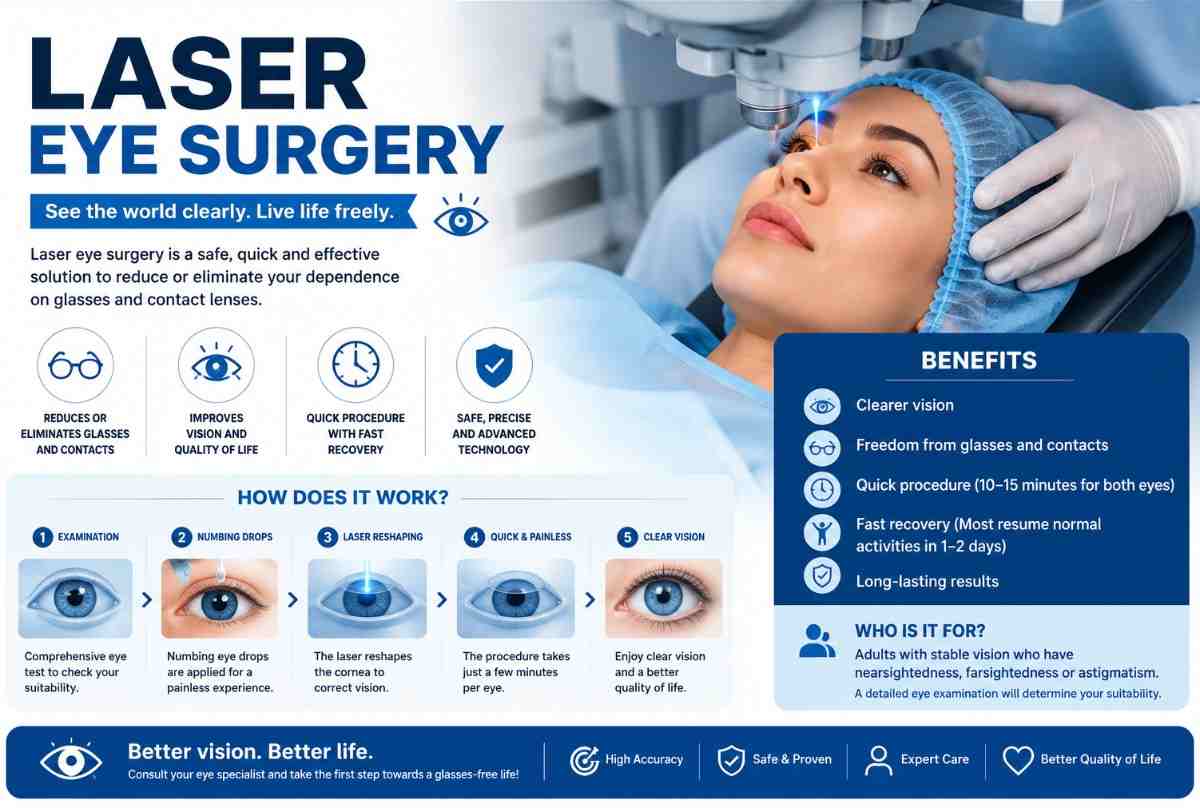
Laser eye surgery has become a popular option for people who want to reduce their dependence on glasses or contact lenses. For many patients, the idea is appealing: wake up, see clearly, and get through everyday activities without reaching for glasses.
But laser vision correction is still surgery, and it is not suitable for everyone. Procedures such as LASIK, PRK, and SMILE work by changing the shape of the cornea to improve how light focuses on the retina. The right procedure depends on factors such as your prescription, corneal thickness, eye health, lifestyle, and personal expectations.
This guide explains what laser eye surgery is, how it works, its potential benefits and risks, recovery, eligibility, and important questions to ask before making a decision.
What Is Laser Eye Surgery?
Laser eye surgery is a group of procedures used to correct certain refractive errors, including nearsightedness (myopia), farsightedness (hyperopia), and astigmatism.
The goal is to reshape the cornea so that incoming light focuses more accurately on the retina. This can reduce dependence on glasses or contact lenses. LASIK, for example, uses a computer-controlled laser to reshape corneal tissue beneath a thin corneal flap.
Despite the name “laser eye surgery,” the laser does not simply remove a layer from the surface of the eye. Different procedures use different techniques, and the amount and location of tissue treatment are carefully calculated from measurements taken during the preoperative examination.
Types of Laser Eye Surgery
1. LASIK
LASIK (Laser-Assisted In Situ Keratomileusis) is one of the best-known forms of laser vision correction. A thin flap is created in the cornea, the underlying tissue is reshaped with a laser, and the flap is repositioned.
LASIK generally has a relatively quick visual recovery compared with surface procedures, although the exact recovery experience varies from person to person.
2. PRK
PRK (Photorefractive Keratectomy) reshapes the cornea without creating the same type of corneal flap used in LASIK. Instead, the surface layer of the cornea is removed or displaced and allowed to heal.
PRK can be considered for some people who are not suitable for LASIK, including certain patients with thinner corneas, although candidacy must be determined individually.
3. SMILE
SMILE (Small Incision Lenticule Extraction) uses a laser to create a small piece of corneal tissue called a lenticule, which is removed through a small incision. It is another form of laser vision correction and may be appropriate for selected patients.
The best procedure is not necessarily the newest or most heavily advertised one. An eye specialist should determine which technique is appropriate after examining your eyes and discussing your visual needs.
Who May Be a Candidate for Laser Eye Surgery?
Being tired of glasses does not automatically make someone a good candidate.
Your eye doctor will typically evaluate your prescription, corneal shape and thickness, tear production, pupil size, general eye health, and whether your prescription has remained stable. A detailed examination is essential before surgery.
You may be considered a potential candidate if:
- You are an adult whose vision prescription has been stable.
- Your eyes are generally healthy.
- Your corneas have suitable thickness and shape.
- Your expectations are realistic.
- Your prescription falls within the range treatable by the specific procedure and laser.
- You understand that glasses or contact lenses may still be needed in some situations.
Age alone does not determine suitability. Your overall eye health and individual measurements are much more important.
Who May Not Be a Good Candidate?
Laser eye surgery is not appropriate for everyone.
People with certain eye conditions, unstable prescriptions, very thin corneas, significant dry eye, or medical conditions that interfere with healing may face increased risks. The FDA also identifies pregnancy or breastfeeding, certain medications, some autoimmune conditions, diabetes, keratoconus, previous eye surgery, and active participation in contact sports as circumstances requiring careful consideration.
Someone with severe dry eye, for example, may find that symptoms become worse after LASIK. Similarly, people involved in activities where the eye may receive a direct impact need to discuss whether a flap-based procedure is appropriate.
Importantly, only a qualified eye-care professional can determine whether you are a suitable candidate.
Laser Eye Surgery Procedure
Laser eye surgery is performed to reshape the cornea and improve how light focuses on the retina. The exact procedure depends on the type of surgery, such as LASIK, PRK, or SMILE.
- Eye Examination: Your ophthalmologist checks your prescription, corneal thickness and shape, tear production, and overall eye health to determine whether surgery is suitable.
- Numbing the Eyes: Anesthetic eye drops are applied to minimize discomfort during the procedure.
- Preparing the Cornea: The surgeon prepares the cornea according to the selected technique. LASIK involves creating a thin flap, while PRK treats the corneal surface and SMILE uses a small incision.
- Laser Reshaping: A computer-controlled laser precisely reshapes corneal tissue to correct refractive errors such as myopia, hyperopia, or astigmatism.
- Completing the Treatment: In LASIK, the corneal flap is carefully repositioned. SMILE removes the small tissue lenticule through the incision, while PRK allows the surface layer to heal naturally.
- Post-Surgery Care: Prescription eye drops and protective measures are provided, and follow-up examinations are scheduled to monitor healing and vision.
The procedure is usually quick, but recovery varies. LASIK often has faster visual recovery, while PRK generally takes longer to heal.
Laser Eye Surgery Cost
The cost of laser eye surgery varies widely depending on the procedure, laser technology, surgeon, hospital, city, and tests or follow-up care included in the package. These are indicative ranges rather than fixed prices. LASIK pricing varies by surgeon, technology and location.
| Laser Eye Surgery | USA Cost Per Eye | India Cost Per Eye | USA Cost for Both Eyes | India Cost for Both Eyes |
|---|---|---|---|---|
| Standard LASIK | $1,500–$3,000 | ₹20,000–₹45,000 | $3,000–$6,000 | ₹40,000–₹90,000 |
| Femto / Bladeless LASIK | $2,000–$3,500 | ₹35,000–₹60,000 | $4,000–$7,000 | ₹70,000–₹1,20,000 |
| Contoura / Custom LASIK | $2,500–$4,500 | ₹45,000–₹65,000 | $5,000–$9,000 | ₹90,000–₹1,30,000 |
| PRK | $1,500–$3,000 | ₹20,000–₹45,000 | $3,000–$6,000 | ₹40,000–₹90,000 |
| SMILE | $2,500–$4,500 | ₹45,000–₹80,000 | $5,000–$9,000 | ₹90,000–₹1,60,000 |
| SMILE Pro | $3,000–$5,000+ | ₹65,000–₹90,000 | $6,000–$10,000+ | ₹1,30,000–₹1,80,000+ |
Note: The final cost may include or exclude consultation, corneal scans, medications, follow-up visits and enhancement procedures, so patients should request an all-inclusive quotation before surgery.
Benefits of Laser Eye Surgery
1. Reduced Dependence on Glasses
One of the biggest attractions is the possibility of relying less on glasses for everyday activities.
2. Less Dependence on Contact Lenses
People who experience discomfort, dryness, allergies, or inconvenience from contact lenses may appreciate having another option for vision correction.
3. Convenience During Daily Activities
Clearer unaided vision can make activities such as exercising, traveling, swimming, or waking up in the morning more convenient.
4. Potentially Long-Lasting Vision Correction
Laser vision correction permanently reshapes treated corneal tissue. However, that does not mean your eyesight can never change again. Aging and other eye changes can affect vision over time.
5. Quick Recovery With Some Procedures
LASIK in particular can have relatively rapid visual recovery, although patients should not assume that everyone will have perfect vision immediately after surgery.
What Happens Before Laser Eye Surgery?
The preoperative evaluation is one of the most important parts of the entire process.
Your doctor may measure your visual prescription, corneal thickness, corneal shape, pupil size, tear production, and other aspects of eye health. Your medical history and medications should also be reviewed.
If you wear contact lenses, you may be asked to stop wearing them before your examination and surgery because lenses can temporarily change the shape of the cornea. The exact amount of time depends on the type of contact lens.
This appointment is also your opportunity to ask questions.
A good consultation should cover:
- Which procedure is recommended and why.
- The expected improvement in vision.
- Possible complications.
- Whether glasses may still be needed.
- Recovery expectations.
- Alternatives to laser surgery.
- The surgeon’s experience with the specific procedure and laser.
- What happens if the result is not as expected.
The FDA recommends taking time to understand the risks, benefits, alternatives, and informed consent information rather than feeling pressured into surgery.
Does Laser Eye Surgery Hurt?
Most people do not experience significant pain during LASIK because numbing eye drops are used.
However, discomfort after surgery can occur. Dryness, irritation, watering, light sensitivity, or a gritty sensation may occur during recovery. PRK can involve more discomfort during the early healing period because the surface of the cornea needs to regenerate.
Your surgeon should provide specific instructions about medications, eye drops, and pain management.
Recovery After Laser Eye Surgery
Recovery depends heavily on the procedure.
After LASIK, vision may improve quickly, but it can fluctuate during the early healing period. PRK generally takes longer because the surface layer of the cornea needs time to heal.
During recovery, you may be instructed to:
- Use prescribed eye drops as directed.
- Avoid rubbing or pressing on your eyes.
- Wear an eye shield while sleeping if instructed.
- Attend scheduled follow-up appointments.
- Avoid swimming or activities that could expose the eyes to contamination for the period recommended by your surgeon.
- Avoid strenuous or contact activities until your doctor says they are safe.
The patients should arrange transportation home, protect the eyes after surgery, use prescribed drops, and expect that vision may not be perfectly clear immediately.
Common Side Effects of Laser Eye Surgery
Temporary side effects can occur after laser vision correction.
Some people experience:
- Dry eyes
- Blurred or fluctuating vision
- Light sensitivity
- Glare
- Halos around lights
- Starbursts
- Difficulty seeing clearly at night
- Eye irritation
- A foreign-body sensation
Many symptoms improve during healing, but some can persist. The FDA specifically warns that dry eye and visual symptoms such as glare, halos, and starbursts can occur and may sometimes significantly affect nighttime vision.
Risks and Complications of Laser Eye Surgery
Although laser eye surgery is widely performed and many patients are satisfied with their results, it is not risk-free. Potential complications include:
- Undercorrection or overcorrection: The treatment may not completely correct the original prescription or may correct it more or less than intended.
- Dry eye: Some patients can develop significant or persistent dryness after surgery.
- Visual disturbances: Glare, halos, starbursts, ghost images, or reduced contrast sensitivity can occur.
- Infection or inflammation: As with other surgical procedures, infection and inflammation are possible.
- Corneal complications: Changes to the cornea can occasionally lead to serious problems requiring further treatment.
- Need for additional treatment: Some patients may need an enhancement, although additional surgery is not always possible or advisable.
- Reduced visual quality: A patient can have good results on a standard vision chart but still notice poorer vision in low-light or low-contrast situations.
- Loss of vision: Rare but serious complications can result in loss of vision that cannot be corrected with glasses, contact lenses, or additional surgery.
This is why laser eye surgery should be treated as an elective medical procedure rather than a simple cosmetic treatment.
Can You Still Need Glasses After Laser Eye Surgery?
Yes. Laser eye surgery is designed to reduce dependence on glasses or contact lenses, but it does not guarantee that you will never need them again.
Some people may require glasses for specific activities, while others may need reading glasses as they get older because of presbyopia, the age-related reduction in the eye’s ability to focus on nearby objects.
Only a certain percentage of patients achieve 20/20 vision without glasses or contacts and that reading glasses may still be necessary.
Is Laser Eye Surgery Permanent?
The corneal reshaping performed during laser vision correction is intended to be permanent. However, your eyesight can still change with age.
Presbyopia can develop later in life, and conditions such as cataracts or other eye diseases can affect vision independently of previous laser surgery.
Therefore, it is better to think of laser eye surgery as a way to correct your current refractive error rather than a guarantee of perfect eyesight for the rest of your life.
Laser Eye Surgery vs. Glasses and Contact Lenses
Choosing surgery is a personal decision.
Glasses are noninvasive, adjustable, and generally low-risk, but some people dislike their appearance or find them inconvenient.
Contact lenses can provide excellent vision without frames, but they require proper hygiene and ongoing care.
Laser surgery can reduce dependence on both, but it involves permanent changes to the cornea and carries surgical risks.
There is no universally “best” option. The right choice depends on your vision, lifestyle, eye health, tolerance for risk, and personal priorities.
How to Choose a Laser Eye Surgeon?
Do not choose a clinic based solely on a low price or an advertisement promising perfect vision.
Look for a qualified eye surgeon with appropriate experience in the procedure being considered. Ask how frequently they perform the procedure and what happens if complications occur.
The FDA recommends comparing providers, understanding the specific laser being used, reviewing patient information, and being cautious about guarantees or promotional packages.
A trustworthy surgeon should be comfortable discussing both successful outcomes and potential complications.
Questions to Ask Before Surgery
Before signing consent forms, consider asking:
- Am I a good candidate for laser eye surgery?
- Which procedure is best for my eyes?
- What are my individual risk factors?
- How stable is my prescription?
- Do I have dry eye or any corneal problems?
- How much improvement can I realistically expect?
- Could I still need glasses?
- What side effects are most likely in my situation?
- How long should I expect recovery to take?
- What happens if the surgery does not produce the expected result?
These questions can help you make a decision based on your own eyes rather than someone else’s experience.
When Should You Seek Medical Attention After Surgery?
Contact your eye surgeon promptly if you experience significant or worsening pain, sudden vision loss, severe redness, increasing discharge, marked light sensitivity, or another symptom that concerns you.
Do not assume that a serious change is simply part of normal recovery. Your surgical team should give you specific instructions about which symptoms require urgent evaluation.
Final Thoughts
Laser eye surgery can be life-changing for appropriately selected patients. It may reduce dependence on glasses and contact lenses and make many everyday activities more convenient.
At the same time, it is important to keep expectations realistic. LASIK, PRK, SMILE, and other refractive procedures involve permanent changes to the cornea and can cause side effects or complications. Not everyone is a candidate, and even successful surgery does not guarantee perfect vision forever.
The safest approach is to have a comprehensive eye examination, compare the benefits and risks, understand alternatives, and choose an experienced qualified eye surgeon. Your decision should be based on your individual eye health rather than advertisements, price, or someone else’s surgical experience.
FAQ’s
Is laser eye surgery safe?
Laser eye surgery is generally considered safe for appropriately selected patients, but it is not risk-free. Dry eyes, glare, halos, infection, and other complications can occur.
Is laser eye surgery painful?
LASIK is usually not painful during the procedure because numbing eye drops are used. Mild discomfort, dryness, irritation, or light sensitivity may occur afterward.
How long does laser eye surgery take?
The laser treatment itself is usually very quick, often taking only a few minutes per eye. The complete appointment takes longer because of preparation and postoperative checks.
How long does it take to recover from laser eye surgery?
Recovery varies by procedure. LASIK often has a faster visual recovery, while PRK generally takes longer because the corneal surface needs to heal.
What age is best for laser eye surgery?
There is no single ideal age. Generally, candidates should be adults with a stable prescription and healthy eyes. An ophthalmologist should determine suitability.
Can laser eye surgery correct astigmatism?
Yes. Certain laser vision correction procedures can correct astigmatism, depending on its severity and the patient’s individual eye measurements.
Can laser eye surgery correct both near and far vision?
Standard laser procedures primarily correct refractive errors such as myopia, hyperopia, and astigmatism. Age-related near-vision changes may still require reading correction.
Who should avoid laser eye surgery?
People with certain corneal conditions, unstable prescriptions, significant dry eye, some medical conditions, or other eye-health problems may not be suitable. A detailed eye examination is necessary.
Can I have laser eye surgery if I have dry eyes?
Possibly, but significant dry eye can increase the risk of worsening symptoms after surgery. Your eye doctor should assess and treat dry eye before considering surgery.
Can laser eye surgery cause blindness?
Severe vision loss is rare, but serious complications are possible. This is why patients should understand the risks and choose a qualified, experienced eye surgeon.
Can I use my phone after laser eye surgery?
Your surgeon will provide personalized instructions. You may experience temporary eye strain or sensitivity, so limiting screen time during the early recovery period may be more comfortable.
When can I drive after laser eye surgery?
Do not drive until your surgeon confirms that your vision meets the necessary requirements and it is safe for you to drive.
Can I exercise after laser eye surgery?
Light activity may be resumed relatively soon after some procedures, but strenuous exercise and activities that could injure or contaminate the eyes may need to be avoided temporarily.
Can I swim after laser eye surgery?
Swimming is usually restricted during the early recovery period because water can introduce microorganisms and irritate healing eyes. Follow your surgeon’s specific instructions.
What happens if laser eye surgery does not work?
Some patients may have residual refractive error or experience complications. Depending on the situation, glasses, contact lenses, medication, additional treatment, or other options may be considered.
Is laser surgery good for eyes?
Yes, it can safely reduce dependence on glasses or contact lenses in suitable patients, but an eye examination is essential first.
How risky is laser eye surgery?
It is generally safe for suitable candidates, but risks include dry eyes, glare, halos, infection, and vision changes.
How painful is laser eye surgery?
LASIK is usually painless during surgery because numbing drops are used. Mild irritation or discomfort may occur afterward.
How many days of rest are required after laser eye surgery?
Many LASIK patients resume normal activities within a few days, while PRK usually requires a longer recovery.
Sources / References:
About the Author:
Written by: Kirti Solanki, Health Content Researcher
Kirti Solanki researches and writes health-focused content using reputable medical and public-health sources, with an emphasis on clear, reader-friendly explanations.
Medical Disclaimer:
This article is for general educational purposes only and does not replace professional medical advice, diagnosis, or treatment. Consult a qualified ophthalmologist before deciding whether laser eye surgery is appropriate for you.
Also Read: