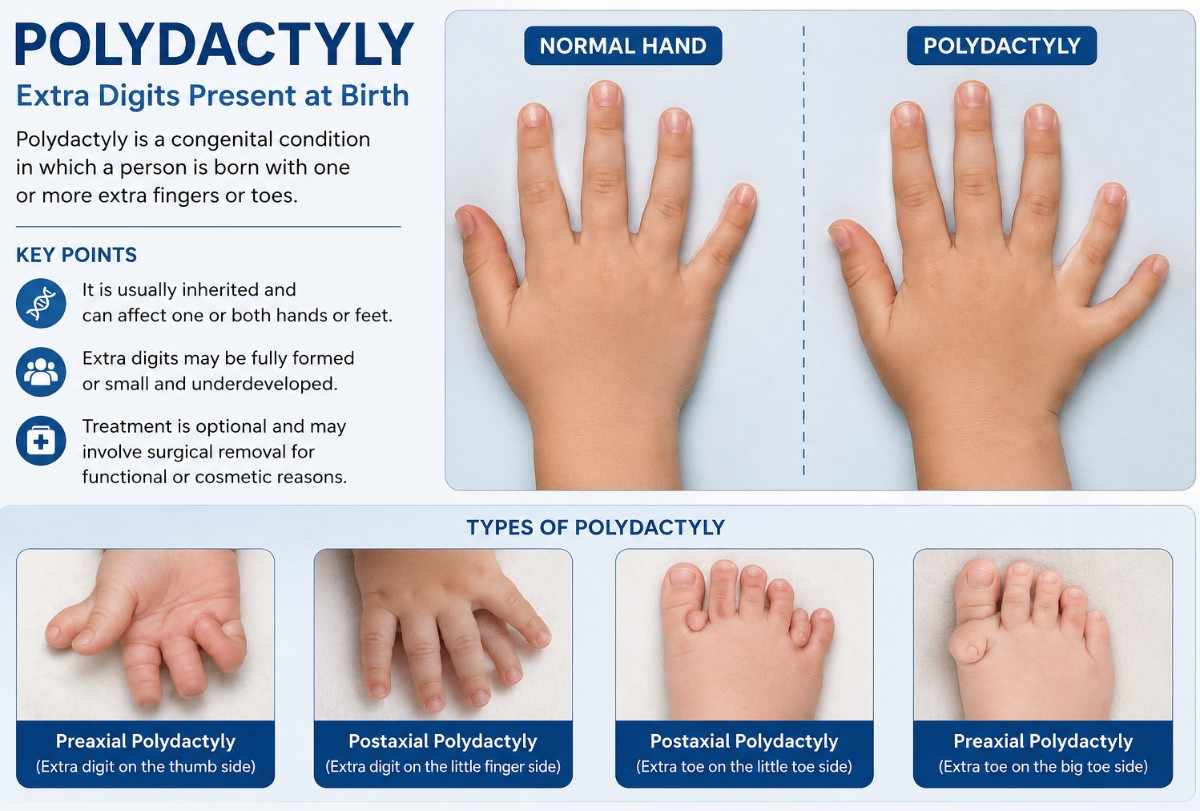
Imagine a newborn arriving with six tiny fingers instead of five, or an extra toe alongside the little toe. While this can understandably surprise parents, having an extra finger or toe is a recognized congenital condition called polydactyly. In many cases, it occurs by itself and does not cause serious health problems.
Polydactyly can look very different from one person to another. An extra digit may be a small piece of soft tissue connected by a narrow stalk, or it may be a fully developed finger or toe containing bones, joints, nerves and blood vessels. It can affect one hand or foot, several limbs, or occasionally all four.
For some people, polydactyly is simply an inherited physical characteristic. In others, it can be associated with a genetic syndrome or another developmental condition. Understanding the type and structure of the extra digit helps doctors determine whether treatment is necessary.
This guide explains what polydactyly means, why it happens, its types, symptoms, diagnosis, treatment options, possible complications and what parents should know.
What Is Polydactyly?
Polydactyly is a congenital condition in which a person is born with more than five fingers on a hand or more than five toes on a foot. The extra digit is also called a supernumerary digit or accessory digit.
The extra finger or toe can range from a small, poorly developed structure to a nearly normal-looking digit. Some extra digits contain only skin and soft tissue, while others have bones and joints and may even have useful movement.
Polydactyly is usually noticed at birth. In some cases, it can also be detected during pregnancy through ultrasound examinations. Importantly, polydactyly itself does not automatically mean that a baby has a serious genetic disorder. Many people have isolated polydactyly without other medical problems.
What Causes Polydactyly?
Polydactyly develops while the baby’s hands and feet are forming during pregnancy. The exact cause depends on the individual.
1. Genetic Changes
Some forms of polydactyly run in families. Changes in genes involved in limb development can affect how the fingers and toes are patterned before birth. The GLI3 gene, for example, is associated with several forms of isolated polydactyly as well as certain genetic syndromes.
2. Family History
A child may be more likely to have polydactyly when other family members have also been born with extra fingers or toes. In some families, the condition can be inherited through an autosomal dominant pattern, depending on the specific genetic cause.
3. Genetic Syndromes
Polydactyly can occasionally occur as part of a broader genetic condition. Examples include Carpenter syndrome, Greig cephalopolysyndactyly syndrome, Pallister-Hall syndrome and other rare disorders.
When extra digits occur alongside other unusual physical findings or developmental concerns, doctors may recommend additional evaluation.
4. Sometimes the Cause Is Not Obvious
Not every case can be traced to a specific gene, family history or syndrome. A baby can have isolated polydactyly even when neither parent nor other relatives have the condition.
Types of Polydactyly
Doctors commonly classify polydactyly according to where the extra digit appears.
| Type | Location | Common Description |
|---|---|---|
| Preaxial polydactyly | Thumb or big-toe side | Extra digit develops next to the thumb or great toe |
| Postaxial polydactyly | Little-finger or little-toe side | Extra digit develops next to the pinky or little toe |
| Central polydactyly | Middle of hand or foot | Extra digit develops between the usual fingers or toes |
1. Preaxial Polydactyly
Preaxial polydactyly occurs on the thumb side of the hand or big-toe side of the foot. A person may appear to have two thumbs or an additional toe beside the big toe.
The extra digit can vary significantly in development. In some cases, the duplicated digit may be well formed and contain bones and joints.
2. Postaxial Polydactyly
Postaxial polydactyly occurs on the little-finger or little-toe side. This is one of the most commonly recognized patterns and may involve a small skin-and-soft-tissue digit or a more fully developed extra finger or toe.
3. Central Polydactyly
Central polydactyly is less common. Here, the additional digit develops in the middle of the hand or foot rather than next to the thumb, big toe, little finger or little toe.
Because the extra digit can interact with neighboring fingers or toes, central polydactyly may sometimes occur together with webbing or other structural differences.
What Does an Extra Finger or Toe Look Like?
There is no single appearance of polydactyly.
An extra digit may be:
- A small skin-covered projection
- Connected by a narrow stalk
- Made primarily of soft tissue
- Connected to a bone
- Associated with its own joint
- Fully developed and capable of movement
- Similar in size to the neighboring fingers or toes
- Partially fused with another digit
The structure of the digit is important because it influences treatment. A small soft-tissue projection may require a much simpler procedure than a fully developed extra finger containing bones, nerves and blood vessels.
Signs and Symptoms of Polydactyly
The main sign is straightforward: the presence of an extra finger or toe at birth.
However, the condition can have different physical characteristics.
1. Extra Finger or Toe
The most obvious feature is having six or more digits on a hand or foot.
2. Small Accessory Digit
Some extra digits are very small and may resemble a skin tag attached near the pinky or little toe.
3. Fully Formed Extra Digit
Some people have an extra finger or toe that looks surprisingly normal and may contain bones, joints and muscles.
4. Limited Movement
An extra digit may have little or no movement, particularly when it is primarily made of soft tissue.
5. Webbing or Fused Digits
Polydactyly can sometimes occur with syndactyly, a condition in which two or more fingers or toes are joined together. Certain genetic syndromes may include both findings.
6. Problems With Shoes or Hand Function
A larger extra toe can make footwear uncomfortable. An extra finger can occasionally interfere with grip, dexterity or everyday hand use.
Is Polydactyly Painful?
Polydactyly is not necessarily painful. Many babies and children with an extra finger or toe have no discomfort.
However, pain or other problems can develop depending on the structure of the extra digit. A poorly positioned digit may rub against shoes, become irritated or interfere with normal movement.
A small extra digit attached by a narrow stalk can also potentially twist and affect its blood supply, which can cause pain and tissue damage.
Any painful, swollen, darkening or injured extra digit should be evaluated by a healthcare professional.
Can Polydactyly Be Detected Before Birth?
Yes. In some pregnancies, an extra finger or toe can be identified during a routine ultrasound.
The ability to detect it depends on factors such as:
- The baby’s position
- The stage of pregnancy
- The size and development of the extra digit
- The quality of the ultrasound examination
If an ultrasound identifies polydactyly, doctors may look for other structural findings and consider whether additional testing is appropriate.
Importantly, finding an extra digit on ultrasound does not automatically mean that the baby has a genetic syndrome.
How Is Polydactyly Diagnosed?
Polydactyly is often diagnosed simply through physical examination after birth.
A doctor may examine:
- The size and shape of the extra digit
- Its location
- Whether it contains bone
- Its movement
- Blood supply
- Connection to nearby fingers or toes
- The appearance of the other hand and foot
1. X-Ray
An X-ray can show whether the extra digit contains bones and how those bones connect with the surrounding structures. This information can be particularly useful when surgery is being considered.
2. Family History
Doctors may ask whether parents, siblings, grandparents or other relatives have had extra fingers or toes.
3. Genetic Testing
Genetic testing may be considered when polydactyly is accompanied by other physical findings, developmental concerns or a strong family history suggesting an inherited disorder. Genetic testing can help identify changes associated with particular conditions.
When Is Polydactyly Associated With a Genetic Syndrome?
Most people with isolated polydactyly do not necessarily have a broader genetic syndrome. However, doctors may investigate further when extra digits occur together with other unusual findings.
For example, some rare syndromes involving polydactyly can also affect the skull, brain, heart, kidneys, airway or other parts of the body.
Further evaluation may be particularly appropriate when a baby has:
- Multiple congenital abnormalities
- Significant developmental concerns
- Unusual facial or skull features
- Heart abnormalities
- Kidney abnormalities
- Abnormalities affecting the brain
- A strong family history of genetic disorders
The purpose of this evaluation is not to assume that something is wrong, but to make sure associated conditions are not overlooked.
Does Polydactyly Need Treatment?
Not always. Treatment depends on the size, location and structure of the extra digit and whether it causes or is likely to cause problems.
A small, nonfunctional digit that causes no problems may be managed differently from a fully developed extra finger that affects hand function.
Doctors may consider:
- The child’s age
- Overall health
- Bone and joint structure
- Blood supply and nerves
- Hand or foot function
- Cosmetic concerns
- Risk of future irritation
- Whether the extra digit interferes with footwear or movement
Treatment Options for Polydactyly
1. Observation
Some cases may simply be monitored, particularly when the extra digit is small and does not cause functional problems.
2. Surgical Removal
Surgery is the most common definitive treatment when an extra digit needs to be removed. The exact procedure depends heavily on its anatomy.
A surgeon may remove a small accessory digit or reconstruct the area when the extra digit shares bones, joints or other structures with a normal digit.
3. Reconstructive Surgery
When an extra finger is well developed, the goal may not simply be removal. The surgeon may need to preserve the best-functioning structures and reconstruct the remaining finger.
This is one reason why treatment should be planned after careful examination and imaging.
4. Post-Surgical Care
After surgery, parents may need to follow wound-care instructions, keep the area clean and protected, and attend follow-up appointments to monitor healing.
Can an Extra Finger or Toe Be Removed at Home?
No. Parents should never attempt to cut, tie off, burn or otherwise remove an extra digit themselves.
Even a small-looking digit can contain blood vessels, nerves and other tissues. Attempting home removal can cause bleeding, infection, scarring or damage to surrounding structures.
A healthcare professional should determine the safest treatment.
What Is the Outlook for People With Polydactyly?
For people with isolated polydactyly, the long-term outlook is generally very good.
Many individuals live completely normal lives. When treatment is needed, modern hand and foot surgery can often improve function and appearance.
The prognosis becomes more dependent on the underlying condition when polydactyly is part of a genetic syndrome. In such cases, treatment focuses not only on the extra digit but also on any associated medical concerns.
Can Polydactyly Be Prevented?
There is currently no reliable way for parents to prevent every case of polydactyly.
Because some forms are related to genetic factors affecting early development, prevention is not usually possible through diet, exercise or routine pregnancy habits.
If polydactyly runs in a family, genetic counselling may be useful for understanding inheritance patterns and potential risks in future pregnancies.
Polydactyly Surgery Cost
The cost of polydactyly surgery varies considerably depending on the country, hospital, surgeon, type of extra digit, anesthesia, imaging, and whether reconstruction is required.
Approximate Polydactyly Surgery Cost:
| Type of Procedure | Approximate Cost (USD) |
|---|---|
| Simple extra digit removal | $2,000–$4,000 |
| Toe polydactyly surgery | $2,000–$5,000 |
| More complex finger surgery | $4,000–$8,000 |
| Complex reconstruction | $7,000–$15,000+ |
| Hospital-based surgery | $5,000–$15,000+ |
These are general estimates, not fixed prices. The actual cost can be higher or lower depending on the individual case.
What Can Affect the Cost?
- Type of polydactyly: A small soft-tissue digit is usually simpler to treat than a fully developed extra finger.
- Bone and joint involvement: Surgery may be more complicated when the extra digit shares bones, joints, nerves or blood vessels.
- Age of the child: The surgeon may recommend treatment at a particular age depending on the anatomy and overall health.
- Anesthesia: Costs vary depending on the type of anesthesia and hospital.
- X-rays and investigations: Imaging may be needed before surgery.
- Surgeon’s fees: Pediatric orthopedic, hand or plastic surgery specialists may have different fees.
- Hospital stay: Some procedures are day-care surgeries, while complex cases may require observation or hospitalization.
- Post-operative care: Follow-up visits, medicines, dressings and physiotherapy can add to the overall expense.
Is Polydactyly Surgery Covered by Insurance?
It may be covered in some circumstances, particularly when surgery is considered medically necessary to improve function or treat complications. Coverage for procedures performed primarily for cosmetic reasons can differ between insurance policies. Before scheduling surgery, check with the insurer and hospital about pre-authorization, exclusions, documentation and out-of-pocket expenses.
FAQ’s
Is polydactyly a birth defect?
Yes. Polydactyly is a congenital limb difference that develops before birth.
Can polydactyly run in families?
Yes. Some types of polydactyly can be inherited from parents.
Is polydactyly dangerous?
Most isolated cases are not dangerous, although an extra digit can sometimes cause functional or physical problems.
Does polydactyly always require surgery?
No. Small, harmless extra digits may sometimes be monitored, while others may require surgical removal.
Can an extra finger or toe be removed?
Yes. Surgical removal may be recommended depending on the digit’s size, structure, location and function.
Can polydactyly affect both hands and feet?
Yes. It can affect one or multiple hands and feet.
Can people with polydactyly live normally?
Yes. Most people with isolated polydactyly can live normal, active lives.
Is polydactyly genetic?
Some forms have a genetic basis, while others occur sporadically without a known family history.
When should a child with polydactyly see a doctor?
A child should be evaluated after birth so doctors can determine the structure of the extra digit and whether further treatment or testing is needed.
Can polydactyly be associated with other conditions?
Yes. Although many cases are isolated, polydactyly can occasionally occur as part of a genetic syndrome, particularly when other physical abnormalities are present.
Is having six fingers rare?
Polydactyly is considered an uncommon congenital limb difference, but its frequency varies among populations and according to the specific type. Many cases are isolated and do not indicate a serious disorder.
Can a person with polydactyly use the extra finger?
Sometimes. A fully developed extra finger may have bones, joints and movement. A small soft-tissue digit generally has little or no useful function.
Does removing an extra finger affect the normal finger?
The outcome depends on how the extra digit is connected to the normal one. When bones, joints, nerves or blood vessels are shared, surgery may involve reconstruction rather than simple removal.
How many babies are born with polydactyly?
Polydactyly occurs in approximately 1 in 500 to 1 in 1,000 live births, although the rate varies by population and type.
Is polydactyly more common in India?
Polydactyly does occur in India, but its prevalence can vary among different Indian populations. Some studies have reported higher rates in certain ethnic or regional groups.
What gender is polydactyly most common in?
Polydactyly is generally reported more often in males than females, although the difference varies depending on the type and population studied.
Is polydactyly painful?
Usually, polydactyly is not painful. However, an extra finger or toe may cause discomfort if it rubs against clothing or footwear, is injured, or has an abnormal structure.
What is the rarest type of polydactyly?
Central polydactyly is generally considered much less common than preaxial or postaxial polydactyly. It involves an extra finger or toe developing between the usual digits.
Is an extra finger a disability?
Not necessarily. Polydactyly is a congenital limb difference, but an extra finger does not automatically mean a person has a disability. Many people have normal hand function and daily activities. Whether it causes a disability depends on its structure and effect on movement or function.
Final Thoughts
Polydactyly, or having extra fingers or toes, can look unusual, but it is an established congenital condition with a wide range of presentations. For many children, it is an isolated physical difference with an excellent long-term outlook.
The most important step is understanding what kind of extra digit is present and how it is connected to the hand or foot. A medical examination and, when appropriate, imaging can help determine whether observation or treatment is best.
Parents should also remember that an extra finger or toe does not automatically mean their child has a serious genetic condition. When additional physical or developmental findings are present, however, doctors may recommend genetic testing or other investigations to understand the bigger picture.
Sources / References:
- MedlinePlus Medical Encyclopedia – Polydactyly
- MedlinePlus Genetics – GLI3 Gene
- NHS – Genetic and Genomic Testing
- Cambridge University Hospitals – Polydactyly Removal
- MedlinePlus Genetics – Greig Cephalopolysyndactyly Syndrome
Disclaimer:
This article is for general educational purposes only and is not a substitute for professional medical advice, diagnosis or treatment. If you or your child has an extra finger or toe, consult a qualified healthcare professional for an individual assessment.
Also Read: