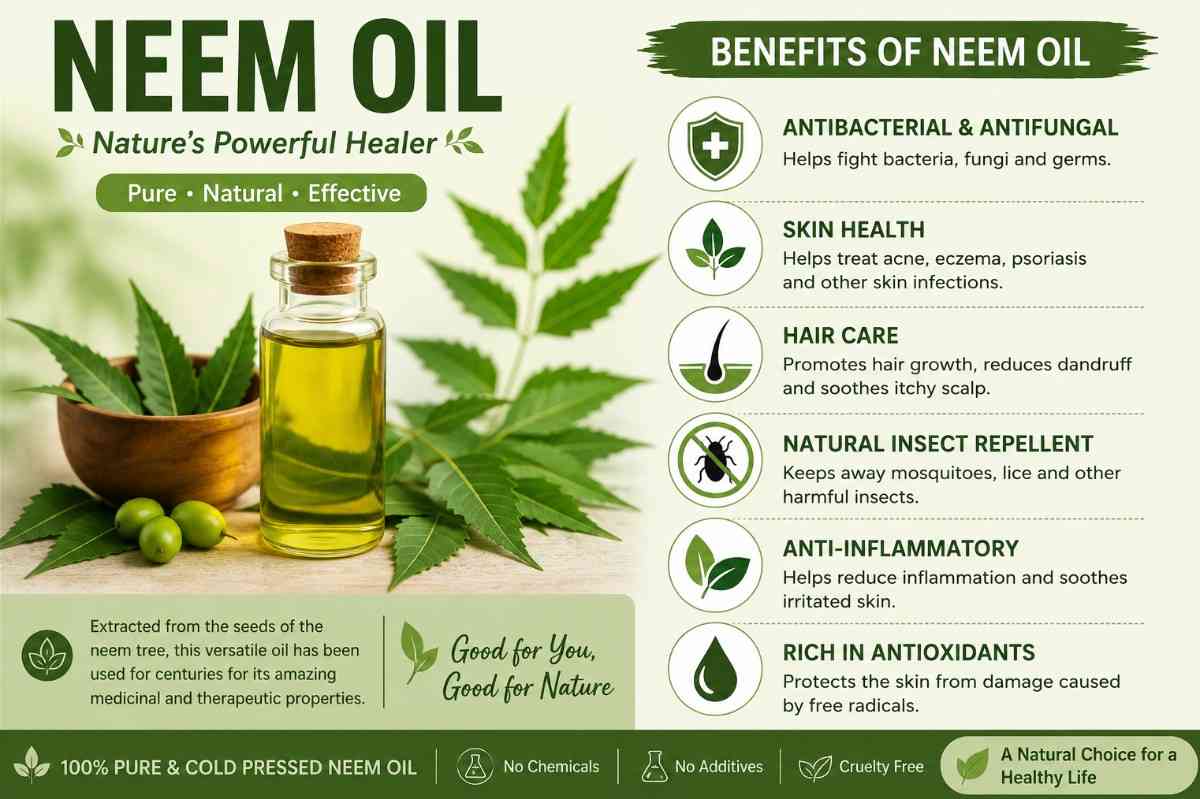
Neem oil has been used in traditional Indian practices for generations, but today it is equally popular in gardening, skincare, hair care, soaps, and natural pest control. It is pressed from the seeds and sometimes other parts of the neem tree, Azadirachta indica, a tropical evergreen tree native to the Indian subcontinent.
Neem oil is especially interesting because it contains several naturally occurring compounds, including limonoids such as azadirachtin, along with fatty acids. Its traditional reputation is broad, but modern evidence does not support every health claim made about neem oil.
One important distinction should be made at the beginning: neem oil intended for cosmetics or gardening is not automatically suitable for drinking or eating. There is also no well-established standard daily oral dose of neem oil for general health. Some neem products are traditionally taken orally, but concentrated neem oil can cause toxicity, particularly in children.
This guide explains what neem oil is, its potential benefits, practical uses, side effects, safety precautions, and what you should know before using it.
What Is Neem Oil?
Neem oil is a vegetable oil obtained primarily by pressing the seeds of the neem tree. The tree is botanically known as Azadirachta indica and is widely associated with traditional Indian agriculture and personal care.
Cold-pressed neem oil is usually thick and ranges from yellow to brown or dark greenish-brown, depending on processing and quality. It has a distinctive strong, bitter, garlic-like or sulfurous smell. The U.S. Environmental Protection Agency describes cold-pressed neem oil as having a bitter taste and pungent garlic/sulfur odor.
Neem oil contains fatty acids including oleic, palmitic, stearic, and linoleic acids. It also contains naturally occurring non-fat compounds, including limonoids. FAO data lists oleic acid as one of the major fatty acids in neem oil.
Neem oil is commonly used in:
- Skincare products
- Hair oils and shampoos
- Soaps
- Traditional personal-care preparations
- Garden pest control
- Plant disease management
- Natural insect-control products
- Agricultural formulations
Scientific research has investigated neem’s antimicrobial, insecticidal, anti-inflammatory, antioxidant, and other biological activities. However, laboratory findings should not automatically be interpreted as proof that neem oil treats a disease in humans.
Components of Neem Oil
| Nutrient/Component | Approximate amount per 100 g | Notes |
|---|---|---|
| Total fat | About 100 g | Primarily triglycerides and related lipids |
| Calories | About 880–900 kcal | Typical energy range for edible vegetable oils; neem oil is not a conventional edible oil |
| Oleic acid | About 42 g | Major monounsaturated fatty acid reported in neem oil |
| Stearic acid | About 21 g | Saturated fatty acid |
| Palmitic acid | About 19 g | Saturated fatty acid |
| Linoleic acid | About 15 g | Polyunsaturated fatty acid |
| Arachidic acid | About 1–2 g | Minor fatty acid |
| Azadirachtin and other limonoids | Variable | Concentrations depend on seed quality and processing |
| Protein | Negligible | Neem oil is essentially a fat-rich product |
| Carbohydrates | Negligible | Not a carbohydrate-rich food |
20 Proven Benefits of Neem Oil
1. May Support Healthy-Looking Skin: Oil is included in some skincare preparations because its naturally occurring compounds may help maintain the appearance and condition of the skin.
2. Contains Fatty Acids: Oleic, linoleic, palmitic, and stearic acids give neem oil emollient properties that can help soften dry skin when properly formulated.
3. May Help With Dry Skin: When diluted and used externally, its oily texture can help reduce the feeling of dryness by supporting the skin’s surface barrier.
4. Has Antimicrobial Properties: Laboratory research has identified antimicrobial activity in various neem preparations, although this does not mean neem oil should replace medical treatment for infections.
5. May Have Anti-Inflammatory Activity: Compounds found in neem have demonstrated anti-inflammatory effects in experimental research, but more human clinical evidence is needed to establish therapeutic benefits.
6. May Support Scalp Care: Diluted neem oil is traditionally incorporated into scalp and hair preparations because of its conditioning and cleansing properties.
7. May Help With a Dry, Flaky Scalp: Some people use diluted neem oil as part of a scalp-care routine, although persistent dandruff should be evaluated because several different conditions can cause scalp flaking.
8. May Help Protect Plants From Insects: Oil is particularly well known for agricultural and gardening applications because neem compounds can interfere with insect feeding and development.
9. May Act as an Insect Growth Regulator: Azadirachtin and related neem compounds can interfere with the growth and development of certain insects, making neem products useful in integrated pest management.
10. May Help Repel Certain Pests: Neem preparations can have repellent or antifeedant effects against some insects, although effectiveness varies by species and formulation.
11. May Support Plant Health: Registered neem products are used on agricultural and ornamental plants for managing certain insect pests and plant problems.
12. May Have Antifungal Activity: Neem compounds have demonstrated antifungal effects in experimental research, which is one reason neem preparations are traditionally used in plant and personal-care applications.
13. Provides Emollient Benefits: Its lipid-rich composition allows neem oil to function as a conditioning ingredient in soaps, creams, and hair products.
14. May Help Maintain a Clean-Feeling Scalp: Neem-based hair preparations are traditionally used as part of scalp hygiene, particularly when combined with other cleansing ingredients.
15. Can Be Used in Natural Soap: Neem oil can be incorporated into handmade soaps because its fatty acids contribute to the soap-making process.
16. May Help Protect Stored Plants and Garden Crops: Neem-based agricultural products can be useful for managing certain pests when applied according to their registered product directions.
17. Has Antioxidant-Related Activity: Neem contains bioactive compounds that have demonstrated antioxidant activity in experimental studies, although the health significance of topical neem oil in humans remains uncertain.
18. Has Traditional Ayurvedic Uses: Neem has been used traditionally in Indian systems of medicine for skin and other health-related purposes, although traditional use does not by itself establish clinical effectiveness.
19. Can Be Used in Personal-Care Formulations: Neem oil is found in products such as soaps, creams, hair products, and other cosmetic preparations.
20. Offers a Plant-Based Pest-Control Option: Properly formulated neem products provide gardeners with a plant-derived option for managing certain pests while following product-label directions.
10 Side Effects of Neem Oil
Neem oil can be useful when appropriately formulated and used externally, but it is not risk-free.
1. Skin Irritation: Undiluted neem oil may irritate sensitive skin, particularly when used repeatedly or in large quantities.
2. Allergic Reactions: Some people may develop redness, itching, rash, or other signs of contact sensitivity after topical application.
3. Eye Irritation: Neem oil should not be allowed to enter the eyes because oils and concentrated botanical compounds can cause significant irritation.
4. Strong Odor: Its naturally pungent smell can be unpleasant or overwhelming for some people.
5. Stomach Upset: Oral exposure may cause nausea, vomiting, abdominal discomfort, or other gastrointestinal symptoms.
6. Serious Toxicity After Ingestion: Concentrated neem oil ingestion has been associated with poisoning, particularly in young children, so it should never be casually treated as an everyday health drink.
7. Possible Effects on the Liver: Large or inappropriate oral exposure may pose toxicological concerns, and concentrated neem products should not be self-administered internally.
8. Possible Reproductive Concerns: Neem has demonstrated biological activity affecting reproductive processes in experimental research, which is one reason oral neem products require particular caution during pregnancy.
9. Increased Sensitivity in Children: Children may be more vulnerable to poisoning from concentrated oil, making safe storage especially important.
10. Problems From Improper Dilution: Applying concentrated oil directly to the skin or scalp can increase the likelihood of irritation compared with an appropriately diluted formulation.
How to Use Neem Oil?
For skin or hair, choose a product specifically manufactured for cosmetic use. If using pure neem oil, dilute a small amount with a suitable carrier oil such as coconut, jojoba, or another cosmetic carrier.
Perform a patch test before broader application. Avoid the eyes, lips, mucous membranes, broken skin, and irritated areas.
For gardening, use a neem product specifically labeled for plants and follow the manufacturer’s directions. Neem pesticide products have specific concentrations, application methods, crop restrictions, and safety instructions.
Other Uses of Neem Oil
Neem oil has uses far beyond personal skincare.
It is widely used in gardening as a botanical pest-management ingredient. Registered products may be used against certain aphids, caterpillars, mites, whiteflies, beetles, and other pests, depending on the formulation and label.
It is also used in:
- Handmade soaps
- Hair oils
- Shampoos
- Body-care products
- Traditional skin preparations
- Plant sprays
- Agricultural pest-management products
- Ornamental plant care
- Some natural household formulations
The EPA maintains registrations for multiple oil pesticide products, demonstrating that oil has an established agricultural and horticultural role when used according to approved labels.
How to Make Neem Oil at Home?
True neem oil is produced by extracting oil from neem seeds, commonly through mechanical pressing or other extraction methods. Producing high-quality oil at home is difficult because proper seed selection, drying, pressing, filtration, storage, and contamination control all affect the final product.
A simple traditional preparation can instead involve crushing clean, dried neem seeds and pressing them, but this does not guarantee a standardized, purified, or microbiologically safe oil.
For skincare or gardening, a commercially produced neem oil from a reputable manufacturer is generally more practical because the product can provide information about processing, concentration, intended use, and storage.
How Much Neem Oil Can You Use Per Day?
There is no established universal daily amount of neem oil that can be recommended for oral consumption.
For topical use, the appropriate amount depends on the product, concentration, application area, and intended purpose. More is not necessarily better. A small amount of appropriately diluted oil is generally preferable to applying a thick layer.
For gardening, follow the exact product label rather than calculating your own concentration.
Neem oil dosage depends heavily on what the product is being used for.
| Intended Use | General Guidance |
|---|---|
| Skin | Use a properly formulated cosmetic product or dilute pure oil before application |
| Hair/scalp | Use a diluted preparation and avoid the eyes |
| Gardening | Follow the pesticide product label exactly |
| Oral use | No standard self-care dose is established |
| Children | Do not give concentrated neem oil orally |
| Pregnancy | Avoid oral use unless specifically advised by a qualified healthcare professional |
This distinction is important because neem oil products can have very different concentrations and intended uses.
Best Time to Use Neem Oil
For skincare, neem oil can generally be used according to the instructions of the cosmetic product. If using a diluted preparation, many people prefer applying it in the evening because of its strong smell and oily texture.
For hair and scalp care, it can be incorporated into a routine according to the product directions.
For gardening, timing depends on the pest, crop, weather, and specific formulation. Some neem pesticide labels provide detailed instructions about when and how the product should be applied. Always follow the registered product label.
Who Should Use Neem Oil?
- Adults Seeking Plant-Based Skincare: Adults who tolerate botanical ingredients may use properly formulated neem products as part of a skincare routine.
- People With Dry Skin: A suitable neem-based moisturizer or diluted formulation may provide emollient benefits for some people.
- People Interested in Hair Care: Neem-containing hair products may be incorporated into a normal scalp-care routine when tolerated.
- Gardeners: Neem-based horticultural products can be useful for people looking for plant-derived pest-management options.
- People Using Cosmetic Neem Products: Products manufactured specifically for topical use are preferable to homemade preparations when safety and consistency matter.
Who Should Not Use Neem Oil?
- Young Children: Concentrated oil should be kept away from children because accidental ingestion can cause serious poisoning.
- Pregnant People: Oral neem oil should be avoided during pregnancy unless a qualified healthcare professional specifically recommends a suitable preparation.
- People With Sensitive Skin: Those prone to irritation or botanical allergies should patch-test first or avoid neem products that cause reactions.
- People With Eye Conditions: Oil should not be applied in or immediately around the eyes.
- People With Broken Skin: Applying concentrated oil to wounds or damaged skin may increase irritation.
- People Taking Medicines: Anyone considering oral neem products while taking medication should first discuss potential interactions with a healthcare professional.
- People Planning Oral Use: Anyone looking for a daily wellness oil should not assume neem oil is an appropriate dietary supplement.
How to Store Neem Oil?
Store neem oil in a tightly closed, light-resistant container in a cool, dry location.
Neem oil can become thicker or cloudy at cooler temperatures, which does not necessarily mean it has spoiled. Gently warming the container can return it to a more fluid state, but avoid excessive heat.
Keep the bottle away from:
- Direct sunlight
- Excessive heat
- Moisture
- Children
- Pets
- Food and cooking oils
Always follow the manufacturer’s storage instructions because shelf life varies according to processing, packaging, and formulation.
Precautions and Interactions
- Patch Test First: Apply a small amount of diluted product to a limited skin area before using it more widely.
- Never Put It in the Eyes: Avoid direct eye exposure and rinse thoroughly with clean water if accidental exposure occurs.
- Do Not Drink Pesticide Products: Oil sold for gardening should never be consumed.
- Do Not Confuse Cosmetic and Oral Products: Different formulations may contain different ingredients, concentrations, and preservatives.
- Avoid Unsupervised Oral Use: There is insufficient evidence to establish a routine oral neem oil dose for general health.
- Use Extra Caution Around Children: Store oil securely and seek urgent medical assistance if a child swallows concentrated neem oil.
- Follow Pesticide Labels: Neem products registered as pesticides must be used according to their label directions. The EPA specifically emphasizes following pesticide labeling for safe use.
- Do Not Assume Natural Means Risk-Free: Neem is plant-derived, but it contains biologically active compounds and can cause adverse effects when misused.
- Discuss Medication Use With a Professional: If you take regular medicines and are considering oral neem preparations, ask a healthcare professional about possible interactions.
- Stop If Irritation Develops: Discontinue topical use if you develop persistent burning, redness, swelling, itching, or a rash.
Final Thoughts
Neem oil is one of the more versatile plant oils, with a history that connects traditional Indian practices, modern cosmetics, and agricultural pest management. Its fatty-acid composition gives it useful emollient characteristics, while neem’s naturally occurring limonoids and other compounds have attracted considerable scientific interest.
Its strongest practical application today is arguably external and agricultural use, particularly in properly formulated skincare and plant-care products. Scientific research supports several interesting biological properties, but evidence for many claimed human health benefits remains limited or preliminary.
Most importantly, oil should not be treated as an everyday edible oil. There is no universally established safe oral dose for general wellness, and concentrated ingestion can be dangerous. Choosing a product according to its intended use, following its label, and seeking professional advice before oral use are the safest approaches.
FAQ’s
What is neem oil good for?
Oil is commonly used for skincare, hair care, soaps, and natural plant pest control. It contains fatty acids and bioactive compounds that have been studied for antimicrobial, anti-inflammatory, and insecticidal properties.
Can I apply neem oil directly to my skin?
It is generally better to dilute pure oil with a suitable carrier oil before applying it to the skin. Always perform a patch test first because neem oil can cause irritation in some people.
Can neem oil be used on hair?
Yes. Diluted oil is traditionally used in hair and scalp-care preparations. Avoid getting it into your eyes and stop using it if irritation occurs.
Is neem oil safe during pregnancy?
Oral oil should be avoided during pregnancy unless specifically recommended by a qualified healthcare professional. Neem contains biologically active compounds that may affect reproductive processes.
Does neem oil help with dandruff?
Oil is traditionally used for scalp care and may help maintain a clean, healthy-feeling scalp. However, persistent or severe dandruff may require treatment specifically targeted to its underlying cause.
Does neem oil repel insects?
Yes. Neem compounds such as azadirachtin can affect feeding, growth, and development of certain insects. Neem-based products are widely used in gardening and agriculture for pest management.
Does neem oil expire?
Yes. oil can deteriorate over time, especially when exposed to heat, light, and air. Store it tightly closed in a cool, dark, dry place and follow the manufacturer’s expiration or storage instructions.
Why does neem oil smell so strong?
Oil naturally has a pungent, bitter, garlic-like or sulfurous odor. The smell is a characteristic of the oil and can vary depending on its processing and quality.
Can neem oil be used every day?
For topical use, frequency depends on the product and your skin or scalp’s tolerance. Pure oil should not necessarily be used daily, particularly if it causes dryness or irritation.
Can neem oil be used on plants?
Yes. oil is commonly used in gardening and agriculture to manage certain insect pests. Use only products intended for plants and follow the label directions carefully.
Is neem oil good for acne?
Neem has traditionally been used for skin problems and has demonstrated antimicrobial activity in laboratory research, but there is not enough high-quality clinical evidence to recommend oil as a primary acne treatment.
Can neem oil remove dark spots?
There is insufficient clinical evidence to show that oil reliably removes dark spots or hyperpigmentation. Using concentrated oil on the skin may instead cause irritation, which can worsen pigmentation in some people.
Can neem oil cause skin irritation?
Yes. Undiluted oil may cause redness, itching, burning, or irritation, especially in people with sensitive skin. Patch-test diluted oil before wider use.
Is neem oil safe for children?
Concentrated oil should be kept away from children. Accidental ingestion has been associated with serious poisoning, particularly in young children.
Can neem oil be used on the face?
A properly formulated cosmetic neem product may be used on the face if tolerated. If using pure oil, dilute it appropriately, avoid the eyes and lips, and perform a patch test first.
Is neem oil antifungal?
Neem preparations have demonstrated antifungal activity in laboratory and experimental studies. However, oil should not replace medically recommended antifungal treatment for an established infection.
Is neem oil good for dry skin?
Oil contains fatty acids that can provide emollient properties when used appropriately. A properly diluted or formulated neem product may help moisturize and soften dry skin.
How long does it take for Neem Oil to work?
For plants, oil may begin affecting pests within a few days, but results vary by pest, product, and application. It is not an instant insecticide.
What does Neem Oil smell like?
Oil has a strong, pungent smell often described as garlic-like, bitter, earthy, or sulfur-like.
What is Neem Oil used for?
Oil is commonly used for skincare, hair and scalp care, soaps, and plant pest management. It is particularly well known as a botanical gardening product.
Where should you not use Neem Oil?
Avoid using oil in the eyes, on mucous membranes, broken or severely irritated skin, or internally unless specifically directed by a qualified healthcare professional.
What plants cannot be sprayed with Neem Oil?
Some plants can be sensitive to oil, especially delicate, newly transplanted, stressed, or heat-stressed plants. Always check the product label and test a small area before treating the whole plant.
Does Neem Oil repel cockroaches?
Neem compounds may have insect-repellent or growth-disrupting effects, but oil is generally not considered one of the most reliable standalone solutions for a cockroach infestation.
What is more effective than Neem Oil?
For serious plant pest infestations, the most effective option depends on the pest. Insecticidal soaps, horticultural oils, biological controls, or appropriately labeled pesticides may work better in specific situations.
Is Neem Oil better than Coconut Oil?
Neither is universally better. Oil is mainly valued for its bioactive compounds and pest-control applications, while coconut oil is commonly used as an emollient and carrier oil in personal care.
Which is better, Neem Oil or Neem Powder?
It depends on the purpose. Oil is concentrated in oil-soluble compounds and is commonly used topically or for plants, while neem powder contains other plant components and is used differently. They should not be considered interchangeable.
Does Neem Oil really work?
Yes, neem-based products can work against certain plant pests, particularly when used correctly and repeatedly as directed. Effectiveness varies depending on the pest, concentration, timing, and formulation.
How to identify pure Neem Oil?
Pure oil is typically thick and has a strong characteristic odor, with a color ranging from yellow to dark greenish-brown. However, appearance and smell alone cannot confirm purity. Look for a reputable manufacturer, ingredient list, extraction method, batch information, and appropriate quality certification.
Sources / References:
- U.S. Environmental Protection Agency – Cold Pressed Neem Oil Biopesticides Registration Decision
- U.S. Environmental Protection Agency – Pesticide Labeling Questions & Answers
- U.S. EPA – Neem Oil Product Registration and Labels
- Indian Journal of Dermatology – Neem in Dermatology: Shedding Light on the Traditional Panacea
- PMC – Vegetable Butters and Oils as Therapeutically and Cosmetically Active Ingredients for Dermal Use
About the Author:
Written by: Kirti Solanki (Health Content Researcher)
Kirti Solanki creates reader-friendly health and nutrition content based on scientific literature, established health resources, and evidence-based research. Content is written to make complex health information easier to understand while clearly separating traditional uses from scientifically established evidence.
Disclaimer:
This article is for educational purposes only and does not replace professional medical advice, diagnosis, or treatment. Neem oil can cause adverse effects when misused, and oral use is not recommended without appropriate professional guidance. Always check the product label and consult a qualified healthcare professional before using oil medicinally.
Also Read: