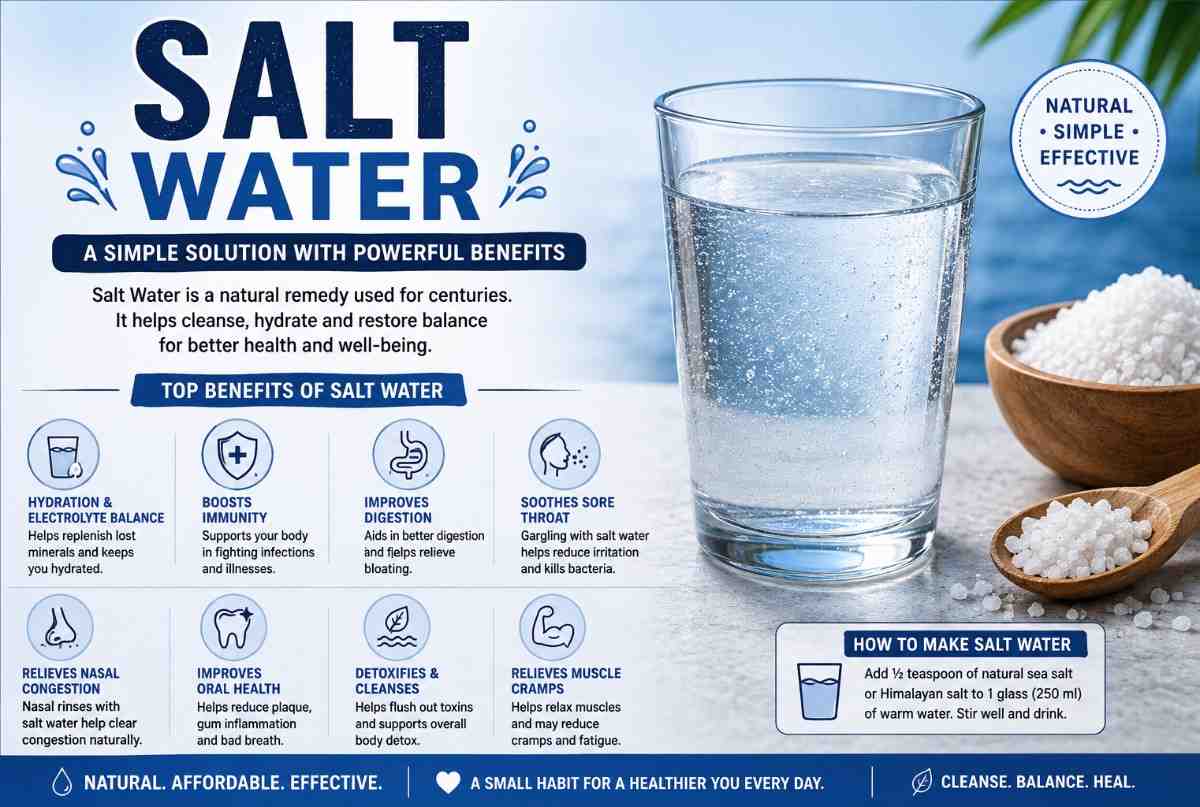
Salt water is one of the simplest mixtures people use at home. It is made by dissolving salt, usually table salt or sodium chloride, in water. Depending on how it is prepared, salt water may be used for cooking, gargling, oral rehydration in specific medical situations, cleaning, and several household purposes.
You may also hear claims that drinking salt water every morning “detoxes” the body, improves digestion, boosts energy, or promotes weight loss. However, these claims need to be separated from what science actually supports. Salt provides sodium, an essential electrolyte needed for normal nerve function, muscle contraction, and fluid balance, but most people already get enough or too much sodium from their regular diet.
The World Health Organization recommends that adults consume less than 2,000 mg of sodium per day, equivalent to less than 5 grams of salt per day. Excess sodium intake is associated with increased blood pressure and cardiovascular risk. (World Health Organization)
So, salt water can have useful applications, but drinking concentrated salt water regularly is not generally necessary for healthy people.
What Is Salt Water?
Salt water is water containing dissolved salt. The most common type is made with sodium chloride, the same salt commonly used in cooking.
When salt dissolves in water, it separates into sodium and chloride ions. Sodium is an important electrolyte that helps regulate body fluids, support nerve signaling, and enable normal muscle function.
The concentration of salt makes a major difference. A lightly salted solution is very different from seawater or highly concentrated salt water.
Salt water can be prepared for different purposes, including:
- Drinking in carefully formulated rehydration solutions.
- Gargling for temporary throat comfort.
- Food preparation and cooking.
- Cleaning and household applications.
- Certain oral-care routines.
- Rinsing some foods or surfaces.
Importantly, ordinary homemade salt water should not be considered the same as oral rehydration solution (ORS). ORS contains carefully balanced amounts of glucose and electrolytes and is designed to improve absorption during dehydration caused by conditions such as diarrhea.
20 Science-Backed Benefits of Salt Water
1. Supports Fluid Balance: Sodium helps regulate the amount of fluid inside and outside cells, making it an important electrolyte for normal body-fluid balance.
2. Supports Nerve Function: Sodium ions help nerves generate and transmit electrical signals needed for normal communication throughout the body.
3. Helps Normal Muscle Function: Sodium participates in the electrical processes required for muscles to contract and relax normally.
4. Supports Normal Blood Volume: Sodium contributes to extracellular fluid volume, which plays an important role in maintaining normal circulation.
5. Helps Replace Sodium Loss During Heavy Sweating: During prolonged, intense exercise or substantial sweating, sodium and other electrolytes can be lost through sweat, although the appropriate replacement strategy depends on the activity and individual needs.
6. Can Support Rehydration When Properly Formulated: Sodium combined with glucose in an appropriately prepared oral rehydration solution helps the intestine absorb water and electrolytes efficiently.
7. Helps Replace Electrolytes During Certain Illnesses: Medically appropriate oral rehydration solutions can replace water and electrolytes lost during diarrhea and other causes of dehydration.
8. May Soothe a Sore Throat: Gargling warm salt water can temporarily soothe throat irritation and discomfort, and reputable medical guidance recommends salt-water gargling as a home-care measure.
9. May Help Loosen Throat Mucus: Gargling with warm salt water can help clear mucus and provide temporary relief when the throat feels congested.
10. Supports Oral Hygiene as a Rinse: A salt-water rinse may be used as a simple oral-care rinse, although it should not replace brushing with fluoride toothpaste and regular dental care.
11. Can Temporarily Reduce Mouth Discomfort: A mild salt-water rinse may provide soothing comfort for some minor mouth irritation.
12. Provides an Essential Mineral: The sodium obtained from salt contributes to essential physiological functions when consumed in appropriate amounts.
13. Can Help Prevent Sodium Deficiency in Specific Situations: People with significant sodium losses may require electrolyte replacement, although the appropriate amount should be determined according to the cause and severity.
14. Supports Normal Cellular Function: Sodium gradients across cell membranes are fundamental to many normal cellular processes.
15. Supports Nutrient and Water Absorption in ORS: In oral rehydration solution, sodium and glucose work together to improve intestinal absorption of water and electrolytes.
16. Can Be Useful During Certain Episodes of Diarrhea: Properly prepared ORS is an established treatment for dehydration associated with diarrhea and is very different from simply drinking salty water.
17. Can Be Used as a Simple Gargle: Warm salt water is an inexpensive home-care option for temporary throat comfort when used as a gargle rather than swallowed.
18. May Help Maintain Electrolyte Availability: Sodium is one of the major electrolytes required for normal physiological function.
19. Can Be Useful After Significant Fluid Loss When Properly Formulated: Appropriate electrolyte solutions can be more useful than plain water when substantial fluid and electrolyte losses occur.
20. Supports the Body’s Normal Sodium-Dependent Processes: Adequate sodium availability is necessary for normal nerve, muscle, and fluid-regulation processes.
A key point: These benefits should not be interpreted as evidence that healthy people need to drink salt water every day. In fact, excess sodium can raise blood pressure, and WHO recommends reducing excessive sodium consumption. (World Health Organization)
10 Side Effects of Salt Water
Drinking concentrated or excessive amounts of salt water can cause problems because of its high sodium content.
1. Increased Blood Pressure: Regularly consuming excessive sodium can contribute to elevated blood pressure, which increases cardiovascular risk.
2. Excessive Thirst: Concentrated salt water can make you feel thirstier because the body needs additional water to maintain appropriate fluid concentration.
3. Nausea: Drinking highly concentrated salt water may irritate the stomach and cause nausea.
4. Vomiting: Large amounts of concentrated salt water can trigger vomiting and further worsen fluid loss.
5. Stomach Discomfort: Salt water that is too concentrated may cause abdominal discomfort or digestive irritation.
6. Fluid Retention: Excess sodium can cause the body to retain more water, particularly in people who are sensitive to sodium.
7. Increased Kidney Workload: The kidneys must regulate and excrete excess sodium, making excessive sodium intake particularly concerning for people with kidney problems.
8. Electrolyte Imbalance: Consuming excessive amounts of salt can disrupt the body’s electrolyte balance and may become dangerous in severe cases.
9. Worsening of Certain Medical Conditions: High sodium intake can be particularly problematic for people with hypertension, heart failure, kidney disease, or other salt-sensitive conditions.
10. Dehydration Risk With Highly Concentrated Solutions: Very salty drinks can worsen thirst and may interfere with appropriate hydration rather than improving it.
How to Make Salt Water?
The correct recipe depends on what you intend to use the salt water for.
For a Salt-Water Gargle
For a sore throat, Mayo Clinic recommends approximately 1/4 to 1/2 teaspoon of table salt in 4 to 8 ounces (120 to 240 mL) of warm water. Gargle the solution and spit it out rather than swallowing it. Children older than 6 and adults can generally use this method if they can gargle safely. (Mayo Clinic)
For Drinking During Dehydration
Do not improvise a concentrated salt-water drink when you have significant diarrhea or dehydration.
For dehydration associated with diarrhea, use a commercially prepared oral rehydration salts (ORS) solution according to the package instructions whenever possible. WHO describes ORS as a solution containing water, salts, and glucose in carefully balanced proportions.
A homemade drink containing only water and salt is not equivalent to ORS.
Simple Salt Water for Other Non-Drinking Uses
For non-medical household purposes, the amount of salt can vary according to the intended use. Always use clean water and avoid assuming that a household salt-water mixture is suitable for drinking.
Tips for Consuming Salt Water
- Keep It Light: Avoid making drinking water heavily salty because concentrated sodium can quickly add to your daily intake.
- Do Not Drink It Simply for Detox: Your kidneys and liver already perform the body’s normal waste-processing functions, and there is no good evidence that routine salt-water drinking “detoxes” the body.
- Watch Your Total Sodium Intake: Remember that sodium comes from packaged foods, restaurant meals, sauces, snacks, bread, processed meats, and many other foods.
- Choose Plain Water for Everyday Hydration: For most healthy people, ordinary drinking water is sufficient for routine hydration.
- Use ORS When Appropriate: If you have significant fluid loss from diarrhea, use a properly prepared ORS rather than experimenting with concentrated salt water.
- Do Not Confuse Gargling With Drinking: Salt-water gargles are intended to be spit out.
- Avoid Very Salty Solutions: A strong salty taste is a warning that the solution may contain a substantial amount of sodium.
Other Uses of Salt Water
Salt water has several practical uses beyond drinking.
1. Salt-Water Gargle
A warm salt-water gargle may temporarily soothe a sore throat and is a commonly recommended home-care measure.
2. Oral Rinsing
Some people use mild salt-water rinses as part of oral hygiene, although they should not replace brushing, flossing, fluoride toothpaste, or professional dental care.
3. Food Preparation
Salt water can be used when cooking pasta, vegetables, grains, and other foods.
4. Food Preservation
Salt has historically been used as part of preservation methods because high salt concentrations can inhibit the growth of many microorganisms.
5. Cleaning
Salt-water mixtures are sometimes used for simple household cleaning tasks, although effectiveness varies depending on the surface and type of contamination.
6. Gargling After Certain Oral Procedures
A dentist may sometimes recommend a particular salt-water rinse after certain dental procedures. Follow your dentist’s specific instructions rather than using a highly concentrated homemade solution.
How Much Salt Water Can You Drink in a Day?
There is no universal recommended daily amount of plain salt water for healthy people.
For routine hydration, plain water is generally a better choice than deliberately adding salt.
The more important number is your total sodium intake. WHO recommends that adults consume less than 2,000 mg of sodium per day, equivalent to less than 5 grams of salt per day. This includes salt naturally present in foods, salt added during cooking, and salt added at the table.
Because even a small amount of salt can contain hundreds of milligrams of sodium, drinking salty water every day can unnecessarily increase sodium intake.
If you have substantial fluid loss from diarrhea or another medical problem, follow appropriate ORS instructions rather than trying to determine a daily quantity of homemade salt water yourself.
Best Time to Drink Salt Water
For most healthy people, there is no medically established best time to drink plain salt water.
You may see recommendations online suggesting salt water first thing in the morning, before exercise, or before meals. These practices are often promoted for hydration, digestion, detoxification, or weight loss, but strong evidence does not establish that drinking salt water at a particular time provides these benefits.
For ordinary hydration, drink water according to thirst and your individual needs.
During prolonged exercise or heavy sweating, electrolyte replacement may sometimes be appropriate, but the best approach depends on exercise duration, sweat losses, climate, diet, and individual health.
Who Should Drink Salt Water?
Salt water should not be viewed as a daily health drink. Specific salt-containing fluids may be appropriate in particular circumstances.
- People Using Salt-Water Gargles: Adults and older children who can safely gargle may use an appropriate warm salt-water gargle for temporary sore-throat relief.
- People With Dehydration From Diarrhea: People experiencing diarrhea-related dehydration may benefit from properly prepared ORS, rather than ordinary salty water.
- People With Significant Fluid Loss: Individuals experiencing substantial fluid and electrolyte losses may need an appropriate electrolyte solution based on medical guidance.
- Endurance Exercisers in Certain Situations: People exercising for prolonged periods in hot conditions may sometimes require electrolyte replacement, depending on sweat losses and the overall exercise plan.
- People Advised by a Healthcare Professional: Individuals who have been specifically instructed to increase sodium or use an electrolyte solution should follow the prescribed formulation and amount.
Who Should Avoid Salt Water?
- People With High Blood Pressure: People with hypertension should be cautious about adding unnecessary sodium because excessive sodium intake can raise blood pressure.
- People With Kidney Disease: Reduced kidney function can affect the body’s ability to regulate sodium and fluid, so additional salt should not be taken casually.
- People With Heart Failure: Excess sodium can contribute to fluid retention and may worsen problems with fluid balance.
- People Following a Sodium-Restricted Diet: Anyone advised by a healthcare professional to restrict sodium should avoid routine salt-water drinking.
- People With Certain Liver Conditions: Some liver conditions involve fluid retention or sodium restrictions, making unnecessary salt intake inappropriate.
- Young Children: Young children should not be given homemade concentrated salt water, particularly during illness; use age-appropriate medical guidance and properly prepared ORS when indicated.
- People Taking Certain Medications: Some medicines affect blood pressure, kidney function, potassium, or fluid balance, so additional sodium may not be appropriate.
- People Drinking Salt Water for Detox: Anyone using salt water as a detox or cleansing drink should reconsider the practice because excessive sodium can create health risks without established detox benefits.
How to Store Salt Water?
- Use a Clean Container: Store salt water only in a clean, food-safe container when storage is necessary.
- Keep It Covered: A covered container helps reduce contamination from dust, microorganisms, and other environmental sources.
- Refrigerate When Appropriate: If a prepared solution needs to be kept temporarily, refrigeration can help maintain quality, but storage recommendations depend on what the solution is intended for.
- Prepare ORS According to Instructions: Follow the storage instructions on commercial ORS products because prepared ORS has a limited usable period.
- Discard Contaminated Solutions: Throw away salt water if it becomes cloudy, develops an unusual smell, or appears contaminated.
- Do Not Store Homemade Medical Solutions Indefinitely: Solutions intended for illness-related rehydration should be prepared and stored according to established medical instructions rather than kept for long periods.
Precautions and Interactions
Salt water is simple, but the sodium it contains can interact with health conditions and medications.
1. Monitor Sodium Intake: Count salt water as part of your total daily sodium intake rather than treating it as sodium-free hydration.
2. Be Careful With Blood Pressure Problems: Excess sodium can increase blood pressure, so people with hypertension should avoid unnecessary salt-water consumption.
3. Consider Kidney Function: People with kidney disease may need individualized limits on sodium and fluids.
4. Consider Heart Conditions: People with heart failure or fluid-retention problems should follow their healthcare professional’s sodium and fluid recommendations.
5. Check Medications: Some medicines influence fluid balance, blood pressure, sodium, or kidney function, making additional sodium inappropriate for some people.
6. Do Not Replace ORS With Salt Water: ORS is specifically formulated to contain glucose and electrolytes in proportions that support absorption; plain salty water does not provide the same formulation.
7. Avoid Concentrated Solutions: Very salty water can cause nausea, vomiting, excessive thirst, and electrolyte disturbances.
8. Do Not Use Salt Water as a Detox Drink: There is no established need for healthy people to drink concentrated salt water to cleanse the body.
9. Do Not Treat Severe Dehydration at Home Alone: Severe diarrhea, repeated vomiting, confusion, extreme weakness, or inability to drink requires prompt medical attention.
10. Spit Out Gargling Solutions: Salt water intended for gargling should generally be spit out rather than swallowed.
Salt Water vs. ORS: What Is the Difference?
Salt water and oral rehydration solution are often confused, but they are not the same.
| Feature | Salt Water | Oral Rehydration Solution |
|---|---|---|
| Main ingredients | Water + salt | Water + glucose + sodium + other electrolytes |
| Primary purpose | Various household/oral uses | Rehydration during fluid loss |
| Designed for dehydration treatment | No | Yes |
| Contains glucose | No | Yes |
| Electrolyte balance | Depends on recipe | Carefully formulated |
| Suitable for routine drinking | Usually unnecessary | Used when medically indicated |
| Can replace medical ORS? | No | Yes, when appropriately prepared |
WHO specifically recommends ORS for preventing and treating dehydration associated with diarrhea.
Is Drinking Salt Water Every Morning Healthy?
For most healthy people, drinking salt water every morning is not necessary.
The body requires sodium, but sodium needs are normally met through food. WHO notes that high sodium intake is common worldwide and recommends reducing excessive sodium consumption.
Claims that morning salt water automatically improves metabolism, melts belly fat, removes toxins, or dramatically boosts energy are not well supported by high-quality evidence.
If you enjoy drinking water in the morning, plain water is generally a simpler choice.
Can Salt Water Help With Weight Loss?
Salt water is not a proven weight-loss drink.
It contains essentially no calories, but that does not mean it causes fat loss. Any temporary change in body weight after consuming or eliminating large amounts of fluid is more likely to reflect changes in water and intestinal contents rather than body-fat reduction.
Sustainable weight management is better supported by an overall balanced eating pattern, appropriate physical activity, adequate sleep, and a calorie intake suited to individual needs.
Can Salt Water Detox the Body?
There is no good evidence that drinking concentrated salt water provides a special detoxification effect.
Your liver, kidneys, lungs, digestive system, and other organs continuously process and eliminate waste products. Drinking excessive salt water can instead increase sodium intake and may cause unwanted effects.
A healthy diet, adequate hydration, regular physical activity, and avoiding excessive alcohol and highly processed foods are more meaningful approaches to supporting overall health.
Final Thoughts
Salt water is a simple mixture with several legitimate uses, but it is important not to confuse traditional health claims with evidence-based benefits.
Sodium is essential for normal nerve function, muscle activity, and fluid regulation. Properly formulated oral rehydration solutions can also play an important role in treating dehydration, particularly during diarrhea. Salt-water gargles may temporarily soothe a sore throat.
However, regularly drinking concentrated salt water is not necessary for most healthy people. Too much sodium can contribute to high blood pressure and cardiovascular risk. WHO recommends keeping adult salt intake below 5 grams per day, including salt from all foods and drinks.
For everyday hydration, plain water is usually the simpler choice. When dehydration requires electrolyte replacement, use a properly formulated ORS according to medical or package instructions rather than relying on a homemade concentrated salt-water drink.
FAQ’s
Is drinking salt water good for you?
Salt is an essential source of sodium, but most people get enough sodium from food. Drinking plain salt water regularly is generally unnecessary and excessive intake may increase blood pressure.
Can I drink salt water every day?
It is generally not recommended to drink homemade water every day. Plain water is usually a better choice for everyday hydration.
What does salt water do to the body?
Water provides sodium, which helps support fluid balance, nerve function, and muscle function. Too much sodium, however, can cause health problems.
Does salt water help with dehydration?
Properly formulated oral rehydration solution (ORS) can help treat dehydration, especially from diarrhea. Homemade water alone is not the same as ORS.
Can salt water help with weight loss?
No. water does not directly burn body fat or cause meaningful weight loss. Any short-term weight change is usually related to fluid changes.
Does salt water detox the body?
There is no strong evidence that drinking water detoxifies the body. Your kidneys, liver, and other organs naturally process and eliminate waste.
Can I drink salt water in the morning?
You can drink water in the morning, but there is no established health benefit to adding salt for most people. Plain water is generally sufficient.
Is salt water good for a sore throat?
Yes. Gargling with warm salt water may temporarily soothe a sore throat and help reduce irritation. It should generally be spit out rather than swallowed.
How much salt should I put in water for a sore throat?
A commonly recommended gargle is about 1/4 to 1/2 teaspoon of salt in 4–8 ounces (120–240 mL) of warm water.
Can salt water improve digestion?
There is not enough good evidence that routinely drinking water improves digestion. Concentrated water may actually cause nausea or stomach discomfort.
Does salt water make you poop?
Large amounts of concentrated water can have a laxative effect, but intentionally drinking it to induce bowel movements is not recommended because it can cause dehydration and electrolyte problems.
Can salt water lower blood pressure?
No. Excess sodium can actually increase blood pressure. People with hypertension should be particularly careful about unnecessary salt intake.
Is salt water good for the kidneys?
The kidneys need sodium to function normally, but excessive sodium can increase the kidneys’ workload and may be harmful, particularly in people with kidney disease.
Can children drink salt water?
Children should not routinely drink homemade water. If a child is dehydrated because of diarrhea or vomiting, use an age-appropriate ORS according to medical guidance.
What is the best salt for salt water?
For a basic gargle, ordinary table salt is generally sufficient. For rehydration, use a properly formulated ORS rather than trying to substitute different types of salt.
Is Himalayan salt water healthier than regular salt water?
No strong evidence shows that Himalayan salt water provides major health advantages over ordinary salt water. Both can provide significant amounts of sodium.
Can salt water replace electrolytes?
Salt provides sodium, but it does not provide the balanced combination of electrolytes and glucose found in ORS or many properly formulated electrolyte drinks.
Is salt water good before exercise?
Not necessarily. For ordinary workouts, water and a balanced diet are usually sufficient. During prolonged or intense exercise with substantial sweating, electrolyte replacement may sometimes be useful.
Can salt water help with headaches?
Water is not a proven treatment for headaches. A headache caused by dehydration may improve with adequate fluid intake, but adding salt is not automatically necessary.
Does salt water increase energy?
Water does not provide calories or a direct energy boost. Sodium supports normal nerve and muscle function, but that is different from providing energy.
Is salt water alkaline or acidic?
Water made with ordinary sodium chloride is generally close to neutral, although the exact pH can vary depending on the water and other dissolved substances.
Can I drink seawater?
No. Seawater contains far more salt than the human body can safely eliminate through the kidneys. Drinking seawater can worsen dehydration rather than relieve it.
What does Salt Water taste like?
Salt Water tastes salty, with stronger concentrations tasting more intense.
How long does Salt Water take to work?
A salt-water gargle may soothe the throat within minutes, while ORS starts supporting hydration soon after drinking.
What does Salt Water smell like?
Clean Salt Water usually has little to no noticeable smell.
Is Salt Water safe for pregnant women?
Pregnant women generally do not need to drink salt water routinely and should follow their healthcare provider’s sodium recommendations.
What does drinking Salt Water before bed do?
It has no proven special benefit and may increase thirst or sodium intake.
Is Salt Water good first thing in the morning?
There is no proven advantage for most people; plain water is usually sufficient.
Sources / References:
- Mayo Clinic – Sore Throat: Diagnosis and Treatment (Mayo Clinic)
- MedlinePlus – Sodium
- MedlinePlus – Electrolyte Panel
- UNICEF – Oral Rehydration Salts (ORS)
- American Heart Association – Shaking the Salt Habit
- MedlinePlus
About the Author:
Written by: Kirti Solanki (Health Content Researcher)
Kirti Solanki writes evidence-informed health and nutrition content, focusing on clear, practical information supported by reputable medical and scientific sources.
Disclaimer:
This article is for general educational purposes and is not a substitute for professional medical advice. People with kidney disease, heart conditions, high blood pressure, or sodium restrictions should consult a healthcare professional before intentionally increasing sodium intake.
Also Read: