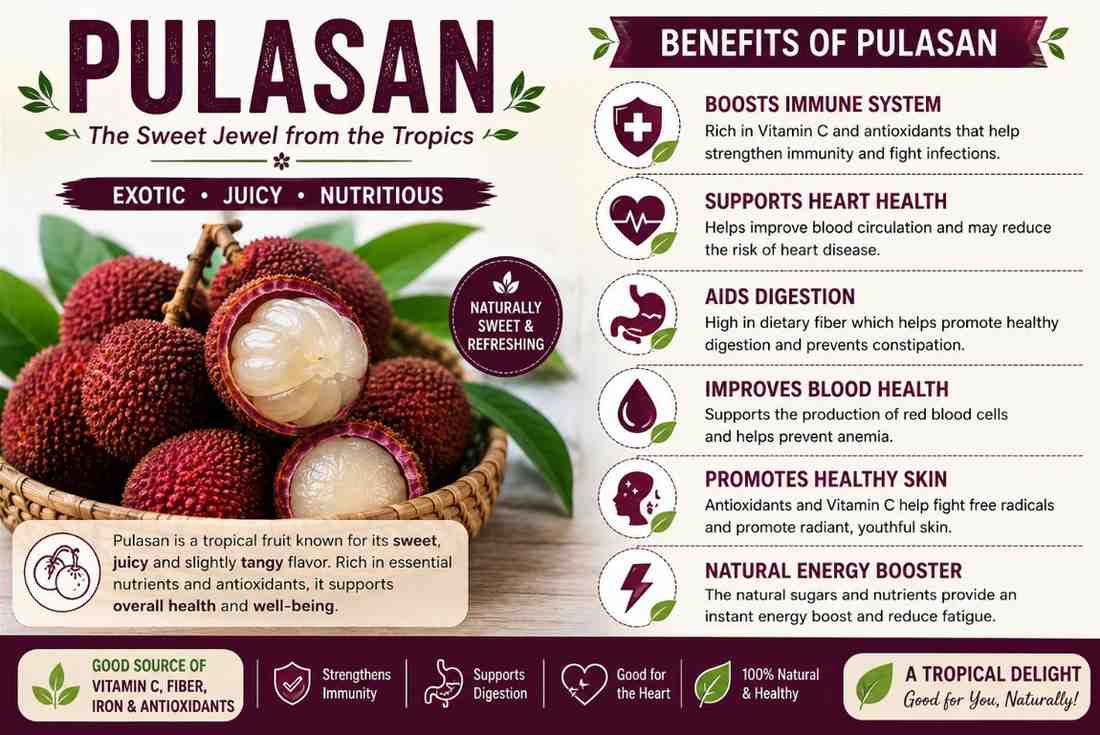
Pulasan (also known as Pulasaan, Kapulasan, Wild Rambutan, or Bulala) is one of those tropical fruits that can easily be mistaken for rambutan at first glance. Its colorful, textured skin and sweet, juicy flesh make it an attractive fruit, but pulasan is less commonly known outside Southeast Asia. It belongs to the soapberry family, Sapindaceae, and is closely related to rambutan and other Nephelium fruits.
The accepted botanical name is Nephelium ramboutan-ake (Labill.) Leenh., although older literature commonly uses Nephelium mutabile. Kew’s Plants of the World Online recognizes Nephelium ramboutan-ake as the accepted name and lists it as native from the eastern Himalaya through western Malesia.
Pulasan is especially associated with Malaysia, Indonesia, Thailand, Borneo, and other tropical parts of Southeast Asia. The fruit is generally eaten fresh, and its soft, juicy flesh has a sweet flavor that is often compared with rambutan or lychee.
This guide explores what pulasan is, its nutritional profile, potential health benefits, how to eat it, appropriate serving sizes, possible side effects, storage, precautions, and what science currently tells us about this unusual tropical fruit.
What Is Pulasan?
Pulasan is a tropical fruit produced by the tree Nephelium ramboutan-ake. It belongs to the same botanical family as rambutan and lychee.
The fruit is usually oval or rounded and develops a red, reddish-purple, or dark-colored outer skin when mature. Unlike rambutan, which has long, flexible hair-like spines, pulasan generally has shorter, thicker, blunt projections or warty structures on its surface.
The edible portion inside is usually pale, translucent, juicy, and soft. Its flavor is sweet and tropical, with some varieties having a slightly tart or floral character.
The name “pulasan” is associated with the Malay word “pulas,” meaning to twist, reflecting the traditional method of twisting the fruit open.
Pulasan has traditionally been consumed as a fresh fruit, but researchers have also investigated its peel, seed kernel, and other plant parts for phytochemicals and potential functional-food applications.
Importantly, many scientific studies on pulasan focus on extracts rather than ordinary servings of fresh fruit. Therefore, laboratory findings about antioxidant, blood-pressure, or blood-sugar effects should not be interpreted as proof that eating pulasaan treats or prevents disease.
Nutrition Facts of Pulasan
Nutrition values can vary according to variety, ripeness, growing conditions, and the portion measured. Available food-composition sources report approximately 85 g of water, 13 g of carbohydrates, 0.8 g of protein, 0.6 g of fat, and 0.1 g of fiber per 100 g edible portion. A Malaysian food-composition database also reports vitamin C and several minerals for pulasan.
| Nutrient | Approximate amount per 100 g edible portion |
|---|---|
| Water | 85 g |
| Energy | Approximately 60–70 kcal |
| Carbohydrates | 13 g |
| Protein | 0.8 g |
| Fat | 0.6 g |
| Dietary fiber | 0.1–0.5 g |
| Calcium | Approximately 54 mg* |
| Phosphorus | Approximately 9 mg* |
| Iron | Approximately 0.1 mg* |
| Potassium | Approximately 94 mg* |
| Sodium | Approximately 6 mg* |
| Vitamin C | Approximately 10.8 mg* |
*Reported values can differ between food-composition databases and samples. Use the table as an approximate nutritional guide rather than a laboratory analysis of every Pulasaan variety.
Pulasan is therefore best viewed as a water-rich tropical fruit that contributes carbohydrates and selected micronutrients rather than as a concentrated source of protein, fat, or fiber.
20 Proven Health Benefits of Pulasan
1. Provides Antioxidant Compounds
Pulasan contains plant compounds such as phenolics and flavonoids, and research has identified several bioactive compounds in its peel, including geraniin, catechin, chlorogenic acid, corilagin, syringic acid, and naringenin.
2. Supports Normal Immune Function
Pulasan provides vitamin C, a nutrient involved in normal immune-system function, collagen production, and protection of cells from oxidative stress.
3. Helps Add Fluids to the Diet
Because pulasan contains a high proportion of water, eating the fresh fruit can contribute to daily fluid intake alongside water and other hydrating foods.
4. Provides Natural Carbohydrates
The fruit supplies carbohydrates that the body can break down into glucose and use as an energy source, making pulasan a convenient naturally sweet snack.
5. Supports Collagen Production
Its vitamin C content contributes to normal collagen formation, which is important for healthy skin, blood vessels, bones, cartilage, and connective tissues.
6. May Help Protect Cells From Oxidative Stress
Antioxidant compounds identified in pulasan may help neutralize reactive molecules in laboratory testing, although the effects of eating whole Pulasaan in humans require more research.
7. May Support Cardiovascular Health as Part of a Balanced Diet
Pulasan contributes potassium and other nutrients, while a diet rich in fruits is generally compatible with heart-healthy eating patterns. However, Pulasaan itself should not be considered a treatment for high blood pressure.
8. Provides Potassium
Potassium is an essential mineral involved in fluid balance, nerve signaling, and normal muscle function, and pulasan contributes a modest amount.
9. May Contribute to Healthy Skin
Vitamin C supports collagen formation and antioxidant defenses, while adequate fruit intake contributes to an overall nutrient-rich diet that supports skin health.
10. Supports Normal Connective-Tissue Formation
Vitamin C is required for normal collagen synthesis, so including vitamin-C-containing fruits such as pulasan can help meet dietary needs.
11. Contains Naturally Occurring Polyphenols
Pulasan contains phenolic and flavonoid compounds that are being studied for their biological activities and antioxidant properties.
12. May Support Digestive Health Through Fruit Consumption
Although pulasan is not especially high in fiber, eating whole fruit instead of highly processed sweets can contribute to a more nutrient-dense dietary pattern.
13. Can Be a Better Snack Choice Than Many Highly Processed Sweets
Fresh pulasan provides water, carbohydrates, vitamin C, minerals, and plant compounds, making it a more nutrient-rich choice than many desserts dominated by added sugar.
14. May Contribute to Dietary Variety
Adding less-common fruits such as pulasan to the diet increases fruit variety and exposes the diet to a broader range of naturally occurring plant compounds.
15. May Have Antioxidant Potential in Extracts
Studies examining pulasan extracts have demonstrated antioxidant activity using laboratory assays such as DPPH, TEAC, and FRAP. These findings are promising but do not establish the same effects from normal fruit consumption.
16. May Have Potential for Blood-Sugar Research
Laboratory research on Pulasaan rind extracts has demonstrated alpha-amylase inhibition, suggesting potential relevance to carbohydrate digestion, but this does not mean eating pulasan lowers blood sugar in people.
17. May Have Blood-Pressure-Related Research Potential
Compounds from pulasan rind have demonstrated ACE-inhibitory activity in laboratory research, but clinical trials are needed before any blood-pressure benefit can be established in humans.
18. Provides Small Amounts of Calcium
Reported food-composition data indicate that pulasan contains calcium, a mineral needed for normal bones, teeth, muscle function, and nerve signaling.
19. Provides Small Amounts of Other Minerals
Pulasan contributes smaller amounts of phosphorus, iron, potassium, and sodium, although it should be consumed as part of a varied diet rather than relied upon as a major mineral source.
20. May Have Potential as a Functional-Food Ingredient
Research on Pulasaan peel and other by-products suggests that its phytochemicals may have future applications in functional foods and other products, although these applications remain an area of research rather than established medical treatment.
10 Side Effects of Pulasan Fruit
- Digestive Discomfort: Eating a large amount at once may cause bloating, stomach discomfort, or loose stools in some people.
- Natural Sugar Intake: Pulasaan contains naturally occurring carbohydrates, so very large servings can add a significant amount of sugar and calories to the diet.
- Allergic Reactions: People with fruit allergies may potentially experience itching, swelling, hives, digestive symptoms, or other allergic reactions after eating Pulasaan.
- Mouth or Throat Irritation: Sensitive individuals may experience irritation after eating unfamiliar tropical fruits, particularly if the fruit is not fresh.
- Seed Choking Risk: The seed can present a choking hazard, particularly for young children, so the edible flesh should be separated carefully.
- Spoiled-Fruit Problems: Overripe, damaged, fermented, or contaminated fruit can cause gastrointestinal illness.
- Food-Sensitivity Symptoms: People with individual food sensitivities may experience symptoms even when the fruit is considered safe for the general population.
- Excessive Intake: Eating large quantities can displace other nutritious foods and make the diet less balanced.
- Unproven Supplement Risks: Concentrated Pulasaan extracts are different from ordinary fruit, and their safety and appropriate doses have not been established as thoroughly as common foods.
- Possible Interaction Concerns With Concentrated Extracts: Research into pulasan rind compounds includes biological effects in laboratory assays, so people should not assume concentrated extracts are equivalent to eating the fruit.
How to Eat Pulasan?
Eating fresh pulasan is relatively simple.
First, choose a ripe fruit that has a healthy-looking outer skin without extensive bruising, mold, leaking juice, or an unpleasant fermented smell.
Wash the fruit under clean running water before opening it. Hold the pulasan firmly and twist the fruit until the skin separates. You can also use a clean knife to make a small cut through the peel if twisting is difficult.
Remove the outer skin and eat the soft, juicy flesh inside. The seed should generally be removed rather than casually chewed or swallowed.
Pulasaan can be eaten chilled, added to a fruit platter, mixed into fruit salads, or used in desserts. Because the fruit is naturally sweet, it usually does not need additional sugar.
Tips for Consuming Pulasan
- Choose Fresh Fruit: Select fruits that look fresh and free from mold, excessive bruising, or fermentation.
- Wash Before Opening: Rinse the fruit thoroughly before removing the skin.
- Start With a Small Serving: If you have never eaten Pulasaan before, try a small quantity first.
- Remove the Seed Carefully: Separate the flesh from the seed before giving the fruit to young children.
- Eat It Fresh: Fresh pulasan generally provides the simplest way to enjoy its flavor and nutritional value.
- Avoid Adding Excess Sugar: The fruit is already naturally sweet, so additional sugar is usually unnecessary.
- Pair It With Other Foods: Combine Pulasaan with plain yogurt, nuts, seeds, or other fruits for a more balanced snack.
- Do Not Rely on It as Medicine: Research into pulasan extracts is interesting, but eating the fruit should not replace medical treatment.
Other Uses of Pulasan
Pulasan has potential uses beyond simply eating the fresh flesh, particularly because researchers have investigated its peel and other parts for bioactive compounds.
- Fresh Fruit: Pulasaan is traditionally consumed fresh after removing the outer skin.
- Fruit Salads: The sweet flesh can be combined with other tropical fruits to create a colorful fruit salad.
- Desserts: Fresh pulasan can be incorporated into desserts where its natural sweetness and juicy texture are useful.
- Beverages: The flesh may be used experimentally in fruit beverages, although preparation should prioritize food safety.
- Canned Products: Like related tropical fruits, Pulasaan can be processed into preserved products.
- Functional-Food Research: Researchers are investigating pulasan peel and other fruit parts as potential sources of phytochemicals for functional-food applications.
- Antioxidant Research: Pulasaan peel has demonstrated antioxidant activity in laboratory testing and contains several phenolic compounds.
- Cosmetic Research: Oils and extracts from Pulasaan by-products have been studied for their phytochemical and antioxidant properties, although commercial cosmetic applications require further research and safety evaluation.
How Much Pulasan Can You Eat in a Day?
There is no scientifically established daily recommended serving specifically for pulasan.
For most healthy adults, a practical serving can be around 100–150 g of edible flesh, depending on the person’s overall diet and fruit intake. A smaller serving may be appropriate if you are eating several other fruits during the day.
The important point is variety. Pulasan can be included as one fruit within a balanced diet rather than consumed in unusually large amounts because of claims about its antioxidants.
If you have diabetes or are monitoring carbohydrate intake, include Pulasaan within your overall carbohydrate plan rather than treating it as a “free” food.
Best Time to Eat Pulasan Fruit
There is no proven medically superior time to eat pulasan.
You can eat it as a morning snack, alongside lunch, in the afternoon, or as part of a meal. If fruit tends to cause you digestive discomfort when eaten alone, having a moderate serving with a meal or another food may be more comfortable.
For people watching their blood glucose, portion size and the total carbohydrate content of the meal are generally more important than a specific clock time.
Who Should Eat Pulasan?
- Healthy Adults: Most healthy adults can enjoy fresh Pulasaan as part of a varied diet.
- Fruit Lovers: People looking to increase the variety of tropical fruits in their diet can include Pulasaan when available.
- People Seeking Vitamin-C Foods: Pulasaan can contribute vitamin C to the diet, although the amount varies among samples.
- People Wanting Naturally Sweet Snacks: Fresh pulasan can be an alternative to highly processed sweet snacks.
- People Following Plant-Rich Diets: Pulasaan fits naturally into vegetarian and plant-forward eating patterns.
- People Interested in Tropical Fruits: Those exploring Southeast Asian fruits may enjoy pulasan for its distinctive flavor and texture.
- People Looking for Hydrating Foods: Its high water content makes it a water-rich fruit choice.
Who Should Not Eat Pulasan?
- People With a Known Pulasan Allergy: Anyone who has previously experienced an allergic reaction to Pulasaan should avoid it unless a healthcare professional advises otherwise.
- People With a Serious Fruit Allergy: Those with significant food allergies should introduce unfamiliar fruits cautiously and follow their clinician’s advice.
- Young Children: Young children should not be allowed to eat the fruit unsupervised because the seed can create a choking hazard.
- People Eating Spoiled Fruit: Pulasaan showing mold, leakage, unusual fermentation, or significant spoilage should be discarded.
- People With Individual Food Intolerances: Anyone who consistently develops digestive symptoms after eating pulasan should avoid it and discuss recurring symptoms with a healthcare professional.
- People Considering Concentrated Extracts: Individuals should not assume that Pulasaan extracts, peel preparations, or supplements are as safe as ordinary food.
How to Store Pulasan?
- Refrigerate Fresh Fruit: Keep ripe pulasan refrigerated if you are not planning to eat it immediately.
- Use a Breathable Container: Avoid trapping damp fruit in a completely sealed container because excess moisture can encourage spoilage.
- Keep Damaged Fruit Separate: Remove bruised or leaking fruit so that spoilage does not spread to healthier fruit.
- Do Not Wash Far in Advance: Washing fruit long before storage can leave excess moisture on the skin and potentially shorten storage life.
- Check Before Eating: Inspect stored Pulasaan for mold, unusual odor, discoloration, or fermentation.
- Eat Promptly: Fresh tropical fruit generally tastes best and retains its quality when consumed soon after purchase or harvest.
Precautions and Interactions
- Keep Portions Moderate: Even nutritious fruit should be eaten in reasonable portions as part of a balanced diet.
- Consider Blood Sugar: Pulasaan contains carbohydrates, so people with diabetes should account for the fruit within their overall meal plan.
- Check for Allergies: Stop eating the fruit and seek appropriate medical attention if symptoms of a serious allergic reaction develop.
- Do Not Swallow the Seed: Remove the seed carefully, particularly when serving Pulasaan to children.
- Avoid Spoiled Fruit: Do not eat fruit with visible mold, a fermented smell, leaking fluid, or obvious deterioration.
- Be Cautious With Extracts: Concentrated extracts may contain substantially different levels of compounds than ordinary fruit and should not automatically be considered safe at high doses.
- Do Not Replace Prescribed Treatment: Evidence involving Pulasaan extracts does not establish pulasan as a treatment for hypertension, diabetes, cancer, or other medical conditions.
- Discuss Supplements With Your Clinician: If you are considering a pulasan-derived supplement or concentrated extract while taking prescription medicines, ask a healthcare professional or pharmacist about potential interactions.
- Pregnancy and Breastfeeding: Fresh Pulasaan eaten as a normal food portion is different from concentrated herbal preparations; anyone considering supplements or unusual extracts during pregnancy or breastfeeding should consult a healthcare professional first.
- Use Food-First Evidence: Current research is much stronger for nutritional composition and laboratory phytochemical activity than for proven clinical benefits in humans.
Pulasan vs. Rambutan: What Is the Difference?
Pulasan and rambutan are close relatives, but they are not the same fruit.
Both belong to the Nephelium genus and the Sapindaceae family. Pulasan generally has shorter, thicker projections on its skin, while rambutan is known for its longer, hair-like spines.
Pulasan is also less widely cultivated and traded than rambutan. Its relative rarity is one reason many people outside Southeast Asia have never encountered it.
From a culinary perspective, both fruits have juicy, sweet flesh, but flavor and texture vary considerably by cultivar and ripeness.
FAQ’s
Are pulasan and litchi the same?
No. Pulasan and litchi (lychee) are different tropical fruits, although both belong to the Sapindaceae family. Pulasan is closely related to rambutan and has a distinctive thick, textured skin.
What is the English name for the pulasan fruit?
The fruit is commonly called pulasan in English. Its botanical name is Nephelium ramboutan-ake.
Can we eat pulasan seeds?
It is best to remove and avoid eating the Pulasaan seed. Eat only the soft, edible flesh and take care when serving it to children because the seed can also pose a choking risk.
What does pulasan taste like?
Pulasaan has sweet, juicy, soft flesh with a flavor that is often compared with rambutan and lychee. The exact taste varies depending on the variety and ripeness.
Is pulasan the same as rambutan?
No. Pulasan and rambutan are different fruits, although they are closely related. Pulasan usually has shorter, thicker projections on its skin, while rambutan has longer, hair-like spines.
Is pulasan good for health?
Yes, Pulasaan can be part of a healthy diet because it provides water, vitamin C, carbohydrates, minerals, and naturally occurring plant compounds.
Is pulasan high in vitamin C?
Pulasaan contains vitamin C, although the exact amount can vary according to variety, ripeness, and growing conditions.
Can I eat pulasan every day?
Most healthy people can enjoy a moderate serving of Pulasaan regularly as part of a varied diet. There is no specific requirement to eat it every day.
Can diabetics eat pulasan?
People with diabetes may be able to include Pulasaan in moderate portions, but it contains carbohydrates and should be counted as part of the overall meal or carbohydrate plan.
Is pulasan good for the skin?
Pulasaan provides vitamin C, which supports normal collagen production and antioxidant protection. However, eating Pulasaan should not be considered a treatment for skin conditions.
Is pulasan good for digestion?
Pulasaan contains water and a small amount of dietary fiber. Eating whole fruit can contribute to a healthy diet, although Pulasaan is not an especially high-fiber fruit.
Can pulasan help with weight loss?
Pulasaan can fit into a weight-management diet because fresh fruit can be a nutrient-rich snack. However, no evidence shows that Pulasaan itself directly causes weight loss.
Is pulasan high in sugar?
Pulasaan contains naturally occurring sugars as part of its carbohydrate content. Portion size is important, especially for people monitoring blood glucose or total carbohydrate intake.
Can children eat pulasan?
Children can generally eat the edible flesh when appropriately prepared, but the seed should be removed and young children should be supervised because of the choking risk.
How do you know when pulasan is ripe?
Ripe Pulasaan generally has strongly developed fruit color and feels appropriately firm rather than excessively hard. Avoid fruits showing mold, leaking fluid, or signs of fermentation.
Can pulasan be eaten during pregnancy?
Fresh Pulasaan can generally be treated as a fruit food, but pregnant individuals should wash it properly and consume it as part of a balanced diet. Consult a healthcare professional before using concentrated Pulasaan extracts or supplements during pregnancy.
Does pulasan have antioxidant properties?
Research has identified phenolic compounds and antioxidant activity in Pulasaan, particularly in studies of the peel and extracts. More human research is needed to determine the clinical significance of these findings.
Can pulasan lower blood sugar?
There is laboratory research suggesting that compounds in Pulasaan rind may affect enzymes involved in carbohydrate digestion, but this does not prove that eating fresh Pulasaan lowers blood sugar in humans.
Can pulasan lower blood pressure?
Some laboratory research has found ACE-inhibitory activity in Pulasaan rind extracts. However, there is not enough clinical evidence to recommend Pulasaan as a treatment for high blood pressure.
Is pulasan good for the heart?
Pulasaan provides potassium and other nutrients that can contribute to a balanced diet. However, there is currently insufficient evidence to claim that Pulasaan specifically prevents or treats heart disease.
Can you eat pulasan on an empty stomach?
There is no strong scientific evidence showing that Pulasaan must be eaten with or without food. If fruit causes stomach discomfort when eaten alone, try a smaller portion with a meal.
Where does pulasan grow?
Pulasaan is associated with tropical regions of Southeast Asia and has been reported from areas extending through parts of the eastern Himalaya and western Malesia.
Is pulasan rare?
Pulasaan is less widely available internationally than rambutan, so it may be considered relatively uncommon in markets outside its traditional growing regions.
Is pulasan better than rambutan?
Neither fruit is universally “better.” Both can provide nutrients and fit into a healthy diet, while their flavor, texture, availability, and nutritional composition differ.
Can pulasan be used in desserts?
Yes. The fresh flesh can be added to fruit salads, desserts, chilled fruit dishes, and other recipes. Because Pulasaan is naturally sweet, additional sugar may not be necessary.
Is pulasan a superfood?
“Superfood” is a marketing term rather than a scientific classification. Pulasaan is a nutritious tropical fruit, but there is not enough human evidence to consider it a special treatment or cure for disease.
Sources / References:
- Kew Science – Plants of the World Online: Nephelium ramboutan-ake
- Malaysian Food Composition Database – Pulasan
- World Agroforestry – Nephelium ramboutan-ake species profile
- Monash University – Anti-hypertensive and hypoglycemic potential of pulasan rind
- Malaysian Journal of Chemistry – Phenolic Profile and Antioxidant Activities of Rambutan and Pulasan Peels
- Plant-Based Functional Foods from Borneo – Nutrients
- Review of Nephelium lappaceum and Nephelium ramboutan-ake – PMC
About the Author:
Written by: Kirti Solanki (Health Content Researcher)
Kirti Solanki creates research-based health and nutrition content focused on making scientific information clear, practical, and easy to understand.
Disclaimer:
This article is for general educational purposes only and is not a substitute for professional medical advice, diagnosis, or treatment. Health claims about pulasan extracts should not be interpreted as proven medical benefits. Consult a qualified healthcare professional for individual dietary or medical concerns.
Also Read: