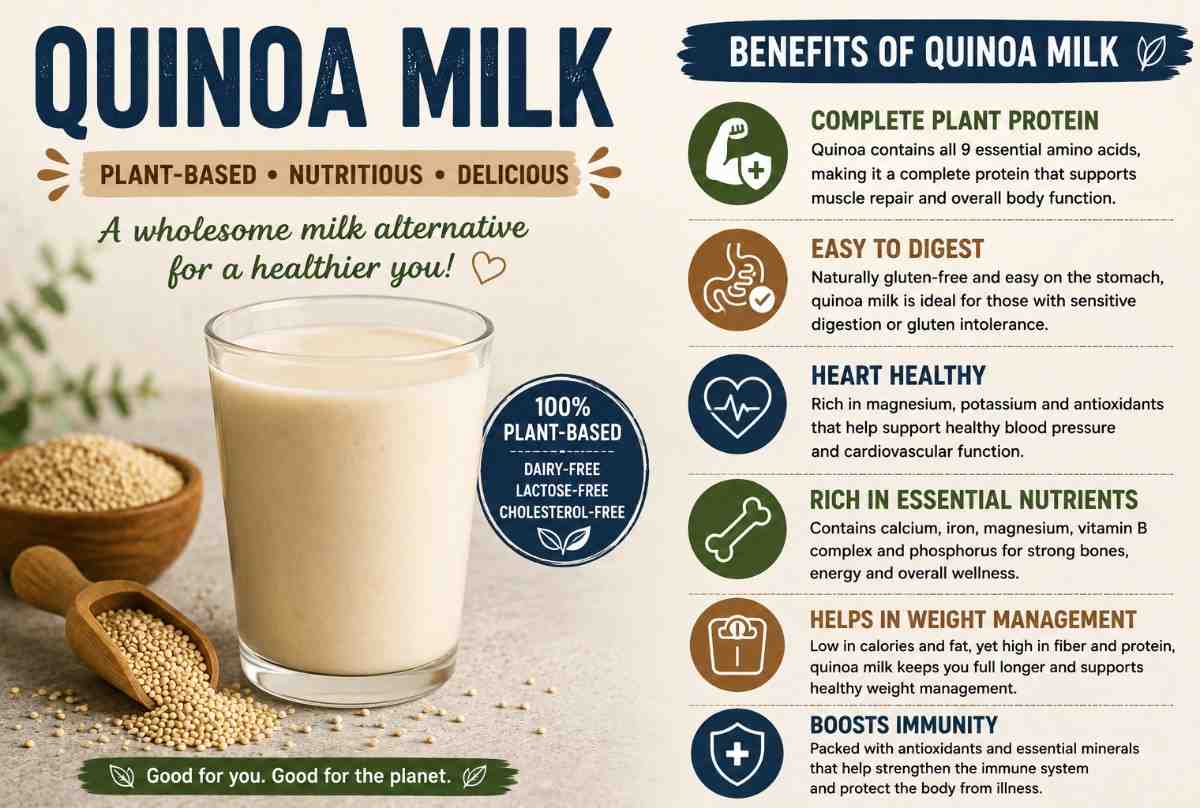
Quinoa milk is a plant-based beverage made by blending quinoa with water and then straining the mixture to create a smooth, dairy-free drink. It has a mild, slightly nutty flavor and can be used as an alternative to dairy milk in smoothies, cereals, coffee, baking, and everyday drinks.
Unlike some popular plant milks, quinoa milk is not yet as widely available commercially, and its nutritional profile can vary considerably depending on how it is prepared. Research specifically examining quinoa milk is still developing, so many of its potential benefits are based on the nutritional properties of quinoa itself rather than large human trials conducted specifically on quinoa milk. Recent food-science research has nevertheless investigated quinoa milk’s protein characteristics, stability, flavor, and processing methods.
What Is Quinoa Milk?
Quinoa milk is a non-dairy beverage prepared from quinoa seeds and water. Depending on the recipe, quinoa may be rinsed, soaked, cooked or blanched before being blended with water and filtered.
Quinoa itself is a nutrient-rich pseudocereal containing protein, carbohydrates, dietary fiber, minerals, and various plant compounds. The outer layer of quinoa naturally contains saponins, which can contribute a bitter taste. Most commercially processed quinoa has already had much of its saponin content removed, although rinsing the seeds before cooking can further reduce bitterness.
Quinoa milk should not automatically be considered nutritionally equivalent to cow’s milk or fortified soy milk. Depending on the preparation, homemade quinoa milk may provide relatively little calcium, vitamin D, vitamin B12, and protein per serving. Commercial plant-based milks can also vary widely in nutritional composition.
Nutrition Facts of Quinoa Milk
The following is an approximate nutritional profile for 1 cup (240 mL) of homemade quinoa milk prepared from quinoa and water. These values are estimates rather than laboratory-tested values because the amount of quinoa used, blending method, straining, and dilution can substantially change the final nutrition.
| Nutrient | Approximate Amount per 1 Cup |
|---|---|
| Calories | 50–80 kcal |
| Protein | 1–3 g |
| Total Fat | 1–2 g |
| Saturated Fat | Less than 0.5 g |
| Carbohydrates | 8–14 g |
| Dietary Fiber | 0.5–2 g |
| Natural Sugars | 0–1 g |
| Calcium | Variable; usually low unless fortified |
| Iron | Small amount |
| Magnesium | Small amount |
| Phosphorus | Small amount |
| Potassium | Small amount |
| Sodium | Usually low |
| Vitamin D | Usually negligible unless fortified |
| Vitamin B12 | Usually negligible unless fortified |
Important: Homemade milk does not have a standardized nutrition label. If you purchase commercial quinoa milk, check the package for protein, calcium, vitamin D, vitamin B12, added sugar, and calorie content. USDA FoodData Central is a useful reference for comparing food composition data.
20 Proven Health Benefits of Quinoa Milk
1. Provides Plant-Based Nutrition: Quinoa milk can add nutrients from quinoa to the diet while providing a dairy-free beverage option.
2. Naturally Dairy-Free: Milk contains no lactose or dairy proteins when prepared solely from quinoa and water, making it an option for people who choose to avoid dairy.
3. Provides Some Plant Protein: Quinoa is recognized for its protein content and amino-acid profile, although the amount of protein that remains in strained quinoa milk depends heavily on the recipe and filtration process.
4. May Support a Balanced Diet: Replacing a sugary beverage with unsweetened quinoa milk can be one way to increase dietary variety without adding large amounts of added sugar.
5. Contains Dietary Fiber: Depending on how thoroughly it is strained, homemade milk can retain some of quinoa’s dietary fiber, although it generally contains less fiber than eating whole quinoa.
6. Provides Magnesium: Quinoa contains magnesium, a mineral involved in normal muscle and nerve function, energy metabolism, and numerous enzymatic processes.
7. Provides Phosphorus: Quinoa naturally contains phosphorus, which contributes to normal bone structure and energy metabolism.
8. Contributes Plant-Based Iron: Quinoa contains iron, although the quantity delivered by a serving of strained quinoa milk can be modest and varies according to preparation.
9. Contains Potassium: Quinoa provides potassium, an essential mineral involved in fluid balance, nerve signaling, and normal muscle function.
10. Contains Plant Compounds: Quinoa contains phenolic compounds and other bioactive substances that have attracted research interest because of their antioxidant potential.
11. May Add Antioxidant Compounds: Research on quinoa and quinoa-based fermented products suggests that processing can influence the availability of phenolic compounds and antioxidant activity.
12. May Be Useful for Lactose-Free Diets: Because homemade quinoa milk contains no lactose, it can be incorporated into meals for people who avoid lactose, provided the beverage is nutritionally appropriate for their needs.
13. Can Increase Beverage Variety: Using quinoa milk alongside other nutritious foods can make a plant-forward eating pattern more varied and enjoyable.
14. May Be Useful in Plant-Based Eating Patterns: Milk can be incorporated into vegetarian or vegan diets, but nutrients such as vitamin B12, calcium, vitamin D, iodine, and adequate protein still need attention from the overall diet.
15. May Provide a Mild Source of Energy: The carbohydrates naturally present in quinoa can contribute energy, particularly when quinoa milk is made with a relatively generous amount of quinoa.
16. Can Be Made Without Added Sugar: Homemade quinoa milk allows you to control the ingredients and leave out added sugar, syrups, or sweeteners.
17. Can Complement a Protein-Rich Meal: Although quinoa milk itself may not contain enough protein to replace a major protein source, it can accompany foods such as nuts, seeds, legumes, tofu, eggs, or yogurt.
18. May Offer Useful Amino Acids: Quinoa has a relatively favorable essential amino-acid profile compared with many cereal grains, although straining reduces the amount of quinoa solids consumed in the beverage.
19. May Have Potential as a Functional Beverage: Food-science research has investigated quinoa milk as a developing plant-based beverage and has examined methods for improving its stability, texture, and sensory characteristics.
20. Can Be Part of a Heart-Conscious Eating Pattern: Unsweetened quinoa milk is generally low in saturated fat when made from quinoa and water, making it compatible with dietary patterns that emphasize whole grains, legumes, vegetables, fruits, nuts, and seeds.
10 Side Effects of Quinoa Milk
Quinoa milk is generally well tolerated by many people, but drinking too much or consuming a poorly prepared product may cause problems.
1. Digestive Discomfort: Large amounts may cause bloating, gas, abdominal discomfort, or changes in bowel habits, particularly in people who are sensitive to quinoa or increased dietary fiber.
2. Bitter Taste: Inadequately rinsed quinoa can produce a bitter or unpleasant flavor because of naturally occurring saponins.
3. Possible Allergy: Although uncommon, quinoa allergy is possible and may cause symptoms such as itching, hives, swelling, vomiting, or breathing difficulties in susceptible individuals.
4. Nutritional Gaps: Homemade quinoa milk can be low in calcium, vitamin D, and vitamin B12, so it should not automatically replace nutritionally fortified dairy or soy beverages.
5. Added Sugar Concerns: Flavored or sweetened commercial products may contain substantial amounts of added sugar, depending on the brand.
6. Food-Safety Risk: Homemade quinoa milk can spoil quickly if it is not handled, refrigerated, and stored properly.
7. Texture and Sedimentation: Homemade milk may separate or develop sediment because plant proteins and particles do not always remain uniformly suspended. Recent research has specifically examined stability and sedimentation in quinoa milk.
8. Excessive Intake May Add Unnecessary Calories: Drinking large quantities can contribute additional calories and carbohydrates, especially when the milk is made with a high amount of quinoa or sweeteners.
9. Digestive Sensitivity to Quinoa: People who already experience digestive symptoms after eating quinoa may also experience discomfort after drinking quinoa-based beverages.
10. Cross-Contact Concerns: People with severe food allergies should consider how quinoa milk was prepared or manufactured because cross-contact with other ingredients can occur in commercial facilities.
How to Make Quinoa Milk?
Making quinoa milk at home is relatively simple.
Ingredients:
- 1/2 cup uncooked quinoa
- 3–4 cups water for blending
- Additional water for rinsing and cooking
- Optional: cinnamon, vanilla, or a small amount of date for flavor
Method:
- Step 1: Rinse the quinoa. Place the quinoa in a fine-mesh strainer and rinse it thoroughly under cool running water.
- Step 2: Cook the quinoa. Add the rinsed quinoa to water and simmer until the grains become tender. Cooking generally takes around 15 minutes, depending on the quinoa and cooking method.
- Step 3: Cool slightly. Allow the cooked quinoa to cool enough to safely blend.
- Step 4: Blend. Add the cooked quinoa and 3–4 cups of water to a high-speed blender and blend until smooth.
- Step 5: Strain. Pour the mixture through a nut-milk bag, cheesecloth, or fine-mesh strainer if you prefer a smoother drink.
- Step 6: Flavor if desired. Add cinnamon, vanilla, cocoa, or a small amount of fruit for flavor rather than relying heavily on refined sugar.
- Step 7: Refrigerate. Transfer the finished quinoa milk to a clean, covered container and refrigerate promptly.
The exact amount of water can be adjusted depending on whether you prefer a thicker or lighter beverage.
How to Drink Quinoa Milk?
Quinoa milk can be consumed cold, gently warmed, or incorporated into other foods.
You can drink it plain, add cinnamon or vanilla, blend it into smoothies, pour it over cereal, or use it in oatmeal. It can also be used in recipes that traditionally call for dairy milk or another plant-based beverage.
Because homemade quinoa milk can separate during storage, gently shake or stir it before drinking.
Tips for Consuming Quinoa Milk
- Choose unsweetened quinoa milk when possible.
- Check the nutrition label of commercial products for calcium and vitamin D.
- Look for products with adequate protein if you intend to use milk as a regular milk replacement.
- Rinse quinoa well before preparing homemade milk.
- Start with a smaller serving if you have never consumed milk before.
- Shake homemade milk before serving because natural sedimentation can occur.
- Avoid adding large quantities of sugar simply to improve the flavor.
- Use milk as part of a balanced diet rather than treating it as a complete nutritional replacement for every type of milk.
How to Use Quinoa Milk?
Quinoa milk can be used in many of the same ways as other plant-based milks.
It works well in:
- Smoothies
- Oatmeal
- Breakfast cereals
- Chia pudding
- Pancake batter
- Muffins
- Homemade desserts
- Soups
- Sauces
- Coffee and tea
- Protein shakes
- Fruit-based drinks
- Porridge
Its mild, slightly nutty flavor can work particularly well with cinnamon, cocoa, vanilla, berries, bananas, dates, and nut butters.
Other Uses of Quinoa Milk
Beyond simply drinking it, quinoa milk can be useful as a cooking ingredient.
- Smoothies: Blend it with banana, berries, nut butter, or oats for a creamy drink.
- Breakfast: Pour it over cereal, granola, or cooked oats.
- Baking: Use it as the liquid component in pancakes, muffins, quick breads, and some cakes.
- Desserts: It can be incorporated into puddings and dairy-free dessert recipes.
- Savory Recipes: Unsweetened quinoa milk can sometimes be used in soups and sauces where a mild plant-based liquid is suitable.
- Coffee: It can be added to coffee, although homemade versions may not froth as consistently as specially formulated commercial plant milks.
Food scientists are continuing to study quinoa milk formulations, including ways to improve protein solubility, stability, texture, and flavor.
How Much Quinoa Milk Can You Drink in a Day?
For most healthy adults, about 1 cup (240 mL) per day is a reasonable starting serving, especially when introducing homemade quinoa milk.
Some people may comfortably consume more, but there is no established evidence-based daily dosage specifically for milk. Your ideal amount depends on your total diet, calorie needs, tolerance, and whether the beverage is fortified.
If quinoa milk is replacing dairy milk, pay particular attention to protein, calcium, vitamin D, and vitamin B12. Plant-based beverages vary substantially in these nutrients, and many are not nutritionally equivalent to dairy milk or fortified soy beverages.
Best Time to Drink Quinoa Milk
There is no scientifically established “best” time to drink quinoa milk.
- Morning: It can be added to oatmeal, cereal, smoothies, or breakfast drinks.
- Afternoon: It can work as part of a snack when paired with a protein-rich food.
- Evening: Unsweetened quinoa milk can be included with dinner or used in a warm beverage.
The most important factor is how milk fits into your overall nutritional intake rather than the exact time you consume it.
Who Should Drink Quinoa Milk?
- People Avoiding Dairy: Milk can be useful for people who prefer dairy-free beverages.
- People Following Plant-Based Diets: It can add variety to vegetarian and vegan meal patterns while contributing some nutrients from quinoa.
- People Looking for Unsweetened Options: Homemade quinoa milk allows you to control added sugar and other ingredients.
- People Wanting More Beverage Variety: It can provide an alternative to repeatedly consuming the same plant-based milk.
- People Who Enjoy Quinoa: Those who already tolerate quinoa well may enjoy its mild, slightly nutty flavor in beverage form.
- People Cooking Dairy-Free Recipes: Milk can be useful as a liquid ingredient in smoothies, cereals, baking, and selected savory recipes.
Who Should Avoid Quinoa Milk?
- People With a Quinoa Allergy: Anyone with a confirmed quinoa allergy should avoid quinoa milk unless specifically advised otherwise by a qualified healthcare professional.
- People Who Develop Symptoms After Quinoa: If quinoa consistently causes digestive or other symptoms, stop consuming quinoa milk and discuss the symptoms with a healthcare professional.
- Infants: Milk should not be used as a replacement for breast milk or infant formula during the first year of life; plant-based beverages are not nutritionally equivalent to infant formula.
- People Requiring High Protein From Their Milk: Homemade quinoa milk may contain considerably less protein than dairy milk or fortified soy milk.
- People With Specific Nutrient Requirements: Those who depend on milk alternatives as major sources of calcium, vitamin D, or vitamin B12 should choose an appropriately fortified product rather than assuming homemade quinoa milk supplies these nutrients.
- People With Severe Food Allergies: Check packaged products carefully for allergen statements and possible cross-contact.
How to Store Quinoa Milk?
- Use a Clean Container: Store homemade milk in a thoroughly cleaned, airtight glass or food-safe container.
- Refrigerate Promptly: Keep homemade quinoa milk refrigerated rather than leaving it at room temperature for extended periods.
- Make Small Batches: Homemade plant milk is best prepared in quantities you can consume relatively quickly.
- Shake Before Drinking: Separation is normal in homemade milk, so shake or stir it before use.
- Check for Spoilage: Discard it if you notice an unusual smell, mold, unexpected discoloration, excessive fermentation, or other signs of spoilage.
- Follow Commercial Label Instructions: For packaged milk, follow the manufacturer’s refrigeration and after-opening instructions.
- Do Not Rely Only on Appearance: A beverage can potentially become unsafe without dramatic visual changes, so good refrigeration and food-handling practices are important.
Precautions and Interactions
Quinoa milk does not have a well-established list of drug interactions. However, several practical precautions are worth keeping in mind.
- Check the ingredient list: Commercial milk may contain added sugar, oils, gums, flavors, or blends of other plant ingredients.
- Do not assume fortification: Homemade milk generally will not contain meaningful amounts of calcium, vitamin D, or vitamin B12 unless these nutrients are deliberately added.
- Rinse quinoa properly: Rinsing can help reduce bitterness associated with residual saponins.
- Consider the whole diet: If quinoa milk replaces dairy milk, make sure other foods provide sufficient protein, calcium, vitamin D, vitamin B12, and other nutrients.
- Watch portion size: A larger serving is not necessarily better, particularly if the beverage contains added sugars or contributes substantial calories.
- Be cautious with allergies: Stop consuming the beverage and seek appropriate medical advice if you experience signs of an allergic reaction.
- Talk with a healthcare professional when needed: People with diagnosed food allergies, significant digestive disorders, kidney disease, or specialized nutritional requirements should discuss major dietary changes with an appropriate healthcare professional.
Quinoa Milk vs. Other Plant-Based Milks
Quinoa milk is best viewed as another option within the broad plant-milk category rather than a universally superior alternative.
Soy milk generally provides substantially more protein than many other plant-based beverages and is one of the plant-based options recognized as nutritionally comparable to dairy for certain dietary recommendations when fortified. Other plant beverages can vary widely in protein, calcium, vitamin D, vitamin B12, calories, and added sugars.
Quinoa milk’s main appeal is its use of quinoa as the base, its dairy-free nature, and its versatility. Its nutritional value depends heavily on the amount of quinoa used and whether the final product is fortified.
FAQ’s
What does Quinoa Milk smell like?
Milk usually has a mild, earthy, slightly nutty or grain-like smell. Fresh homemade milk may have a subtle cooked-quinoa aroma. If it develops a strong sour, fermented, rancid, or unpleasant odor, it may have spoiled and should be discarded.
Is quinoa milk healthy?
Milk can be a nutritious dairy-free beverage, particularly when it is unsweetened and made from a reasonable amount of quinoa. However, homemade milk may be low in protein, calcium, vitamin D, and vitamin B12 compared with fortified dairy or soy milk.
Does quinoa milk need to be boiled?
If you are making milk from raw quinoa, cooking the quinoa before blending is a practical approach. Properly cooking the quinoa also produces a smoother, more palatable beverage.
Is quinoa milk good for you?
Yes, milk can be a nutritious dairy-free beverage, especially when unsweetened. However, homemade milk may be lower in protein, calcium, vitamin D, and vitamin B12 than fortified dairy or soy milk.
Is quinoa milk safe to drink every day?
For most people who tolerate quinoa well, moderate daily consumption can be part of a balanced diet. About 1 cup per day is a reasonable serving.
Does quinoa milk contain gluten?
Pure quinoa is naturally gluten-free, so milk made from quinoa and water is generally gluten-free. Check packaged products for cross-contact and added ingredients.
Does quinoa milk contain lactose?
No, milk does not contain lactose because it is made from quinoa rather than dairy milk.
What does quinoa milk taste like?
Milk usually has a mild, slightly nutty and grain-like taste. Rinsing the quinoa thoroughly can help reduce bitterness.
Is quinoa milk high in protein?
Quinoa contains protein, but homemade milk may not be particularly high in protein because the beverage is diluted and often strained.
Can quinoa milk help with weight loss?
Milk does not directly cause weight loss. Unsweetened milk can fit into a calorie-controlled diet as a lower-saturated-fat beverage option.
Can I drink quinoa milk at night?
Yes, you can drink milk at night if it suits your diet and digestion. There is no established scientific evidence that quinoa milk must be consumed at a particular time.
Is quinoa milk good for children?
Older children can consume quinoa milk as part of a varied diet, but it should not automatically replace nutritionally complete milk or fortified alternatives. Infants should not use plant-based beverages as a replacement for breast milk or infant formula.
Is quinoa milk suitable for vegans?
Yes, milk made from quinoa and water is naturally plant-based and suitable for vegan diets.
Can quinoa milk cause gas or bloating?
It can cause digestive discomfort, including gas or bloating, in some people, particularly when consumed in large amounts or when someone is sensitive to quinoa.
How long does homemade quinoa milk last?
Homemade milk should be refrigerated in a clean, airtight container and consumed promptly. Discard it if it develops an unusual smell, mold, discoloration, or other signs of spoilage.
Can I use quinoa milk for coffee?
Yes, milk can be added to coffee. Homemade versions may separate or fail to froth as well as specially formulated commercial plant milks.
Is quinoa milk better than almond milk?
Neither is universally better. Milk may provide nutrients from quinoa, while almond milk is typically lower in calories. The best choice depends on protein, calcium, vitamin D, added sugar, and your individual dietary needs.
Does quinoa milk contain calcium?
Homemade milk is generally not a significant source of calcium. Some commercial milk products may be fortified with calcium, so check the nutrition label.
Can quinoa milk be used for cooking?
Yes, unsweetened milk can be used in oatmeal, pancakes, smoothies, sauces, soups, baked goods, and some desserts.
Can pregnant women drink quinoa milk?
Quinoa itself can be included in a balanced pregnancy diet when properly prepared. However, milk should not be relied upon as a major source of pregnancy nutrients unless it is appropriately fortified.
Sources / References:
About the Author:
Written by: Kirti Solanki (Health Content Researcher) — Health content researcher focused on creating clear, reader-friendly nutrition and wellness information based on reliable sources.
Disclaimer:
This article is for general educational purposes only and does not replace professional medical or dietary advice. If you have an allergy, medical condition, or specific nutritional requirement, consult a qualified healthcare professional before making major dietary changes.
Also Read: