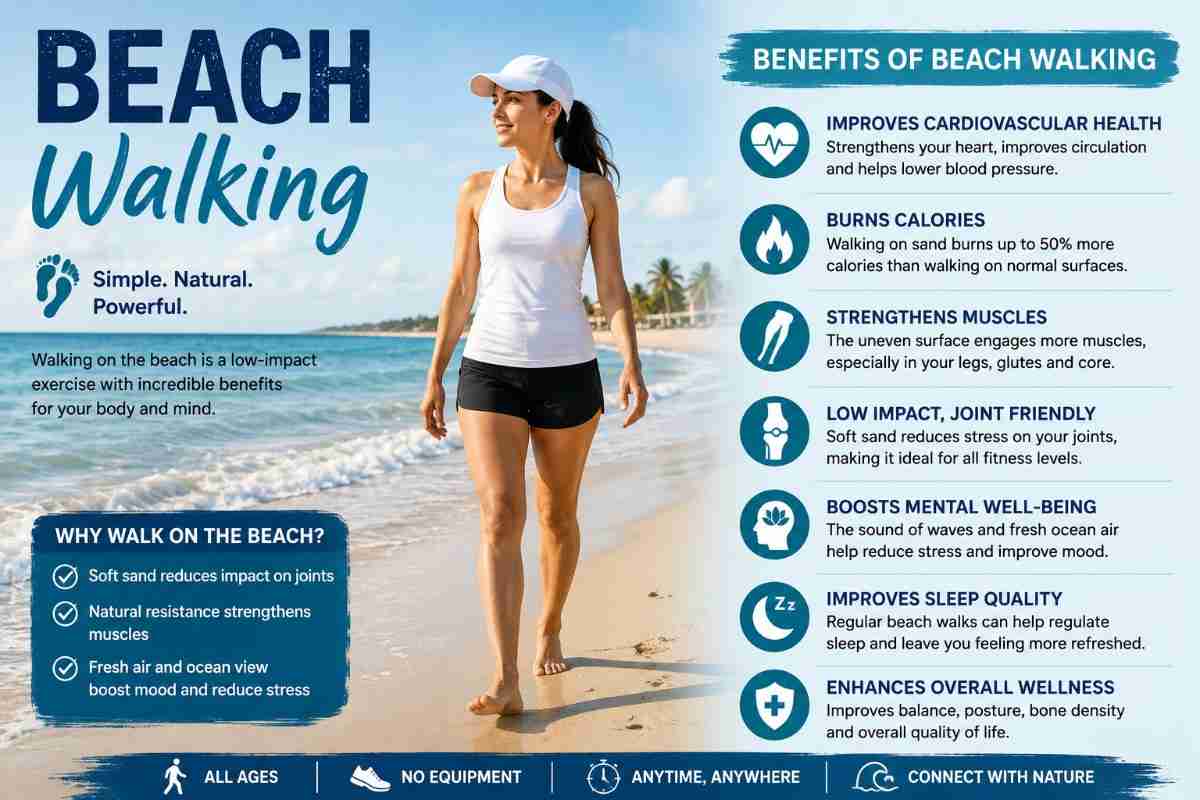
Beach walking is one of those simple activities that can feel more like leisure than exercise. The combination of fresh air, ocean views, gentle waves, and the changing texture of sand can make a regular walk more enjoyable while still giving your body a meaningful workout.
Unlike walking on a treadmill, road, or pavement, beach walking requires your body to adapt to an uneven and sometimes unstable surface. Dry sand, in particular, can make walking considerably more demanding because your feet sink into the surface and your muscles have to work harder to move you forward.
That does not mean beach walking has to be intense. You can make it as gentle or challenging as your fitness level allows.
What Is Beach Walking?
Beach walking is simply walking along a beach, usually on sand near the shoreline. You can walk barefoot or wear supportive footwear, and you can choose between firm wet sand and softer dry sand.
The surface makes a significant difference. Firm, wet sand is generally easier to walk on because it provides more stability, while loose, dry sand shifts underneath your feet and requires more muscular effort.
Beach walking can be used for:
- Cardiovascular exercise
- Weight-management support
- Lower-body conditioning
- Gentle outdoor activity
- Recreational movement
- Stress relief
- Improving daily physical activity levels
Walking itself is a well-established form of physical activity. Current U.S. physical activity guidelines recommend that adults aim for 150 to 300 minutes of moderate-intensity aerobic activity each week, with brisk walking being one example.
Why Is Walking on Sand Harder?
The biggest difference between beach walking and ordinary walking is the surface.
On pavement, your foot lands on a relatively firm surface that provides predictable support. On loose sand, your foot can sink and slide backward slightly. Your body therefore has to produce additional mechanical work to maintain forward movement.
Research comparing walking on sand with walking on hard surfaces found that walking on sand required 1.6 to 2.5 times more mechanical work and 2.1 to 2.7 times more energy expenditure at the same speed.
A more recent study also found that differences in sand depth and sinking can influence walking mechanics and movement patterns.
This is why a relaxed-looking beach walk can leave you more tired than expected.
15 Benefits of Beach Walking
1. Supports Cardiovascular Fitness
Walking at a moderate or brisk pace raises your heart rate and makes your cardiovascular system work harder. Because sand can increase the energy cost of walking, beach walking may provide an effective aerobic workout when performed at an appropriate intensity.
Regular walking is associated with important health benefits, including better cardiovascular health and lower risk of several chronic diseases.
2. Burns More Energy Than Firm-Surface Walking
One of the most interesting features of beach walking is its energy demand. Walking on dry sand can require substantially more energy than walking at the same speed on a hard surface.
However, calorie expenditure varies according to body weight, walking speed, terrain, sand firmness, duration, and fitness level, so there is no single calorie number that applies to everyone.
3. Strengthens the Lower Body
Walking through loose sand can challenge the calves, ankles, thighs, hips, and gluteal muscles.
The muscles have to help stabilize your body while your feet adjust to the shifting surface. This can make a beach walk feel more muscularly demanding than an ordinary walk.
4. Challenges Balance and Stability
Sand is uneven and constantly changes under your feet. Your body has to make small adjustments to maintain balance.
This can challenge stabilizing muscles around the feet, ankles, knees, and hips. If you are new to beach walking, starting on firm wet sand can make the transition easier.
5. Helps Increase Daily Physical Activity
You do not necessarily need a complicated exercise program to become more active. Walking is accessible to many people and can be incorporated into everyday life.
The U.S. Department of Health and Human Services emphasizes that moving more and sitting less can contribute to better health.
6. May Support Weight Management
Beach walking can contribute to your overall energy expenditure and physical activity level. Combined with an appropriate diet and other forms of exercise, regular walking can be part of a sustainable weight-management routine.
Importantly, weight loss should not be the only reason to walk. Physical activity can provide health benefits even when body weight does not change.
7. Engages the Core
Your abdominal and trunk muscles help stabilize your body as you move over uneven ground.
Beach walking is not a replacement for dedicated core exercises, but the constantly changing surface can require more postural control than walking on a predictable, firm surface.
8. Provides a Low-Impact Alternative to Running
Walking generally places less impact on the body than running. For people who enjoy outdoor exercise but do not want to run, beach walking can be an appealing alternative.
However, soft sand is not automatically suitable for everyone. People with foot, ankle, knee, or hip problems should introduce it gradually.
9. Can Make Exercise More Enjoyable
Enjoyment matters when building an exercise habit. A walk beside the ocean can feel less repetitive than walking indoors or around the same neighborhood.
A pleasant environment may make it easier to spend more time moving without feeling as though you are completing a traditional workout.
10. Supports Mental Well-Being
Regular physical activity is associated with mental-health benefits, and walking can be an accessible way to stay active.
Outdoor environments may also provide a calming setting for movement, reflection, or social connection. Physical activity guidelines note benefits related to feeling better and improving overall well-being.
11. May Improve Muscular Endurance
Because sand increases the effort required for each step, longer beach walks can challenge muscular endurance.
Rather than immediately walking long distances, gradually increasing duration allows your muscles and connective tissues time to adapt.
12. Encourages Variety in Exercise
Changing your walking surface can add variety to a fitness routine.
For example, you might walk on pavement during the week and include a beach walk on the weekend. Different surfaces create different movement demands.
13. Can Support Healthy Aging
Regular physical activity is important throughout adulthood and can help people maintain physical function as they age.
For older adults, beach walking should be approached carefully because uneven surfaces increase balance demands. Firm sand and supportive footwear may be preferable to deep, loose sand.
14. Can Be a Social Activity
Beach walking does not have to be a solo workout. Walking with a friend, partner, or family member can turn exercise into a social activity.
Social walking can also make regular movement easier to maintain over time.
15. Gives You a Simple Outdoor Workout
Perhaps the biggest advantage is simplicity. You do not need a gym membership, complicated equipment, or advanced exercise skills.
A comfortable pair of walking shoes, sun protection, water, and a safe beach may be enough.
Beach Walking vs. Regular Walking
| Feature | Beach Walking | Regular Firm-Surface Walking |
|---|---|---|
| Surface | Sand, often uneven | Pavement, track, treadmill, etc. |
| Stability | Lower, especially on dry sand | Usually higher |
| Energy demand | Can be considerably higher | Generally lower at the same speed |
| Balance challenge | Higher | Usually lower |
| Muscle demand | Greater on unstable sand | More predictable |
| Walking speed | Often slower on dry sand | Usually faster |
| Difficulty | Can range from easy to challenging | Easier to control |
| Equipment | Optional supportive footwear | Usually simple walking shoes |
A study examining walking on beach sand found that dry sand reduced walking speed compared with concrete and increased step counts during a standardized walking task.
How Many Calories Does Beach Walking Burn?
| Body Weight | 30 Minutes | 45 Minutes | 60 Minutes |
|---|---|---|---|
| 50 kg (110 lb) | ~145 kcal | ~220 kcal | ~290 kcal |
| 60 kg (132 lb) | ~175 kcal | ~260 kcal | ~350 kcal |
| 70 kg (154 lb) | ~205 kcal | ~310 kcal | ~410 kcal |
| 80 kg (176 lb) | ~235 kcal | ~350 kcal | ~470 kcal |
| 90 kg (198 lb) | ~265 kcal | ~400 kcal | ~530 kcal |
| 100 kg (220 lb) | ~295 kcal | ~445 kcal | ~590 kcal |
Note: These are approximate estimates for moderate beach walking. Actual calorie burn depends on walking speed, body weight, sand firmness, terrain, incline, and individual fitness level. Walking on soft, dry sand generally requires more energy than walking on a firm surface.
Risks of Beach Walking
Beach walking is generally a safe activity for most healthy people, but the uneven and shifting surface can create a few risks. Knowing what to watch for can help you enjoy your walk safely.
- Ankle Sprains: Uneven sand can cause the foot to roll unexpectedly and increase the risk of ankle injuries.
- Foot Cuts and Scrapes: Shells, rocks, broken glass, or other debris can injure bare feet.
- Muscle Strain: Walking on soft sand requires more effort from the calves, feet, ankles, and legs, which may cause soreness or strain if you increase your distance too quickly.
- Knee or Hip Discomfort: The unstable surface can change your walking mechanics and may aggravate existing joint problems.
- Falls and Loss of Balance: Loose sand can make it harder to maintain stability, particularly for older adults or people with balance difficulties.
- Sunburn: Long periods outdoors can expose your skin to significant ultraviolet radiation.
- Dehydration: Walking in hot, humid, or windy conditions can increase fluid loss.
- Heat Exhaustion: Exercising during very hot weather can cause excessive sweating, weakness, dizziness, nausea, or headache.
- Foot Burns: Sand can become extremely hot during sunny weather and may burn exposed feet.
- Tide and Water Hazards: Walking too close to the shoreline can become dangerous when tides rise or waves become stronger.
- Overexertion: Because soft sand can make walking more strenuous, a distance that feels easy on pavement may be considerably harder on the beach.
- Worsening of Existing Injuries: People recovering from foot, ankle, knee, or hip injuries may experience increased pain on unstable sand.
How Long Should You Walk on the Beach?
If you are new to beach walking, start with about 15 to 20 minutes at a comfortable pace.
As your body adapts, you can gradually increase your walking time:
- Beginner: 15–20 minutes
- Regular walker: 25–40 minutes
- Experienced walker: 45–60 minutes or more
You do not need to walk on deep sand for the entire session. A practical approach is to spend part of your walk on firmer wet sand and gradually introduce softer sections.
For overall health, work toward the broader recommendation of 150 to 300 minutes of moderate aerobic activity per week.
Wet Sand vs. Dry Sand: Which Is Better?
Both can be useful, but they provide different challenges.
Wet Sand
Wet sand near the waterline is usually firmer and more stable. It may be a better starting point for beginners or people who find loose sand uncomfortable.
Dry Sand
Dry sand is softer and less stable. It generally requires more effort and can place greater demands on the muscles involved in maintaining balance and forward movement.
If your goal is simply to enjoy a comfortable walk, firm sand may be preferable. If you want a more challenging workout, short periods on softer sand can increase the difficulty.
How to Do Beach Walking Safely?
1. Start Slowly
Do not assume that your usual walking distance will feel the same on sand.
Begin with a shorter walk and assess how your feet, calves, ankles, knees, and hips feel afterward.
2. Choose Firm Sand First
If you are new to beach walking, start near the shoreline where the sand is generally firmer.
3. Maintain Good Posture
Keep your head up, shoulders relaxed, and arms moving naturally. Avoid staring continuously at your feet.
4. Take Shorter Steps
Shorter, controlled steps can make it easier to maintain balance on loose sand.
5. Increase Duration Gradually
Once your body adapts, gradually add a few minutes to your walk rather than suddenly doubling the distance.
6. Hydrate
Beach environments can be hot and sunny. Bring water, particularly when walking for extended periods or during warm weather.
7. Protect Your Skin
Use appropriate sun protection, including sunscreen, clothing, sunglasses, and a hat when needed.
Beach Walking Safety Tips
- Start on firm, wet sand: It is generally more stable and easier to walk on than deep, dry sand.
- Increase your distance gradually: Begin with shorter walks and slowly increase duration as your body adapts.
- Wear appropriate footwear: Use supportive walking shoes or water shoes if the beach surface is rough or your feet are sensitive.
- Inspect the walking area: Look for shells, rocks, glass, fishing equipment, and other potentially hazardous objects.
- Protect your feet: Avoid barefoot walking if the sand is extremely hot or the beach contains sharp debris.
- Apply sunscreen: Use broad-spectrum sunscreen and reapply it according to the product instructions, especially during longer walks.
- Stay hydrated: Bring enough water, particularly when walking in warm weather.
- Choose cooler times: Early morning or later in the day may be more comfortable than walking during peak heat.
- Watch the tide: Check local tide conditions and avoid isolated areas where rising water could cut off your route.
- Pay attention to your surroundings: Watch for strong waves, slippery areas, steep slopes, and sudden changes in the sand.
- Maintain good posture: Keep your head up, shoulders relaxed, and take controlled steps.
- Take shorter steps on soft sand: Shorter steps can make it easier to maintain balance and control.
- Listen to your body: Stop or reduce your pace if you experience unusual pain, dizziness, weakness, or excessive fatigue.
- Be cautious if you have joint problems: If you have an existing injury or medical condition affecting mobility, ask a healthcare professional whether beach walking is appropriate.
- Don’t make every walk intense: Alternate challenging soft-sand walking with easier walks on firm surfaces to allow adequate recovery.
Is Barefoot Beach Walking Good for You?
Barefoot walking can provide a different sensory experience because the feet directly interact with the sand.
However, barefoot does not automatically mean healthier. Shells, rocks, broken objects, hot sand, sharp debris, and uneven surfaces can cause injuries.
If you have reduced sensation in your feet, existing foot problems, balance difficulties, or another condition affecting your ability to walk safely, footwear may be a better option and professional advice may be appropriate.
Who Should Be Careful With Beach Walking?
Most healthy adults can incorporate walking into an active lifestyle, but beach walking is not appropriate for everyone at every intensity.
Use extra caution if you have:
- Significant foot or ankle pain
- A recent lower-body injury
- Severe balance problems
- Joint pain that worsens on uneven surfaces
- Difficulty walking normally
- A condition that limits exercise tolerance
If you develop persistent pain, swelling, dizziness, chest discomfort, unusual shortness of breath, or another concerning symptom, stop exercising and seek appropriate medical advice.
Tips for a Better Beach Walking Workout
For a more effective and enjoyable session:
- Walk during cooler parts of the day when possible.
- Begin with firm sand before progressing to loose sand.
- Keep your walking pace comfortable enough to maintain good form.
- Alternate between easy and moderately brisk sections.
- Carry water for longer walks.
- Use supportive footwear if barefoot walking is uncomfortable.
- Check the beach for sharp objects before walking barefoot.
- Avoid walking alone in isolated areas.
- Pay attention to tides and local beach conditions.
- Give your calves and feet time to recover after longer walks.
A Simple 30-Minute Beach Walking Routine
If you already walk regularly, try this simple routine:
- Minutes 0–5: Walk slowly on firm sand to warm up.
- Minutes 5–15: Increase to a comfortable, moderately brisk pace.
- Minutes 15–20: Walk on slightly softer sand if comfortable.
- Minutes 20–25: Return to firmer sand and maintain a steady pace.
- Minutes 25–30: Gradually slow down for a cool-down.
This routine can be adjusted according to your fitness level. The goal is consistency rather than making every beach walk exhausting.
Final Thoughts
Beach walking is a simple form of exercise with a unique advantage: the sand changes the physical demands of ordinary walking. Dry sand can significantly increase energy expenditure and mechanical work compared with walking on firm ground, while the uneven surface can challenge balance and lower-body muscles.
At the same time, more challenging does not necessarily mean better. A comfortable walk on firm sand may be more sustainable than forcing yourself through deep sand for an unnecessarily long workout.
For most people, the best approach is to start gradually, choose a safe surface, stay hydrated, protect yourself from the sun, and build walking time over several weeks.
Ultimately, beach walking can be both exercise and a way to spend meaningful time outdoors. When performed consistently and safely, it can contribute to your weekly physical activity while making movement feel a little less like a chore.
FAQ’s
Is beach walking good exercise?
Yes. Beach walking can be an effective form of aerobic exercise, and walking on soft sand can require more effort than walking on a firm surface.
Does beach walking burn more calories than normal walking?
It can. Soft, dry sand increases the energy required to walk compared with firm surfaces, although actual calorie burn depends on your body weight, pace, terrain, and duration.
Is walking on wet sand better than dry sand?
Wet, firm sand is generally easier and more stable, while dry sand is softer and more challenging. Beginners may prefer wet sand before progressing to deeper dry sand.
Does beach walking help lose belly fat?
Beach walking can increase calorie expenditure and support overall weight management, but it cannot specifically target belly fat. Fat loss occurs throughout the body as part of an overall calorie deficit.
Is beach walking good for the legs?
Yes. Walking on sand can challenge the calves, thighs, glutes, ankles, and other stabilizing muscles more than walking on a firm surface.
Can I walk on the beach every day?
If you are healthy, comfortable, and recovering well, you can include beach walking regularly. However, beginners should gradually increase their walking time and distance.
Is beach walking good for your knees?
Walking is generally a joint-friendly activity, but soft or uneven sand can increase the demand on the legs and joints. People with existing knee problems should start cautiously.
What is the best time to walk on the beach?
Early morning or later in the evening is often more comfortable because temperatures and sun exposure may be lower. Always consider local weather, tides, and beach safety conditions.
Does beach walking improve balance?
It can challenge balance because sand is uneven and shifts beneath your feet. This requires the body to make frequent small adjustments while walking.
Can beach walking reduce stress?
Regular physical activity can support mental well-being, and walking outdoors may provide an enjoyable and relaxing environment for exercise.
What should I wear for beach walking?
Wear comfortable, breathable clothing and suitable walking shoes if needed. Consider sunglasses, a hat, and sunscreen for sun protection.
Is beach walking better than treadmill walking?
Neither is universally better. Beach walking offers an uneven surface and outdoor environment, while treadmill walking provides a predictable surface and makes speed and incline easier to control.
How many steps should I take during a beach walk?
There is no specific number of steps required. Focus on walking consistently for an appropriate amount of time rather than chasing a particular step count.
Is beach walking better than regular walking?
Not necessarily. Beach walking can be more physically demanding because sand increases the energy cost of walking, particularly on dry sand. Regular walking on a firm surface may be easier to control and more appropriate for some people.
Sources / References:
About the Author:
Written by: Kirti Solanki, Health Content Researcher
Kirti Solanki is a health content researcher focused on creating clear, reader-friendly wellness content based on credible scientific and public-health sources.
Disclaimer:
This article is for general educational purposes only and does not replace professional medical advice. If you have a medical condition, injury, or concerns about starting exercise, consult a qualified healthcare professional.
Also Read: