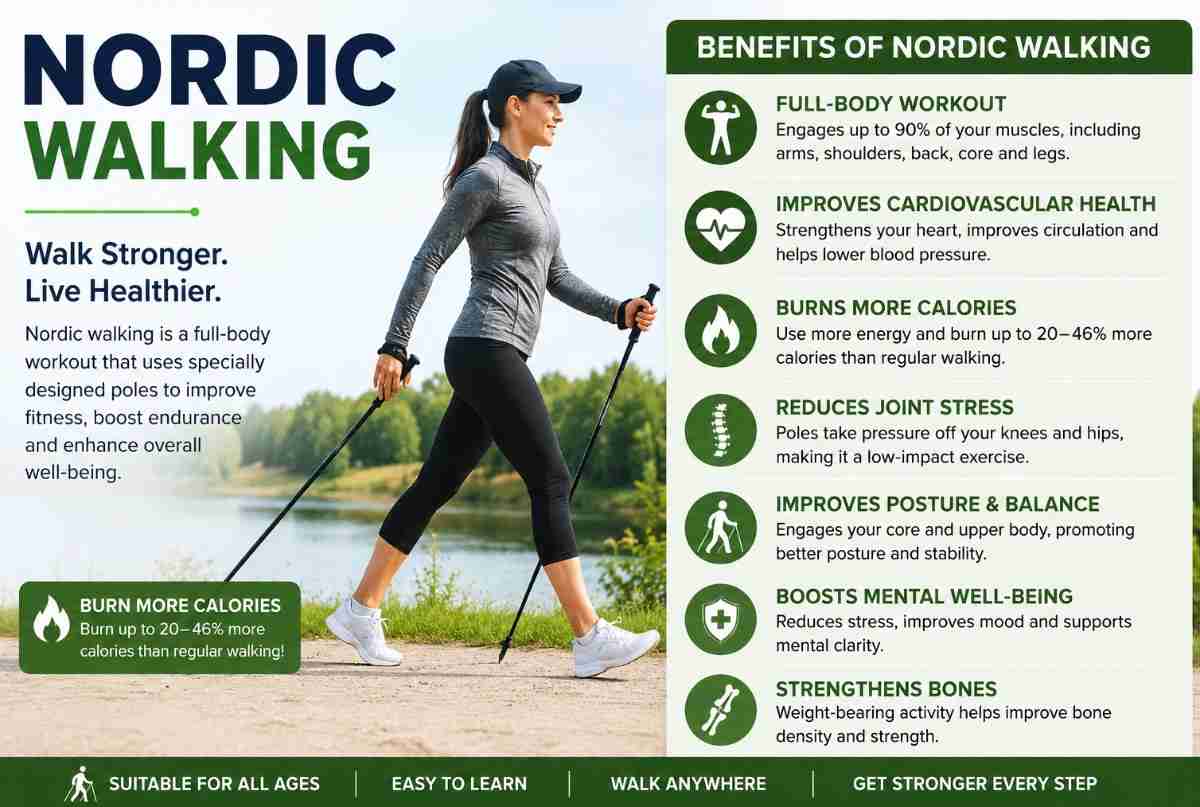
Nordic walking or pole walking is a simple form of exercise that looks a little like ordinary walking, but with one important difference: you use specially designed walking poles to actively involve your upper body. Instead of letting your arms swing naturally at your sides, you push through the poles as you walk, creating a full-body workout.
What makes Nordic walking appealing is that it does not require a gym, complicated equipment, or advanced athletic ability. It can be performed on parks, sidewalks, trails, and other suitable walking surfaces. For many people, it is a practical way to make regular walking more challenging while still keeping the movement familiar and low-impact.
Research has found that Nordic walking can increase exercise intensity compared with ordinary walking and may benefit cardiovascular fitness, exercise capacity, blood pressure, and quality of life. A systematic review of randomized trials found favorable effects on heart rate, oxygen consumption, exercise capacity, and quality of life compared with brisk walking without poles.
What Is Nordic Walking?
Nordic walking is a form of fitness walking in which specially designed poles are used with a coordinated arm-and-leg movement. It originated from the training methods used by cross-country skiers and later developed into a recreational and fitness activity.
The key difference between Nordic walking and simply walking with hiking poles is the technique. In Nordic walking, the poles are not just used for balance or support. You actively plant and push against them, encouraging movement through the shoulders, arms, chest, back, and core.
This makes Nordic walking a whole-body activity rather than an exercise focused primarily on the legs.
How Does Nordic Walking Work?
During ordinary walking, your legs do most of the work while your arms naturally swing to help with balance and rhythm. Nordic walking adds purposeful upper-body movement.
As one leg moves forward, the opposite arm generally moves forward with its pole. The pole is planted behind or beside the body, and you push backward through the handle while moving forward.
A basic movement pattern looks like this:
- Stand upright with relaxed shoulders.
- Hold the poles lightly rather than gripping them tightly.
- Walk naturally while allowing your arms to swing.
- Gradually increase the backward push through each pole.
- Coordinate the opposite arm and leg.
- Maintain a comfortable, steady walking rhythm.
Learning the technique is important because simply carrying poles while walking does not provide the same benefits as actively using them.
15 Potential Health Benefits of Nordic Walking
1. Supports Cardiovascular Fitness
Nordic walking can raise heart rate and oxygen consumption compared with ordinary walking at similar speeds, helping make walking a more effective cardiovascular workout.
2. Works More Muscle Groups
Because the poles involve active pushing and arm movement, Nordic walking recruits muscles in the arms, shoulders, chest, back, and core in addition to the lower body.
3. May Improve Exercise Capacity
Regular Nordic walking can help improve physical fitness and exercise tolerance. Research reviews have reported improvements in exercise capacity among various groups.
4. Can Support Healthy Weight Management
Nordic walking can increase the overall physical demand of a walking session, which may help increase energy expenditure. However, weight loss still depends on overall calorie balance, diet, activity level, sleep, and other lifestyle factors.
5. May Support Blood Pressure Health
Research involving older adults has found improvements in several cardiovascular risk factors following Nordic walking programs, including reductions in systolic blood pressure.
6. Encourages Better Upper-Body Engagement
The pushing action of the poles gives the upper body a more active role than it normally has during walking.
7. Supports Walking Endurance
Regular practice can help people become more comfortable walking for longer periods. A 2023 systematic review found evidence supporting benefits of pole walking for walking ability in certain populations, although results differed according to the group studied.
8. May Benefit Quality of Life
Studies included in systematic reviews have reported improvements in quality-of-life measures following pole-walking programs.
9. Provides a Low-Impact Exercise Option
Nordic walking is still a walking activity, so it generally places less impact on the body than higher-impact activities such as running. Individual comfort can vary, particularly when walking downhill or on hard surfaces.
10. Can Challenge the Core
Maintaining an upright posture while coordinating the arms, legs, and poles requires the trunk to participate in the movement.
11. May Improve Balance and Coordination
The coordinated opposite-arm-and-leg pattern encourages rhythm, body awareness, and coordination. However, poles should not automatically be considered a substitute for professional balance training when someone has a significant fall risk.
12. Can Make Walking More Engaging
For people who find conventional walking repetitive, learning a new technique and incorporating poles can make a routine walk feel more purposeful.
13. May Be Useful for Some Older Adults
Nordic walking has been studied extensively in middle-aged and older populations. Research suggests potential benefits for cardiovascular fitness and other health outcomes, although individual abilities and medical conditions should always be considered.
14. May Support Metabolic Health
Recent research has investigated Nordic walking in people with prediabetes and diabetes. A 2026 meta-analysis reported improvements in several measures, including HbA1c, body weight, and HDL cholesterol compared with control conditions, although the results varied across outcomes and studies.
15. Can Be a Social Form of Exercise
Nordic walking can easily be done with a friend, walking group, or family member. The social aspect may make it easier for some people to stay consistent with physical activity.
Nordic Walking vs. Regular Walking
The biggest difference is upper-body involvement.
| Feature | Regular Walking | Nordic Walking |
|---|---|---|
| Legs | Highly involved | Highly involved |
| Arms | Natural swinging | Active pole movement |
| Upper body | Limited involvement | Greater involvement |
| Equipment | Comfortable shoes | Shoes plus Nordic walking poles |
| Exercise intensity | Depends on speed and terrain | Can be increased through pole technique |
| Skill required | Minimal | Basic technique needs to be learned |
| Outdoor use | Yes | Yes |
Nordic walking is not necessarily “better” for every person. Someone who enjoys ordinary walking and does it consistently may already be receiving substantial health benefits. The main advantage of Nordic walking is that poles can add an upper-body component and increase the overall challenge.
How to Do Nordic Walking Correctly?
Technique matters more than simply owning a pair of poles.
1. Start With Natural Walking
Before trying to push strongly through the poles, walk naturally while allowing your arms to swing. This helps establish a comfortable rhythm.
2. Keep Your Shoulders Relaxed
Avoid pulling your shoulders upward or becoming stiff. Your shoulders should remain relaxed while your arms move naturally.
3. Use a Light Grip
Nordic walking poles generally have specialized straps that help maintain contact with the hand. You do not need to squeeze the handles tightly throughout the entire walk.
4. Push the Pole Backward
The active part of Nordic walking comes from pushing backward through the pole rather than simply placing it in front of you for support.
5. Coordinate Opposite Limbs
Your right arm generally works with your left leg, while your left arm works with your right leg. At first, this may feel awkward, but the movement usually becomes more natural with practice.
6. Maintain Good Posture
Keep your head upright, chest comfortably open, and spine in a natural position. Avoid leaning excessively forward.
7. Gradually Increase the Effort
Once the technique feels comfortable, you can increase your walking speed, arm swing, pole push, distance, or terrain difficulty.
How to Choose Nordic Walking Poles?
Nordic walking poles are different from ordinary walking sticks and trekking poles. They are designed specifically for the Nordic walking technique and usually include comfortable grips and hand straps.
When selecting poles, consider:
- Appropriate pole length for your height
- Comfortable handles
- Secure hand straps
- Suitable pole tips for the surface
- Lightweight construction
- A design that allows natural arm movement
A pole that is too long or too short can make technique uncomfortable. Beginners may benefit from learning the basics from a qualified Nordic walking instructor.
How Long Should You Do Nordic Walking?
There is no single duration that works for everyone.
A beginner might start with 15–20 minutes of comfortable walking and gradually increase the duration. As fitness improves, sessions of 30–60 minutes can become realistic for many people.
Research studies have used a wide range of programs. One systematic review of Nordic walking for chronic pain and fatigue reported interventions lasting 6–24 weeks, commonly performed 2–4 days per week for approximately 25–75 minutes per session.
The best routine is one you can perform safely and consistently.
Risks of Nordic Walking
1. Risk of Falling
Poles can provide stability, but they can also become a hazard if they catch on roots, rocks, uneven surfaces, or other obstacles. Poor technique or walking too quickly on difficult terrain can increase the risk of losing balance.
2. Thumb and Hand Injuries
A distinctive injury reported among Nordic walkers is sometimes called “Nordic walking thumb.” It can occur during a fall when a person remains attached to the pole and the handle forces the thumb backward.
Using the straps correctly and learning how to release the pole safely during a fall may help reduce this risk.
3. Shoulder Strain
The repetitive arm movement can place additional demands on the shoulders. Beginners who use excessive force or have poor technique may develop shoulder soreness or strain.
4. Wrist and Forearm Overuse
Nordic walking involves repetitive forces through the hands and wrists. Biomechanical research has found considerable wrist acceleration during Nordic walking, suggesting that excessive or repetitive loading may contribute to upper-extremity overuse problems.
5. Muscle Soreness
If you are new to Nordic walking, your arms, shoulders, upper back, and core may become sore because these muscles are working more than they do during ordinary walking.
Start gradually rather than immediately attempting a long or vigorous session.
6. Blisters or Hand Discomfort
Poorly fitted straps or grips can cause rubbing and discomfort. Adjust the straps properly and avoid gripping the poles excessively tightly.
7. Joint Discomfort
Although Nordic walking can be relatively low-impact, some people may experience discomfort in the knees, hips, ankles, wrists, or shoulders, particularly if they have an existing musculoskeletal problem.
8. Overtraining
Because Nordic walking can feel enjoyable and manageable, it is easy to increase distance or frequency too quickly. Sudden increases in training volume can lead to persistent muscle soreness or overuse injuries.
9. Incorrect Pole Length
Poles that are poorly suited to your height can make your posture and arm movement less comfortable and may interfere with proper technique.
10. Exercising Beyond Your Fitness Level
Nordic walking can become a moderate or vigorous workout, particularly on hills or when using a strong pole technique. People who are new to exercise should build intensity gradually.
How Many Calories Does Nordic Walking Burn?
Nordic walking can burn more calories than regular walking at the same speed because actively pushing with the poles increases upper-body muscle activity and overall exercise intensity. In one field study, Nordic walking increased calorie expenditure compared with regular walking, while a more recent crossover trial found higher oxygen consumption and heart rate during Nordic walking.
However, calorie burn varies considerably with body weight, walking speed, terrain, incline, duration, and how strongly you use the poles. The following chart gives practical estimates rather than exact measurements.
Estimated Calories Burned During Nordic Walking:
| Body Weight | 30 Minutes | 45 Minutes | 60 Minutes |
|---|---|---|---|
| 50 kg (110 lb) | 140–190 kcal | 210–285 kcal | 280–380 kcal |
| 60 kg (132 lb) | 170–225 kcal | 255–340 kcal | 340–450 kcal |
| 70 kg (154 lb) | 195–265 kcal | 290–400 kcal | 390–530 kcal |
| 80 kg (176 lb) | 225–300 kcal | 335–450 kcal | 450–600 kcal |
| 90 kg (198 lb) | 250–340 kcal | 375–510 kcal | 500–680 kcal |
| 100 kg (220 lb) | 280–375 kcal | 420–565 kcal | 560–750 kcal |
Important: These are reasonable estimated ranges, not laboratory measurements for every person. A vigorous uphill Nordic walking session can burn substantially more than a relaxed walk on flat ground. Research has shown that Nordic walking can require considerably more energy than ordinary walking when a vigorous technique is used.
Can Nordic Walking Help With Weight Loss?
Nordic walking can be part of a weight-management program because it provides regular aerobic activity and can increase the physical demand of walking.
Research specifically examining overweight and obese adults has reported positive effects across measures such as body composition, cardiovascular fitness, and metabolic health, although the studies varied in their exercise programs and outcomes.
For sustainable weight loss, Nordic walking works best when combined with an appropriate eating pattern, adequate sleep, and other healthy lifestyle habits.
Is Nordic Walking Good for Older Adults?
Nordic walking may be an attractive exercise option for some older adults because it combines walking with active upper-body movement.
A 2024 systematic review and meta-analysis of 22 studies involving 1,271 older adults reported improvements in several cardiovascular and body-composition measures, including body weight, BMI, waist circumference, maximal oxygen consumption, and blood pressure.
Still, older adults with significant balance problems, joint limitations, heart conditions, or other medical concerns should discuss an appropriate exercise program with a healthcare professional before starting.
Nordic Walking for People With Health Conditions
Nordic walking has been studied in several clinical populations, including people with cardiovascular disease, peripheral artery disease, Parkinson’s disease, diabetes, and chronic pain.
The evidence is encouraging but should not be interpreted as meaning Nordic walking treats these conditions. For example, research in cardiovascular disease suggests Nordic walking can be a feasible and promising form of exercise, but more research is needed for some specific clinical applications.
Similarly, research involving chronic pain and fatigue found potentially beneficial effects, but Nordic walking was not consistently superior to ordinary walking or inactivity for every outcome.
If you have a diagnosed medical condition, use Nordic walking as part of an appropriate exercise plan rather than replacing prescribed treatment.
Common Nordic Walking Mistakes
Beginners often make a few simple mistakes:
- Holding the poles too tightly: A relaxed grip allows smoother movement.
- Keeping the poles directly in front: Pole walking relies on an active backward push.
- Moving both arms and legs on the same side: Practice the opposite-arm-and-leg rhythm slowly.
- Shrugging the shoulders: Keep the shoulders relaxed.
- Walking too fast too soon: Master technique before increasing intensity.
- Using unsuitable poles: Proper Nordic walking poles make the technique easier and more comfortable.
Who Should Try Nordic Walking?
Nordic walking may be suitable for people who:
- Enjoy outdoor exercise
- Want to make walking more challenging
- Prefer low-impact aerobic activities
- Want greater upper-body involvement
- Are looking for a social activity
- Want an alternative to gym-based cardio
- Are beginning a regular walking routine
The activity can be adapted to different fitness levels by changing speed, duration, terrain, and pole effort.
Who Should Be Cautious?
Speak with a healthcare professional before starting if you have significant heart or lung disease, uncontrolled blood pressure, severe joint problems, major balance difficulties, recent surgery, or another condition that limits exercise.
Stop exercising and seek appropriate medical attention if you experience concerning symptoms such as chest pain, fainting, severe shortness of breath, or unusual dizziness.
Tips to Make Nordic Walking a Habit
Start small rather than trying to complete a long session immediately.
Choose a comfortable route with a relatively even surface while learning the technique. Wear supportive walking shoes and take a few minutes to warm up.
You can also make your routine more enjoyable by walking with a friend, listening to music when safe, exploring different routes, or joining a local walking group.
Most importantly, do not judge your progress only by weight. Improvements in walking endurance, energy, fitness, confidence, and consistency can be meaningful signs that your routine is working.
Final Thoughts
Nordic walking takes an ordinary activity and gives it a full-body twist. By actively using walking poles, you can involve your arms and upper body while continuing to enjoy the familiar movement of walking.
Scientific evidence suggests that Pole walking can improve several measures of fitness and health, including exercise capacity, oxygen consumption, cardiovascular health, and quality of life.
It is not a magic exercise, and it does not need to replace regular walking or other forms of physical activity. Its biggest advantage may simply be that it gives people another practical, enjoyable way to stay active.
If you are new to Pole walking, concentrate on technique first, begin at a comfortable intensity, and gradually build your walking time. Consistency matters much more than trying to make every session exhausting.
FAQ’s
Is Nordic walking better than normal walking?
Pole walking can provide greater upper-body involvement and may increase exercise intensity compared with regular walking. However, normal walking is also highly beneficial.
Can Nordic walking tone the body?
It can help strengthen and condition the arms, shoulders, back, core, hips, and legs because the poles add upper-body movement.
Is Nordic walking good for beginners?
Yes. Beginners can start slowly and learn the basic opposite-arm-and-leg technique before increasing speed or distance.
Can you Nordic walk every day?
Many people can Nordic walk regularly, but recovery depends on intensity, fitness, age, and health. Alternating easier and harder sessions can be helpful.
What muscles does Nordic walking work?
Pole walking works the legs and glutes while also engaging the shoulders, arms, chest, upper back, and core.
Do I need special poles for Nordic walking?
Special Pole walking poles are recommended because they are designed for the swinging and pushing technique used during the activity.
Can Nordic walking improve fitness?
Yes. Regular Pole walking can improve cardiovascular fitness, walking endurance, and exercise capacity.
Is Nordic walking hard on the knees?
Pole walking is generally considered a relatively low-impact activity, but knee comfort can vary. Proper technique, suitable footwear, and an appropriate walking surface can help.
Can Nordic walking help with belly fat?
Pole walking can contribute to overall fat loss by increasing physical activity, but it cannot specifically target belly fat. Fat loss occurs throughout the body rather than from one chosen area.
What is the best time to do Nordic walking?
There is no universally best time. Morning, afternoon, or evening can all work. The most important factor is choosing a time that allows you to exercise consistently and safely.
Can I use trekking poles for Nordic walking?
Trekking poles and Nordic walking poles are designed for different purposes. Pole walking poles are specifically designed for the arm swing and pushing technique used in fitness walking.
Does Nordic walking build muscle?
It can increase the involvement of the arms, shoulders, chest, back, and core compared with ordinary walking. However, it should not be considered a replacement for dedicated resistance training.
Sources / References:
Disclaimer:
This article is for general educational purposes only and does not replace professional medical advice, diagnosis, or treatment. If you have a medical condition or concerns about starting exercise, consult a qualified healthcare professional.
Also Read: