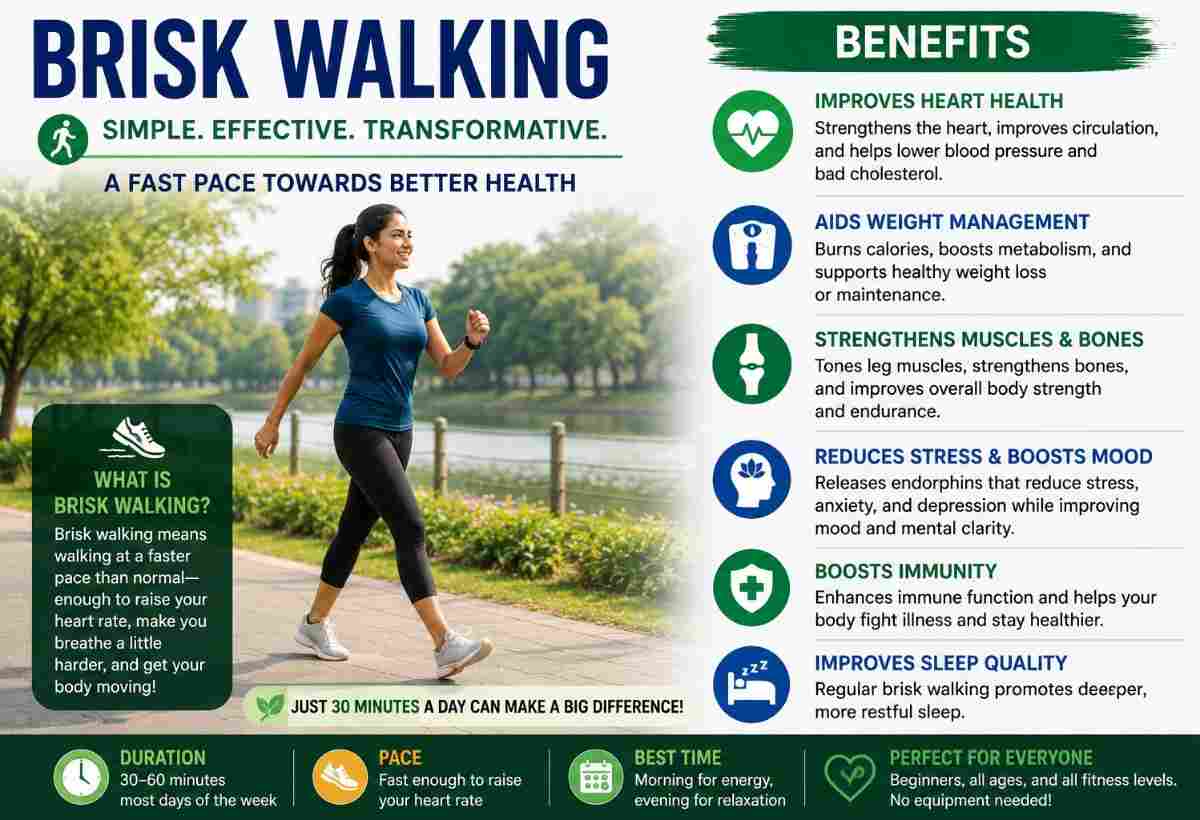
Brisk walking is one of the simplest ways to become more physically active without needing a gym membership, complicated equipment, or advanced fitness skills. It looks like ordinary walking, but the pace is fast enough to raise your heart rate and breathing while still allowing you to maintain control.
For many people, brisk walking is an approachable middle ground between casual walking and more demanding activities such as jogging or running. It can fit into a busy day as a morning walk, lunchtime activity, evening routine, or even a short walk broken into several sessions.
Health guidelines recognize brisk walking as a moderate-intensity aerobic activity. Adults are generally advised to aim for at least 150 minutes of moderate-intensity physical activity each week, with additional benefits possible as activity increases.
The best part is that you do not have to start with a long walk. Building your pace and duration gradually can make brisk walking a sustainable habit rather than another short-lived fitness goal.
What Is Brisk Walking?
Brisk walking is walking at a pace that is noticeably faster than your normal relaxed pace. There is no single speed that defines brisk walking for everyone because fitness level, age, terrain, and health status can influence how hard a particular pace feels.
A useful way to judge intensity is the talk test. During a moderate-intensity brisk walk, you should generally be able to talk but find it difficult to comfortably sing a full song.
Your breathing should become faster, your heart rate should rise, and you should feel that your body is working harder than it would during an easy stroll.
Brisk walking can be performed outdoors, on a treadmill, in a park, around a shopping area, or along a safe indoor route.
Brisk Walking vs. Normal Walking
The main difference is intensity.
| Feature | Normal Walking | Brisk Walking |
|---|---|---|
| Pace | Comfortable and relaxed | Faster and purposeful |
| Breathing | Mostly unchanged | Noticeably faster |
| Heart rate | Slight increase | Moderate increase |
| Effort | Light | Moderate |
| Conversation | Easy | Possible but more effortful |
| Fitness effect | Useful for movement | Stronger aerobic stimulus |
This does not mean slow walking is useless. Any movement is generally better than prolonged inactivity. However, increasing walking intensity can provide a stronger cardiovascular workout.
20 Health Benefits of Brisk Walking
- Supports Heart Health: Regular brisk walking provides moderate-intensity aerobic exercise that can support cardiovascular health and fitness.
- Helps Manage Weight: Brisk walking increases energy expenditure and can support healthy weight management when combined with a balanced diet.
- Improves Cardiovascular Fitness: Walking at a purposeful pace challenges the heart and lungs and can gradually improve endurance.
- Supports Healthy Blood Pressure: Consistent physical activity, including brisk walking, can contribute to healthier blood pressure levels.
- May Help Blood Sugar Control: Regular walking can increase muscle activity and support glucose utilization and insulin sensitivity.
- Supports Diabetes Prevention: Maintaining an active lifestyle with activities such as brisk walking may lower the risk of developing type 2 diabetes.
- Strengthens Leg Muscles: Brisk walking repeatedly engages the calves, quadriceps, hamstrings, glutes, and other lower-body muscles.
- Improves Physical Endurance: Regular walks can make everyday activities such as climbing stairs and shopping feel easier over time.
- Supports Bone Health: Weight-bearing activities such as walking place gentle mechanical stress on bones and can contribute to maintaining bone strength.
- May Support Joint Function: Regular, appropriate movement can help maintain mobility and joint function, particularly when walking is performed at a comfortable intensity.
- Boosts Daily Energy: A brisk walk can increase circulation and provide a refreshing break from prolonged sitting or inactivity.
- Supports Mental Well-Being: Physical activity can contribute to better mood and overall psychological well-being.
- May Help Reduce Stress: Taking a brisk walk can provide a mental break and may help reduce feelings of everyday stress.
- Supports Brain Health: Regular physical activity is associated with benefits for cognitive health and may support healthy brain aging.
- May Improve Sleep: Regular exercise can contribute to better sleep quality and a healthier sleep routine.
- Supports Healthy Aging: Maintaining regular walking habits can help preserve mobility, physical function, and independence as people age.
- Improves Balance and Coordination: Walking requires continuous coordination between the legs, arms, trunk, and nervous system.
- Increases Daily Physical Activity: Brisk walking is an accessible way to reach recommended weekly physical-activity targets without requiring specialized equipment.
- Supports Overall Metabolic Health: Regular physical activity can benefit several aspects of metabolic health, including body composition, blood sugar regulation, and cardiovascular fitness.
- May Promote Longevity: Higher levels of regular physical activity and walking are associated with lower risks of several chronic diseases and premature mortality, although walking alone does not guarantee longer life.
How Fast Should You Walk?
There is no universal brisk-walking speed that works for every person.
A commonly used practical range for many adults is around 3 to 4 miles per hour, or approximately 4.8 to 6.4 kilometers per hour. However, fitness level matters more than a specific number.
For one person, 3 mph may feel moderately challenging. For another, it may feel easy.
Instead of becoming overly focused on speed, pay attention to your breathing and effort. A brisk pace should feel purposeful and moderately challenging without requiring an all-out effort.
How Many Calories Does Brisk Walking Burn?
Calories burned during brisk walking depend mainly on body weight, walking speed, duration, terrain, and individual metabolism. The chart below gives approximate calories burned during a brisk walk at around 3–4 mph (4.8–6.4 km/h).
| Body Weight | 30 Minutes | 45 Minutes | 60 Minutes |
|---|---|---|---|
| 50 kg (110 lb) | 120–145 kcal | 180–220 kcal | 240–290 kcal |
| 60 kg (132 lb) | 145–175 kcal | 215–260 kcal | 290–350 kcal |
| 70 kg (154 lb) | 170–200 kcal | 255–300 kcal | 340–400 kcal |
| 80 kg (176 lb) | 190–230 kcal | 285–345 kcal | 380–460 kcal |
| 90 kg (198 lb) | 215–260 kcal | 320–390 kcal | 430–520 kcal |
| 100 kg (220 lb) | 240–290 kcal | 360–435 kcal | 480–580 kcal |
Note: These are approximate estimates, not exact measurements. Walking uphill, increasing your speed, or walking on an incline can increase energy expenditure, while a slower pace or flat, easy terrain may reduce it.
How to Do Brisk Walking Correctly?
Good technique can make walking feel smoother and more comfortable.
- Keep Your Head Up: Look ahead rather than constantly looking at the ground.
- Relax Your Shoulders: Avoid tightening or lifting your shoulders while walking.
- Bend Your Arms: Keep your elbows comfortably bent and allow your arms to swing naturally.
- Maintain Good Posture: Keep your torso upright rather than leaning excessively forward.
- Take Natural Steps: Avoid forcing extremely long strides. A comfortable, efficient stride is usually better than overstriding.
- Walk From Heel to Toe: Allow your foot to move naturally through the step instead of landing heavily on the entire foot.
- Increase Pace Gradually: Rather than suddenly going from a slow stroll to maximum speed, build your pace over several minutes.
A Simple 30-Minute Brisk Walking Routine
If you are new to brisk walking, try this structure:
| Time | Activity |
|---|---|
| 0–5 minutes | Easy walking warm-up |
| 5–10 minutes | Gradually increase pace |
| 10–25 minutes | Brisk walking |
| 25–30 minutes | Slow walking cooldown |
As your fitness improves, you can gradually increase the brisk portion.
You do not necessarily need to walk for 30 minutes continuously. Shorter bouts can also help you accumulate physical activity throughout the day.
Brisk Walking Technique
- Head Position: Keep your head up and look ahead rather than constantly looking down.
- Posture: Keep your back comfortably upright without leaning excessively forward.
- Shoulders: Relax your shoulders and avoid unnecessary tension.
- Arms: Bend your elbows comfortably and swing your arms naturally in coordination with your steps.
- Stride: Take natural, comfortable steps instead of deliberately taking very long strides.
- Foot Placement: Allow your foot to move naturally from heel through the foot and toward the toes.
- Core: Keep your abdominal muscles gently engaged without stiffening your torso.
- Pace: Walk quickly enough to increase your breathing and heart rate while remaining in control.
Ideal Pace for Brisk Walking
There is no single ideal pace for everyone. For many adults, about 3–4 mph (4.8–6.4 km/h) can feel like a brisk walking pace, but fitness level and individual health make a difference.
A simple way to judge your pace is the talk test: you should be able to talk during brisk walking, but you should find it difficult to sing comfortably. This generally corresponds to moderate-intensity activity.
- Beginner: Start around a comfortable pace and gradually increase speed.
- Moderate Brisk Pace: Approximately 3–4 mph (4.8–6.4 km/h) for many adults.
- More Fit Individuals: A faster pace may still be moderate intensity for someone with higher fitness.
The goal is not to reach a particular speed at all costs. The ideal brisk-walking pace is one that feels moderately challenging while allowing you to maintain good technique and control.
How Often Should You Do Brisk Walking?
A practical goal for many adults is to work toward at least 150 minutes of moderate-intensity aerobic activity each week.
For example:
- 30 minutes on 5 days per week
- 25 minutes on 6 days per week
- Approximately 20–25 minutes most days
- Several shorter walking sessions spread throughout the day
The key is consistency. If 150 minutes feels overwhelming, start with less and gradually build your routine.
The Physical Activity Guidelines note that substantial benefits occur with 150 to 300 minutes of moderate-intensity activity per week, such as brisk walking.
Risks of Brisk Walking
Brisk walking is generally considered a safe form of moderate-intensity exercise, but like any physical activity, it can cause problems when performed incorrectly or increased too quickly.
- Muscle Soreness: Increasing walking duration or speed suddenly can cause temporary soreness in the calves, thighs, hips, or glutes.
- Foot Blisters: Long walks or poorly fitting shoes can create friction and lead to painful blisters.
- Joint Discomfort: People with existing knee, hip, or ankle problems may experience increased discomfort when walking at a faster pace.
- Overuse Injuries: Repeating long or intense walks without adequate recovery may contribute to problems such as shin pain, tendon irritation, or foot discomfort.
- Falls and Trips: Uneven, slippery, or poorly lit surfaces can increase the risk of falling.
- Dehydration: Walking for long periods, particularly in hot or humid weather, can increase fluid loss.
- Heat-Related Illness: Brisk walking in very hot conditions may increase the risk of heat exhaustion or heat stroke.
- Excessive Fatigue: Walking too fast or for too long without adequate conditioning can leave you unusually tired.
- Worsening Existing Symptoms: People with certain health conditions may experience symptoms when exercising beyond their current fitness level.
- Cardiovascular Warning Signs: Chest pain, fainting, severe breathlessness, or unusual dizziness during exercise should not be ignored and requires prompt medical evaluation.
Is Brisk Walking Good for Weight Loss?
Brisk walking can contribute to weight loss because physical activity increases energy expenditure. However, walking alone does not guarantee weight loss.
Your overall calorie intake, food choices, sleep, stress, activity level, genetics, and other factors influence body weight.
For someone trying to lose weight, brisk walking can be particularly useful because it is relatively accessible and can be performed regularly.
A sensible approach is to combine walking with a balanced eating pattern and, when appropriate, muscle-strengthening exercise.
Can Brisk Walking Help Reduce Belly Fat?
Brisk walking can help reduce overall body fat when it contributes to a sustained calorie deficit, but it cannot specifically target belly fat.
The body does not reliably choose one area from which to burn fat. Changes in abdominal fat generally occur as part of overall changes in body composition.
Combining regular walking with resistance training, nutritious food choices, adequate protein, sufficient sleep, and sustainable calorie control can provide a more complete approach to body-fat management.
Best Time to Go Brisk Walking
There is no universally superior time of day for brisk walking.
Morning walks may help some people establish a consistent routine, while evening walks may be easier for people with busy mornings.
The best time is the time you can maintain consistently.
If walking outdoors during hot weather, choose a cooler part of the day, stay hydrated according to your needs, and consider environmental conditions.
What Should You Wear for Brisk Walking?
You do not need expensive equipment.
A comfortable pair of walking shoes with appropriate fit and support is usually the most important item. Choose breathable clothing suitable for the weather and consider reflective clothing or other visibility measures if walking in low-light conditions.
For outdoor walking, weather-appropriate clothing and sun protection may also be useful.
Who Should Do Brisk Walking?
- Healthy Adults: Brisk walking is a practical moderate-intensity exercise for adults looking to improve their overall fitness.
- Beginners: People new to exercise can start with slower walking and gradually increase their pace.
- Older Adults: Many older adults can benefit from brisk walking when the intensity matches their fitness and mobility.
- People Seeking Weight Management: Regular brisk walking can increase daily energy expenditure and support a healthy weight.
- People With Sedentary Lifestyles: Brisk walking can be an accessible way to replace prolonged sitting with regular physical activity.
Who Should Avoid Brisk Walking?
- People With Severe Exercise-Related Symptoms: Anyone experiencing unexplained chest pain, fainting, or severe breathlessness should not exercise until medically evaluated.
- People With Significant Injuries: Those with acute foot, ankle, knee, or hip injuries may need to avoid brisk walking until recovery.
- People With Certain Medical Conditions: Individuals with uncontrolled heart, lung, or other significant health conditions should seek medical advice before starting vigorous or moderate-intensity exercise.
- People Recovering From Surgery: Follow your healthcare professional’s recommendations before increasing walking intensity.
Safety Tips for Brisk Walking
- Start with 5 minutes of easy walking to warm up.
- Increase your pace gradually rather than starting too fast.
- Wear comfortable, properly fitting walking shoes.
- Choose safe, well-maintained walking surfaces.
- Stay aware of traffic, cyclists, and other pedestrians.
- Drink fluids according to your needs, especially in hot weather.
- Avoid walking outdoors during extreme heat when possible.
- Stop if you experience unusual pain, dizziness, fainting, chest pain, or severe shortness of breath.
- Increase walking duration and intensity gradually.
- Allow adequate recovery if your muscles or joints become unusually sore.
Common Brisk Walking Mistakes
- Starting Too Fast: Beginning at maximum speed can cause unnecessary fatigue and make the workout unpleasant.
- Taking Excessively Long Strides: Overstriding can feel awkward and may increase discomfort.
- Ignoring Pain: Mild exercise fatigue is different from sharp or persistent pain.
- Doing Too Much Too Soon: Suddenly increasing walking time or intensity can increase the risk of overuse problems.
- Focusing Only on Step Count: Steps are useful for tracking movement, but walking intensity, duration, strength training, recovery, and overall lifestyle also matter.
Brisk Walking and Step Counts
Step counts can be a useful way to monitor daily movement, but there is no requirement for everyone to reach exactly 10,000 steps every day.
Recent research suggests that meaningful health associations can occur at lower step counts, and a 2025 systematic review found that around 5,000–7,000 steps per day was an important range for several outcomes examined.
Instead of becoming discouraged by an arbitrary number, consider gradually increasing your activity from your current baseline.
For example, someone averaging 3,000 steps could first aim for 4,000 or 4,500 rather than immediately attempting 10,000.
FAQ’s
Is brisk walking good for cholesterol?
Yes. Regular brisk walking can support heart health and may help improve cholesterol levels as part of an overall healthy lifestyle.
Is 20 minutes of brisk walking a day enough?
Yes. Twenty minutes daily adds up to about 140 minutes per week, which is close to the recommended 150 minutes of moderate-intensity activity. Even shorter sessions are beneficial when building an exercise habit.
How many steps are in a 10-minute brisk walk?
Many adults take approximately 1,000–1,300 steps during a 10-minute brisk walk, depending on walking speed and stride length.
How long should I brisk walk daily?
Aim for around 30 minutes on most days, gradually working toward at least 150 minutes of moderate-intensity activity per week.
What happens if I brisk walk every day?
Daily brisk walking can improve cardiovascular fitness, support weight management, strengthen the lower body, increase endurance, and contribute to better overall physical and mental well-being.
What speed is considered brisk walking?
For many adults, about 3–4 mph (4.8–6.4 km/h) is brisk, but your breathing and effort level are more important than a specific speed.
Is 30 minutes of brisk walking enough?
Yes. Thirty minutes of brisk walking can contribute significantly toward the recommended weekly amount of moderate-intensity physical activity.
Is brisk walking better than normal walking?
Brisk walking provides a greater cardiovascular workout and generally burns more calories than slow, relaxed walking.
Can I brisk walk every day?
Yes, many people can brisk walk daily, provided the duration and intensity are appropriate for their fitness level.
How many calories does 30 minutes of brisk walking burn?
Calories vary according to body weight, pace, terrain, and individual factors, so there is no single calorie number for everyone.
Can brisk walking improve heart health?
Regular moderate-intensity activity such as brisk walking can support cardiovascular fitness and overall heart health.
Is brisk walking good for beginners?
Yes. Beginners can start with comfortable walking and gradually increase their pace and walking duration.
How many steps are in 30 minutes of brisk walking?
The number varies with walking speed and stride length, but many people may take roughly 3,000–4,000 steps in 30 minutes.
Can brisk walking tone the legs?
Yes. Regular brisk walking works the calves, thighs, glutes, and other lower-body muscles.
How quickly can I see results from brisk walking?
Fitness and energy improvements may develop within weeks, while noticeable changes in body composition usually require consistent activity over a longer period.
Can brisk walking replace running?
Brisk walking can provide effective moderate-intensity aerobic exercise, although running provides a higher-intensity workout.
Is brisk walking good for older adults?
It can be an excellent form of moderate physical activity for many older adults, provided the pace is appropriate and there are no medical restrictions.
Should I brisk walk before or after eating?
A comfortable walk after eating may be suitable for many people. Avoid immediately doing a very intense walk if it causes digestive discomfort.
Can brisk walking lower blood sugar?
Regular physical activity can help improve blood glucose management and insulin sensitivity, although individual results vary.
How can I make brisk walking more effective?
Gradually increase your walking duration, maintain a purposeful pace, include hills or inclines when appropriate, and combine walking with strength training and a balanced diet.
Final Thoughts
Brisk walking proves that an effective workout does not always have to be complicated. A purposeful pace, regular schedule, comfortable shoes, and a little consistency can turn ordinary walking into a meaningful form of aerobic exercise.
The evidence supporting physical activity is strong, and brisk walking is specifically recognized as a moderate-intensity activity that can help adults meet recommended weekly activity levels.
Rather than worrying about achieving a perfect pace or an exact number of steps, focus on building a routine you can maintain. Start where you are, increase gradually, and allow your walking habit to become part of everyday life.
Sources / References:
About the Author:
Written by: Kirti Solanki, Health Content Researcher
Kirti Solanki creates evidence-informed health and wellness content with a focus on making complex health information clear, practical, and reader-friendly.
Disclaimer:
This article is for general educational purposes only and does not replace professional medical advice, diagnosis, or treatment. Consult a qualified healthcare professional before starting a new exercise program if you have a medical condition or concerns about your health.
Also Read: