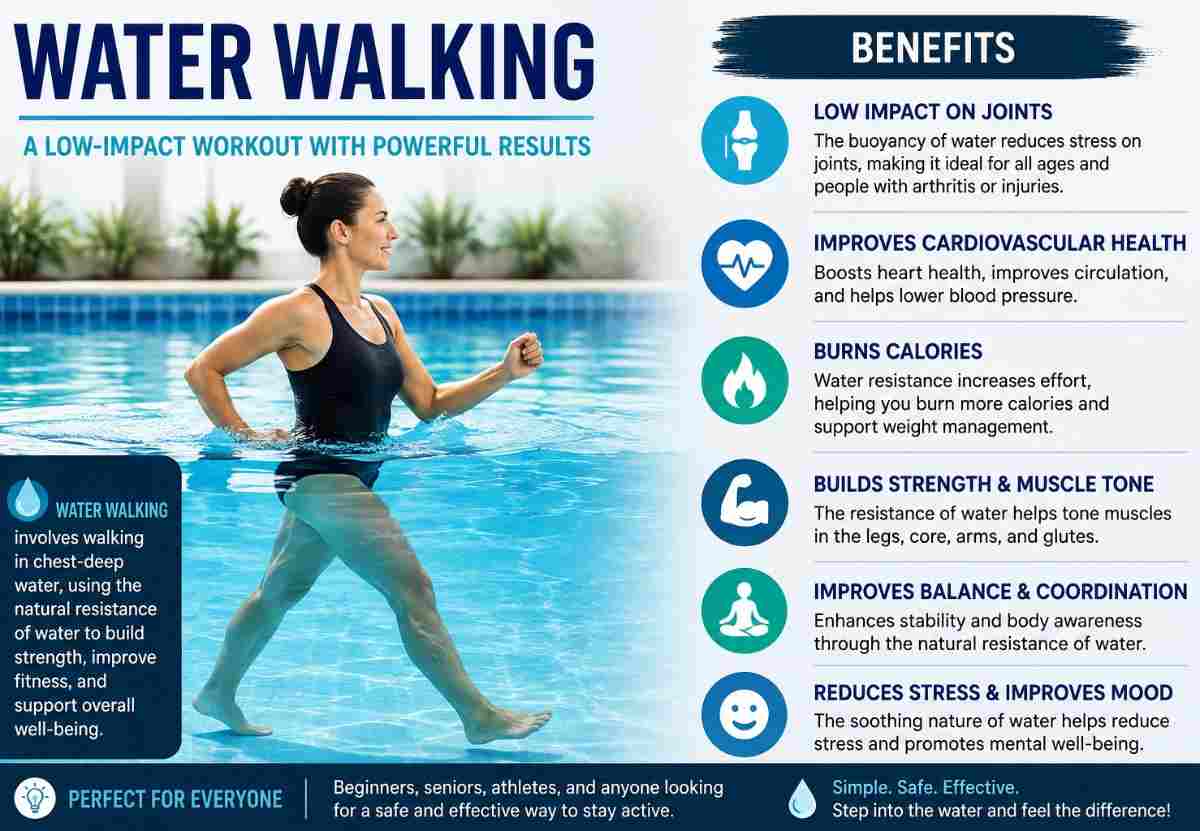
Water walking is a simple form of exercise that involves walking through a swimming pool or another suitable body of water. It looks easy, but the water creates resistance around your body, making your muscles work harder while reducing the impact on your joints.
For people who find regular walking uncomfortable, water walking can be an appealing alternative. It can also be useful for older adults, people returning to exercise, and anyone looking for a refreshing low-impact workout.
Unlike swimming, water walking does not require advanced swimming skills. You simply walk forward, backward, or sideways through waist- to chest-deep water while maintaining good posture and a controlled pace.
Research on aquatic exercise suggests that exercising in water can improve physical functioning, particularly in older adults, while studies in people with osteoarthritis have found improvements in areas such as pain, stiffness, balance, and walking ability.
What Is Water Walking?
Water walking, also called aquatic walking or pool walking, is a type of water-based aerobic exercise performed in a swimming pool.
The water provides resistance in every direction. As you move your legs and arms, you have to push against the water, which can make ordinary walking movements more challenging. At the same time, the buoyancy of water supports part of your body weight and can reduce stress on weight-bearing joints.
Water walking can be performed at different intensities. A slow walk may be appropriate for beginners or people recovering from inactivity, while faster walking, longer strides, arm movements, or changes in direction can create a more demanding workout.
It is different from simply standing or moving casually in a pool. To receive cardiovascular and fitness benefits, the goal is to walk continuously enough to raise your heart rate and breathing.
How Does Water Walking Work?
Water walking combines the benefits of walking with the unique properties of water.
- Buoyancy Supports the Body: Water helps support your body weight, which may make movement more comfortable than walking on a hard surface.
- Water Creates Resistance: Every movement against water requires effort, so your legs, hips, core, shoulders, and arms can work harder than they would during an ordinary walk.
- Water Reduces Impact: Because water supports the body, walking in a pool generally places less impact on the joints than many land-based exercises.
- Water Challenges Balance: The movement of water and resistance from different directions can require your muscles to make constant small adjustments to keep you stable.
These features make water-based exercise particularly useful for people who want to stay active while limiting joint stress. The CDC lists water exercises among joint-friendly activities for people with arthritis.
10 Potential Benefits of Water Walking
1. Supports Cardiovascular Fitness
Water walking can provide an aerobic workout when performed continuously at a moderate pace. Your heart and lungs have to work harder as your walking speed and resistance increase.
Regular aerobic activity supports cardiovascular health and can contribute to overall physical fitness.
2. Provides a Low-Impact Workout
One of the biggest attractions of water walking is its low-impact nature. The buoyancy of water reduces the amount of body weight carried by the joints during movement.
This can make exercise more comfortable for people who find traditional walking, jogging, or other high-impact activities difficult.
3. May Help People With Joint Pain
Water-based exercise has been studied extensively in people with osteoarthritis. A 2025 systematic review of randomized controlled trials found that aquatic exercise improved pain, stiffness, balance, and walking ability compared with non-exercise controls in older adults with osteoarthritis.
However, water walking is not a cure for arthritis, and its benefits are not necessarily greater than every type of land-based exercise.
4. Strengthens the Lower Body
Walking through water creates resistance against your legs. Your quadriceps, hamstrings, calves, glutes, and hip muscles all contribute to each step.
Increasing the water depth, walking faster, or using larger movements can increase the challenge.
5. Engages the Core
Maintaining an upright position in moving water requires your abdominal and back muscles to help stabilize your body.
Adding controlled arm movements and changes in direction can make the core work even harder.
6. Can Improve Balance and Stability
Water walking can challenge balance without placing the same level of impact on the body as many land-based exercises.
Research in older adults with osteoarthritis has reported improvements in balance following aquatic exercise programs.
For people with significant balance problems or a history of falls, however, supervision and appropriate pool safety are important.
7. May Improve Mobility
Stiffness and discomfort can make everyday movements more difficult. Gentle movement in warm water may help people move more comfortably and practice a wider range of motion.
Aquatic exercise has been associated with improvements in physical functioning among older adults.
8. Can Make Exercise Feel More Comfortable
Some people simply find exercising in water more enjoyable than exercising on land. The water can provide a cooling and supportive environment, especially during warm weather.
The CDC notes that people may be able to exercise longer in water without increased joint or muscle pain, particularly those with arthritis or osteoarthritis.
9. Supports Regular Physical Activity
The best exercise is often the type you can do consistently. If water walking feels comfortable and enjoyable, it may help you build a regular exercise routine.
Adults should generally aim for at least 150 minutes of moderate-intensity aerobic activity per week, along with muscle-strengthening activities on at least two days. Water walking can contribute toward the aerobic portion when the intensity is sufficient.
10. Can Be Adapted to Different Fitness Levels
Water walking is easy to modify. Beginners can start slowly, while more experienced exercisers can increase speed, add arm movements, walk backward, or use water resistance equipment.
This flexibility makes it suitable for a wide range of fitness levels.
How to Do Water Walking Correctly?
You do not need complicated equipment to get started.
Step 1: Choose a Suitable Pool
A pool with a flat, non-slippery bottom and easy access is ideal. Beginners may prefer a pool with a shallow section where they can comfortably stand.
Step 2: Start With a Warm-Up
Spend about five minutes walking slowly through the water. Move your shoulders, arms, ankles, and hips gently to prepare your body.
Step 3: Maintain Good Posture
Keep your head up, shoulders relaxed, chest comfortably upright, and abdominal muscles gently engaged. Avoid leaning excessively forward.
Step 4: Walk Naturally
Take controlled steps rather than trying to rush. Swing your arms naturally and keep your movements smooth.
Step 5: Gradually Increase Your Pace
Once you feel comfortable, walk faster until your breathing becomes noticeably deeper. A moderate intensity generally means you can talk but would find singing difficult.
Step 6: Cool Down
Finish by slowing your pace for several minutes. Gentle movements afterward can help you transition back to normal activity.
Water Walking Workout for Beginners
If you are new to water exercise, try this simple routine:
| Exercise | Time |
|---|---|
| Slow water walking | 5 minutes |
| Moderate forward walking | 5 minutes |
| Sideways walking | 2 minutes each direction |
| Backward walking | 3 minutes |
| Faster walking | 5 minutes |
| Slow cool-down walk | 5 minutes |
This gives you a roughly 25-minute session. You can shorten or extend the workout according to your fitness level.
If you are inactive, starting with shorter sessions is perfectly reasonable. The CDC emphasizes that some physical activity is better than none and that activity can be accumulated in smaller periods throughout the week.
Water Walking Techniques
Water walking can be more effective and comfortable when you use proper technique. Start slowly and focus on controlled movements rather than simply walking as fast as possible.
1. Basic Forward Water Walking
Stand upright in waist- to chest-deep water and walk forward with a natural heel-to-toe movement. Keep your back straight, shoulders relaxed, and arms swinging naturally.
2. High-Knee Water Walking
Lift one knee toward your waist while stepping forward, then alternate legs. Keep your movements controlled and avoid leaning backward. This technique increases the challenge for your hips, thighs, and core.
3. Backward Water Walking
Walk backward slowly while maintaining an upright posture. Take short, controlled steps and avoid looking over your shoulder constantly. This can challenge your balance and work your muscles differently from forward walking.
4. Sideways Water Walking
Turn sideways and step to the right for several steps, then repeat toward the left. Keep your knees slightly bent and maintain control. This technique can engage the hips and outer thighs.
5. Fast Water Walking
Once comfortable with basic walking, gradually increase your pace. Pump your arms through the water while maintaining good posture. Faster walking increases water resistance and can provide a more demanding cardiovascular workout.
6. Long-Step Water Walking
Take slightly longer steps than normal while keeping your movements controlled. Push through the water rather than rushing from one step to the next. This can increase resistance against the legs.
7. Arm-Push Walking
While walking forward, push your hands forward, backward, and sideways through the water. Keep your elbows slightly bent and your movements controlled to increase upper-body resistance.
8. Cross-Step Water Walking
Take a step forward and slightly across your body, alternating sides. Start slowly because this movement requires more balance and coordination.
9. Water Walking With Knee Lifts
Walk forward while bringing each knee higher than during a normal step. Engage your abdominal muscles and keep your torso upright. This can increase the intensity of the workout.
10. Interval Water Walking
Alternate between periods of comfortable walking and faster walking. For example, walk at a moderate pace for 2 minutes, followed by 30–60 seconds of faster walking. Repeat several times according to your fitness level.
Risks of Water Walking
Water walking is generally a low-impact exercise, but it is not completely risk-free. The pool environment, water depth, and certain medical conditions can increase the chance of injury or health complications.
- Slip and Fall Risk: Wet pool decks, ladders, and steps can be slippery, increasing the risk of falls when entering or leaving the pool
- Drowning Risk: People with poor balance, severe weakness, or limited confidence in water may be at risk of drowning if they exercise without proper supervision or in water that is too deep.
- Muscle Fatigue: Walking against water resistance can tire the leg and core muscles more quickly than expected, especially for beginners.
- Joint or Muscle Pain: Although water reduces impact, overexercising or using improper technique may still lead to muscle soreness or worsening joint pain. Severe or persistent pain should be evaluated by a healthcare professional.
- Dizziness or Lightheadedness: Some people may feel dizzy during water exercise, particularly in warm water or if they have underlying blood pressure or cardiovascular problems.
- Skin Irritation: Chlorinated pool water may irritate sensitive skin or aggravate certain skin conditions in some individuals.
- Waterborne Illnesses: Pools can spread infections if the water is contaminated or if swimmers enter the pool while ill, particularly with diarrhea or certain contagious infections.
- Breathing Difficulties: People with uncontrolled respiratory conditions may experience discomfort during aquatic exercise and should seek medical guidance before participating.
Ways to Make Water Walking More Challenging
Once regular water walking becomes easy, you can gradually increase the intensity.
- Walk Faster: Increasing your pace creates greater resistance and raises the cardiovascular demand.
- Use Your Arms: Push your arms forward, backward, and sideways through the water.
- Take Larger Steps: Longer controlled steps can increase the amount of work required from your legs.
- Walk Backward: Backward walking changes the movement pattern and challenges different muscles.
- Walk Sideways: Side-stepping can engage the hips and outer thighs differently from forward walking.
- Use Water Weights: Foam dumbbells or other aquatic resistance equipment can increase upper-body resistance, although beginners should first become comfortable without equipment.
Is Water Walking Good for Weight Loss?
Water walking can contribute to weight management because it is a form of physical activity that uses energy.
However, there is no special fat-burning effect unique to water walking. Weight loss generally depends on the relationship between calorie intake, physical activity, body composition, and other factors.
Walking faster, exercising for longer, and performing regular sessions can increase the amount of energy you use. Combining water walking with a balanced eating pattern and other forms of exercise may provide a more complete approach to weight management.
Water Walking vs. Regular Walking
Both forms of walking can provide valuable aerobic exercise, but they feel different.
Regular walking is convenient because you can do it almost anywhere and requires little equipment. Water walking, on the other hand, requires access to a suitable pool but provides buoyancy and water resistance.
For people with joint discomfort, water walking may feel more comfortable. Research suggests aquatic exercise can produce improvements in physical functioning and may be at least as effective as land-based exercise for some older adults, although the evidence has limitations.
The best choice is ultimately the activity you can perform safely and consistently.
Is Water Walking Good for Older Adults?
Water walking can be an excellent option for many older adults because it combines movement with reduced joint loading.
Research has found that aquatic exercise can improve physical functioning in older adults, and newer research involving people with osteoarthritis has reported benefits in balance, stiffness, pain, and walking ability.
Older adults should still consider pool access, water depth, temperature, balance ability, and medical conditions before starting.
Safety Tips for Water Walking
Water exercise is generally considered safe for many people, but a pool is not risk-free.
- Check the Pool Depth: Choose a depth where you can stand comfortably and maintain control.
- Avoid Walking Alone if You Are Unsteady: People with significant balance problems should consider supervised exercise.
- Enter and Exit Carefully: Wet pool surfaces can be slippery, so use handrails when available.
- Stay Hydrated: You can sweat while exercising in water even if you do not notice it as much as during land exercise.
- Do Not Overdo It: Muscle fatigue can affect balance and walking technique, so increase duration and intensity gradually.
- Pay Attention to Pain: Mild muscle fatigue is different from sharp, severe, or worsening pain. Stop if something feels wrong.
- Consider Medical Conditions: People with significant heart, lung, neurological, or musculoskeletal conditions should ask a healthcare professional about an appropriate exercise plan.
People with chronic health conditions or disabilities consult a healthcare professional or physical activity specialist about suitable types and amounts of activity.
Who May Benefit From Water Walking?
Water walking may be particularly appealing to:
- People who want low-impact aerobic exercise
- Older adults looking for joint-friendly movement
- People with arthritis who find land exercise uncomfortable
- Beginners returning to exercise
- People who enjoy pool-based workouts
- Individuals looking to add variety to their exercise routine
That does not mean it is appropriate for everyone. Personal fitness, health conditions, swimming ability, and pool safety should all be considered.
Who Should Avoid Water Walking?
Some people should avoid water walking temporarily, while others should only begin after receiving medical clearance.
- People with Open Wounds or Unhealed Surgical Incisions: Avoid pool exercise until wounds have healed completely to reduce infection risk.
- People with Active Skin Infections: Conditions that may spread through water or worsen with pool exposure should be treated before returning to aquatic exercise.
- People with Diarrhea or Contagious Illness: Do not enter a swimming pool when experiencing diarrhea or another contagious illness because it can spread germs to others.
- People with Fever or Acute Infection: Water exercise should be postponed until recovery from fever or significant infection.
- People with Unstable Heart Conditions: Individuals with unstable angina, uncontrolled arrhythmias, decompensated heart failure, or other unstable cardiovascular conditions should avoid aquatic exercise unless specifically cleared by their cardiology team.
- People with Severe Balance Problems: Those who cannot safely stand or walk in water without assistance should only participate under qualified supervision.
- People with Uncontrolled Seizure Disorders: Individuals whose seizures are not well controlled may face additional safety risks in the water and should seek medical advice before aquatic exercise.
- People Recovering from Recent Serious Medical Events: Anyone recovering from a recent heart attack, myocarditis, pulmonary embolism, or major surgery should wait until cleared by their healthcare provider before beginning water walking.
- People with Severe Shortness of Breath: Those with poorly controlled lung disease or breathing difficulties should consult a healthcare professional before starting water-based exercise.
If you have a chronic medical condition, significant mobility limitation, or are unsure whether water walking is appropriate for you, speak with your healthcare provider before beginning an aquatic exercise routine.
How Often Should You Do Water Walking?
There is no single schedule that works for everyone.
A beginner might start with 15 to 20 minutes two or three times per week and gradually build toward longer sessions.
For general health, adults should work toward at least 150 minutes of moderate-intensity aerobic activity each week, plus muscle-strengthening activity on at least two days.
Water walking can be one component of this weekly routine rather than the only form of exercise.
Final Thoughts
Water walking may look simple, but it can provide a surprisingly effective workout. The combination of water resistance and buoyancy allows you to challenge your muscles and cardiovascular system while reducing the impact associated with many land-based activities.
Research supports aquatic exercise as a useful option for improving physical function, particularly among older adults and people with osteoarthritis. At the same time, it is important not to present water walking as a miracle exercise or a replacement for every other type of physical activity.
Start at a comfortable pace, focus on good posture, and increase your workout gradually. Most importantly, choose an exercise routine that feels safe enough and enjoyable enough to maintain over time.
FAQ’s
How long should you water walk?
Beginners can start with 15–20 minutes and gradually increase to 30–45 minutes as fitness improves.
Does water walking burn belly fat?
Water walking can help reduce overall body fat, but it cannot specifically target belly fat.
Is water walking better than regular walking?
Water walking is lower impact and may be more comfortable for people with joint pain, while regular walking is easier to do almost anywhere.
What muscles does water walking work?
It mainly works the legs, hips, glutes, and core. Arm movements can also engage the shoulders and upper body.
Is water walking good for arthritis?
Yes. Aquatic exercise may help reduce pain and stiffness and improve mobility and physical function in people with arthritis.
Can you lose weight by walking in water?
Yes. Regular water walking increases physical activity and calorie expenditure, which can support healthy weight management.
How many times a week should I water walk?
Aim for 3–5 sessions per week, depending on your fitness level and overall exercise routine.
Can water walking tone your legs?
Yes. The resistance provided by water makes the leg muscles work harder and may help improve muscle strength and tone.
Is 30 minutes of water walking enough?
Thirty minutes can provide a useful workout, especially when performed at a moderate pace. You can gradually increase the duration as your fitness improves.
Can water walking help with knee pain?
It may be easier on painful knees than land-based exercise because water supports part of your body weight. However, persistent knee pain should be evaluated by a healthcare professional.
Does water walking count as cardio?
Yes. When performed continuously at moderate intensity, water walking can provide aerobic or cardiovascular exercise.
Can I water walk if I cannot swim?
Usually, yes, if you are exercising in water shallow enough to stand securely. However, always follow pool safety rules and avoid exercising alone if you are not a confident swimmer.
What is the best water depth for walking?
Waist- to chest-deep water is commonly suitable, but the ideal depth depends on your height, ability, and the type of workout you are doing.
How many calories does 30 minutes of water walking burn?
About 120–250 calories, depending on body weight and workout intensity.
Why is it harder to walk in water?
Water creates resistance, making your muscles work harder with every movement.
Which organ is most affected by aerobic exercise?
The heart is one of the main organs affected, becoming more efficient with regular exercise.
What happens after 2 weeks of water aerobics?
You may notice better energy, mobility, mood, and endurance, but major physical changes usually take longer.
How long does it take to see water aerobics results?
Some fitness improvements may appear within a few weeks, while visible changes can take several weeks or months.
Which burns more calories: walking or water aerobics?
It depends on intensity. Vigorous water aerobics may burn more calories than slow walking.
How many steps are in 1 hour of aqua aerobics?
There is no standard step count because aqua aerobics includes many non-walking movements.
Why am I tired after water aerobics?
Water resistance makes your muscles and cardiovascular system work harder, causing normal post-workout fatigue.
How many calories does 1 hour of water aerobics burn?
Approximately 250–500+ calories, depending on intensity, body weight, and exercise type.
Sources / References:
About the Author:
Written by: Kirti Solanki, Health Content Researcher
Kirti Solanki researches health, nutrition, wellness, and lifestyle topics and focuses on creating clear, reader-friendly content based on reliable health information and scientific references.
Disclaimer:
This article is for general educational purposes only and does not replace personalized medical advice, diagnosis, or treatment. If you have a medical condition, injury, or concerns about starting exercise, consult a qualified healthcare professional.
Also Read: