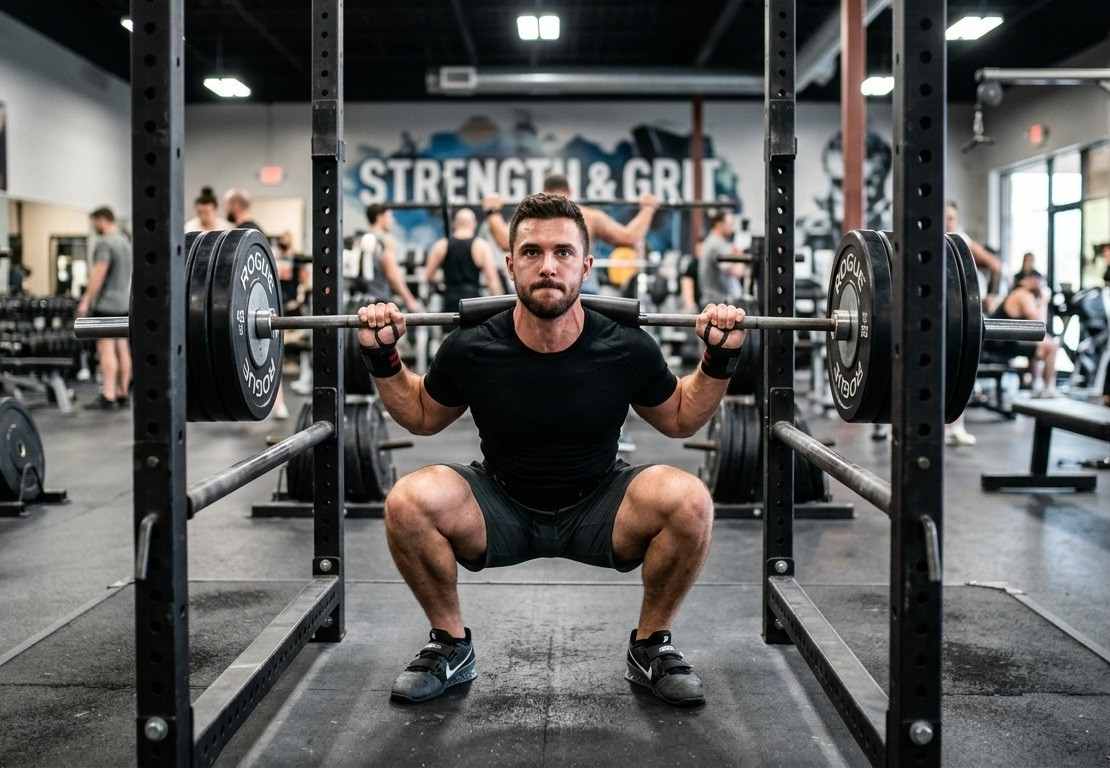
Squats are one of the simplest and most useful exercises you can add to a workout routine. You do not need a gym, expensive equipment, or a complicated training plan to perform a basic squat. A properly performed squat trains several muscles at once and closely resembles everyday movements such as sitting down, standing up, and picking something up from the floor.
Squats can be performed using only body weight or progressed with dumbbells, barbells, resistance bands, or other forms of resistance. Current resistance-training guidance also emphasizes that consistency matters more than having a complicated workout program.
Whether your goal is to build stronger legs, improve lower-body endurance, support athletic performance, or simply make everyday movement easier, squats can be a practical addition to your exercise routine.
What Are Squats?
A squat is a compound lower-body exercise in which you bend your hips and knees to lower your body and then push through your feet to return to a standing position.
A basic bodyweight squat generally involves:
- Standing with your feet about shoulder-width apart.
- Keeping your chest comfortably lifted.
- Bending your hips and knees to lower your body.
- Keeping your feet firmly planted.
- Lowering only as far as you can while maintaining good control.
- Pushing through your feet to return to standing.
The exact depth and stance can vary depending on your mobility, body structure, training experience, and the type of squat you are performing.
What Muscles Do Squats Work?
Squats primarily train the muscles of the lower body, while your core also works to help stabilize your torso.
1. Quadriceps
The quadriceps are located at the front of your thighs and contribute significantly to extending the knee as you stand up from a squat.
2. Glutes
The gluteal muscles help extend the hips and are heavily involved when you drive upward from the bottom of the movement.
3. Hamstrings
The muscles at the back of your thighs contribute to hip extension and help control the movement.
4. Adductors
The muscles on the inner thigh assist with hip movement and stabilization during squats.
5. Calves
The calf muscles help stabilize the ankle and foot during the exercise.
6. Core Muscles
Your abdominal and trunk muscles help keep your torso stable while you move through the squat.
15 Proven Benefits of Squats
1. Strengthen the Lower Body
One of the main benefits of squats is their ability to strengthen several lower-body muscle groups simultaneously. Regular resistance exercise can improve muscle strength, endurance, and physical function.
2. Build Stronger Glutes
Squats involve the gluteal muscles, particularly when performed with controlled depth and appropriate resistance.
3. Strengthen the Thighs
The quadriceps and hamstrings contribute substantially to the squat, making it a useful exercise for developing stronger thighs.
4. Improve Functional Movement
Squatting is similar to movements you perform throughout daily life, such as sitting in a chair and standing back up.
5. Support Better Lower-Body Endurance
Higher-repetition bodyweight squats can challenge muscular endurance, particularly when incorporated into a larger workout.
6. Help Improve Physical Performance
Stronger lower-body muscles can support activities such as climbing stairs, running, jumping, and recreational sports.
7. Support Bone and Connective-Tissue Health
Resistance exercise can place useful mechanical demands on the musculoskeletal system. Regular resistance training is associated with improvements in muscle, bone, and connective-tissue durability.
8. Improve Movement Control
Learning to control your hips, knees, ankles, and torso during a squat can help develop better body awareness and movement coordination.
9. Can Be Done Without Equipment
Bodyweight squats require no special equipment, making them convenient for home workouts, travel, or beginner exercise routines.
10. Easy to Progress
Once bodyweight squats become comfortable, you can increase the challenge by changing repetitions, tempo, range of motion, or adding resistance.
11. Support Muscle-Building Workouts
Squats can form part of a resistance-training program designed to improve muscle size and strength. Bodyweight exercises and home-based routines can provide meaningful benefits.
12. Help Develop Leg Power
More advanced squat variations can be incorporated into training programs designed to develop power, although explosive variations require appropriate technique and fitness.
13. Improve Balance and Stability
A controlled squat requires coordination between the hips, knees, ankles, and trunk.
14. Make Everyday Activities Easier
Developing lower-body strength can make tasks such as getting up from a chair, climbing stairs, or lifting objects easier.
15. Fit Into Short Workouts
A few sets of squats can be incorporated into a short full-body or lower-body workout without requiring much equipment or space.
How to Do a Basic Bodyweight Squat?
Follow these steps to practice a basic squat safely.
Step 1: Stand Tall
Stand with your feet approximately shoulder-width apart. Keep your feet stable and distribute your weight comfortably across your feet.
Step 2: Brace Your Core
Gently tighten your abdominal muscles while keeping your breathing natural.
Step 3: Bend Your Hips and Knees
Begin lowering your body by bending at your hips and knees. Think about sitting back and down rather than simply dropping straight toward the floor.
Step 4: Keep Your Knees Controlled
Allow your knees to move naturally in line with your feet. Avoid forcing them into an uncomfortable position.
Step 5: Lower With Control
Descend only as far as you can while maintaining balance, control, and comfortable form.
Step 6: Stand Back Up
Push through your feet and extend your hips and knees to return to the standing position.
Step 7: Repeat
Start with a manageable number of repetitions and gradually increase your workload as your strength and technique improve.
How Many Squats Should You Do?
There is no single number of squats that is appropriate for everyone.
For beginners, 1 to 3 sets of about 8 to 15 controlled repetitions can be a reasonable starting point, depending on fitness and exercise experience.
More experienced exercisers may use higher repetitions, additional resistance, or more challenging variations.
Rather than trying to perform hundreds of squats every day, focus on good technique and gradual progression. Adults are generally advised to perform muscle-strengthening activities involving the major muscle groups on at least 2 days per week.
10 Variations of Squats
There are many ways to modify the basic squat.
1. Bodyweight Squat
The simplest version uses your body weight as resistance and is suitable for many beginners.
2. Sumo Squat
The feet are positioned wider with the toes turned somewhat outward, placing a different emphasis on the lower-body muscles.
3. Goblet Squat
A dumbbell or kettlebell is held in front of the chest while performing the squat.
4. Jump Squat
This explosive variation adds a jump as you rise from the squat. It is more demanding than a regular bodyweight squat.
5. Wall Squat
Your back is supported against a wall while you lower into a squat-like position. It can be useful for controlled lower-body endurance work.
6. Split Squat
One foot is positioned forward and the other behind while you lower and raise your body. It challenges each side of the lower body more independently.
7. Bulgarian Split Squat
This advanced unilateral variation places the rear foot on an elevated surface.
8. Barbell Back Squat
A barbell is placed across the upper back. Because this variation involves external weight, proper instruction and technique are especially important.
9. Front Squat
The weight is positioned toward the front of the body, usually using a barbell. It requires good mobility, control, and technique.
10. Chair Squat
You squat toward a chair and use it as a target for your hips. This can be a useful modification for people learning the movement.
Common Squat Mistakes
Even though squats look simple, technique can become less controlled when you increase repetitions or resistance.
1. Going Too Deep Too Soon
Not everyone has the same mobility. Squatting deeper is not automatically better if you lose control or experience pain.
2. Letting the Knees Collapse Inward
Try to maintain controlled knee alignment rather than allowing the knees to suddenly move inward.
3. Lifting the Heels
Your feet should remain stable and grounded unless a specific variation calls for otherwise.
4. Rushing the Movement
Fast, uncontrolled repetitions can make it harder to maintain good technique.
5. Adding Too Much Weight
Increasing resistance too quickly can compromise form. ACSM advises avoiding excessive weight and emphasizes proper technique when resistance exercises are performed.
6. Ignoring Pain
Muscle effort and temporary fatigue are different from sharp, severe, or persistent pain. Pain should not simply be pushed through.
Are Squats Good for Weight Loss?
Squats can contribute to an active lifestyle, but they should not be viewed as a stand-alone weight-loss exercise.
They use multiple large muscle groups and can increase energy expenditure, particularly when performed with resistance or as part of a demanding workout. However, body-fat reduction depends on overall energy balance, diet, physical activity, sleep, and other factors.
Regular physical activity can help with maintaining a healthy body weight, and resistance training can help preserve muscle during weight loss.
How Many Calories Do Squats Burn?
Calories burned during squats depend on body weight, exercise intensity, duration, number of repetitions, and whether you use additional resistance. The table below provides approximate calorie estimates for bodyweight squats.
| Body Weight | 10 Min Squats | 20 Min Squats | 30 Min Squats |
|---|---|---|---|
| 50 kg (110 lb) | 35–55 kcal | 70–110 kcal | 105–165 kcal |
| 60 kg (132 lb) | 42–66 kcal | 84–132 kcal | 126–198 kcal |
| 70 kg (154 lb) | 49–77 kcal | 98–154 kcal | 147–231 kcal |
| 80 kg (176 lb) | 56–88 kcal | 112–176 kcal | 168–264 kcal |
| 90 kg (198 lb) | 63–99 kcal | 126–198 kcal | 189–297 kcal |
| 100 kg (220 lb) | 70–110 kcal | 140–220 kcal | 210–330 kcal |
Important: These are estimates, not exact calorie counts. Most people perform squats in sets with rest periods, so continuously squatting for 10–30 minutes is different from completing several short sets. Intense weighted squats may increase energy expenditure, but the exact amount varies substantially between individuals.
For a typical 100 squats, calorie expenditure is usually much lower than a continuous 10-minute workout because 100 repetitions may take only several minutes, depending on pace and rest.
Factors That Affect Calories Burned
| Factor | Effect on calorie expenditure |
|---|---|
| Body weight | Heavier individuals generally use more energy during the same movement |
| Workout duration | Longer workouts generally use more energy |
| Intensity | Harder efforts can increase energy expenditure |
| Added resistance | Weights can increase the training demand |
| Number of repetitions | More repetitions generally increase total work |
| Rest periods | Longer rest reduces active exercise time |
Squats vs. Lunges
Both exercises can strengthen the lower body, but they challenge the body differently.
| Feature | Squats | Lunges |
|---|---|---|
| Main focus | Both legs together | Greater emphasis on one leg at a time |
| Balance demand | Moderate | Often higher |
| Beginner-friendly | Yes | Yes, with modifications |
| Equipment needed | Not necessarily | Not necessarily |
| Progression | Weights, tempo, depth, variations | Weights, direction, range, variations |
| Main muscles | Quads, glutes, hamstrings | Quads, glutes, hamstrings |
Including both exercises can provide variety rather than relying on only one movement pattern.
Squats for Beginners
If you are new to exercise, begin with a version that allows you to maintain control.
A simple beginner routine could include:
- 8–10 bodyweight squats
- Rest for about 30–60 seconds
- Repeat for 2 sets
- Practice 2–3 days per week
As the movement becomes easier, you can gradually increase repetitions or introduce a more challenging variation.
The U.S. Physical Activity Guidelines recommend starting with manageable amounts of activity and building up gradually, particularly for people who have been inactive.
Squats for Older Adults
Squat-based movements can be adapted for older adults according to individual strength, mobility, balance, and health status.
A chair squat can provide an accessible starting point. Holding onto a stable support may also be appropriate for someone who needs additional balance assistance.
Older adults are encouraged to include muscle-strengthening activities and activities that support balance as part of a broader physical activity routine.
Are Squats Safe Every Day?
Squats are not necessarily harmful when performed frequently, but whether you should squat every day depends on the type and intensity of training.
A few easy bodyweight squats may be manageable for many healthy people. However, high-volume or heavy weighted squats require recovery time.
If your legs remain very sore, your technique is deteriorating, or you develop persistent joint or muscle pain, reduce the workload and allow adequate recovery.
Squats Risks and Precautions
Squats are generally a useful exercise, but poor technique, excessive training volume, or inappropriate resistance can increase the risk of discomfort or injury.
Potential problems may include:
- Knee discomfort
- Hip discomfort
- Lower-back strain
- Muscle soreness
- Loss of balance
- Excessive fatigue
- Overuse injuries
People with an existing injury, significant joint problems, recent surgery, severe pain, or a medical condition affecting exercise tolerance should consider speaking with a healthcare professional or qualified exercise professional before beginning a new squat program.
If a squat causes sharp pain, swelling, significant instability, or symptoms that persist after exercise, stop the movement and seek appropriate medical advice.
Tips for Better Squats
1. Warm Up First
Spend a few minutes doing light movement before a challenging lower-body workout.
2. Start With Body Weight
Learn the movement before adding dumbbells, barbells, or other resistance.
3. Use Controlled Repetitions
Quality is more important than rushing through a high number of repetitions.
4. Progress Gradually
Increase repetitions, resistance, or difficulty over time rather than changing everything at once.
5. Choose the Right Variation
A chair squat may be more appropriate for a beginner, while a weighted squat may suit someone with more training experience.
6. Do Not Chase Depth at the Expense of Form
Your comfortable squat depth may change as your mobility and strength improve.
How Often Should You Do Squats?
For general fitness, squats can be included in a lower-body or full-body resistance-training routine around 2 or more days per week, depending on the rest of your program and recovery.
The broader physical activity guidelines recommend muscle-strengthening activity involving all major muscle groups on at least two days each week.
You do not necessarily need to squat every day to see progress. Consistent training combined with appropriate recovery is more useful than doing very high volumes occasionally.
The Bottom Line
Squats are a versatile compound exercise that can strengthen the quadriceps, glutes, hamstrings, adductors, calves, and core. They can be performed almost anywhere, modified for different fitness levels, and progressed from simple bodyweight movements to more challenging weighted exercises.
For beginners, the best approach is to start with a comfortable variation, learn controlled technique, and gradually increase the challenge. Squats can be an important part of a balanced resistance-training routine, but they work best alongside other exercises and regular physical activity.
FAQ’s
Is 20 squats a day enough?
Yes, 20 squats can improve lower-body strength, especially for beginners.
What will 30 squats a day do?
30 squats can improve leg and glute strength and endurance.
What happens if a girl does squats every day?
Daily squats may strengthen the legs and glutes and improve lower-body endurance.
What is the best time of day to do squats?
Any time works. Choose a time when you feel comfortable and can exercise consistently.
What are squats good for?
Squats help strengthen the quadriceps, glutes, hamstrings, adductors, and supporting core muscles. They can also improve lower-body strength, balance, and functional movement.
Do squats reduce belly fat?
Squats can support overall calorie expenditure and muscle development, but they do not specifically burn belly fat. Reducing body fat generally requires an overall calorie deficit combined with regular physical activity.
Do squats make your thighs bigger?
Squats can increase thigh muscle size when performed regularly with sufficient resistance and progressive training. Bodyweight squats are more likely to improve muscular endurance and strength than produce substantial muscle growth.
Do squats make your butt bigger?
Squats can help build and strengthen the glute muscles, particularly when progressively challenging the muscles with resistance and adequate training volume.
Do squats burn a lot of calories?
Squats burn calories, but short sets generally do not burn as many calories as longer-duration activities such as brisk walking, running, or cycling.
Are squats good for beginners?
Yes. Bodyweight squats or chair squats can be good starting options for beginners because the difficulty can be adjusted according to strength and mobility.
Can squats reduce knee pain?
Squats can strengthen muscles around the knee and may support functional movement, but they are not appropriate for every cause of knee pain. If squats cause or worsen pain, consult a healthcare professional.
Are squats bad for your knees?
Squats are not inherently bad for healthy knees when performed appropriately. Problems can occur when technique, resistance, volume, or exercise selection is unsuitable for the individual.
Do squats strengthen your knees?
Squats strengthen the muscles that help support the knee, particularly the quadriceps and surrounding lower-body muscles. They do not directly strengthen the knee joint itself.
How long does it take to see results from squats?
Results vary depending on training frequency, nutrition, resistance, genetics, and starting fitness level. Improvements in strength can occur before visible changes in muscle size.
Are 100 squats a day enough?
Doing 100 squats a day is not necessary for everyone. A smaller number of well-controlled repetitions with gradual progression can be more useful than simply chasing a high daily number.
Do squats make your legs stronger?
Yes. Regularly performed squats can improve lower-body muscular strength, especially when the exercise is progressively made more challenging.
Can squats help improve posture?
Squats can strengthen the lower body and core, which may support overall movement and stability. However, squats alone are not a complete treatment for poor posture.
What is the best type of squat?
There is no single best squat for everyone. Bodyweight squats are useful for beginners, while goblet, split, front, back, and other variations can provide different challenges.
Should your knees go past your toes when squatting?
Knee position varies with body proportions, squat style, and mobility. Your knees can naturally move forward during a squat; the priority is controlled movement, comfortable range of motion, and good overall technique.
Are squats better than lunges?
Neither exercise is universally better. Squats primarily train both legs together, while lunges place greater emphasis on unilateral strength, balance, and coordination. Including both can provide useful variety.
Sources / References:
Disclaimer:
This guide is for general educational purposes only and does not replace personalized medical or exercise advice. If you have an injury, medical condition, or persistent pain, consult a qualified healthcare professional before starting or changing an exercise program.
Also Read: