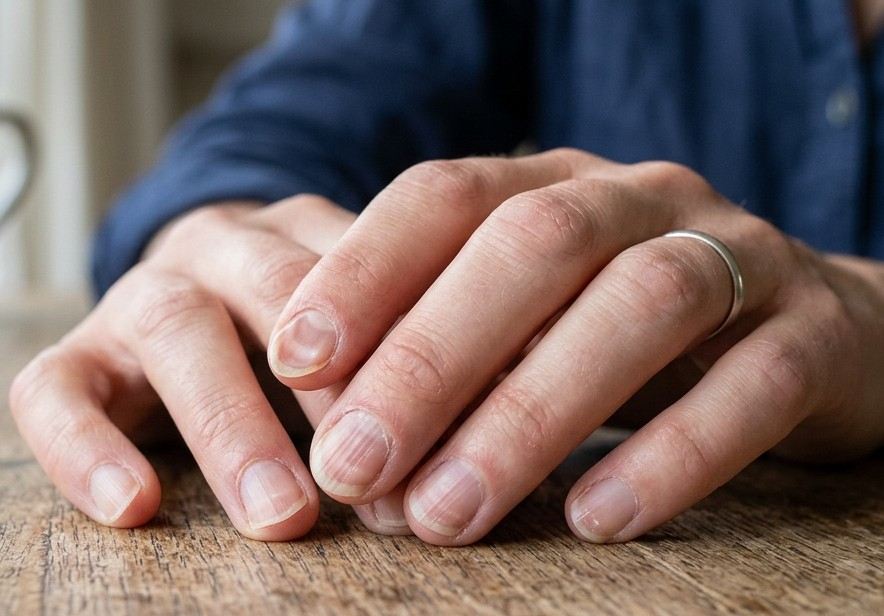
Your nails can sometimes provide clues about what is happening inside your body. While nail changes are not enough to diagnose a nutritional deficiency, certain changes—especially thin, brittle, or spoon-shaped nails—can occur with iron deficiency or iron-deficiency anemia.
Iron is essential for making hemoglobin, the protein in red blood cells that carries oxygen throughout the body. When iron stores become low, symptoms may develop gradually, and nail changes can sometimes appear alongside more familiar signs such as tiredness, weakness, headaches, pale skin, hair loss, or shortness of breath.
However, not every nail problem means you are low in iron. Nail trauma, fungal infections, psoriasis, thyroid problems, certain medications, and other nutritional or systemic conditions can also affect the nails.
What Is Iron Deficiency?
Iron deficiency occurs when the body does not have enough iron to meet its needs. If the deficiency becomes significant enough to reduce hemoglobin and red blood cell production, it can lead to iron-deficiency anemia.
Iron is needed to produce hemoglobin, which allows red blood cells to transport oxygen from the lungs to tissues throughout the body. When iron availability is inadequate, oxygen delivery can be affected and symptoms such as fatigue and weakness may develop.
Common reasons for iron deficiency include:
- Not getting enough iron from the diet
- Heavy menstrual bleeding
- Pregnancy, when iron requirements increase
- Blood loss from the digestive tract
- Problems absorbing iron
- Certain gastrointestinal conditions
- Increased nutritional needs during periods of growth
Because the underlying cause matters, simply taking an iron supplement without finding out why iron is low is not always the best approach.
10 Nail Warning Signs That May Indicate Iron Deficiency
Nail changes can be subtle at first. The following signs are worth paying attention to, particularly when several occur together or are accompanied by other symptoms of iron deficiency.
1. Spoon-Shaped Nails
One of the most characteristic nail changes associated with iron deficiency is koilonychia, commonly called spoon nails.
Instead of remaining gently rounded or slightly curved outward, the center of the nail becomes depressed while the edges may curve upward. The nail can eventually look like a small spoon.
Spoon-shaped nails are strongly associated with iron deficiency, but they can also occur because of other medical, nutritional, hereditary, or environmental factors.
2. Thin Nails
Iron deficiency may be associated with nails that become noticeably thinner than usual.
You may find that your nails no longer feel as firm as they once did or that the nail plate appears delicate and fragile. Thin nails alone do not prove iron deficiency, but they can be more meaningful when they occur with other symptoms.
3. Brittle Nails That Break Easily
If your nails repeatedly split, crack, or break with everyday activities, it may be worth looking at your overall health and nutrition.
Brittle nails have many possible causes, including frequent exposure to water or cleaning products, aging, nail trauma, fungal infection, and certain medical conditions. Iron deficiency is one possible contributor.
4. Nails That Curve Upward at the Edges
With koilonychia, the sides and end of the nail may begin to turn upward rather than maintaining their normal shape.
This change can develop gradually, so you may notice that your nails look different only when comparing them with older photographs or when the change becomes more pronounced.
5. Increased Nail Fragility
Iron deficiency may be accompanied by changes in nail structure that make the nails more vulnerable to everyday stress.
For example, nails may become easier to chip or develop small cracks. However, this finding is nonspecific and should not be interpreted as evidence of iron deficiency by itself.
6. Changes in Nail Texture
Some people with nutritional deficiencies may notice that their nails look or feel different in texture.
A rough or uneven nail surface can have numerous causes, including trauma, skin disorders, nutritional deficiencies, and systemic illnesses. Therefore, persistent texture changes should be assessed in context rather than attributed automatically to low iron.
7. Nail Changes Along With Hair Loss
Nail changes become more worth investigating when they occur together with other symptoms associated with iron deficiency.
For example, increased hair shedding may occur in people with iron-deficiency anemia.
If you notice both persistent nail changes and unusual hair loss, discussing your symptoms with a healthcare professional may help determine whether blood tests are appropriate.
8. Nail Changes With Unusual Tiredness
Persistent fatigue is a much more common symptom of iron-deficiency anemia than nail changes.
If brittle or spoon-shaped nails appear alongside unusual tiredness, weakness, headaches, pale skin, or reduced exercise tolerance, iron deficiency may be one possibility worth investigating.
9. Nail Changes With Pale Skin
Paler-than-usual skin can occur with iron-deficiency anemia.
When nail changes occur at the same time as noticeable pallor, fatigue, or weakness, it is reasonable to discuss the combination with a healthcare professional rather than treating the nails alone.
10. Nail Changes With Unusual Cravings
A condition called pica, which involves craving or eating non-food substances such as ice, paper, clay, or dirt, can occur with iron deficiency.
If unusual cravings occur alongside nail changes and other symptoms, they are another reason to consider medical evaluation.
What Do Iron-Deficient Nails Look Like?
The classic appearance is koilonychia, or spoon-shaped nails.
The nail may become:
- Thin
- Brittle
- Concave in the center
- Curved upward at the edges
- More fragile than usual
The change can affect fingernails and, in some circumstances, toenails as well.
It is important to remember that spoon-shaped nails do not automatically mean iron deficiency. Koilonychia has several possible causes, including thyroid disorders, psoriasis, trauma, certain nutritional deficiencies, hereditary conditions, and other systemic illnesses.
Can You Tell If You Have Iron Deficiency by Looking at Your Nails?
No. Nail appearance alone cannot diagnose iron deficiency.
Nails can provide a clue, but blood testing is needed to evaluate iron status and determine whether anemia is present.
Healthcare professionals may consider tests such as:
| Test | What It Helps Assess |
|---|---|
| Complete blood count (CBC) | Checks hemoglobin and other blood-cell measurements |
| Serum ferritin | Provides information about the body’s stored iron |
| Serum iron | Measures circulating iron |
| Transferrin or iron-binding measures | Helps assess iron transport and availability |
| Other tests | May be recommended depending on symptoms and suspected cause |
Serum ferritin is widely used to assess iron stores, although inflammation can raise ferritin levels and make interpretation more complicated.
Other Symptoms of Iron Deficiency to Watch For
Nail changes are only one possible clue. Iron-deficiency anemia can cause several other symptoms.
Common symptoms include:
- Persistent tiredness: You may feel unusually exhausted or lacking in energy.
- Weakness: Everyday activities may feel more difficult than usual.
- Shortness of breath: You may become breathless more easily, particularly with activity.
- Headaches: Recurrent headaches can occur.
- Pale skin: Skin may appear paler than usual.
- Heart palpitations: You may become more aware of your heartbeat.
- Hair loss: Increased hair shedding can occur.
- Pica: Some people develop cravings for non-food substances.
- Sore tongue: Iron deficiency can sometimes affect the tongue.
- Restless legs: Some people with iron deficiency experience restless-leg symptoms.
Having one or more of these symptoms does not necessarily mean you have iron deficiency. Many other health conditions can cause similar symptoms.
Why Does Iron Deficiency Affect the Nails?
Nails are continuously produced by cells in the nail matrix. Their normal growth and structure depend on adequate nutrition and overall health.
When iron stores are significantly depleted, changes can occur in tissues such as the nails. The exact mechanism behind spoon-shaped nails is not completely understood, but koilonychia has a well-established association with iron deficiency.
Interestingly, nail abnormalities may sometimes provide an early clue that prompts further investigation rather than serving as a definitive diagnostic sign.
Should You Take Iron Supplements for Nail Changes?
Do not start high-dose iron supplements solely because your nails look brittle or spoon-shaped.
Iron supplements can be useful when iron deficiency has been confirmed or when a healthcare professional recommends them. But taking unnecessary iron can cause side effects and may be inappropriate for people whose iron levels are normal or elevated.
A healthcare professional can determine whether testing is appropriate and whether supplementation is necessary.
When Should You See a Doctor?
Consider speaking with a healthcare professional if you have:
- New spoon-shaped nails
- Persistent nail thinning or brittleness
- Nail changes that continue to worsen
- Nail changes along with fatigue or weakness
- Unexplained hair loss
- Pale skin
- Shortness of breath
- Frequent headaches
- Heavy menstrual bleeding
- Unusual cravings for ice or other non-food substances
- Possible symptoms of blood loss
New spoon-shaped nails deserve attention because koilonychia can be associated with iron deficiency but can also have other causes.
If you have significant shortness of breath, chest pain, fainting, severe weakness, or a rapid or irregular heartbeat, seek prompt medical attention.
Nail Changes That Are Not Necessarily Caused by Iron Deficiency
It is easy to blame every nail abnormality on a vitamin or mineral deficiency, but that can lead to the wrong conclusion.
Nail changes may also result from:
- Fungal infections
- Nail injuries
- Frequent exposure to water
- Cleaning chemicals
- Psoriasis
- Eczema
- Thyroid disorders
- Diabetes
- Certain medications
- Other nutritional deficiencies
- Hereditary nail conditions
For example, nail pitting is commonly associated with psoriasis, while yellow nails are often related to fungal infection.
This is why the pattern of nail change and the person’s other symptoms matter.
How to Keep Your Nails Healthy?
Regardless of the cause of a nail change, basic nail care can help protect the nail plate.
- Keep nails clean and trimmed.
- Avoid biting or picking at your nails.
- Wear gloves when working with cleaning products.
- Reduce prolonged exposure to water when possible.
- Moisturize your hands and nails regularly.
- Avoid repeatedly using harsh nail products.
- Do not ignore persistent changes in nail shape or structure.
- Maintain a balanced diet containing adequate protein, iron, vitamins, and minerals.
If a nail changes suddenly or develops pain, swelling, discoloration, separation, or significant thickening, have it evaluated rather than assuming it is a nutritional problem.
FAQ’s
Are spoon-shaped nails a sign of low iron?
Yes, spoon-shaped nails, or koilonychia, are commonly associated with iron deficiency, although other conditions can also cause them.
Can brittle nails mean iron deficiency?
Brittle nails can occur with iron deficiency, but they can also result from nail damage, fungal infections, aging, or other health conditions.
Can iron deficiency cause ridges in your nails?
Iron deficiency may be associated with some nail abnormalities, but nail ridges have many possible causes and do not specifically indicate low iron.
Can low iron cause nail splitting?
Yes, low iron may contribute to weak or splitting nails, although frequent water exposure, chemicals, trauma, and other conditions can also cause splitting.
Can iron deficiency cause white spots on nails?
White spots are usually not a specific sign of iron deficiency and are more commonly associated with minor nail trauma or other causes.
Will nails return to normal after treating iron deficiency?
Nails can gradually improve after the underlying iron deficiency is corrected, but visible changes may take several months because nails grow slowly.
Should I take iron supplements for brittle nails?
No. Brittle nails alone do not prove iron deficiency, so it is better to have the cause evaluated before taking iron supplements.
Can nail changes diagnose anemia?
No. Nail changes can provide a clue, but anemia and iron deficiency require appropriate medical evaluation and blood tests.
How long does it take for nails to recover after treating iron deficiency?
Nails grow slowly, so visible improvement can take months. The timeline depends on the severity of the nail changes, the cause of the deficiency, and how well the underlying problem responds to treatment.
Can iron deficiency cause hair loss and nail changes together?
Yes. Hair loss and nail changes can both occur among the less common manifestations of iron-deficiency anemia.
Can children have spoon-shaped nails without iron deficiency?
Yes. Spoon-shaped nails can occasionally be a normal or temporary finding in young children, but persistent or concerning changes should still be discussed with a pediatric healthcare professional.
Final Thought
Spoon-shaped, thin, and brittle nails can be warning signs of iron deficiency, particularly when they occur alongside fatigue, pale skin, hair loss, headaches, or shortness of breath. However, nail appearance cannot confirm iron deficiency because several other conditions can cause similar changes. Blood tests such as a CBC and ferritin assessment can help determine whether low iron or anemia is present.
Rather than treating the nail appearance alone, the most useful approach is to identify why the nails changed and whether an underlying iron deficiency or another health condition is responsible.
Sources / References:
Disclaimer:
This guide is for educational purposes only and is not a substitute for professional medical advice, diagnosis, or treatment. If you have persistent nail changes or symptoms of iron deficiency, consult a qualified healthcare professional for appropriate evaluation and testing.
Also Read: