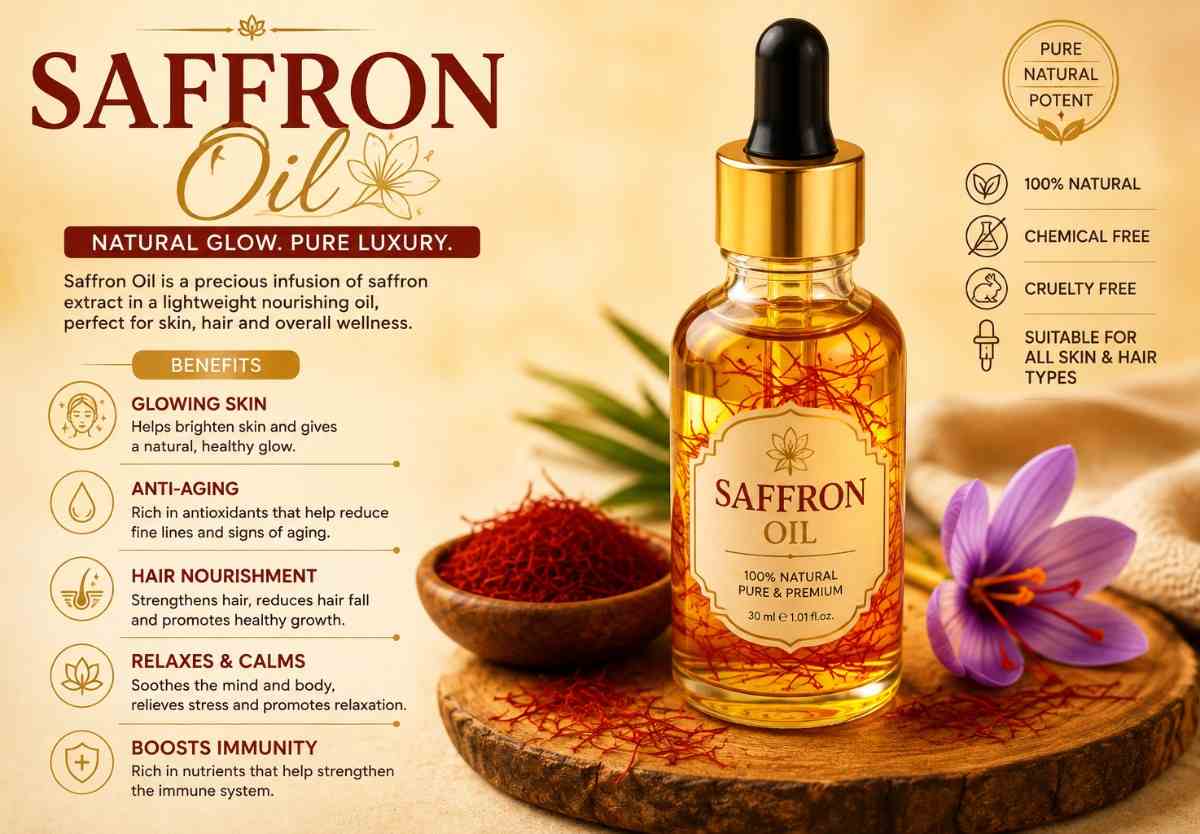
Saffron is famous for its distinctive aroma, golden-red color, and long history in traditional food and wellness practices. But beyond the familiar saffron threads, you may also come across saffron oil, which is used in cosmetics, aromatherapy, massage products, culinary applications, and some traditional wellness practices.
However, the term “saffron oil” can refer to different products. Some are essential oils distilled from saffron flowers or stigmas, while others are carrier oils infused with saffron. These products are not nutritionally or chemically identical, so the label matters.
Saffron itself contains several biologically active compounds, including crocin, crocetin, picrocrocin, and safranal. Research on saffron preparations has explored antioxidant, mood-related, sleep, cognitive, metabolic, and inflammatory outcomes, although much of this evidence involves saffron extracts or supplements rather than saffron oil specifically.
This guide explains what saffron oil is, its potential benefits, how it may be used, possible side effects, precautions, and what science actually says about it.
What Is Saffron Oil?
Saffron oil is an oil preparation made from Crocus sativus, the plant that produces the saffron spice.
Depending on the product, saffron oil may be produced through extraction, infusion, or essential-oil distillation. Genuine saffron essential oil contains aromatic compounds, particularly safranal, while other saffron preparations may contain different concentrations of crocin, crocetin, picrocrocin, and other constituents.
This distinction is important because saffron essential oil should not automatically be treated like an edible cooking oil. Essential oils are highly concentrated and are generally intended for specific topical, aromatic, or manufacturing applications according to the product instructions.
Saffron oil is commonly associated with:
- Skin and hair-care products
- Massage oils
- Aromatherapy
- Fragrance products
- Traditional wellness practices
- Food-flavoring applications when specifically manufactured and labeled for food use
There is promising research on saffron as a whole, but it would be inaccurate to assume that every benefit demonstrated with oral saffron supplements has been proven for saffron oil.
20 Proven Benefits of Saffron Oil
1. Provides Antioxidant Compounds: Saffron contains compounds such as crocin, crocetin, and safranal that have demonstrated antioxidant activity in laboratory and experimental research.
2. May Support Skin Care: Saffron-derived compounds have antioxidant properties, which is one reason saffron ingredients are used in cosmetic and skin-care formulations.
3. May Help Maintain a Healthy-Looking Complexion: When included in a suitable topical formulation, saffron oil may complement a skincare routine designed to protect the skin from environmental oxidative stress.
4. May Support Skin Moisture: When saffron is infused into a suitable carrier oil, the carrier oil itself can help reduce moisture loss and leave the skin feeling softer.
5. May Have Soothing Properties: Experimental research suggests saffron constituents can influence inflammatory and oxidative pathways, although these effects should not be interpreted as proof that saffron oil treats inflammatory skin disorders.
6. May Promote Relaxation: The characteristic aroma of saffron oil may be used in aromatherapy and relaxation routines, although clinical evidence specifically examining saffron essential oil remains limited.
7. May Support Sleep Quality Indirectly: Human research on saffron preparations has reported possible improvements in sleep quality, but these studies generally involve oral saffron rather than saffron oil.
8. May Support Emotional Well-Being: Clinical research on saffron preparations has investigated mood and psychological outcomes, with some studies reporting potential benefits for depressive symptoms and related concerns.
9. May Support Cognitive Health: Research has explored saffron supplementation and cognitive function, although evidence remains insufficient to claim that saffron oil prevents or treats cognitive disorders.
10. May Support a Healthy Inflammatory Response: Laboratory research suggests saffron compounds can influence inflammatory signaling pathways, but more human research is needed to determine how these findings apply to saffron oil.
11. May Support Cardiometabolic Health: Human trials of saffron supplementation have investigated blood pressure, blood glucose, lipids, and other cardiovascular risk factors, but these findings cannot automatically be transferred to saffron oil.
12. May Have Antimicrobial Potential: Saffron essential oil has demonstrated antimicrobial activity in research, which has attracted interest in food preservation and other applications.
13. May Have Antifungal Potential: Experimental research has investigated antifungal properties of saffron essential oil, although this does not mean it should replace medically approved antifungal treatments.
14. May Help Protect Against Oxidative Stress: Saffron’s naturally occurring compounds can act through antioxidant mechanisms that may help counter oxidative stress in experimental models.
15. May Complement Massage Practices: Diluted saffron-infused oil can be incorporated into massage routines, where the carrier oil provides lubrication and the aroma may contribute to a relaxing experience.
16. May Support Hair and Scalp Care: Saffron-containing cosmetic preparations are sometimes used in hair and scalp routines, although strong clinical evidence for saffron oil as a hair-growth treatment is lacking.
17. May Add Natural Fragrance: The distinctive aroma of saffron comes partly from volatile compounds such as safranal, making saffron oil interesting for fragrance and personal-care formulations.
18. May Be Useful in Cosmetic Formulations: Saffron-derived ingredients can be incorporated into creams, serums, massage products, and other cosmetic preparations depending on their formulation and intended use.
19. May Support Relaxing Bedtime Rituals: Using an appropriately formulated aromatic product as part of a bedtime routine may help create a calming environment, although this should not be confused with a proven treatment for insomnia.
20. Provides a Concentrated Saffron Aroma: Saffron oil can offer the characteristic fragrance of saffron in a concentrated form, making it useful for aromatherapy, fragrance, and selected cosmetic applications.
10 Side Effects of Saffron Oil
1. Skin Irritation: Undiluted essential oils can irritate the skin and may cause redness, burning, itching, or discomfort.
2. Allergic Reactions: People sensitive to saffron or related botanical ingredients may experience an allergic response after topical exposure.
3. Eye Irritation: Saffron oil should never be applied directly to the eyes because concentrated oils can cause significant irritation.
4. Digestive Problems: Oral saffron preparations can cause gastrointestinal symptoms such as nausea or stomach discomfort, particularly at higher amounts. A recent systematic review found gastrointestinal effects among the most frequently reported adverse events associated with saffron preparations.
5. Headache or Dizziness: Some people may experience headache, dizziness, or other nonspecific symptoms when using concentrated saffron preparations.
6. Dryness or Sensitivity: Certain topical formulations may cause dryness or sensitivity, particularly in people with reactive skin.
7. Low Blood Pressure: Saffron supplementation has been investigated for effects on blood pressure, so people already taking blood-pressure-lowering medication should use concentrated saffron preparations cautiously.
8. Possible Bleeding Concerns: Concentrated saffron preparations may warrant caution in people taking medicines that affect blood clotting.
9. Pregnancy-Related Concerns: High-dose saffron exposure may stimulate the uterus, and pregnancy requires particular caution with concentrated saffron products.
10. Toxicity at Excessive Amounts: Large medicinal doses of saffron may produce adverse effects, which is why more is not necessarily better.
How to Use Saffron Oil?
How you use saffron oil depends on the type of product.
For a topical saffron-infused oil, you can apply a small amount to clean skin and gently massage it in. It may also be used as a massage oil or incorporated into a homemade cosmetic formulation.
For saffron essential oil, follow the manufacturer’s dilution instructions. Essential oil should generally be diluted in a suitable carrier oil before skin application.
For food use, only use a product specifically labeled as food-grade and intended for internal consumption. Never assume that a cosmetic or aromatherapy saffron oil is edible.
Before using it on your face or body, perform a small patch test.
Other Uses of Saffron Oil
Saffron oil can be used for several non-medicinal purposes, including:
- Aromatherapy
- Massage
- Personal fragrance
- Skin-care formulations
- Hair-care products
- Bath and body products
- Traditional beauty practices
- Food-flavoring applications when specifically approved for culinary use
- Natural fragrance formulations
- Research into natural antimicrobial and antioxidant ingredients
Saffron essential oil has also been investigated for food-preservation applications because of reported antimicrobial, antifungal, and antioxidant properties.
How to Make Saffron Oil at Home?
You can make a simple saffron-infused carrier oil at home, but this is different from making saffron essential oil.
Ingredients:
- 1 cup of a suitable carrier oil such as jojoba, sweet almond, or olive oil
- A small amount of high-quality saffron threads
- A clean, completely dry glass jar
- A fine strainer or clean filter
- A dark glass bottle for storage
Method:
- Place the saffron threads into a clean, dry glass jar.
- Add the carrier oil.
- Close the jar tightly.
- Keep it in a cool, dark place and allow the saffron to infuse.
- Shake the jar gently from time to time.
- Strain the oil through a clean filter.
- Transfer the finished infused oil into a clean, dark bottle.
Important: Homemade infused oils can become contaminated if moisture, contaminated ingredients, or dirty equipment are introduced. If you notice an unusual odor, visible mold, cloudiness, or other signs of spoilage, discard the preparation.
This method produces saffron-infused oil, not distilled saffron essential oil.
How Much Saffron Oil Can You Use Per Day?
There is no universally established daily dose for saffron oil because products differ substantially in composition and concentration.
For topical use, follow the product’s directions and dilute essential oil appropriately.
For oral saffron supplements, clinical studies have used different preparations and doses, so a research dose should not automatically be copied for a commercial saffron oil.
If you are considering oral use for a health condition, discuss the specific product and dose with a doctor or qualified healthcare professional.
Best Time to Use Saffron Oil
There is no scientifically established universal “best time” for saffron oil.
For topical use, it can generally be used at a time that fits your skincare or massage routine.
For aromatic use, some people prefer it during relaxation or before bedtime. Research on oral saffron preparations has suggested possible benefits for sleep quality, but that does not prove that saffron essential oil produces the same effect.
If taking a food-grade saffron supplement, follow the product directions rather than choosing a timing based on general internet claims.
Who Should Use Saffron Oil?
- Adults Seeking Aromatic Uses: Adults interested in saffron’s distinctive aroma may use a properly formulated saffron oil according to the product’s intended purpose.
- People Interested in Massage: A properly diluted saffron-infused oil can be incorporated into a massage routine.
- Skincare Users: People who tolerate botanical oils may use a properly formulated saffron-infused product as part of their skincare routine.
- People Choosing Food-Grade Products: Adults who want oral saffron should choose products specifically labeled for internal use rather than cosmetic or essential oils.
- People Following Professional Advice: Individuals using saffron for a specific health purpose should ideally discuss concentrated products with a healthcare professional.
Who Should Avoid Saffron Oil?
- Pregnant People Without Medical Advice: Concentrated saffron preparations should not be self-used during pregnancy because higher exposures may have uterine effects and safety evidence remains limited.
- People With Saffron Allergies: Anyone with a known allergy to saffron or a product ingredient should avoid exposure.
- People With Sensitive Skin: Individuals prone to reactions should patch-test topical products before wider application.
- Young Children: Concentrated essential oils should not be given orally to children unless specifically directed by an appropriate healthcare professional.
- People Taking Multiple Medicines: Those taking medicines that affect blood pressure, blood clotting, or other important body functions should consult a healthcare professional before using concentrated saffron preparations.
- People With Unexplained Medical Symptoms: Saffron oil should not be used as a substitute for medical evaluation or treatment.
How to Store Saffron Oil?
- Store saffron oil in a tightly closed, dark-colored container away from direct sunlight, heat, and moisture.
- Keep it in a cool, dry location and follow the manufacturer’s storage instructions.
- Always check the expiration or best-before date. Homemade infused oils generally have a shorter and less predictable shelf life than professionally manufactured products.
- If the oil develops an unusual smell, visible contamination, or a significant change in appearance, do not use it.
Precautions and Interactions
- Pregnancy Precaution: Avoid medicinal or concentrated saffron preparations during pregnancy unless your healthcare professional specifically recommends them.
- Breastfeeding Precaution: Because safety data for concentrated saffron oil during breastfeeding are limited, discuss oral use with a healthcare professional.
- Medication Interactions: Ask your doctor or pharmacist before using concentrated saffron preparations if you take regular prescription or over-the-counter medicines.
- Blood Pressure Consideration: People taking blood-pressure medicines should be cautious because saffron supplementation has been studied for effects on blood pressure.
- Bleeding Risk Consideration: People taking anticoagulant or antiplatelet medicines should seek professional advice before using concentrated saffron products.
- Allergy Precaution: Perform a patch test before applying a new saffron-containing topical product to a large area.
- Essential Oil Precaution: Never assume that saffron essential oil is suitable for internal consumption simply because it is sold as a natural product.
- Eye Safety: Keep saffron oil away from the eyes and mucous membranes.
- Dose Precaution: Avoid taking large quantities of saffron preparations in an attempt to obtain faster results because adverse effects become more concerning at higher exposure.
- Medical Treatment Precaution: Saffron oil should complement, not replace, prescribed treatment for medical conditions.
What Does Science Say About Saffron Oil?
One of the most important points for readers is that research on saffron is not the same as research on saffron oil.
A substantial body of research has examined saffron extracts, stigma preparations, crocin, crocetin, or standardized supplements. Studies have investigated mood, sleep, cognition, metabolic health, cardiovascular risk factors, and inflammatory pathways.
At the same time, reviews emphasize limitations such as differences in preparation, dose, standardization, study quality, and sample size. A systematic review of saffron in rheumatic diseases, for example, highlighted substantial heterogeneity and insufficient standardization of herbal preparations.
A 2026 systematic review of adverse events covering human studies found saffron preparations were generally well tolerated, but adverse events were reported and were more relevant with higher doses or prolonged use.
Therefore, it is better to describe saffron oil as a potentially useful cosmetic, aromatic, and traditional wellness ingredient, rather than claiming that it is a proven treatment for disease.
FAQs
What is saffron oil good for?
Saffron oil is commonly used for skincare, massage, aromatherapy, fragrance, and traditional wellness practices. Its potential antioxidant and soothing properties make it popular in cosmetic products.
Can saffron oil help with hair growth?
There is not enough strong human evidence to prove that saffron oil promotes hair growth. It may be used as part of a moisturizing scalp or hair-care routine.
Can I drink saffron oil?
Only consume saffron oil if it is specifically labeled as food-grade and intended for oral use. Saffron essential oil and cosmetic saffron oils should not be swallowed.
Is saffron oil safe during pregnancy?
Pregnant women should avoid concentrated saffron preparations unless their healthcare professional recommends them, as safety data are limited and high exposure may have uterine effects.
Can saffron oil improve skin?
Saffron contains antioxidant compounds that may support healthy-looking skin, while a suitable carrier oil can help moisturize the skin. However, saffron oil is not a proven treatment for skin diseases.
Does saffron oil help with sleep?
Saffron preparations have been studied for possible improvements in sleep quality, but most research involves oral saffron rather than saffron oil specifically.
What does saffron oil smell like?
Saffron oil generally has a distinctive warm, earthy, sweet, slightly spicy aroma. The exact scent depends on the extraction method and whether the product contains a carrier oil.
How long does saffron oil take to work?
There is no established timeframe because saffron essential oil has different uses and formulations. Cosmetic and aromatic effects can vary from person to person.
Can saffron oil be applied directly to the skin?
Saffron-infused carrier oils may be applied according to their product instructions, but concentrated saffron essential oil should generally be diluted before topical application.
Can saffron oil reduce inflammation?
Saffron contains compounds that have demonstrated anti-inflammatory activity in experimental research, but there is not enough evidence to say that saffron oil can treat inflammatory diseases.
Is saffron oil good for massage?
Yes, a properly formulated and diluted saffron essential oil can be used as a massage oil. The carrier oil provides lubrication while the saffron aroma may contribute to a relaxing experience.
Can saffron oil brighten the skin?
Saffron-containing skincare products are sometimes marketed for a brighter-looking complexion, but strong clinical evidence specifically proving that saffron oil lightens or brightens skin is limited.
Is saffron oil the same as saffron essential oil?
No. Saffron essential oil may refer to a saffron-infused carrier oil, while saffron essential oil is a concentrated aromatic product. Their composition, strength, and intended uses can be very different.
Can saffron oil help reduce stress?
The aroma of saffron essential oil may be incorporated into relaxation and aromatherapy routines. However, evidence that saffron essential oil specifically treats stress or anxiety is still limited.
Can saffron oil replace medical treatment?
No. Saffron essential oil should not be used as a substitute for prescribed medication or professional medical treatment.
Does saffron oil have antioxidant properties?
Saffron contains antioxidant compounds including crocin, crocetin, and safranal, and saffron-derived oils have also been investigated for antioxidant activity.
Is Saffron Oil Safe for Children?
Saffron essential oil, especially essential oil, should not be used on children without pediatrician guidance.
What Is Saffron Oil Used For?
Saffron essential oil is commonly used for skincare, massage, aromatherapy, fragrance, and traditional beauty care.
Is Saffron Oil Good for Your Face?
Saffron-infused oil may moisturize the skin and provide antioxidant benefits, but patch-test it first.
How Is Saffron Oil Made?
Saffron essential oil can be made by infusing saffron threads in a carrier oil such as jojoba, almond, or olive oil.
Can I Apply Saffron Oil on My Face Overnight?
Yes, if it is a suitable facial oil and your skin tolerates it. Patch-test first and avoid undiluted essential oil.
Sources / References:
About the Author:
Written by: Kirti Solanki (Health Content Researcher)
Kirti Solanki is a health content researcher who focuses on creating reader-friendly, evidence-informed articles covering nutrition, wellness, pregnancy, parenting, and everyday health topics. Her approach emphasizes clear explanations, responsible health claims, and the use of credible scientific references.
Disclaimer:
This article is for educational purposes only and does not replace professional medical advice, diagnosis, or treatment. Saffron oil products vary considerably in concentration and intended use. Consult a qualified healthcare professional before using concentrated saffron preparations orally, during pregnancy or breastfeeding, for children, or alongside medications.
Also Read: