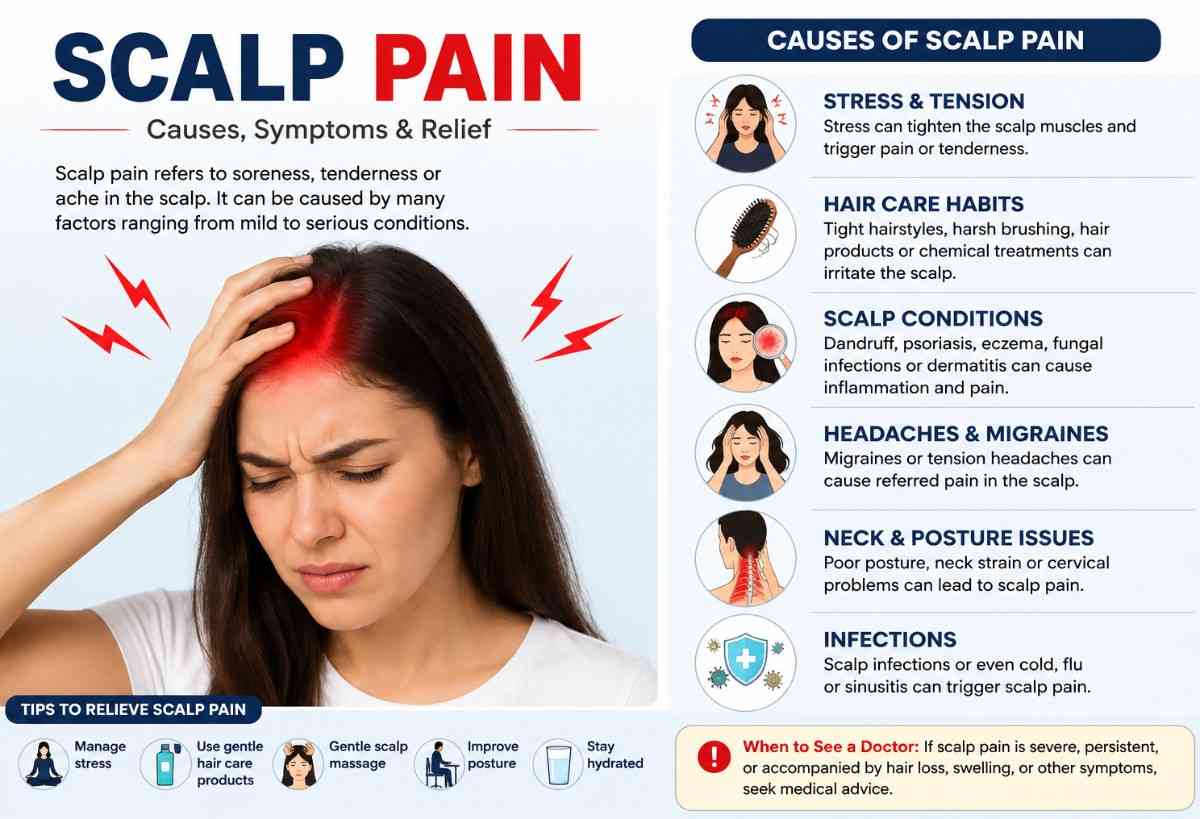
Scalp pain can be surprisingly uncomfortable. Sometimes the scalp feels tender when you brush your hair, wash it, or touch it. In other cases, the pain may feel like burning, tingling, throbbing, pressure, or a sharp sensation that spreads across part of the head.
Scalp pain is not a condition by itself. It is a symptom that can have several possible causes, ranging from tight hairstyles and irritated skin to headaches, infections, nerve irritation, or inflammatory skin conditions. Identifying the accompanying symptoms can help point toward the most likely cause.
This guide explains common causes of scalp pain, what symptoms to watch for, treatment options, home-care measures, and when medical evaluation is important.
What Is Scalp Pain?
Scalp pain refers to discomfort, tenderness, sensitivity, burning, aching, throbbing, itching, or pain felt on the skin and tissues covering the skull.
Some people notice pain only when touching the scalp. Others experience pain even when nothing is touching the area.
Scalp pain can occur with or without visible changes. Depending on the cause, you may also notice:
- Redness or warmth
- Flaking or scaling
- Itching
- Pimples or bumps
- Swelling
- Rash
- Hair loss
- Burning or tingling
- Numbness
- Headache
- Tenderness when brushing the hair
Because several different conditions can cause similar symptoms, persistent or unexplained scalp pain should not automatically be attributed to one particular problem.
Common Causes of Scalp Pain
1. Tight Hairstyles
Ponytails, braids, buns, extensions, or other hairstyles that continuously pull on the hair and scalp can cause tenderness.
If the pain starts after wearing a hairstyle that pulls tightly on the roots, loosening the hair may help. Repeated tension can also contribute to hair damage and certain types of hair loss.
2. Migraine
A migraine can sometimes make the scalp unusually sensitive. This phenomenon is known as cutaneous allodynia, where normally harmless sensations, such as brushing the hair or resting the head on a pillow, may feel painful.
Migraine may also cause throbbing head pain, nausea, and sensitivity to light or sound.
3. Tension Headaches
Tension headaches can cause pressure or aching around the head and may be accompanied by discomfort involving the scalp, neck, or shoulders. Stress, fatigue, poor posture, and prolonged screen use can contribute to tension headaches.
4. Seborrheic Dermatitis
Seborrheic dermatitis is a common inflammatory skin condition that can affect the scalp.
It may cause:
- Flaking
- Itching
- Redness
- Greasy or yellowish scales
- Scalp irritation
Scratching an irritated scalp can make tenderness worse.
5. Scalp Psoriasis
Scalp psoriasis can cause raised, inflamed areas covered with scales. It may be itchy, irritated, or uncomfortable and can sometimes extend beyond the hairline.
Because psoriasis can resemble other scalp conditions, persistent scaling or inflammation is worth discussing with a healthcare professional.
6. Folliculitis
Folliculitis occurs when hair follicles become inflamed or infected. It can look similar to small acne-like bumps and may cause itching or pain.
Scalp folliculitis may develop after irritation, friction, excessive sweating, or damage to the hair follicles.
7. Contact Dermatitis
Hair dye, shampoo, conditioner, fragrances, styling products, and other substances can irritate the scalp or trigger an allergic reaction.
Symptoms may include:
- Burning
- Itching
- Redness
- Tenderness
- Rash
- Swelling
If symptoms began soon after using a new hair product, that product may be worth considering as a possible trigger.
8. Sunburn
The scalp can become sunburned, particularly when the hair is thin or the scalp is exposed for extended periods.
Sunburn may cause redness, warmth, tenderness, burning, and sometimes peeling.
9. Scalp Infection
Fungal infections such as tinea capitis, commonly called scalp ringworm, can cause itching, scaling, inflammation, and areas of hair loss. Some infections require prescription treatment rather than home remedies.
10. Shingles
Shingles can cause significant pain, burning, tingling, or sensitivity in a specific area before or around the time a rash develops.
A painful blistering rash on one side of the scalp or face should receive prompt medical attention. Antiviral treatment is most effective when started early, and shingles affecting the area around the eye requires urgent evaluation.
11. Occipital Neuralgia
Occipital neuralgia involves irritation of nerves that run from the upper neck toward the scalp.
The pain can feel:
- Sharp
- Burning
- Stinging
- Electric or shock-like
- Aching
Pain may travel from the back of the head upward into the scalp and can sometimes be accompanied by scalp tenderness.
12. Head or Scalp Injury
A bump, fall, accident, scratch, cut, or other injury can make the scalp painful.
Even if the skin looks relatively normal, deeper tissue irritation can produce tenderness.
A significant head injury accompanied by neurological symptoms requires immediate medical evaluation.
13. Head Lice
Head lice can cause intense itching and scalp irritation. Scratching can lead to small wounds, inflammation, and tenderness.
Lice are contagious and are not an indication of poor personal hygiene.
14. Scalp Acne
Pimples can develop on the scalp and may become tender or painful, especially when touched or brushed.
Sweat, oil, friction, and certain hair products may contribute to scalp breakouts.
15. Hair Loss Conditions
Some inflammatory forms of hair loss can cause scalp discomfort, burning, itching, or tenderness along with noticeable changes in hair density.
Persistent scalp pain combined with hair loss deserves evaluation because early diagnosis may help prevent further damage.
What Does Scalp Pain Feel Like?
Scalp pain can feel different from person to person.
Common symptoms of scalp pain include:
- Tenderness when touching the scalp
- Burning
- Throbbing
- Aching
- Pressure
- Stinging
- Tingling
- Sharp or stabbing pain
- Electric-shock sensations
- Itching with soreness
- Pain when brushing the hair
The location can also provide useful clues.
For example, pain at the back of the scalp may sometimes involve the nerves originating from the upper neck, while widespread scalp sensitivity can occur with headaches or skin irritation.
Scalp Pain and Headaches: Is There a Connection?
Yes. Scalp pain and headaches can occur together.
Migraines can make the scalp sensitive, while tension headaches may cause pressure and discomfort around the head and neck. Nerve-related headaches, including occipital neuralgia, can also produce pain that travels into the scalp.
However, scalp tenderness does not necessarily mean the pain is coming from a headache. Skin inflammation, infection, injury, and other scalp conditions can cause pain independently.
Scalp Pain When Touching the Hair
If your scalp hurts when you touch, brush, or wash your hair, several possibilities should be considered.
Common causes include:
- Tight hairstyles
- Migraine-related sensitivity
- Tension headaches
- Folliculitis
- Sunburn
- Contact dermatitis
- Scalp psoriasis
- Seborrheic dermatitis
- Shingles
- Nerve irritation
- Recent injury
Pay attention to whether you also have a rash, bumps, scaling, hair loss, headache, fever, or neurological symptoms.
Scalp Pain Without a Rash
It is possible to have scalp pain even when the skin looks normal.
Headaches, migraine-related sensitivity, nerve irritation, tension, and certain forms of scalp sensitivity may cause pain without an obvious rash or visible skin changes.
If unexplained pain continues, repeatedly returns, or becomes severe, a healthcare professional can help determine whether the source is the scalp, nerves, muscles, or another structure.
How Is Scalp Pain Diagnosed?
There is no single test for scalp pain.
A healthcare professional may ask about:
- When the pain began
- Where the pain occurs
- Whether it is constant or intermittent
- What the pain feels like
- Recent injuries
- Headaches or migraines
- New hair products
- Hairstyles
- Skin changes
- Hair loss
- Medications
- Other symptoms
The scalp may then be examined for redness, scaling, bumps, wounds, infections, or hair changes.
If the symptoms suggest a neurological or headache-related problem, additional evaluation may be appropriate.
Treatment for Scalp Pain
Treatment depends on the underlying cause.
1. Treating Skin Irritation
If a hair product is irritating the scalp, stopping the suspected product may allow the skin to recover.
A healthcare professional may recommend appropriate topical treatments if dermatitis or another inflammatory skin condition is responsible.
2. Treating Folliculitis
Mild folliculitis may improve after removing the source of irritation. Warm compresses can provide comfort, while some cases require medication prescribed by a healthcare professional.
3. Treating Dandruff or Seborrheic Dermatitis
Medicated shampoos may be recommended for scalp conditions such as seborrheic dermatitis. The appropriate ingredient depends on the condition and severity.
4. Treating Migraine or Headache
Management may include identifying triggers, adequate sleep, hydration, stress management, lifestyle changes, and appropriate medications.
Frequent headaches should be evaluated rather than repeatedly treated with pain medication without determining the cause.
5. Treating Shingles
Shingles is generally treated with antiviral medication, particularly when treatment is started early. Medical evaluation is especially important if the rash involves the face or area around the eye.
6. Treating Nerve-Related Pain
Occipital neuralgia and other nerve-related conditions may require a specific treatment plan based on the underlying cause. Treatment can differ substantially from treatment for migraine or scalp skin disease.
Home Care for Mild Scalp Pain
For mild pain without concerning symptoms, several simple measures may help:
1. Use Gentle Hair Care
Choose gentle hair-care products and avoid aggressive scratching, vigorous brushing, or excessive heat.
2. Avoid Tight Hairstyles
Give the scalp regular breaks from tightly pulled ponytails, buns, braids, extensions, or other styles that create tension.
3. Protect the Scalp From Sun
Wear a hat or use appropriate sun protection when the scalp is exposed to strong sunlight.
4. Avoid New Irritating Products
If pain began after using a new dye, shampoo, conditioner, or styling product, stop using the suspected product until the cause is clearer.
5. Use a Cool Compress
A cool compress may temporarily soothe irritation associated with minor inflammation or sun exposure.
6. Manage Headache Triggers
If scalp tenderness occurs during headaches, maintaining regular sleep, meals, hydration, and stress-management habits may help reduce some headache triggers.
7. Avoid Excessive Scratching
Scratching can damage the skin and increase the risk of infection.
When Should You See a Doctor for Scalp Pain?
Make an appointment with a healthcare professional if scalp pain:
- Persists or repeatedly returns
- Is becoming worse
- Occurs with unexplained hair loss
- Is associated with a persistent rash
- Causes significant tenderness
- Occurs with painful bumps or sores
- Develops after starting a new medication or hair product
- Interferes with sleep or daily activities
- Occurs with frequent or worsening headaches
A dermatologist may be particularly helpful when scalp pain is accompanied by rash, scaling, bumps, inflammation, or hair loss.
Emergency Warning Signs of Scalp Pain
Scalp pain accompanied by certain symptoms can require urgent medical attention.
Seek emergency care for a sudden, extremely severe headache, particularly if it is unlike previous headaches.
Emergency evaluation is also important when head pain occurs with:
- Weakness or numbness
- Difficulty speaking
- Confusion
- Seizures
- Difficulty walking or balancing
- Major vision changes
- Loss of consciousness
- A serious head injury
- Severe headache with fever and stiff neck
These symptoms can indicate a potentially serious neurological or other medical problem.
How to Prevent Scalp Pain?
Not every cause of scalp pain can be prevented, but general scalp care may reduce some triggers.
- Avoid hairstyles that pull tightly on the scalp.
- Give your scalp breaks from extensions and other tension-producing styles.
- Use hair products appropriate for your skin.
- Stop products that repeatedly cause burning or irritation.
- Protect exposed scalp from excessive sunlight.
- Avoid aggressive scratching.
- Keep combs, brushes, and other personal hair tools clean.
- Treat persistent scalp conditions rather than ignoring them.
- Maintain good sleep and stress-management habits if headaches contribute to scalp sensitivity.
- Seek medical advice for persistent pain or unexplained hair loss.
Exercises for Scalp Pain Relief
Gentle exercises may help when scalp discomfort is associated with neck tension, tight muscles, stress, or tension-type headaches. They are less likely to help when scalp pain is caused by an infection, rash, injury, shingles, or another medical condition.
1. Neck Side Stretch
Sit upright and slowly tilt your head toward your right shoulder without raising the shoulder. Hold for 15–20 seconds, then switch sides. Repeat 2–3 times per side.
2. Chin Tucks
Sit or stand with your back straight. Gently draw your chin backward, as if making a small double chin. Hold for 5 seconds, then relax. Repeat 8–10 times.
3. Upper Trapezius Stretch
Keep your right shoulder relaxed while gently tilting your head toward the left. Hold for 15–20 seconds, then switch sides. Repeat 2–3 times.
4. Shoulder Rolls
Slowly roll both shoulders backward in a circular motion. Perform 10 repetitions, then repeat forward. This may help reduce tension around the neck and shoulders.
5. Neck Rotation
Keeping your shoulders relaxed, slowly turn your head to the right until you feel a gentle stretch. Return to the center and repeat on the left. Do 5–10 repetitions per side.
6. Gentle Chest Stretch
Place your hands behind your back or hold a towel between them. Gently draw your shoulders back without forcing the movement. Hold for 15–20 seconds and repeat 2–3 times.
7. Deep Breathing
Sit comfortably and relax your shoulders. Breathe slowly through your nose, allowing your abdomen to expand, then gently exhale. Continue for 3–5 minutes. Relaxation techniques may be useful when stress contributes to muscle tension or headaches.
8. Gentle Scalp Massage
Using your fingertips rather than your fingernails, gently massage the scalp with small circular movements for 2–5 minutes. Stop if massage increases the pain, particularly if the scalp is inflamed, injured, or painful to touch.
9. Posture Reset
If you spend long periods at a computer or phone, gently bring your shoulders back, keep your chin neutral, and relax your jaw. Hold this comfortable position for 20–30 seconds and repeat throughout the day.
How Often Should You Do These Exercises?
For mild tension-related discomfort, try 5–10 minutes once or twice a day. Movements should feel gentle rather than painful. Avoid forceful neck stretching or sudden movements.
When to Avoid Scalp Pain Exercises?
Do not exercise through severe or unexplained scalp pain, especially if you have a recent head or neck injury, fever, rash, swelling, weakness, numbness, vision changes, dizziness, or a sudden severe headache. Seek medical evaluation when these symptoms occur.
If scalp pain is persistent or accompanied by hair loss, sores, scaling, painful bumps, or a rash, the underlying cause should be evaluated rather than relying only on exercises.
FAQ’s
Why does my scalp hurt when I touch it?
Scalp tenderness can be caused by tight hairstyles, migraines, skin irritation, infections, sunburn, or nerve irritation.
Can stress cause scalp pain?
Yes. Stress may contribute to tension headaches and muscle tension that can cause scalp discomfort.
Can a tight ponytail cause scalp pain?
Yes. Hairstyles that continuously pull on the scalp can cause soreness and tenderness.
Can dandruff cause scalp pain?
Dandruff and seborrheic dermatitis can cause irritation, itching, and inflammation that may make the scalp sore.
Why does my scalp hurt in one spot?
Localized pain may result from a pimple, irritated hair follicle, injury, infection, or nerve irritation.
Can migraine cause scalp tenderness?
Yes. Migraines can make the scalp unusually sensitive, so touching or brushing the hair may hurt.
Can scalp pain cause hair loss?
Some scalp conditions that cause pain or inflammation can also cause hair loss. Persistent pain with hair loss should be evaluated.
What can I do for scalp pain at home?
Avoid tight hairstyles and irritating products, use gentle hair care, protect the scalp from sun exposure, and try a cool compress for temporary relief.
Which doctor should I see for scalp pain?
A primary-care doctor can evaluate the problem initially. A dermatologist can help with scalp and skin conditions, while a neurologist may be appropriate for nerve-related pain or headaches.
Is scalp pain a sign of a serious condition?
Most causes are manageable, but sudden severe headache, weakness, confusion, seizures, vision changes, or serious head injury requires urgent medical evaluation.
Can dehydration cause scalp pain?
Dehydration can contribute to headaches, which may sometimes be associated with scalp discomfort. Persistent or severe scalp pain should not automatically be attributed to dehydration.
What vitamin deficiency causes scalp pain?
Vitamin D, B12, iron, and other nutrient deficiencies may contribute to hair or scalp problems, but scalp pain alone does not confirm a deficiency.
What are signs of a healthy scalp?
A healthy scalp is generally comfortable, without persistent itching, redness, excessive flaking, sores, unusual bumps, or unexplained hair loss.
How can I check my scalp health?
Check for redness, flakes, bumps, sores, excessive oiliness, dryness, tenderness, and changes in hair growth. A dermatologist can perform a professional scalp examination if needed.
Why does my scalp hurt when I press on it?
Scalp tenderness can be caused by tight hairstyles, inflammation, folliculitis, sunburn, migraine-related sensitivity, nerve irritation, or minor injury.
Final Thoughts
Scalp pain can be caused by something as simple as a tight hairstyle or irritated skin, but it can also accompany migraines, infections, inflammatory scalp conditions, or nerve-related pain.
The most useful clues are often the symptoms that occur alongside the pain. A rash, scaling, bumps, hair loss, headache, burning sensation, or neurological symptoms can help healthcare professionals narrow down the cause.
If scalp pain is persistent, severe, recurrent, or accompanied by concerning symptoms, getting a professional evaluation is the safest approach.
Sources / References:
About the Author:
Written by: Kirti Solanki, Health Content Researcher
Kirti Solanki creates evidence-informed health content designed to make medical and wellness information easier for general readers to understand. Content is researched using reputable medical and public-health sources.
Disclaimer:
This article is for educational purposes only and does not replace professional medical advice, diagnosis, or treatment. Seek medical care for severe, persistent, or concerning symptoms.
Also Read: