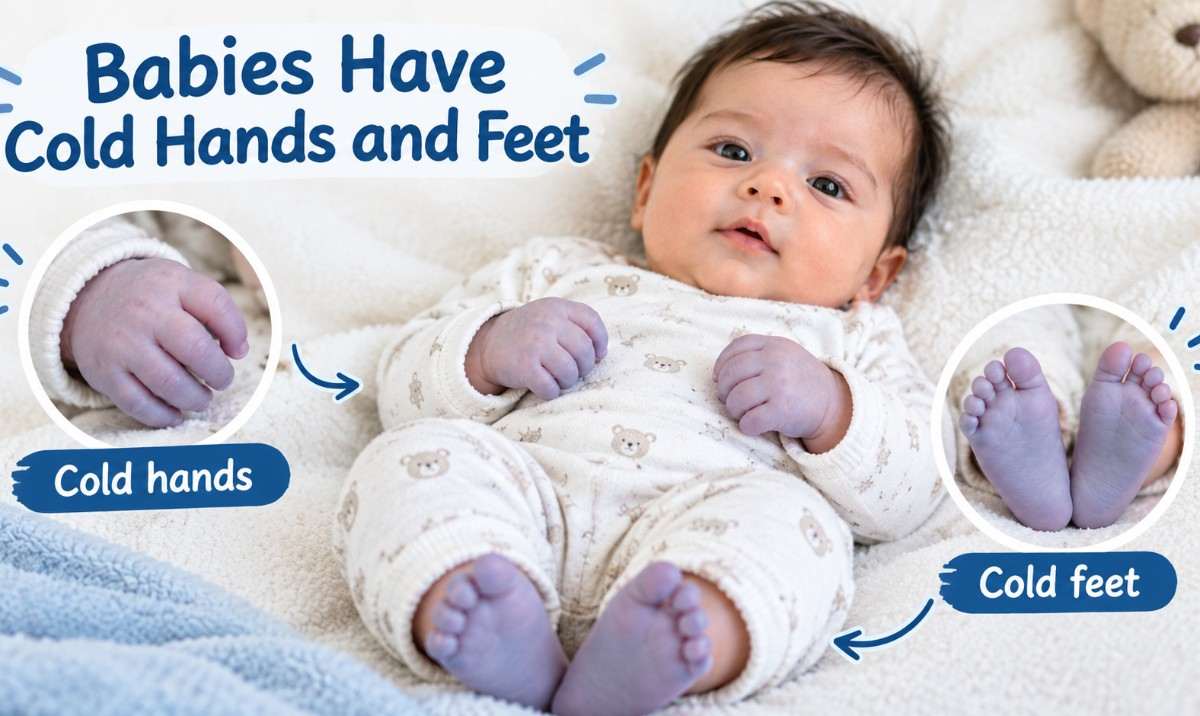
Have you ever touched your baby’s tiny hands or feet and wondered why they feel so cold, even when the rest of their body seems warm? If so, you are not alone. Many parents notice this during the first few weeks and months of their baby’s life.
The good news is that cold hands and feet are usually normal in babies, especially newborns. Their bodies are still learning to regulate temperature, and their hands and feet may feel cooler than their chest, back, or tummy.
However, cold extremities should not always be ignored. If your baby also feels cold throughout the body, has a change in skin color, feeds poorly, or seems unusually sleepy, it could indicate a problem that needs medical attention.
In this guide, we will explain why babies have cold hands and feet, how to tell whether your baby is warm enough, what you can do at home, and when to contact a doctor.
Why Do Babies Have Cold Hands and Feet? 7 Reasons
Babies can have cold hands and feet because their temperature-regulation system is still developing. Their bodies prioritize maintaining warmth around vital organs, while the hands and feet may remain cooler.
Here are the most common reasons.
1. Their Temperature-Regulation System Is Still Developing
Newborns cannot regulate their body temperature as efficiently as older children and adults. Their bodies are still adapting to life outside the womb, making it easier for them to lose heat.
As a result, their hands and feet may feel cool even when their overall body temperature is normal.
2. Blood Circulation Is Still Maturing
A baby’s circulation continues to develop after birth. The body regulates blood flow to help maintain a stable temperature around important organs, such as the heart and brain.
Because of this, the hands and feet may not feel as warm as the chest or abdomen. Cool hands and feet alone do not necessarily mean that your baby has poor circulation.
3. The Room Is Too Cool
Cold weather, air conditioning, fans, open windows, or a cool room can make your baby’s hands and feet feel chilly.
Babies lose heat more easily than adults, so even a modest change in their surroundings may affect how their skin feels.
4. Your Baby Is Wearing Too Few Layers
If your baby is dressed too lightly for the environment, their body may lose heat. This is particularly important for newborns, premature babies, and babies with a low birth weight.
If the chest or back also feels cold, consider whether your baby needs another appropriate layer.
5. Your Baby Has Just Woken Up or Been Uncovered
A baby’s hands and feet may feel cooler after sleeping, during a diaper change, or after a bath. These activities can expose the skin to cooler air.
If your baby otherwise appears comfortable and the chest or back feels warm, this is generally less concerning.
6. Your Baby Was Born Prematurely
Premature babies have less body fat and may have more difficulty maintaining a stable temperature. They can lose heat more quickly than full-term babies.
If your baby was born prematurely or has a low birth weight, follow your healthcare professional’s instructions for maintaining warmth and monitoring temperature.
7. Your Baby May Be Losing Too Much Body Heat
Sometimes, cold hands and feet occur alongside a genuinely low body temperature. This can happen if a baby is exposed to cold conditions or is unwell.
A baby with a low temperature may also become less active, feed poorly, have a weak cry, or develop breathing difficulties. These symptoms require prompt medical assessment.
Are Cold Hands and Feet Normal in Newborns?
Yes, cold hands and feet are common in newborns and do not automatically mean that something is wrong.
Newborns often have cooler extremities because their temperature regulation and circulation are still developing. Their hands and feet may also occasionally appear slightly bluish during the early newborn period.
However, the temperature of your baby’s hands and feet alone is not a reliable way to determine whether they are too cold.
Instead, check your baby’s chest, tummy, or back. These areas provide a more useful indication of their overall warmth.
If your baby feels comfortably warm on the chest or back, has normal skin color, breathes comfortably, wakes and responds normally, and feeds as usual, cool hands and feet are usually not a cause for concern.
If the baby’s whole body feels cold or they show other signs of illness, seek medical advice rather than assuming the temperature is normal.
How to Tell If Your Baby Is Too Cold
Parents often worry about whether their baby needs more clothing. Fortunately, a few simple observations can help.
Signs your baby is probably warm enough:
- Their chest, tummy, or back feels comfortably warm.
- Their skin color looks normal for them.
- They are feeding as usual.
- They wake and respond normally.
- Their breathing appears comfortable.
- Their hands and feet may feel cool, but the rest of their body feels warm.
Signs your baby may be too cold or unwell:
- Their chest, tummy, or back also feels cold.
- They are unusually sleepy, weak, or difficult to wake.
- They are feeding less than usual or refusing feeds.
- Their cry is unusually weak.
- Their skin looks pale, blue, grey, or unusually blotchy.
- They have breathing difficulties or seem less responsive.
These signs are particularly important in newborns because serious illness can sometimes cause a low temperature rather than a fever.
What Is the Normal Body Temperature for a Baby?
A baby’s temperature can vary slightly depending on age, activity, the environment, and how it is measured. A temperature around 36.5°C to 37.5°C is commonly used as a reference range for newborn temperature maintenance, although the appropriate interpretation depends on the measurement method and clinical situation.
| Temperature reading | What it may mean |
|---|---|
| Around 36.5°C–37.5°C | Common reference range for a newborn’s temperature |
| Below 36°C | Potentially concerning and requires urgent medical assessment |
| 38°C or higher in a baby under 3 months | Requires urgent medical assessment |
Use a digital thermometer and follow the recommended method for your baby’s age. Do not rely on touching the hands, feet, or forehead alone to assess temperature.
Important: If your baby is under 3 months old and has a measured temperature of 38°C or higher, seek urgent medical care. A low reading below 36°C also needs urgent assessment, especially if confirmed or accompanied by other symptoms. Do not delay seeking help when your baby appears seriously unwell.
How to Keep Your Baby’s Hands and Feet Warm
If your baby has cool hands and feet but otherwise seems well, a few simple steps can help them stay comfortable.
1. Dress Your Baby in Suitable Layers
Choose soft, breathable clothing appropriate for the room temperature and weather. If your baby’s body feels cool, add a light layer and reassess their warmth.
Avoid dressing your baby in too many layers, as overheating can also be dangerous.
2. Use Socks When Needed
Soft, properly fitting baby socks can help keep the feet comfortable in a cool environment. Check that they are not tight around the ankles.
Socks are not a substitute for checking your baby’s overall temperature if they seem unwell.
3. Try Skin-to-Skin Contact
Holding your baby against your bare chest, with their head turned to the side and their face visible, can help support warmth and bonding.
Stay awake and ensure the baby’s nose and mouth remain unobstructed. If you feel sleepy, place your baby on their back in a separate, flat, firm sleep space.
4. Maintain a Comfortable Room Temperature
Keep your baby’s room comfortably cool rather than excessively warm. The NHS recommends a room temperature of approximately 16°C to 20°C for baby sleep, alongside appropriate sleep clothing or bedding.
Avoid placing your baby directly in front of a fan, next to a heater, or close to an open flame.
5. Check the Chest or Back Regularly
Touch your baby’s chest, tummy, or back to assess their warmth. If the skin feels sweaty or the chest feels hot, remove an unnecessary layer.
Do not keep adding clothes simply because the hands and feet feel cold.
6. Follow Safe-Sleep Guidelines
Always place your baby on their back to sleep on a firm, flat mattress in a clear cot or crib. Avoid loose blankets, hot-water bottles, electric blankets, and other direct heat sources.
Do not use hats or hoods indoors during sleep unless a healthcare professional has specifically advised otherwise.
Can Cold Hands and Feet Be a Sign of Poor Circulation?
Not necessarily. Cool hands and feet are common in babies and do not, by themselves, prove that circulation is poor.
However, persistent or unusual changes in skin color, one hand or foot being much colder than the other, or cold extremities accompanied by other symptoms deserve medical attention.
Blue or grey lips, tongue, or central body skin can indicate a serious problem with oxygen delivery. Seek emergency medical care if these changes occur, particularly alongside breathing difficulties or reduced responsiveness.
When Should You Worry About Your Baby’s Cold Hands and Feet?
Although cool extremities are often harmless, certain symptoms should never be ignored.
Seek emergency medical care immediately if your baby:
- Has blue or grey lips or tongue.
- Has difficulty breathing or is breathing abnormally.
- Is very difficult to wake or does not respond normally.
- Has pale, grey, or markedly mottled skin and appears unwell.
- Feels cold throughout the body and is unusually weak or unresponsive.
Get urgent medical assessment if your baby:
- Has a temperature below 36°C.
- Is under 3 months old and has a temperature of 38°C or higher.
- Is feeding poorly or refusing feeds.
- Has fewer wet diapers than usual, especially with other signs of illness.
- Continues to feel cold despite appropriate clothing and a comfortable environment.
If you are concerned about a newborn’s temperature or behavior, contact a healthcare professional promptly. Do not wait for every warning sign to appear.
FAQ’s
Why are my baby’s hands and feet cold but the body is warm?
A baby’s hands and feet may feel cooler because the body regulates blood flow to maintain warmth around vital organs. This is common in newborns and does not necessarily indicate poor circulation.
Should I put socks on my baby if their feet are cold?
Yes, you can use soft, properly fitting socks if the room is cool. However, check your baby’s chest or back to assess overall warmth rather than relying on the temperature of the feet alone.
Do cold hands and feet mean my baby is sick?
Not usually. However, cold hands and feet accompanied by poor feeding, unusual sleepiness, breathing difficulties, abnormal skin color, or a cold body may indicate illness and require prompt medical attention.
Why does my newborn have cold hands and feet while sleeping?
Newborns may have cooler hands and feet during sleep because their temperature regulation is still developing. Check their chest or back, dress them appropriately, and follow safe-sleep guidelines.
Are cold hands and feet normal in a 3-month-old baby?
Yes, they can be normal at 3 months of age. If your baby is otherwise comfortable, feeding well, and behaving normally, cool extremities alone are usually not concerning.
Should I check my baby’s temperature if their hands and feet are cold?
If your baby seems unwell or their chest and back also feel cold, use a digital thermometer according to age-appropriate instructions. Seek urgent medical care for a temperature below 36°C or a temperature of 38°C or higher in a baby younger than 3 months.
Do cold hands mean a baby is cold?
No, cold hands are common in babies. Check the chest or back to assess overall warmth.
Why are my baby’s hands very cold?
Developing temperature regulation, cool surroundings, or exposed skin can cause cold hands.
How do I know if my baby is cold at night?
Feel the chest or back. If these areas feel cold, your baby may need another layer.
Should a baby’s room be hot or cold?
A comfortably cool room is best. The NHS recommends 16°C–20°C for baby sleep.
When is a baby’s cold a serious concern?
Breathing difficulties, blue lips, poor feeding, or unusual sleepiness require prompt medical attention.
When should I stop covering my baby’s hands at night?
Avoid hand coverings during sleep unless medically advised. Use appropriate sleep clothing instead.
Final Thoughts
Cold hands and feet are common in babies, especially during the newborn stage, because their bodies are still learning to regulate temperature. In many cases, the baby’s chest or back will feel comfortably warm even when the fingers and toes feel cool.
The best approach is to check your baby’s overall warmth, dress them appropriately, avoid overheating, and pay attention to feeding, breathing, skin color, and alertness.
Most importantly, remember that cold hands and feet alone are usually not a problem, but a cold body or other signs of illness should be taken seriously. When in doubt, seek medical advice.
Sources / References
Disclaimer:
This article is for educational purposes only and is not a substitute for professional medical advice, diagnosis, or treatment. Seek prompt medical care if your baby has an abnormal temperature or concerning symptoms.
Also Read: