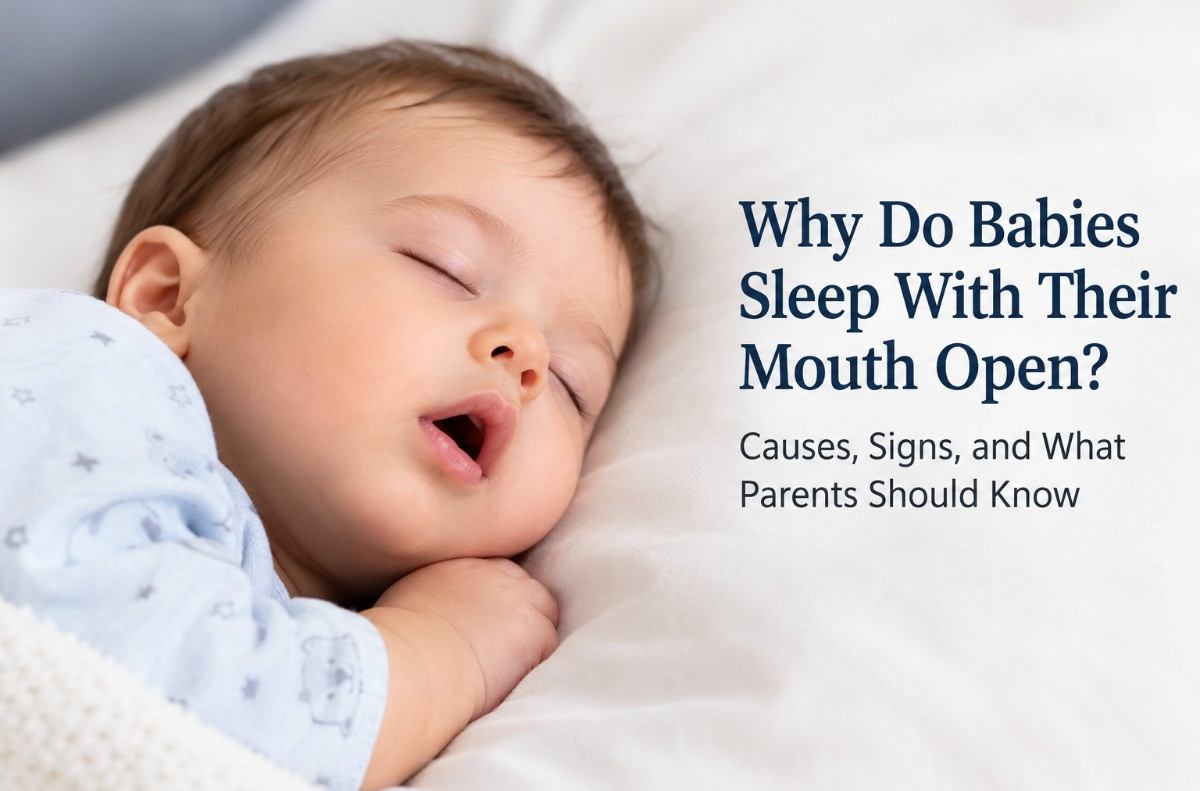
Have you ever looked at your sleeping baby and noticed that their little mouth is slightly open? It may seem adorable and harmless, but you might wonder whether your baby is breathing normally or if something is affecting their sleep.
Babies can sometimes sleep with their mouths open because of temporary nasal congestion, a blocked nose, or the way their mouth rests during sleep. However, regular mouth breathing, especially when accompanied by snoring or breathing difficulties, deserves medical attention.
Newborns and young infants primarily breathe through their noses, so persistent mouth breathing should not automatically be dismissed as a normal sleeping habit. Understanding the possible causes can help you decide when simple care is enough and when your baby needs a pediatrician’s evaluation.
In this guide, we explain why babies sleep with their mouths open, which symptoms parents should watch for, and how to support safe, comfortable sleep.
Is It Normal for Babies to Sleep With Their Mouth Open?
Occasionally seeing your baby’s mouth open during sleep does not necessarily mean something is wrong. Your baby may have a slightly open jaw while sleeping, or temporary congestion may make nasal breathing more difficult.
However, there is an important difference between sleeping with the mouth open and consistently breathing through the mouth. An open mouth alone does not tell you whether your baby is breathing through their nose or mouth.
Because young babies rely heavily on nasal breathing, frequent or persistent mouth breathing should be discussed with a pediatrician, particularly if it occurs from the newborn stage or is associated with other symptoms.
If your baby is otherwise comfortable, feeding normally, and breathing quietly, an occasional open-mouth sleeping position may be less concerning. Still, monitor the pattern rather than assuming it is always harmless.
8 Reasons Why Babies Sleep With Their Mouth Open
Several factors can explain why a baby sleeps with their mouth open. The cause may be temporary, or it may involve an underlying problem that needs medical evaluation.
1. Nasal Congestion
A stuffy nose is one of the common reasons a baby may struggle to breathe comfortably during sleep. Babies have small nasal passages, so even a little mucus or swelling can interfere with airflow.
Congestion may develop because of a common cold, a respiratory infection, or irritation inside the nose. When nasal breathing becomes difficult, a baby may open their mouth or show signs of increased breathing effort.
Other symptoms may include a runny nose, sneezing, noisy breathing, difficulty feeding, or waking more frequently than usual.
2. A Common Cold or Respiratory Infection
Respiratory infections can cause inflammation and mucus buildup in the nasal passages. This can make it harder for your baby to breathe through their nose, particularly when lying down.
You might notice that your baby sleeps with their mouth open only during an illness and returns to their usual breathing pattern once the congestion improves.
Watch for additional symptoms, including coughing, fever, reduced feeding, fewer wet diapers, or unusual sleepiness. Young infants can become unwell quickly, so seek medical advice promptly if they develop a fever or show signs of illness.
3. Enlarged Adenoids
Adenoids are patches of immune tissue located behind the nose, near the upper throat. They help the body respond to germs, but enlarged adenoids can narrow the airway and make nasal breathing difficult.
Children with enlarged adenoids may breathe through their mouths more frequently, snore, experience restless sleep, or have persistent nasal congestion.
Although enlarged adenoids are more commonly discussed in older infants and children, a healthcare professional may consider airway obstruction when a younger baby has persistent symptoms.
4. Enlarged Tonsils
Tonsils are areas of immune tissue at the back of the throat. When enlarged, they can narrow the upper airway and sometimes interfere with comfortable breathing during sleep.
Possible warning signs include regular snoring, noisy breathing, restless sleep, or pauses in breathing.
Enlarged tonsils are not the explanation for every baby who sleeps with an open mouth. A pediatrician can assess whether the tonsils or another part of the airway may be contributing to the problem.
5. Allergies or Nasal Irritation
Allergies and environmental irritants can cause nasal swelling, sneezing, and excess mucus. Dust, smoke, strong fragrances, and other airborne irritants may also aggravate a baby’s nose.
Allergies can contribute to mouth breathing, although persistent nasal symptoms in a young infant should not automatically be attributed to allergies without medical assessment.
Keep your baby’s environment free from tobacco smoke, vaping aerosols, and strong fragrances. If nasal symptoms continue, ask your pediatrician about the possible cause.
6. A Structural Problem in the Nose
Sometimes, the structure of a baby’s nasal passages can make airflow difficult. Examples include a narrow nasal passage, an abnormality affecting the opening of the nose, or a deviated nasal septum.
These problems are less common than temporary congestion, but they may be considered when mouth breathing begins early, persists, or occurs alongside feeding or breathing difficulties.
A baby who struggles to breathe through the nose, especially during feeding, should be evaluated rather than treated with home remedies alone.
7. Obstructive Sleep Apnea
Obstructive sleep apnea occurs when the upper airway repeatedly becomes partially or completely blocked during sleep. Although many people associate this condition with adults, babies and children can also experience it.
Possible symptoms include:
- Regular snoring or unusually noisy breathing.
- Pauses in breathing during sleep.
- Gasping, choking, or snorting sounds.
- Restless sleep or frequent waking.
- Mouth breathing during sleep.
- Difficulty feeding or unusual tiredness, depending on the child’s age and condition.
Not every baby who sleeps with their mouth open has sleep apnea. However, repeated breathing pauses or gasping should never be ignored. Contact a healthcare professional promptly for assessment.
8. The Baby’s Mouth Is Simply Resting Open
Sometimes, a baby’s mouth may appear slightly open while they sleep without obvious signs of illness. The jaw and facial muscles naturally relax during sleep, which can contribute to this appearance.
However, it is difficult to determine from appearance alone whether the baby is breathing through the nose normally.
If your baby occasionally sleeps with an open mouth but has quiet, comfortable breathing and no other concerning symptoms, observe the pattern. If it becomes frequent or persistent, discuss it with your pediatrician.
Is Mouth Breathing During Baby Sleep Dangerous?
Mouth breathing is not automatically an emergency, but persistent mouth breathing can be a sign that your baby is having difficulty moving air through the nose or upper airway.
The level of concern depends on your baby’s age, the frequency of the symptoms, and whether other signs are present.
Occasional open-mouth sleeping without other symptoms may be less concerning than repeated mouth breathing accompanied by snoring, gasping, or pauses in breathing.
Ongoing airway obstruction and untreated sleep-disordered breathing can affect sleep quality and, in some children, growth and development. The underlying cause matters, which is why persistent symptoms should be evaluated rather than managed by simply trying to keep the baby’s mouth closed.
Signs That Your Baby’s Mouth Breathing Needs Medical Attention
Pay attention to the following signs, especially if they occur repeatedly:
- Persistent mouth breathing: Your baby regularly appears to breathe through their mouth during sleep or while awake.
- Frequent snoring: Your baby makes repeated snoring or loud breathing sounds.
- Pauses in breathing: You notice repeated gaps in breathing, followed by gasping or snorting.
- Difficulty feeding: Your baby struggles to coordinate sucking and breathing or repeatedly stops feeding to catch their breath.
- Persistent nasal congestion: Your baby’s nose seems blocked for an extended period.
- Restless sleep: Your baby frequently wakes, appears uncomfortable, or seems to struggle for air.
- Dry or cracked lips: These may accompany ongoing mouth breathing but are not enough on their own to identify the cause.
- Poor feeding or fewer wet diapers: These may indicate illness or dehydration and need prompt assessment.
When Is It an Emergency?
Seek emergency medical care immediately if your baby:
- Is struggling to breathe or has severe chest or rib retractions.
- Has blue or gray lips, tongue, or face.
- Has repeated breathing pauses with difficulty recovering.
- Becomes unusually limp, unresponsive, or difficult to wake.
Do not wait for a routine appointment if your baby shows signs of serious breathing difficulty.
How to Help a Baby Who Sleeps With Their Mouth Open
The safest approach is to address possible congestion, maintain a safe sleep environment, and seek medical advice when symptoms persist.
1. Use Plain Saline Drops for Nasal Congestion
If your baby’s nose is blocked, plain saline nasal drops intended for infants may help loosen mucus. Follow the product instructions or your pediatrician’s advice.
For babies who need it, gentle suction with an infant nasal aspirator can help remove loosened mucus. Avoid inserting anything deeply into the nostrils or suctioning excessively, as this can irritate the nasal lining.
2. Consider a Clean Cool-Mist Humidifier
A cool-mist humidifier may help ease discomfort from dry air. Clean and maintain the device according to the manufacturer’s instructions to prevent mold and bacterial growth.
Keep the humidifier and its cord out of your baby’s reach, and do not use hot-steam devices around infants because of the risk of burns.
3. Keep Your Baby Away From Irritants
Avoid cigarette smoke, vaping aerosols, incense, strong perfumes, and other airborne irritants that may aggravate nasal symptoms.
If congestion continues despite reducing exposure to irritants, ask your pediatrician whether another cause needs investigation.
4. Monitor Your Baby’s Breathing
Notice whether the open-mouth position happens occasionally or every night. Watch for snoring, unusual breathing noises, feeding difficulties, or pauses in breathing.
If you are concerned, a short video of the breathing pattern may help your pediatrician understand what you have observed. Do not delay urgent care to record a video.
5. Arrange a Pediatrician’s Appointment
If your baby regularly sleeps with their mouth open, especially for several nights without an obvious temporary illness, arrange a medical evaluation.
Your pediatrician may examine the nose and throat, review feeding and sleep patterns, and determine whether an ear, nose, and throat specialist or a sleep evaluation is needed.
Treatment depends on the cause. For example, temporary congestion may improve with appropriate supportive care, while an airway obstruction may require further investigation.
Safe Sleep Rules for Babies With Nasal Congestion
Even when your baby has a stuffy nose, safe sleep practices remain essential.
- Place your baby on their back: Put your baby on their back for every sleep, including naps.
- Use a firm, flat sleep surface: Choose a safety-approved infant crib, bassinet, or play yard with a firm, level mattress and fitted sheet.
- Keep the sleep space empty: Do not add pillows, loose blankets, stuffed toys, wedges, or positioners.
- Avoid elevating the mattress: Inclined sleeping surfaces can cause a baby’s head to fall forward and interfere with breathing.
- Do not tape your baby’s mouth: Mouth taping can obstruct breathing and is not an appropriate home treatment for infants.
- Avoid unprescribed cold medicines: Never give an infant decongestants, cough medicines, or other medication without appropriate medical advice.
If your baby seems unable to breathe comfortably while lying flat, seek medical advice instead of changing the sleep position or using an inclined sleeper.
Does Sleeping With the Mouth Open Affect a Baby’s Development?
The answer depends on why it happens and how long the problem continues.
An occasional open-mouth sleeping position does not establish that your baby’s development will be affected. However, persistent mouth breathing caused by an underlying airway problem may be associated with disrupted sleep.
Long-standing mouth breathing in children has also been associated with dry mouth and changes in dental development. When enlarged adenoids or sleep apnea are involved, treating the underlying problem may improve breathing and sleep.
These potential effects should not be assumed in every baby. The priority is to identify whether there is an ongoing breathing problem and address it early when necessary.
FAQ’s
Can a stuffy nose make a baby sleep with their mouth open?
Yes, nasal congestion caused by a cold or irritation can make it harder for a baby to breathe comfortably through their nose.
Should I close my baby’s mouth while sleeping?
No, never force your baby’s mouth closed or use mouth tape. If mouth breathing continues, consult a pediatrician.
Can teething cause mouth breathing during sleep?
Teething may cause drooling and sleep disturbances, but persistent mouth breathing should not automatically be attributed to teething.
Does sleeping with the mouth open mean my baby has sleep apnea?
No, but frequent snoring, gasping, or repeated pauses in breathing may indicate sleep-disordered breathing and require medical evaluation.
Can babies outgrow sleeping with their mouths open?
It depends on the cause. Temporary congestion may resolve, while persistent mouth breathing caused by an airway obstruction may require treatment.
Why does my newborn sleep with their mouth open but breathe through their nose?
A newborn may sleep with their mouth slightly open due to relaxed jaw muscles while breathing through their nose. If this happens regularly or with noisy breathing, consult a pediatrician.
How can I stop my baby from sleeping with their mouth open?
Use infant saline drops for nasal congestion if appropriate, and consult a pediatrician if mouth breathing persists. Never tape your baby’s mouth shut.
Why does my baby sleep with her mouth open and tongue out?
This may happen due to relaxed muscles or natural tongue positioning. If it occurs frequently or causes feeding or breathing difficulties, seek medical advice.
Conclusion
Babies may sleep with their mouths open for several reasons, including nasal congestion, respiratory infections, enlarged adenoids, or other airway issues. Sometimes the mouth simply appears open during sleep, but appearance alone cannot confirm that breathing is normal.
If your baby is breathing comfortably and the position occurs only occasionally, you can monitor the pattern. Persistent mouth breathing, regular snoring, feeding difficulties, or unusual breathing sounds deserve a pediatrician’s assessment.
Sources / References:
Disclaimer:
This article is for educational purposes only and is not a substitute for professional medical advice, diagnosis, or treatment. Consult your pediatrician about persistent mouth breathing or any concerns about your baby’s breathing.
Also Read: