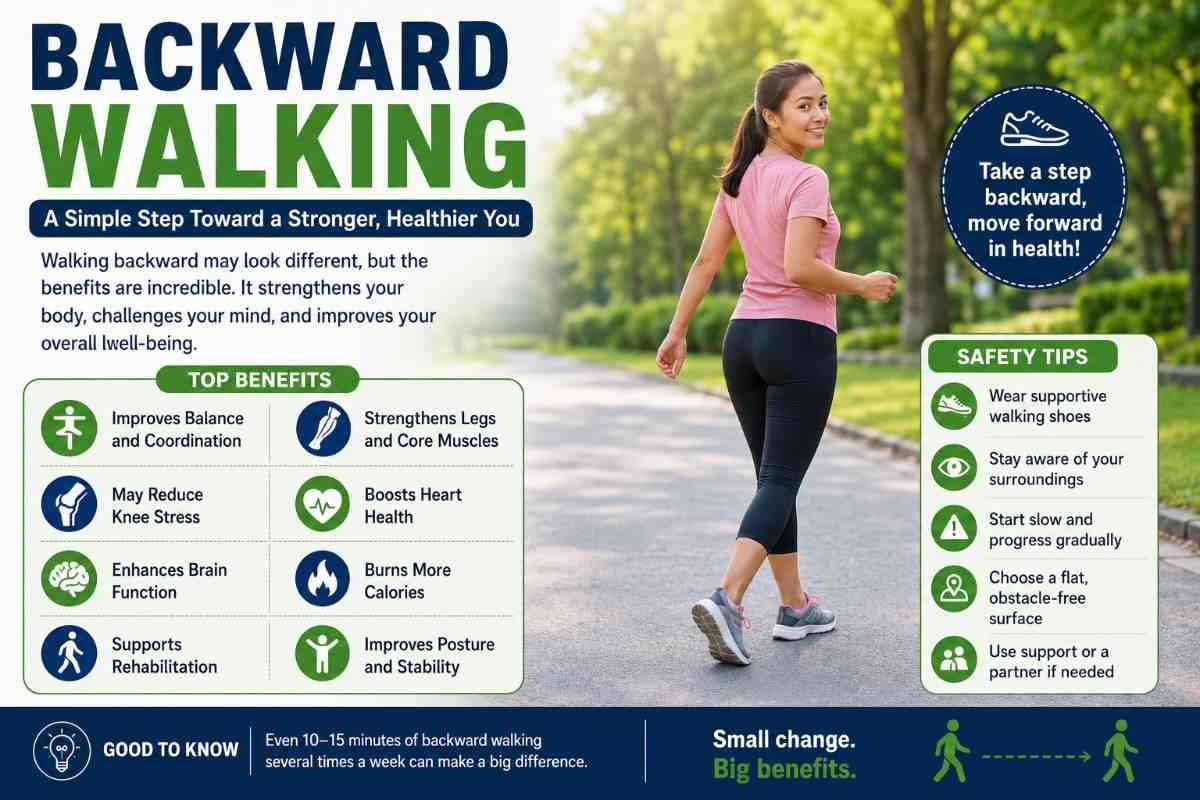
Backward walking, also known as retro walking, is gaining popularity among fitness enthusiasts, physical therapists, athletes, and older adults looking for a new way to improve their health. While it may seem unusual at first, walking backward is a scientifically supported exercise that challenges your body differently than regular walking.
Unlike forward walking, backward walking requires greater concentration, balance, coordination, and muscle activation. It places less stress on certain joints while strengthening muscles that are often underused during everyday movement. Whether you’re trying to improve balance, burn extra calories, recover from an injury, or simply make your walking routine more interesting, backward walking may offer surprising benefits.
In this guide, you’ll learn what backward walking is, its nutritional equivalent in calorie burning, proven health benefits, potential risks, how to do it safely, and answers to the most frequently asked questions.
What Is Backward Walking?
Backward walking, commonly known as retro walking, is exactly what it sounds like—walking in the opposite direction instead of moving forward. Although it may feel awkward initially, this movement pattern engages your muscles, joints, and brain differently than normal walking.
Physical therapists have used backward walking for decades in rehabilitation programs because it helps improve balance, coordination, lower-body strength, and gait mechanics. Today, fitness experts recommend it as a simple yet effective addition to walking routines.
Backward walking can be performed:
- Outdoors on a flat, obstacle-free surface
- Indoors in a hallway
- On a treadmill (only with proper safety precautions)
- On athletic tracks
- During rehabilitation sessions under professional guidance
Even walking backward for 5–15 minutes several times a week can provide measurable health benefits.
Backward Walking vs. Forward Walking
| Feature | Forward Walking | Backward Walking |
|---|---|---|
| Balance challenge | Low | High |
| Coordination | Moderate | High |
| Brain engagement | Moderate | High |
| Quadriceps activation | Moderate | High |
| Calorie burn | Standard | Slightly higher |
| Joint loading | Different pattern | Reduced knee compression in some individuals |
| Difficulty level | Easy | Moderate to Advanced |
How Does Backward Walking Work?
Walking backward changes your natural movement mechanics.
Instead of leading with your heel, you generally contact the ground with your toes first before rolling toward the heel. This altered movement recruits muscles differently and requires continuous communication between your muscles, joints, eyes, and brain.
Backward walking especially activates:
- Quadriceps
- Calves
- Hip flexors
- Glutes
- Core muscles
- Ankle stabilizers
It also requires increased attention, making it both a physical and cognitive exercise.
20 Proven Benefits of Backward Walking
1. Improves Balance
Walking backward forces your body to constantly adjust posture and stability, strengthening balance mechanisms.
2. Enhances Coordination
Retro walking improves communication between the brain and muscles, helping movements become more controlled.
3. Strengthens the Quadriceps
The front thigh muscles work harder during backward walking compared to normal walking.
4. Builds Stronger Leg Muscles
The calves, hamstrings, glutes, and hip muscles are activated differently, creating a more balanced lower-body workout.
5. Burns More Calories
Because backward walking is less efficient than forward walking, your body expends more energy, potentially increasing calorie burn.
6. Improves Cardiovascular Fitness
Even at slower speeds, backward walking raises heart rate and oxygen consumption.
7. May Reduce Knee Pain
Some rehabilitation programs use backward walking because it may decrease stress on certain parts of the knee while strengthening surrounding muscles.
8. Improves Walking Mechanics
It helps retrain proper gait patterns after injuries or surgeries under professional supervision.
9. Increases Brain Activity
Walking backward requires greater focus and concentration, stimulating cognitive function.
10. Enhances Body Awareness
You become more aware of posture, foot placement, and body positioning.
11. Strengthens Core Muscles
Maintaining stability while moving backward engages the abdominal and lower back muscles.
12. Improves Athletic Performance
Many athletes include backward walking in training to improve agility, reaction time, and movement control.
13. Supports Rehabilitation
Physical therapists often use retro walking during recovery from knee injuries, stroke rehabilitation, and mobility disorders.
14. Improves Ankle Stability
Backward walking strengthens muscles surrounding the ankles, potentially lowering injury risk.
15. Challenges Different Muscle Groups
Changing movement direction helps prevent repetitive movement patterns.
16. May Improve Posture
Because backward walking encourages an upright position, it can promote better posture.
17. Increases Functional Mobility
Better coordination and balance can improve everyday activities like climbing stairs or changing direction.
18. Adds Variety to Exercise
Changing your walking routine can help prevent boredom and increase motivation.
19. May Improve Mental Focus
The concentration required helps sharpen attention and mindfulness.
20. Suitable for Most Fitness Levels
When performed safely, backward walking can be modified for beginners, older adults, and athletes.
Related Articles:
- Lose Weight in a Week: The Best 7-Day Walking Plan
- Do You Really Need to Walk 10000 Steps a Day?
- Barefoot Walking: 20 Benefits, Risks & How to Start Safely
Does Backward Walking Burn More Calories?
Yes. Studies suggest backward walking requires more energy than normal walking because it is mechanically less efficient.
Estimated calorie burn (30 minutes):
| Activity | Approximate Calories (70 kg adult) |
| Forward walking | 120–150 calories |
| Backward walking | 160–220 calories |
Actual calorie expenditure depends on:
- Body weight
- Walking speed
- Incline
- Duration
- Fitness level
How to Start Backward Walking?
Beginners should focus on safety before increasing speed or duration.
Step 1
Choose a flat surface free from obstacles.
Step 2
Stand tall with relaxed shoulders.
Step 3
Look over one shoulder occasionally while maintaining awareness of your surroundings.
Step 4
Take short, controlled steps.
Step 5
Land gently with your toes before rolling toward the heel.
Step 6
Swing your arms naturally.
Step 7
Start with 3–5 minutes.
Step 8
Gradually increase to 10–20 minutes.
Backward Walking on a Treadmill
Many people perform backward walking on treadmills, but extra caution is essential.
Safety tips:
- Hold the side rails while learning.
- Begin at the lowest speed.
- Never look away from the treadmill.
- Avoid distractions.
- Increase speed only after gaining confidence.
- Stop immediately if you feel dizzy or unstable.
Who Can Benefit from Backward Walking?
Backward walking may be beneficial for:
- Older adults working on balance
- Office workers with sedentary lifestyles
- Recreational walkers
- Runners
- Athletes
- Individuals in rehabilitation (under professional supervision)
- People seeking low-impact exercise
Who Should Avoid Backward Walking?
Consult a healthcare professional before starting if you have:
- Severe balance disorders
- Frequent dizziness
- Advanced arthritis
- Recent fractures
- Severe osteoporosis
- Neurological disorders affecting mobility
- Vision impairments that increase fall risk
Potential Risks of Backward Walking
Although generally safe, backward walking carries some risks.
These include:
- Falling
- Tripping
- Muscle soreness
- Ankle sprains
- Collisions with objects
- Loss of balance
Most injuries can be prevented by walking in a safe environment and progressing gradually.
Backward Walking Safety Tips
Follow these recommendations:
- Start slowly.
- Use a smooth, obstacle-free surface.
- Wear supportive walking shoes.
- Stay alert to your surroundings.
- Avoid busy roads.
- Walk with a partner if you’re a beginner.
- Stop if you experience pain or dizziness.
- Warm up beforehand.
- Cool down afterward.
Sample Beginner Backward Walking Routine
| Week | Duration | Frequency |
| Week 1 | 3–5 minutes | 3 days/week |
| Week 2 | 5–8 minutes | 3–4 days/week |
| Week 3 | 8–12 minutes | 4 days/week |
| Week 4 | 10–15 minutes | 4–5 days/week |
Tips to Make Backward Walking More Effective
- Combine it with regular forward walking.
- Maintain an upright posture.
- Keep your core engaged.
- Take short, controlled steps.
- Focus on smooth movements.
- Increase duration gradually.
- Incorporate gentle hills only after mastering flat surfaces.
Common Mistakes to Avoid
- Walking too fast
- Looking only behind you instead of scanning safely
- Wearing unsuitable footwear
- Choosing crowded areas
- Ignoring pain
- Leaning backward excessively
- Taking overly large steps
FAQs
Does walking backwards increase memory?
Some studies suggest that walking backward may temporarily improve memory recall by increasing brain engagement and attention, but more research is needed to confirm its long-term effects.
Is backward walking better than regular walking?
Retro walking isn’t necessarily better than regular walking, but it offers unique benefits like improved balance, stronger leg muscles, increased calorie burn, and greater brain engagement. Combining both provides the best overall results.
Can backward walking help with weight loss?
Yes. Retro walking can contribute to weight loss by increasing calorie expenditure. However, it should be combined with a balanced diet and regular exercise for the best results.
Is backward walking good for knee pain?
Research suggests backward walking may help reduce certain types of knee pain by strengthening the muscles around the knee and changing joint loading. Consult a healthcare provider if you have persistent knee pain.
How long should I walk backward each day?
Beginners can start with 3–5 minutes and gradually increase to 10–20 minutes as balance and confidence improve.
Is backward walking safe for seniors?
Yes, many older adults can benefit from improved balance and mobility. Seniors with balance issues should begin under supervision or use support when needed.
Can backward walking improve balance?
Yes. Since retro walking challenges your stability more than forward walking, it can significantly improve balance and coordination over time.
What shoes are best for backward walking?
Wear supportive walking or running shoes with good grip, cushioning, and stability to reduce the risk of slips and falls.
Is backward walking scientifically proven?
Yes. Multiple studies have shown that backward walking can improve balance, muscle strength, walking mechanics, cardiovascular fitness, and rehabilitation outcomes in certain populations.
Can I walk backward every day?
For most healthy individuals, short sessions can be performed regularly if done safely. Allow adequate recovery if you experience muscle soreness, especially when starting.
Is treadmill backward walking safe?
It can be safe when performed at very low speeds with proper precautions, such as using the handrails while learning. Beginners should avoid high speeds or distractions.
Does backward walking strengthen the brain?
Because it requires greater attention, coordination, and spatial awareness than forward walking, it may provide additional cognitive stimulation alongside its physical benefits.
Final Thoughts
Backward walking is a simple yet highly effective exercise that offers benefits beyond traditional walking. By challenging your muscles, balance, coordination, and focus in new ways, it can help improve lower-body strength, cardiovascular fitness, and overall movement quality.
Whether you’re looking to diversify your workouts, enhance athletic performance, or support healthy aging, incorporating a few minutes of retro walking into your weekly routine may be worthwhile. Start slowly, prioritize safety, and gradually increase your duration as your confidence grows. As with any new exercise, consult a qualified healthcare professional if you have existing medical conditions or concerns.
Sources / References:
- American College of Sports Medicine (ACSM)
- Centers for Disease Control and Prevention – Physical Activity
- World Health Organization – Physical Activity
- Harvard T.H. Chan School of Public Health – Physical Activity
- National Institute on Aging – Exercise and Physical Activity
- National Library of Medicine (PubMed)
About the Author:
Written by: Kirti Solanki – Health Content Researcher
Kirti Solanki is a health content researcher dedicated to creating evidence-based, reader-friendly articles on nutrition, fitness, wellness, pregnancy, and preventive healthcare. Every article is thoroughly researched using reputable medical organizations and peer-reviewed scientific literature to provide accurate, practical, and trustworthy information for readers.
Disclaimer:
This guide is intended for educational and informational purposes only and should not be considered medical advice, diagnosis, or treatment. Always consult a qualified physician, physical therapist, or other licensed healthcare professional before beginning a new exercise program, especially if you have a medical condition, recent injury, balance problems, or persistent pain. Never ignore professional medical advice or delay seeking care because of information you have read online.
Also Read: