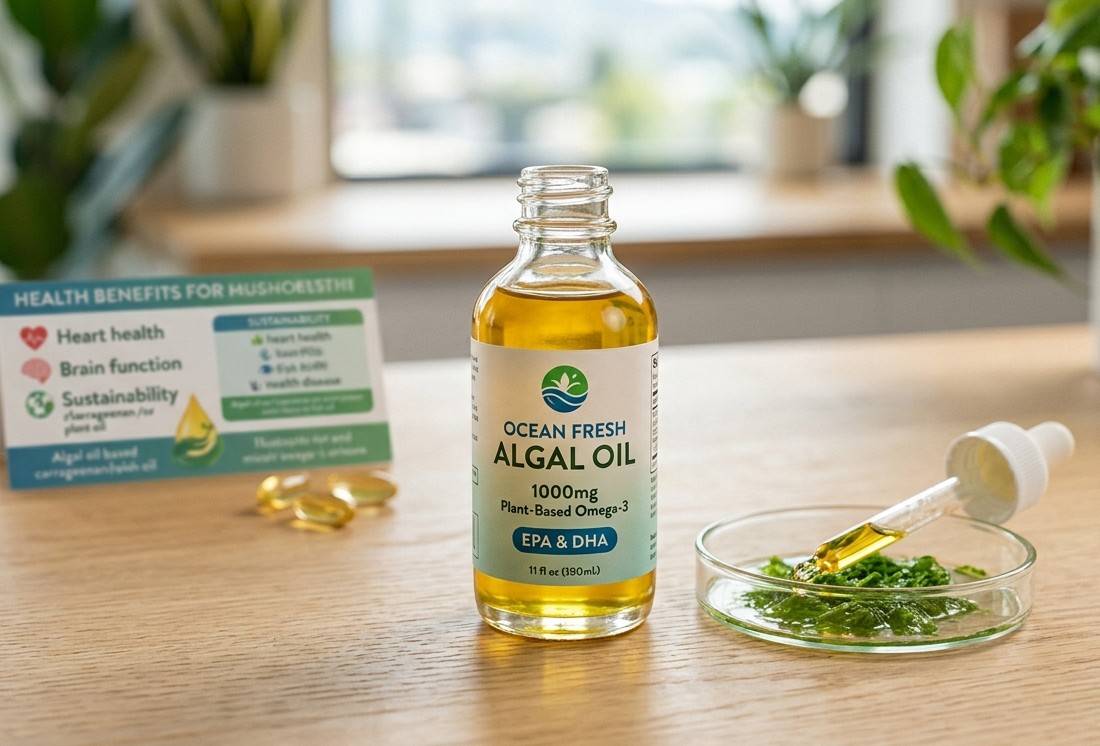
Algal oil (also known as seaweed oil, microalgae oil, or algae oil) has become a popular plant-based source of omega-3 fatty acids, especially among people who follow vegetarian or vegan diets. Unlike fish oil, which contains omega-3s after fish obtain them through the marine food chain, algal oil gets its omega-3s directly from microalgae.
Most algal oil supplements are particularly rich in docosahexaenoic acid (DHA), while some products also provide eicosapentaenoic acid (EPA). These long-chain omega-3 fatty acids have important roles in the body, including supporting normal brain and eye function.
Because algal oil provides DHA and, depending on the product, EPA without using fish, it can be an appealing alternative to traditional fish oil. However, the amount of omega-3 varies considerably between products, so checking the supplement label is important.
What Is Algal Oil?
Algal oil is an oil extracted from certain species of microalgae. These microscopic organisms naturally produce omega-3 fatty acids, particularly DHA and, in some species, EPA.
Microalgae are actually the original producers of much of the DHA and EPA found in the marine food chain. Fish obtain these fatty acids indirectly by consuming algae or organisms that have consumed algae.
Algal oil is commonly produced from microorganisms such as species belonging to the Schizochytrium and Aurantiochytrium groups. Commercial products may contain different concentrations of DHA, so one capsule or teaspoon of one product may provide a substantially different amount of omega-3 than another.
Algal oil is available as softgel capsules, liquid oil, and an ingredient added to fortified foods and beverages.
Nutrition Facts of Algal Oil
Algal oil is primarily a source of fat, with its nutritional value depending on the particular formulation. Many commercial products are concentrated to provide DHA and/or EPA rather than a broad range of vitamins and minerals.
| Nutrient | Typical amount in algal oil | Notes |
|---|---|---|
| Calories | About 40 calories per teaspoon | Depends on serving size and formulation |
| Total fat | About 4.5 g per teaspoon | Primarily oil |
| Saturated fat | Variable | Usually a relatively small portion |
| Omega-3 fatty acids | Variable | Depends strongly on the product |
| DHA | Often the main omega-3 | Concentration varies by manufacturer |
| EPA | Variable | Some products contain little or no EPA |
| Carbohydrates | 0 g | Pure oil generally contains none |
| Protein | 0 g | Pure oil generally contains none |
| Fiber | 0 g | Pure oil generally contains none |
| Sugar | 0 g | Pure oil generally contains none |
Important: These are general values, not a universal nutrition profile. Always use the Supplement Facts or Nutrition Facts panel of the specific product you are consuming.
Commercial algal oils can contain around 35–45% or more DHA depending on the strain and formulation, and FDA GRAS notices document several DHA-rich algal oils used in foods and supplements.
20 Proven Benefits of Algal Oil
- Provides Plant-Based Omega-3s: Algal oil provides a direct dietary source of long-chain omega-3 fatty acids without requiring fish or other animal-derived ingredients.
- Supports Brain Function: DHA is an important structural component of cell membranes in the brain and plays a role in normal neurological function.
- Supports Eye Health: DHA is highly concentrated in the retina, where it contributes to normal retinal structure and function.
- Helps Meet DHA Needs: Algal oil can be a practical way for people who do not consume seafood to obtain preformed DHA rather than relying entirely on conversion from plant-based ALA.
- May Support Heart Health: EPA and DHA have been studied extensively for cardiovascular effects, although the results vary depending on the outcome and dose.
- May Help Maintain Triglyceride Levels: Higher doses of EPA and DHA can reduce triglyceride levels, but therapeutic doses should be used under medical supervision.
- Supports Normal Cardiovascular Function: Adequate omega-3 intake contributes to overall cardiovascular nutrition, although supplements are not a substitute for a heart-healthy diet.
- May Support Healthy Blood Pressure: Research has investigated EPA and DHA for blood-pressure effects, but evidence is not consistent enough to treat algal oil as a blood-pressure medicine.
- Supports Normal Vision: DHA is an important fatty acid found in retinal tissue and contributes to normal visual function.
- Useful During Pregnancy: DHA is important during pregnancy because it contributes to fetal brain and eye development, but pregnant people should discuss the appropriate product and dose with their healthcare professional.
- Useful During Lactation: DHA is transferred into breast milk, making dietary DHA relevant to maternal and infant nutrition during breastfeeding.
- Supports Vegetarian and Vegan Diets: Algal oil provides a convenient omega-3 option for people who avoid fish and other animal-derived foods.
- Avoids Fish as an Omega-3 Source: Algal oil can provide DHA without consuming fish, which may be useful for people with dietary, ethical, or environmental preferences.
- May Help Increase Blood DHA: Consuming preformed DHA can increase DHA availability more directly than relying on the body’s limited conversion of ALA.
- Provides a Sustainable Omega-3 Alternative: Microalgae are being studied and developed as alternative sources of long-chain omega-3s as demand for EPA and DHA increases.
- May Support Normal Inflammatory Regulation: EPA and DHA participate in pathways involved in the body’s inflammatory response, although this does not mean algal oil treats inflammatory diseases.
- Supports Cellular Membranes: DHA and EPA are incorporated into cell membranes and contribute to their structure and signaling functions.
- Can Help Diversify Omega-3 Intake: Algal oil can complement dietary sources of ALA such as flaxseed, chia seeds, walnuts, and certain plant oils.
- Convenient for People Who Avoid Seafood: A capsule or measured liquid can make consistent omega-3 intake easier for people who rarely or never eat seafood.
- May Help Fill a Dietary Gap: For people whose diets contain little or no seafood, algal oil can provide a concentrated source of DHA and, in some formulations, EPA.
10 Side Effects of Algal Oil
Algal oil is generally well tolerated when used as directed, but because it supplies omega-3 fatty acids, some people may experience side effects. Common omega-3 supplement effects include gastrointestinal symptoms and an unpleasant taste or aftertaste.
- Fishy or Unpleasant Aftertaste: Although algal oil is not derived from fish, some products can still leave an unpleasant oily or marine-like aftertaste.
- Heartburn: Taking an omega-3 oil supplement may cause mild heartburn or reflux in some people.
- Nausea: Some individuals may experience nausea, particularly when taking concentrated oil on an empty stomach.
- Stomach Discomfort: Digestive discomfort can occur after consuming concentrated oil.
- Diarrhea: Larger amounts of omega-3 supplements may cause loose stools or diarrhea in sensitive individuals.
- Bloating: Some people may notice temporary digestive bloating after taking an oil supplement.
- Headache: Headache has been reported among the possible mild side effects of omega-3 supplementation.
- Bad Breath: An unpleasant taste or breath odor can occasionally occur after omega-3 supplementation.
- Possible Increased Bleeding Risk at High Doses: High amounts of EPA and DHA may affect platelet activity, making medical guidance important for people taking anticoagulant medicines.
- Possible Atrial Fibrillation Risk at High Doses: Some large trials found a slightly increased risk of atrial fibrillation with 4 g/day omega-3 supplementation in people with cardiovascular disease or high cardiovascular risk, so high-dose use should be medically supervised.
How to Use Algal Oil?
The simplest way to use algal oil is to take a standardized supplement according to its label. Algal oil is available in capsules and liquid formulations.
If using liquid algal oil, measure the serving with the provided dropper or measuring device rather than estimating with a household spoon. You can generally take it with a meal because consuming oil alongside food may make it easier to tolerate.
The most important number to check is not simply the total amount of oil in the capsule. Look for the actual DHA and EPA amounts.
For example, a capsule labeled “500 mg algal oil” does not necessarily contain 500 mg DHA. The DHA amount may be considerably lower.
Other Uses of Algal Oil
Algal oil is used beyond dietary supplements.
- It is used as a source of DHA in fortified foods and beverages.
- It can be incorporated into nutritional products.
- DHA-rich algal oil is used in some infant formula products under regulated conditions.
- It is used in vegetarian and vegan omega-3 supplements.
- It can be used as an alternative source of DHA in functional foods.
- Certain algal oils are being explored as ingredients in sustainable nutrition products.
- Some algal oils are used in specialized nutritional formulations.
The FDA has reviewed multiple GRAS notices involving DHA-rich algal oils for food applications, including certain infant formula uses.
Tips for Consuming Algal Oil
- Check the DHA Amount: Look at the actual milligrams of DHA per serving rather than judging a product by the total oil weight.
- Check for EPA: If you specifically want EPA as well as DHA, choose a product that clearly lists EPA on its label.
- Take It With Food: Taking algal oil alongside a meal may improve tolerance and reduce digestive discomfort.
- Start Conservatively: If you have never used an omega-3 supplement, follow the manufacturer’s recommended serving rather than immediately taking a high dose.
- Choose Reputable Brands: Look for products with clear ingredient information, batch details, quality testing, and appropriate third-party certification where available.
- Read the Entire Label: Check the serving size, DHA, EPA, additional ingredients, storage instructions, and expiration date.
- Avoid Unnecessary High Doses: More omega-3 is not automatically better, particularly when high doses are being used without medical supervision.
- Store It Properly: Follow the manufacturer’s storage instructions because oils can deteriorate when exposed to heat, light, and oxygen.
- Monitor Your Tolerance: Reduce or stop the supplement and seek professional advice if you develop persistent or unusual symptoms.
- Consider Your Whole Diet: Supplements work best as part of an overall nutritious diet rather than as a replacement for healthy foods.
How to Take Algal Oil?
For capsules, swallow the recommended number with water, preferably alongside a meal.
For liquid algal oil, measure the exact amount stated on the product label and add it to an appropriate food or beverage if the manufacturer permits this use.
Do not assume that all algal oil products have the same strength. One product may provide 200 mg DHA per serving while another may provide 500 mg or more.
If your goal is to obtain a particular amount of DHA or EPA, calculate your intake from the actual Supplement Facts panel rather than from the total weight of the oil.
How Much Algal Oil Can You Use Per Day?
There is no single universal daily amount of algal oil because products contain different concentrations of DHA and EPA.
A better approach is to determine the amount of DHA and EPA provided by the product.
For general supplementation, follow the product’s recommended serving unless a healthcare professional has advised you otherwise. High-dose omega-3 supplementation should not be started independently.
The FDA states that dietary supplements providing no more than 5 grams per day of combined EPA and DHA are considered safe when used as recommended, while high-dose supplementation can require medical supervision.
This is a safety reference for EPA+DHA exposure, not a recommendation that everyone should consume 5 grams daily.
Algal Oil Dosage
The appropriate dosage depends on your age, diet, health status, reason for use, and the DHA/EPA concentration of the product.
For general nutritional supplementation, many products provide several hundred milligrams of DHA per daily serving. However, there is no universal “algal oil dosage” that applies to every person.
For people seeking high-dose omega-3 supplementation to manage triglycerides or another medical condition, the dose should be determined by a healthcare professional.
Pregnant and breastfeeding individuals should also discuss DHA supplementation with their doctor, midwife, or dietitian before choosing a high-dose product.
Best Time to Use Algal Oil
There is no strong evidence that algal oil must be taken at a particular time of day.
For most people, taking it with a meal is a practical choice. Some people find that taking it with lunch or dinner reduces the chance of digestive discomfort or aftertaste.
Consistency is generally more important than whether you take it in the morning or evening.
Who Should Use Algal Oil?
- Vegans and Vegetarians: People who do not eat fish can use algal oil as a direct source of DHA and, depending on the product, EPA.
- People Who Rarely Eat Seafood: Algal oil may help provide long-chain omega-3s when seafood intake is low.
- People Seeking DHA: Individuals looking specifically for a concentrated DHA source may find algal oil convenient.
- People Avoiding Fish Oil: Those who prefer not to use fish-derived supplements can choose algal oil.
- People Following Plant-Based Diets: Algal oil can fit naturally into vegetarian and vegan dietary patterns.
- People With Specific Nutritional Needs: Some individuals may benefit from omega-3 supplementation when recommended by a qualified healthcare professional.
- People Interested in Alternative Omega-3 Sources: Algal oil provides a non-fish source of long-chain omega-3 fatty acids.
Who Should Not Use Algal Oil?
- People With a Known Allergy to an Ingredient: Anyone with an allergy to algae-derived ingredients or another component of a specific product should avoid it.
- People Taking Anticoagulants Without Medical Advice: Those using warfarin or similar medicines should discuss omega-3 supplementation with their healthcare provider.
- People Preparing for Surgery: Anyone taking concentrated omega-3 supplements should tell their healthcare team before surgery or an invasive procedure.
- People Using High-Dose Omega-3s: High doses should be used only with appropriate medical guidance.
- People With Certain Heart Conditions: Individuals with cardiovascular disease or a history of atrial fibrillation should discuss high-dose omega-3 supplementation with their clinician.
- Children Without Professional Guidance: Children should not be given concentrated supplements unless the product is appropriate for their age and a healthcare professional recommends it.
- People With Persistent Side Effects: Anyone experiencing ongoing nausea, diarrhea, reflux, or other concerning symptoms should stop self-treatment and seek professional advice.
How to Store Algal Oil?
Store algal oil according to the manufacturer’s instructions.
Many liquid oils are best protected from heat, light, and air. Keep the bottle tightly closed and avoid leaving it in direct sunlight or near a heat source.
Some products may recommend refrigeration after opening, while others are designed for room-temperature storage. Always follow the label because storage requirements can differ between formulations.
Do not use algal oil if it develops an unusually rancid smell, significant changes in appearance, or has passed its expiration date.
Precautions and Interactions
- Blood-Thinning Medicines: High-dose omega-3 supplementation may interact with anticoagulant medicines, so discuss algal oil with your healthcare provider if you take warfarin or similar drugs.
- Blood Pressure Medicines: Omega-3s may have blood-pressure-lowering effects, which could be relevant when combined with antihypertensive medicines.
- Surgery: Tell your surgeon or healthcare team about all omega-3 supplements before a planned procedure.
- High-Dose Supplementation: Do not use large amounts of DHA or EPA simply because a small dose is well tolerated.
- Atrial Fibrillation Risk: People with cardiovascular disease or high cardiovascular risk should discuss high-dose omega-3 supplementation with their healthcare professional because some trials have reported a small increase in atrial fibrillation risk at 4 g/day.
- Pregnancy: DHA is nutritionally important during pregnancy, but pregnant individuals should select supplements with professional guidance, especially when using concentrated products.
- Breastfeeding: Discuss concentrated omega-3 supplementation with a healthcare professional if you are breastfeeding.
- Product Quality: Choose products that clearly state their DHA/EPA content and provide appropriate quality information.
- Multiple Omega-3 Products: Avoid accidentally taking several omega-3 supplements together without calculating the total DHA and EPA intake.
- Follow the Label: Do not exceed the manufacturer’s recommended serving unless a qualified healthcare professional specifically advises a different dose.
Is Algal Oil Better Than Fish Oil?
Neither option is automatically better for everyone.
The main advantage of algal oil is that it provides omega-3s without fish and can fit vegetarian and vegan diets. It can also provide preformed DHA, which is useful because conversion of plant-based ALA into EPA and DHA is limited.
Fish oil can provide both EPA and DHA in substantial amounts, depending on the product. Algal oil products vary considerably, with some being primarily DHA-focused and others containing both DHA and EPA.
The best choice depends on your dietary preferences, nutritional needs, product quality, and advice from your healthcare professional.
Algal Oil vs Flaxseed Oil
Algal oil and flaxseed oil are both plant-associated sources of omega-3s, but they are nutritionally different.
Flaxseed oil is rich in alpha-linolenic acid (ALA), while algal oil can provide preformed DHA and sometimes EPA.
The body can convert ALA into EPA and DHA, but the conversion is limited. Therefore, consuming preformed DHA or EPA is a more direct way to increase levels of these long-chain omega-3s.
For someone specifically looking for DHA, algal oil has an important nutritional advantage over flaxseed oil.
FAQ’s
Is algal oil good for you?
Yes, algae oil can be a useful source of DHA and EPA, particularly for people who do not eat fish or seafood.
Is algal oil vegan?
Yes, algae oil is generally vegan because it comes from algae rather than fish, but check the capsule and other ingredients.
Does algal oil contain DHA?
Yes, most algae oil supplements are particularly rich in DHA, although the amount varies by product.
Does algal oil contain EPA?
Some algae oil products contain EPA, while others are mainly DHA. Always check the supplement label.
Can I take algal oil every day?
Many algae oil supplements can be taken daily according to their label, but the appropriate amount depends on the DHA and EPA concentration.
Can algal oil help with heart health?
Omega-3 fatty acids such as EPA and DHA have been studied for cardiovascular health, but algae oil should not replace prescribed heart medications or a healthy diet.
Can algal oil lower triglycerides?
High doses of EPA and DHA can lower triglyceride levels, but therapeutic doses should be taken only under medical supervision.
Is algal oil safe during pregnancy?
DHA is important during pregnancy, and algae oil can provide DHA, but pregnant women should consult their healthcare professional before choosing a supplement and dose.
Is algal oil safe for children?
Some algae-derived DHA products are designed for children or infant nutrition, but adult supplements may not be appropriate. Use an age-appropriate product with professional guidance.
Does algal oil have a fishy taste?
Although it does not come from fish, some Algae oil supplements may have an oily or unpleasant aftertaste.
Can algal oil cause bleeding?
High doses of omega-3 fatty acids may affect blood clotting. People taking anticoagulant or antiplatelet medicines should consult their healthcare professional.
Can I take algal oil with other supplements?
It may be possible, but check the total amount of omega-3 you are getting from all supplements and discuss combinations with a healthcare professional when necessary.
Is algal oil the same as algae oil?
Yes. “Algal oil” and “algae oil” are commonly used to describe oil derived from microalgae.
Can you make algal oil at home?
Making purified, DHA-rich algae oil at home is not recommended because commercial production requires controlled cultivation, extraction, purification, and quality testing.
Can algal oil lower cholesterol?
Omega-3s may influence blood lipid levels, but the effects vary. Algae oil should not be used as a replacement for prescribed cholesterol treatment.
How long does algal oil take to work?
There is no single timeframe because it depends on the outcome being measured, the dose, diet, and individual metabolism. Omega-3 levels in the body change gradually with regular intake.
What is Algal Oil made from?
Algae oil is made from oil extracted from certain types of microalgae, which naturally produce omega-3 fatty acids such as DHA and sometimes EPA.
What does Algal Oil smell like?
Algae oil usually has a mild oily or slightly marine-like smell. The exact aroma can vary depending on the algae species, processing method, and product.
What is Algal Oil used for?
Algae oil is mainly used as a plant-based source of omega-3 fatty acids, especially DHA. It is commonly found in dietary supplements, fortified foods, and some nutritional products.
Is Algal Oil vegetarian?
Yes, Algae oil itself is vegetarian and is generally suitable for vegan diets because it is derived from microalgae rather than fish. Check the complete ingredient list if you follow a strict vegan diet.
Is Algae Oil actually healthy?
Yes, algae oil can be a healthy source of DHA and, in some products, EPA. It can be especially useful for people who do not eat fish or seafood, although the benefits depend on the product’s omega-3 content and your overall diet.
Final Thoughts
Algal oil is one of the most useful plant-based sources of long-chain omega-3 fatty acids. Its biggest nutritional advantage is that it can provide preformed DHA without relying on fish or seafood.
For vegans, vegetarians, people who avoid fish, and anyone looking for a direct dietary source of DHA, algae oil can be a convenient option. However, the product’s DHA and EPA concentration matters much more than the total amount of oil.
It is also important to remember that “more” does not necessarily mean “better.” High-dose omega-3 supplementation can have different safety considerations, particularly for people taking medications or those with cardiovascular conditions. For everyday nutritional use, follow the product label and choose a reputable, clearly labeled supplement.
Sources / References:
Disclaimer:
This article is for educational purposes only and does not replace professional medical advice, diagnosis, or treatment. If you take medication, are pregnant or breastfeeding, have a medical condition, or plan to use high-dose omega-3 supplements, consult a qualified healthcare professional before using algal oil.
Also Read: