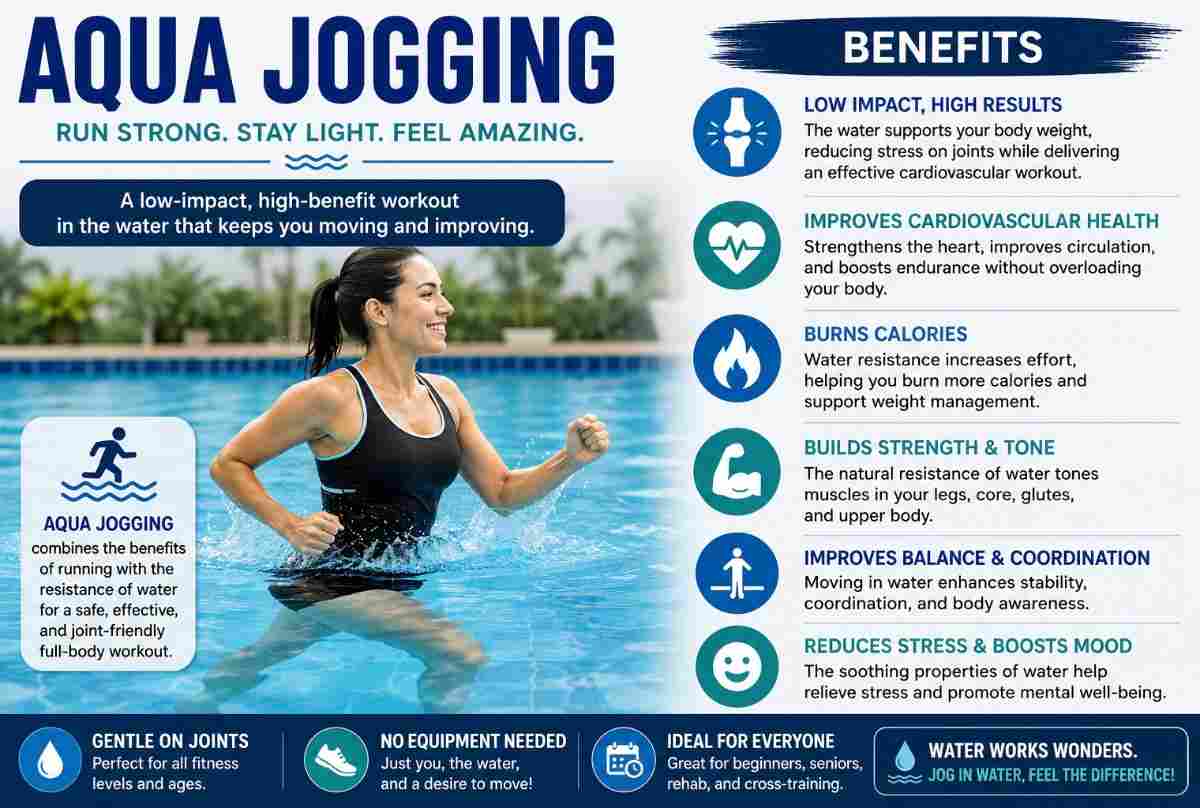
Aqua jogging is a low-impact form of exercise that combines the movement of running with the support and resistance of water. Instead of pounding the pavement, you jog while standing or suspended in a swimming pool. It can be performed in shallow water or, more commonly for deep-water running, with a flotation belt that keeps the body upright.
What makes aqua jogging interesting is that it can feel gentle on the joints while still challenging the muscles and cardiovascular system. Water creates resistance in every direction, so your legs, core, and upper body have to work continuously to move through it. At the same time, buoyancy reduces the amount of body weight your joints have to support.
For runners, aqua jogging can be a useful cross-training option. For beginners, older adults, and people who find traditional jogging uncomfortable, it can provide another way to stay active without the repeated impact of running on a hard surface. Research and clinical guidance on aquatic exercise also support its usefulness for improving physical function while reducing joint stress.
What Is Aqua Jogging?
Aqua jogging, also called water jogging or deep-water running, is an exercise in which you reproduce a running motion while immersed in water.
In deep-water aqua jogging, your feet generally do not touch the bottom of the pool. A flotation belt is often used to help you remain upright while you move your arms and legs in a running pattern.
In shallow-water aqua jogging, your feet remain on the pool floor, allowing you to perform a jogging motion against the resistance of the water.
Unlike swimming, aqua jogging does not require you to move through the water horizontally. Your body stays upright, making the movement feel more similar to running.
The water provides two important forces: buoyancy supports your body, while water resistance makes each movement more challenging. This combination is one reason aquatic exercise can provide a workout with less stress on weight-bearing joints.
How Does Aqua Jogging Work?
Aqua jogging works by mimicking the natural movement pattern of running.
You move your arms and legs in opposition, keep your torso upright, engage your abdominal muscles, and maintain a steady rhythm. However, because water is much denser than air, every movement meets resistance.
The deeper you are in the water, the more buoyancy supports your body. In deep-water running, a flotation belt can keep you suspended while your legs work without repeatedly striking the pool floor.
In shallow water, your feet remain in contact with the bottom, so the exercise has a slightly greater weight-bearing component.
Deep-water exercise can provide a completely non-impact environment, while shallow water can be useful for reproducing land-based movements with less impact.
15 Potential Benefits of Aqua Jogging
1. Provides a Low-Impact Workout
One of the biggest advantages of aqua jogging is its low-impact nature. Water’s buoyancy reduces the load placed on weight-bearing joints, making movement more comfortable for many people.
This can be especially useful for people who find running on pavement, concrete, or other hard surfaces uncomfortable.
2. Supports Cardiovascular Fitness
Aqua jogging can raise your heart rate and provide an aerobic workout. Maintaining a steady jogging rhythm requires continuous work from the heart, lungs, and large muscle groups.
You can increase the cardiovascular challenge by moving faster, increasing your range of motion, or adding intervals.
3. Strengthens the Lower Body
Water resistance makes your legs work throughout each movement. Your quadriceps, hamstrings, glutes, calves, and hip muscles can all contribute to the exercise.
Unlike running through air, you experience resistance when moving your legs in both directions.
4. Engages the Core
Deep-water aqua jogging requires you to maintain an upright position without relying on the ground for stability.
Your abdominal and back muscles help stabilize your torso as your arms and legs move. A stronger core can also help you maintain better posture during other forms of exercise.
5. Reduces Joint Stress
Because buoyancy supports part of your body weight, aquatic exercise can reduce stress on weight-bearing joints.
This is one reason water-based exercise is often included in exercise programs for people with joint problems. Studies reviewed by the Arthritis Foundation have found aquatic exercise can improve pain and function in people with osteoarthritis.
6. Can Be Useful for Runners
Aqua jogging is particularly popular among runners because it allows them to practice a running-like movement without the same repetitive impact associated with road running.
It can be used as cross-training or during periods when a runner wants to temporarily reduce impact while maintaining aerobic activity.
7. May Help Maintain Fitness During Recovery
Some athletes use deep-water running when they need to modify their usual training.
However, aqua jogging should not automatically be considered appropriate for every injury. The right type and intensity of exercise depend on the injury and stage of recovery, so people recovering from significant injuries should follow advice from a qualified healthcare or rehabilitation professional.
8. Improves Muscular Endurance
Water resistance makes the muscles work continuously. Repeated jogging movements can therefore challenge muscular endurance in the legs and core.
The resistance is different from lifting weights, but it can still make repeated movements progressively demanding.
9. Encourages Full-Body Movement
Aqua jogging is not limited to the legs. Your arms swing against water resistance while your core stabilizes the body.
Using coordinated arm and leg movements can turn the exercise into a more complete workout.
10. May Improve Mobility
Water provides support while allowing people to move through a range of motion that may feel uncomfortable on land.
Aquatic exercise has been associated with improvements in mobility and daily function among people with osteoarthritis.
11. Can Be Adapted to Different Fitness Levels
A beginner can start with slow jogging and short intervals, while a fitter person can increase speed or perform longer intervals.
This makes aqua jogging flexible enough to fit into different workout routines.
12. Offers Natural Resistance
You do not necessarily need weights or complicated equipment to make aqua jogging challenging.
The water itself creates resistance. Moving faster generally makes the exercise feel harder because you have to push against the water more forcefully.
13. Can Help Build Exercise Consistency
Some people avoid exercise because traditional workouts feel uncomfortable or intimidating.
A pool environment can offer a gentler alternative. Finding an activity that feels manageable may make it easier to exercise regularly.
14. Can Be Used for Interval Training
Aqua jogging does not have to be performed at one constant speed.
You can alternate between easy jogging and harder efforts. For example, you might jog easily for two minutes followed by one minute of faster running.
15. May Support Overall Well-Being
Regular aerobic activity can contribute to cardiovascular fitness, stamina, energy, and general physical well-being. Aquatic exercise provides one way to achieve that movement while reducing impact.
Aqua Jogging vs. Regular Jogging
The biggest difference is the environment.
Regular jogging requires you to repeatedly support your body weight against gravity and absorb impact as your feet contact the ground. Aqua jogging uses water’s buoyancy to reduce that load.
Aqua jogging also provides continuous resistance. On land, air offers very little resistance to ordinary running movements, while water pushes back against the body.
This means aqua jogging can feel surprisingly difficult even though it is easier on the joints.
For people with joint concerns, aquatic exercise may be particularly appealing because it can provide aerobic and strengthening activity while reducing stress on the joints.
How to Do Aqua Jogging Properly?
Step 1: Choose the Right Pool
For beginners, a pool with a designated exercise area is ideal. If you are doing deep-water jogging, choose an area deep enough to keep your feet off the bottom while allowing comfortable movement.
Step 2: Use a Flotation Belt for Deep Water
A flotation belt can help maintain an upright position during deep-water running. It should feel secure without being uncomfortably tight.
Step 3: Maintain an Upright Posture
Keep your head and chest upright rather than leaning excessively forward.
Your shoulders should remain relaxed while your arms swing naturally.
Step 4: Copy a Running Motion
Move one leg forward while the opposite arm moves forward, then alternate sides.
Think about driving your knees gently upward and pushing the water backward with your legs.
Step 5: Start Slowly
Begin with approximately 5 to 10 minutes of easy movement.
As your fitness improves, gradually increase the duration and intensity.
Step 6: Add Intervals
Once comfortable, try alternating easy and faster periods. This can make a pool workout more challenging without requiring complicated equipment.
Beginner Aqua Jogging Workout
Try this simple 30-minute routine:
| Workout Stage | Time |
|---|---|
| Easy water walking | 5 minutes |
| Gentle aqua jogging | 5 minutes |
| Moderate aqua jogging | 5 minutes |
| Easy jogging | 2 minutes |
| Faster jogging | 1 minute |
| Repeat intervals | 6 minutes |
| Easy cooldown | 6 minutes |
| Total | 30 minutes |
If 30 minutes feels too difficult, begin with 10 to 15 minutes and gradually build up.
The goal is consistency rather than trying to make your first session extremely intense.
Aqua Jogging Techniques
1. Maintain an Upright Posture
Keep your head and chest upright, shoulders relaxed, and torso stable. Avoid leaning too far forward or backward.
2. Use a Natural Running Motion
Move your arms and legs in opposition, similar to land-based running. Keep the movements controlled rather than simply kicking through the water.
3. Drive the Legs
Bring one knee forward while extending the opposite leg backward. Focus on creating resistance against the water with each movement.
4. Swing Your Arms
Keep your elbows comfortably bent and move your arms forward and backward. Avoid excessive side-to-side movements.
5. Engage Your Core
Gently tighten your abdominal muscles to help maintain balance and an upright position, particularly during deep-water jogging.
6. Control Your Breathing
Breathe steadily and avoid holding your breath. Your breathing should become faster as the intensity increases, but you should still be able to control it.
7. Start With Easy Jogging
Begin with several minutes of water walking or gentle jogging before increasing your speed.
8. Use Intervals
Once comfortable, alternate between easy and faster jogging periods to increase the cardiovascular challenge.
Aqua Jogging Equipment
You do not need much equipment to get started, but a few items can make aqua jogging more comfortable and safer.
- Flotation Belt: Particularly useful for deep-water jogging because it helps keep your body upright and suspended.
- Swimsuit: Choose comfortable swimwear that allows unrestricted movement.
- Water Shoes: Can provide additional grip and protection, especially during shallow-water workouts.
- Swimming Goggles: Optional, but useful if water splashes into your eyes or you are exercising in a busy pool.
- Water Bottle: Keep water nearby to maintain hydration.
- Pool Access: A suitable swimming pool with enough space for safe movement is essential.
- Optional Resistance Equipment: Some aquatic fitness programs use webbed gloves or other resistance equipment to increase the challenge.
Risks of Aqua Jogging
Aqua jogging is generally low-impact, but it still carries some risks, especially when performed with poor technique or without proper pool safety.
- Slips and Falls: Wet pool surfaces can be slippery, so enter and exit the pool carefully.
- Muscle Strain: Excessive intensity or sudden increases in workout duration may strain the muscles.
- Overexertion: Water can make exercise feel easier than it actually is, so it is possible to work too hard without noticing.
- Shoulder or Back Discomfort: Poor posture or exaggerated arm movements may place unnecessary stress on the upper body.
- Dehydration: You can still lose fluids during pool exercise even when you do not notice sweating.
- Water-Related Injuries: Deep-water exercise can be dangerous for people who are not comfortable in water or cannot swim safely.
- Temperature-Related Problems: Very cold or very warm pool water may cause discomfort or affect exercise tolerance.
- Existing Injury Aggravation: Aqua jogging may worsen certain injuries if the movement or intensity is inappropriate for the condition.
How Many Calories Does Aqua Jogging Burn?
Calories burned during aqua jogging vary based on body weight, water depth, pace, workout duration, and fitness level. The chart below provides approximate calorie ranges for a 30-minute aqua jogging session.
| Body Weight | 30 Minutes | 60 Minutes |
|---|---|---|
| 120 lb (54 kg) | 180–240 calories | 360–480 calories |
| 150 lb (68 kg) | 225–300 calories | 450–600 calories |
| 180 lb (82 kg) | 270–360 calories | 540–720 calories |
| 200 lb (91 kg) | 300–400 calories | 600–800 calories |
| 250 lb (113 kg) | 375–500 calories | 750–1,000 calories |
Important: These figures are general estimates. A faster, more vigorous aqua-jogging session will usually burn more calories than a gentle session. Fitness trackers may also have difficulty accurately estimating calorie expenditure during water exercise.
Is Aqua Jogging Good for Weight Loss?
Aqua jogging can contribute to weight management because it increases physical activity and energy expenditure.
However, no exercise independently guarantees weight loss. Changes in body weight are influenced by total calorie intake, physical activity, sleep, genetics, medications, and other factors.
For weight management, aqua jogging works best as part of a sustainable routine that includes regular exercise and a balanced eating pattern.
How Often Should You Do Aqua Jogging?
For general fitness, you can gradually work toward regular aerobic activity throughout the week.
A commonly cited adult target is at least 150 minutes of moderate-intensity aerobic activity per week, although individual needs and abilities vary.
You do not need to begin at that level.
A beginner might start with two or three 15- to 20-minute sessions each week and gradually increase duration.
If you are also running, strength training, or participating in other sports, allow enough recovery time between harder workouts.
Common Aqua Jogging Mistakes
1. Going Too Fast Too Soon
Water can make you feel supported, but it does not mean you cannot overdo the workout. Start gradually.
2. Leaning Too Far Forward
Aqua jogging should resemble an upright running movement rather than swimming vertically with your body tilted forward.
3. Ignoring Technique
Moving quickly with poor posture can reduce the quality of the workout. Focus on controlled arm and leg movements.
4. Skipping the Warm-Up
Start with easy walking and gradually increase the pace. The Arthritis Foundation recommends warming up before pool exercise and beginning slowly.
5. Forgetting Hydration
You can still lose fluid during a pool workout even if you do not notice much sweating. Drink water before and after exercise and consider bringing water to the pool.
Aqua Jogging Safety Tips
Aqua jogging is a low-impact workout, but good pool safety and proper technique are still important. Follow these tips to make your sessions safer and more comfortable.
- Warm Up First: Start with 5–10 minutes of easy water walking or gentle jogging before increasing your pace.
- Choose the Right Water Depth: Use shallow water where you can stand securely, or use a flotation belt for deep-water jogging.
- Use a Flotation Belt Correctly: Make sure the belt fits comfortably and keeps your body upright without restricting your breathing.
- Check the Pool Area: Watch for slippery surfaces, crowded lanes, obstacles, and other swimmers before starting.
- Maintain Good Posture: Keep your torso upright, shoulders relaxed, and head facing forward while jogging.
- Start Slowly: Beginners should begin with shorter, easier sessions and gradually increase duration and intensity.
- Stay Hydrated: Drink water before and after your workout, even if you do not feel sweaty in the pool.
- Avoid Overexertion: Water can make exercise feel comfortable, but you can still become fatigued. Reduce your intensity if you feel unusually tired or breathless.
- Listen to Your Body: Stop if you experience significant pain, dizziness, weakness, chest discomfort, or unusual shortness of breath.
- Do Not Exercise Alone in Deep Water: If you are not a confident swimmer, choose supervised aquatic exercise or stay in water where you can stand safely.
- Wear Appropriate Footwear: Water shoes can provide additional traction during shallow-water aqua jogging and when walking around the pool.
- Follow Pool Rules: Observe the facility’s rules regarding lane use, diving, equipment, and safe entry and exit.
- Cool Down Gradually: Finish with several minutes of slow walking or gentle movement instead of stopping suddenly.
- Consider Your Health Conditions: If you have a medical condition, recent injury, or have had surgery, ask a healthcare professional whether aqua jogging is appropriate for you.
- Never Ignore Warning Signs: Stop exercising and seek appropriate medical attention if you develop serious or unusual symptoms during your workout.
Who Can Try Aqua Jogging?
Aqua jogging may be suitable for:
- Beginners looking for a low-impact aerobic workout
- Runners interested in cross-training
- People who prefer exercising in water
- Adults looking for an alternative to traditional jogging
- People who want to reduce repetitive impact during selected workouts
- Individuals participating in appropriate aquatic rehabilitation programs
People with significant medical conditions, recent surgery, serious injuries, balance problems, or specific rehabilitation needs should ask their healthcare professional or physical therapist whether aqua jogging is appropriate.
Who Should Avoid Aqua Jogging?
Aqua jogging is not appropriate for everyone. Consider avoiding it or getting medical clearance first if you:
- Have a Serious Heart or Lung Condition: Speak with your healthcare professional before starting vigorous aquatic exercise.
- Have a Recent Injury or Surgery: Your rehabilitation professional can determine when water exercise is appropriate.
- Have an Open Wound or Skin Infection: Avoid swimming pools until the condition has healed and you have been medically cleared.
- Have Poor Water Confidence: Deep-water jogging should not be attempted if you cannot remain safely in deep water.
- Experience Severe Dizziness or Balance Problems: Pool exercise may increase the risk of falling or other accidents.
- Have Severe Joint or Muscle Pain: Do not assume that low-impact exercise is automatically suitable for an active injury.
- Are Pregnant With Exercise Restrictions: Follow your obstetric or healthcare professional’s recommendations regarding aquatic exercise.
- Have a Medical Condition Affected by Exercise: Get individualized guidance before beginning a new workout program.
Important: Low-impact does not mean risk-free. If you experience chest pain, fainting, severe shortness of breath, unusual weakness, or significant pain during aqua jogging, stop exercising and seek appropriate medical attention.
Is Aqua Jogging Safe?
For many healthy adults, aqua jogging can be a safe form of exercise when performed in an appropriate pool and at a suitable intensity.
Pool safety is still important. Never exercise alone if you are not a confident swimmer, and use appropriate flotation equipment for deep-water exercise.
Stop exercising if you experience chest pain, severe shortness of breath, dizziness, fainting, unusual weakness, or other concerning symptoms and seek appropriate medical attention.
People recovering from surgery or injury should receive individualized guidance before starting an aquatic workout.
Tips to Make Aqua Jogging More Effective
- Keep Your Posture Tall: Maintain an upright torso and relaxed shoulders throughout the movement.
- Use Your Arms: Swing your arms naturally instead of allowing them to remain still.
- Increase Resistance Gradually: Move faster or increase your range of motion as your fitness improves.
- Try Intervals: Alternate comfortable jogging with short periods of faster movement.
- Track Time Rather Than Calories: Workout duration and consistency are often more useful than relying on uncertain calorie estimates.
- Warm Up and Cool Down: Spend several minutes walking slowly before and after jogging.
- Listen to Your Body: Water can make exercise feel easier on the joints, but fatigue can still accumulate. Avoid doing more simply because you feel comfortable in the pool.
Final Thoughts
Aqua jogging is more than simply running in a swimming pool. It combines the familiar movement pattern of jogging with the unique properties of water, including buoyancy and resistance.
For runners, it can be a useful cross-training method. For beginners and people who prefer low-impact exercise, it offers an accessible way to work the cardiovascular system and muscles without the same ground impact as conventional jogging.
The key is to start slowly, focus on technique, and gradually increase your workout duration and intensity. When used consistently and appropriately, aqua jogging can be a practical addition to a well-rounded fitness routine.
FAQ’s
Is aqua jogging better than walking?
Aqua jogging is generally more challenging than ordinary walking because water provides resistance in every direction. However, the better option depends on your fitness level and goals.
Is aqua jogging good for your knees?
Aqua jogging can be gentler on the knees than land-based jogging because water buoyancy reduces weight-bearing and impact. People with knee problems should still follow individual medical advice.
Can you aqua jog in shallow water?
Yes. Aqua jogging can be performed in shallow water with your feet touching the pool floor or in deep water using a flotation belt.
Do you need a flotation belt for aqua jogging?
A flotation belt is commonly used for deep-water jogging because it helps keep your body upright and suspended.
How long should you aqua jog?
Beginners can start with 10 to 20 minutes and gradually increase their workout time as their fitness improves. More experienced exercisers may train for 30 minutes or longer.
Is aqua jogging good for runners?
Yes. Aqua jogging can be useful cross-training for runners because it reproduces a running-like movement while reducing the impact associated with running on land.
Can aqua jogging build muscle?
Aqua jogging can improve muscular endurance because your muscles work against water resistance. It is not a replacement for progressive strength training when muscle strength or muscle size is the primary goal.
Is aqua jogging considered cardio?
Yes. Aqua jogging can provide moderate- to vigorous-intensity aerobic exercise depending on how fast and intensely you move.
Is aqua jogging good for beginners?
Yes. Beginners can adjust their speed, duration, and range of motion, making it relatively easy to start at a comfortable intensity.
Can you aqua jog every day?
Some people may tolerate light aqua jogging frequently, but recovery needs vary. If sessions are intense, including rest or easier days can help prevent excessive fatigue.
Does aqua jogging help with belly fat?
Aqua jogging can contribute to overall fat loss by increasing physical activity, but it cannot specifically target belly fat. Fat loss occurs throughout the body based on overall energy balance and individual factors.
Is aqua jogging better than running?
Neither is universally better. Running provides weight-bearing exercise and greater impact, while aqua jogging offers buoyancy and reduced impact with water resistance. The best choice depends on your goals, preferences, and physical needs.
Does aqua jogging count as steps?
Usually, pool-based jogging is not counted as conventional walking or running steps because many fitness trackers cannot accurately detect steps while exercising in water.
Can aqua jogging improve stamina?
Yes. Regular aqua jogging can challenge the cardiovascular system and may improve aerobic endurance when performed consistently.
What muscles does aqua jogging work?
Aqua jogging primarily works the legs, including the quadriceps, hamstrings, glutes, hip muscles, and calves, while the core and arms also contribute to maintaining posture and movement.
Can you aqua jog without swimming?
Yes. Deep-water aqua jogging requires appropriate flotation equipment and basic water safety skills. If you are not comfortable in deep water, shallow-water exercise may be a better option.
Sources / References
Disclaimer:
This article is for general educational purposes only and is not a substitute for professional medical advice, diagnosis, or treatment. If you have an injury, medical condition, or concerns about exercising in water, consult a qualified healthcare professional before starting.
Also Read: