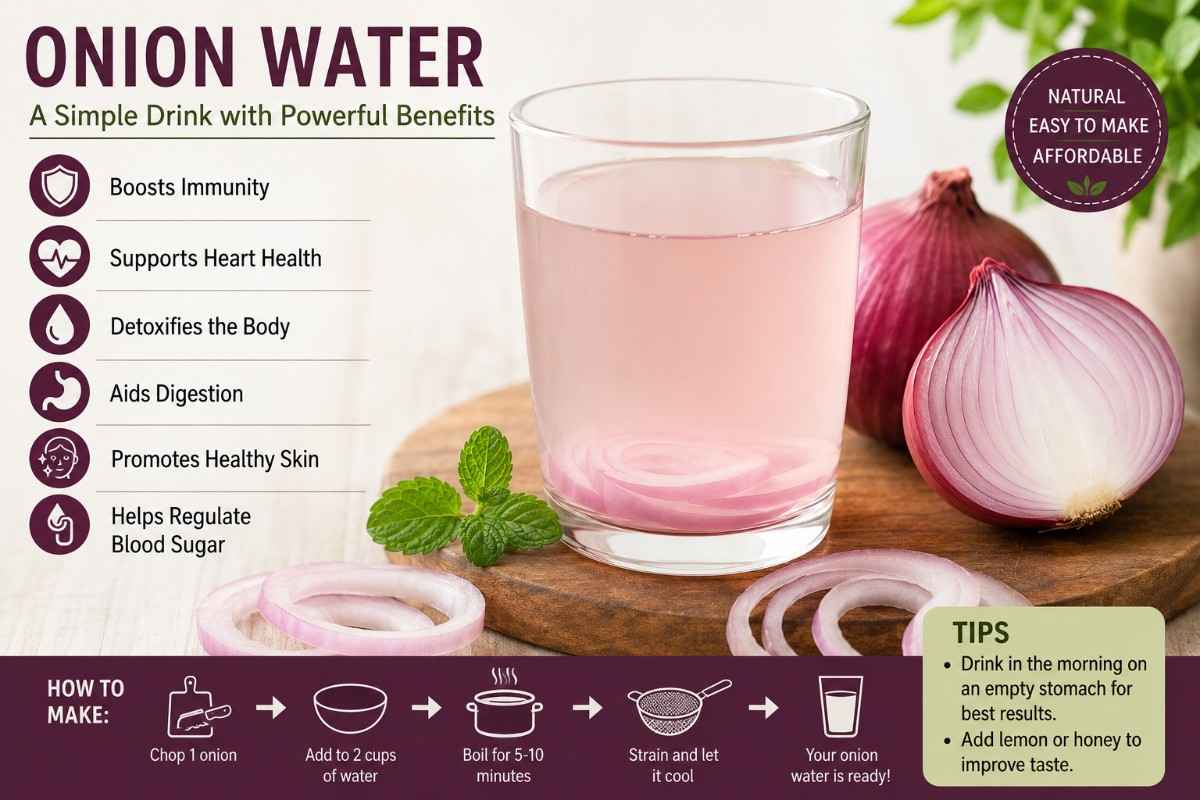
Onion water has become a popular home remedy for people looking for a simple way to add onion compounds to their daily routine. It is usually made by soaking or gently boiling chopped onion in water and then drinking the strained liquid.
Onions are more than just a flavorful kitchen ingredient. They contain flavonoids such as quercetin, sulfur-containing compounds, and other plant compounds that have been studied for their antioxidant, anti-inflammatory, cardiovascular, and metabolic effects. However, it is important to remember that drinking onion water is not the same as eating a whole onion, and the amount of beneficial compounds that actually move into the water can vary depending on the onion, preparation method, temperature, and soaking time.
This guide explains what onion water is, its potential benefits, possible side effects, how to prepare it, how much you may drink, and who should be cautious.
What Is Onion Water?
Onion water is simply water that has been infused with fresh onion. It can be prepared by soaking chopped onion in water for several hours or by simmering onion pieces in water and then straining the liquid.
Red, white, yellow, and other common onion varieties can be used. Red onions are particularly rich in anthocyanins, while many onion varieties contain quercetin and sulfur-containing compounds. (PubMed Central (PMC))
The resulting drink has a mild-to-strong onion aroma and flavor depending on how concentrated it is. Some people drink it plain, while others add ingredients such as lemon, ginger, or a small amount of honey.
One thing to keep in mind is that onion water is not a miracle drink. Research supporting the health properties of onions does not automatically prove that drinking onion-infused water will prevent or cure a disease.
20 Proven Health Benefits of Onion Water
1. Provides Antioxidant Compounds: Onion contains flavonoids such as quercetin that have antioxidant activity and may help protect cells from oxidative stress.
2. May Support a Healthy Inflammatory Response: Compounds found in onions have demonstrated anti-inflammatory activity in laboratory and experimental research, although this should not be interpreted as a treatment for inflammatory disease.
3. May Support Heart Health: Onion-derived flavonoids and sulfur compounds have been investigated for potential cardiovascular-protective effects, making onions a useful part of a heart-healthy eating pattern.
4. May Support Healthy Blood Vessel Function: Research into onion compounds suggests possible effects on vascular and platelet activity, although the evidence does not establish onion water as a cardiovascular treatment.
5. May Help Protect Cells From Oxidative Stress: The antioxidant compounds naturally present in onions can help neutralize or regulate reactive molecules involved in oxidative stress.
6. May Support Metabolic Health: Onion and its bioactive compounds have been investigated for potential effects on glucose metabolism and other metabolic processes, although human evidence for onion water itself remains limited.
7. May Support Immune Function: Onions contain several phytochemicals that have been studied for immunomodulatory effects, although drinking onion water should not be considered an immune-boosting treatment.
8. May Support Digestive Health: Onions contain fructans, which can act as fermentable carbohydrates and may influence gut bacteria, although these same compounds can cause digestive symptoms in sensitive individuals.
9. May Provide Prebiotic Compounds: Onion contains fructans that can be fermented by gut microorganisms, potentially supporting certain beneficial gut bacteria in people who tolerate them.
10. May Support Healthy Cholesterol Levels: Research into onion and its compounds suggests possible beneficial effects on lipid metabolism, but more high-quality human research is needed before making specific cholesterol claims.
11. May Support Healthy Blood Pressure: Onion flavonoids have been investigated in relation to cardiovascular and blood-pressure pathways, but onion water should not replace prescribed blood-pressure treatment.
12. May Have Antimicrobial Properties: Certain sulfur-containing compounds and other onion constituents have demonstrated antimicrobial activity in experimental studies.
13. May Support Respiratory Health: Onion compounds have been studied for possible respiratory-protective effects, but there is insufficient evidence to claim that onion water treats coughs, asthma, infections, or other respiratory illnesses.
14. May Support Liver Health: Experimental research has investigated onion compounds for potential protective effects on the liver, but these findings should not be interpreted as proof that onion water detoxifies the liver.
15. May Support Kidney Health: Some experimental studies have investigated protective effects of onion compounds on kidney-related pathways, but human clinical evidence for onion water is lacking.
16. May Contribute to a Healthy Diet: Unsweetened onion water is generally low in calories and can be an alternative to sugary beverages, although eating the onion provides considerably more fiber and nutrients than drinking strained water.
17. May Help Increase Fluid Intake: Because onion water is primarily water, drinking it can contribute to daily hydration when it is consumed in place of less healthy beverages.
18. May Provide Quercetin: Quercetin is one of the best-known flavonoids in onions and has been widely studied for antioxidant and other biological activities.
19. May Provide Sulfur-Containing Compounds: Onions contain sulfur compounds responsible for much of their characteristic aroma and flavor, and these compounds have been studied for several biological effects.
20. May Complement an Overall Healthy Eating Pattern: The strongest practical benefit is that onion water can be part of a diet that includes vegetables, fruits, whole grains, legumes, adequate protein, and other nutrient-rich foods rather than being used as a stand-alone remedy.
10 Side Effects of Onion Water
Onion water is not suitable for everyone, particularly when it is very concentrated.
1. Bloating: Onion contains fructans, which can ferment in the intestine and cause bloating in people who are sensitive to FODMAP foods.
2. Gas: Fermentation of poorly absorbed fructans can increase intestinal gas and discomfort in susceptible people.
3. Stomach Cramps: Concentrated onion preparations may cause abdominal discomfort or cramping in people with sensitive digestive systems.
4. Diarrhea: Large amounts of onion or onion water may trigger loose stools in some people, particularly those with FODMAP sensitivity.
5. Heartburn: Onion can aggravate reflux symptoms in some individuals, especially when consumed in concentrated amounts or on an empty stomach.
6. Nausea: The strong smell and flavor of onion water may cause nausea in some people.
7. Bad Breath: Onion contains sulfur-containing compounds that can contribute to a strong mouth odor.
8. Allergic Reactions: Although uncommon, people with an onion allergy may develop symptoms after exposure and should avoid onion preparations.
9. Digestive Discomfort in IBS: People with irritable bowel syndrome may be particularly sensitive to onion fructans and can experience bloating, cramps, or diarrhea.
10. Excessive Consumption May Increase Symptoms: Drinking very concentrated onion water repeatedly is more likely to cause digestive problems than using a small amount as an occasional beverage.
How to Make Onion Water?
Making onion water at home is simple. Basic Onion Water:
Ingredients:
- 1 small or medium onion
- 2 cups of clean water
Method:
- Wash and peel the onion.
- Cut it into several pieces.
- Add the onion to approximately 2 cups of water.
- Simmer gently for about 5–10 minutes if you prefer cooked onion water.
- Allow it to cool to a comfortable temperature.
- Strain the liquid.
- Drink it without added sugar if your goal is a low-calorie beverage.
You can also make a cold infusion by placing chopped onion in water and refrigerating it for several hours before straining.
Because some onion compounds can be affected by cooking and some compounds can leach into cooking water, preparation method matters. Research has found that boiling can result in losses of some quercetin compounds, while some compounds move into the cooking water.
Tips for Consuming Onion Water
- Start with a small serving rather than drinking a large amount immediately.
- Use fresh, clean onions.
- Avoid adding large amounts of sugar or sweeteners.
- If you have a sensitive stomach, drink it with or after food.
- Stop drinking it if you develop significant digestive discomfort.
- Do not use onion water as a replacement for prescribed medication.
- Remember that eating whole onions provides fiber that is largely lost when the liquid is strained.
- If you dislike the flavor, you do not need to force yourself to drink it; onions can simply be included in normal meals.
Other Uses of Onion Water
Onion-infused water has traditionally been used in various home-remedy practices, although many claimed uses do not have strong clinical evidence.
Some people use it as:
- A base for soups and broths.
- A cooking liquid for grains or vegetables.
- A flavoring liquid for savory dishes.
- A traditional home beverage.
- An ingredient in homemade culinary preparations.
It is worth distinguishing traditional use from medically established treatment. Onion water should not be promoted as a cure for diabetes, infections, hair loss, high cholesterol, hypertension, or other medical conditions without appropriate clinical evidence.
How Much Onion Water Can You Drink in a Day?
There is no scientifically established therapeutic dosage for onion water.
For general dietary use, a practical approach is to start with around ½ to 1 cup per day and see how your body responds. There is usually little reason to drink several cups of concentrated onion water simply because more is assumed to be better.
If you experience bloating, gas, diarrhea, heartburn, or abdominal discomfort, reduce the amount or stop drinking it.
People with IBS or known FODMAP sensitivity may need to avoid onion preparations because onions are high in fructans.
Best Time to Drink Onion Water
There is no proven “best time” to drink onion water.
Some people prefer it in the morning because it is easy to incorporate into a routine. However, drinking it first thing on an empty stomach is not necessarily better than drinking it later.
If onion water causes heartburn or stomach discomfort, try drinking a smaller amount with food rather than on an empty stomach.
The most important factor is overall dietary quality rather than the exact time you consume the beverage.
Who Should Drink Onion Water?
- People Looking for a Low-Calorie Drink: Unsweetened onion water can provide a flavorful alternative to sugar-sweetened beverages.
- People Who Tolerate Onions Well: Individuals who normally eat onions without digestive problems may tolerate a modest serving of onion water.
- People Increasing Vegetable Variety: Onion compounds can contribute to an overall plant-rich eating pattern when onions are also included in meals.
- People Interested in Traditional Food Practices: Onion water can be used as a traditional culinary beverage, provided expectations remain realistic.
- People Replacing Sugary Drinks: Unsweetened onion water may be useful as an occasional alternative to calorie-containing drinks.
Who Should Avoid Onion Water?
- People With Onion Allergy: Anyone with a known onion allergy should avoid onion water and other onion-containing products.
- People With Significant FODMAP Sensitivity: Onion is high in fructans and can trigger symptoms in people who are sensitive to FODMAP foods.
- People With IBS Who React to Onion: Those who consistently experience bloating, abdominal pain, or diarrhea after eating onion may also react to onion water.
- People With Frequent Acid Reflux: If onion consistently worsens your reflux symptoms, onion water may not be a good choice.
- People With Severe Digestive Symptoms: Anyone experiencing unexplained or persistent digestive symptoms should discuss them with a healthcare professional instead of relying on home remedies.
- People Taking Certain Medications: Individuals taking medicines that may be affected by concentrated flavonoid or antiplatelet effects should seek professional advice before regularly consuming concentrated onion preparations.
How to Store Onion Water?
- Refrigerate Promptly: Place freshly prepared onion water in a clean, covered container and refrigerate it rather than leaving it at room temperature for extended periods.
- Use a Clean Container: A clean glass jar or food-safe container can help reduce contamination.
- Avoid Long Storage: Homemade onion water does not contain commercial preservatives, so it is best prepared in small batches.
- Check Before Drinking: Discard it if it develops an unusual appearance, mold, excessive fermentation, or an unexpectedly unpleasant odor.
- Keep It Covered: Covering the container helps prevent the liquid from absorbing odors and contaminants from the refrigerator.
For the best quality, making a fresh batch regularly is preferable to keeping onion water for many days.
Precautions and Interactions
Onion is a food, but concentrated onion preparations may not behave exactly like ordinary dietary portions.
One area worth discussing with a healthcare professional is blood-thinning medication. Onion extracts have demonstrated antiplatelet or antithrombotic activity in experimental research, although effects vary by onion variety and preparation.
Quercetin has also been investigated for possible interactions with warfarin, particularly at high supplemental doses. This research does not mean that ordinary dietary onion automatically causes a dangerous interaction, but it is a reason to avoid treating concentrated onion preparations as harmless supplements when taking anticoagulants.
People taking anticoagulants, antiplatelet medicines, diabetes medications, or several prescription medicines should speak with their doctor or pharmacist before making concentrated onion water a daily habit.
Pregnant or breastfeeding individuals should also avoid using onion water as a medicinal remedy without discussing concentrated or unusual dietary practices with their healthcare professional.
Final Thoughts
Onion water is an easy homemade beverage made by infusing onion in water. Its potential appeal comes from the naturally occurring flavonoids, sulfur-containing compounds, and other phytochemicals found in onions.
Research suggests that onions themselves may have antioxidant, anti-inflammatory, cardiovascular, metabolic, and other beneficial properties. However, there is not enough human clinical evidence to claim that onion water itself can treat or prevent specific diseases.
For most people who tolerate onions, a modest amount of unsweetened onion water can be an occasional addition to a balanced diet. Still, eating the onion itself is generally a more nutritionally complete choice because it provides fiber and other nutrients that may not transfer fully into the water.
The best approach is to view onion water as a simple food-based beverage—not as a detox drink, weight-loss cure, or replacement for medical treatment.
FAQ’s
What does Onion Water taste like?
Water has a mild to strong savory, slightly sweet, and pungent taste depending on how much onion is used and how long it is infused or boiled.
How long does it take for Onion Water to work?
There is no scientifically established time for water to “work.” Its effects depend on the individual, and it should not be expected to produce immediate health or medicinal results.
What does Onion Water smell like?
Water usually has a noticeable onion-like, sulfurous smell, which can become stronger when the onion is boiled.
Is Onion Water safe for pregnant women?
Normal amounts of onion used as food are different from consuming concentrated water as a remedy. Pregnant women should consult their healthcare professional before drinking it regularly for medicinal purposes.
Is Onion Water safe for children?
Small amounts may be tolerated by children who normally eat onions, but concentrated water has not been well studied in children. Parents should consult a pediatrician before using it as a home remedy.
How to use onion water for hair growth?
There is no established method or dosage for drinking water to promote hair growth. If using onion-based preparations on the scalp, patch-test first and stop if irritation occurs.
How long will onion water last?
Homemade water should be refrigerated promptly in a clean, covered container and preferably consumed within a short period. Discard it if it develops an unusual smell, appearance, mold, or other signs of spoilage.
What to do with leftover onion water?
Leftover water can be used as a savory cooking liquid for soups, sauces, rice, grains, or vegetables instead of drinking it. Keep it refrigerated and discard it if it has been stored too long or shows signs of spoilage.
Is boiled onion water safe to drink?
Boiled water is generally safe for people who tolerate onions, provided it is prepared hygienically and consumed in moderation. It may cause gas, bloating, heartburn, or stomach discomfort in sensitive individuals.
Can onion water be used to treat a cough?
Water is sometimes used as a traditional home remedy for coughs, but there is not enough clinical evidence to establish it as an effective treatment. Persistent, severe, or worsening coughs should be evaluated by a healthcare professional.
Can onion water treat infections?
No. Onion contains compounds with antimicrobial activity in laboratory research, but water has not been proven to treat infections in humans. Bacterial or other infections requiring treatment should be managed with appropriate medical care rather than water alone.
What is onion water good for?
Water may provide some compounds found in onions, including quercetin and sulfur-containing compounds, which have antioxidant and other potential health properties.
Can I drink onion water every day?
For most people who tolerate onions, a small amount may be consumed regularly, but there is no established daily therapeutic dose for water.
Is onion water good for digestion?
It may support digestion in people who tolerate onions, but onion contains fructans that can cause gas, bloating, and discomfort in people with IBS or FODMAP sensitivity.
Does onion water help with weight loss?
Water itself has not been proven to cause weight loss. Unsweetened water is simply a low-calorie beverage that can replace sugary drinks.
Is onion water good for blood sugar?
Onions contain compounds that have been studied for their potential effects on glucose metabolism, but water should not be used to treat or control diabetes.
Can onion water improve skin health?
The antioxidants in onions may support overall cellular health, but there is not enough evidence to show that drinking water directly improves skin.
Is onion water good for hair growth?
There is limited evidence for onion-related preparations and hair health, but drinking water has not been clinically proven to increase hair growth.
Can I drink onion water on an empty stomach?
Some people drink it in the morning, but there is no proven advantage to consuming it on an empty stomach. If it causes acidity or discomfort, drink it with food instead.
Does onion water detox the body?
There is no strong scientific evidence that onion water “detoxes” the body. The liver and kidneys naturally perform the body’s major detoxification functions.
Does onion water help with cough and cold?
Onions contain several bioactive compounds, but water has not been established as a treatment for coughs, colds, or respiratory infections.
Can I add lemon to onion water?
Yes. A small amount of lemon can improve the flavor, although it does not turn water into a medically proven detox drink.
Can I add honey to onion water?
You can add a small amount of honey for taste, but doing so increases the drink’s sugar and calorie content.
Is boiled onion water better than soaked onion water?
Neither preparation has been proven clinically superior. Boiling can transfer some onion compounds into the water, while heat may also reduce or alter certain compounds.
Sources / References:
- Recent Advances in Bioactive Compounds, Health Functions, and Safety Concerns of Onion – PMC
- Onions: USDA SNAP-Ed Nutrition Information
- Monash FODMAP – FODMAP FAQs
- Onions—A Global Benefit to Health – PubMed
- Onion and Antithrombotic Activity – PubMed
About the Author:
Written by: Kirti Solanki (Health Content Researcher)
Kirti Solanki writes health and nutrition content with a focus on making scientific information easier to understand for everyday readers. Content is researched using reputable scientific and nutrition references.
Disclaimer:
This article is for general educational purposes only and does not replace professional medical advice, diagnosis, or treatment. If you have a medical condition or take prescription medication, consult a qualified healthcare professional before using concentrated onion preparations regularly.
Also Read: