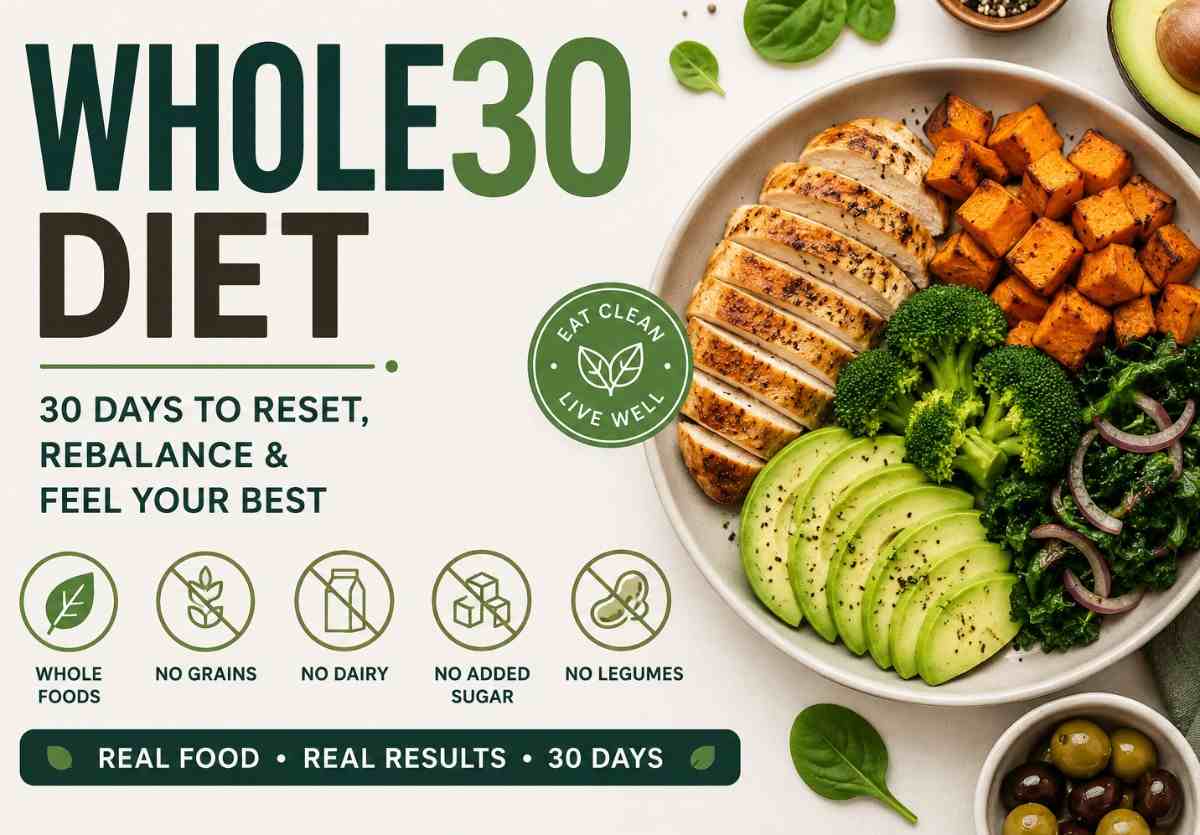
The Whole30 Diet is a short-term elimination-style eating program designed to help people take a closer look at their eating habits, cravings, and possible food-related symptoms. Unlike many weight-loss diets, Whole30 does not require calorie counting or portion tracking during its elimination phase. Instead, it focuses on eating minimally processed foods while temporarily removing several major food groups.
The program lasts 30 days, followed by a structured reintroduction phase. During reintroduction, foods are gradually added back to determine which foods a person tolerates well and which may be associated with unwanted symptoms.
Whole30 can encourage people to eat more vegetables, fruits, meat, seafood, eggs, nuts, seeds, and other minimally processed foods. However, it is also highly restrictive because it eliminates grains, legumes, dairy, added sugars, and alcohol during the initial phase.
What Is the Whole30 Diet?
The Whole30 Diet is a 30-day elimination program that removes specific food groups and ingredients from the diet before systematically reintroducing them.
The official Whole30 program has two major phases:
- 30-day elimination phase: Certain foods and beverages are completely removed.
- Reintroduction phase: Eliminated food groups are gradually brought back one at a time while you observe how you feel.
The goal is not simply to lose weight. The program is designed around identifying possible food-related issues, changing eating habits, reducing reliance on highly processed foods, and developing a more intentional relationship with food.
According to the official Whole30 rules, participants do not count calories or restrict portions during the elimination phase.
However, it is worth separating the program’s intended goals from what has been scientifically established. Whole30 itself has not been studied as extensively as established dietary patterns such as the Mediterranean diet.
How Does the Whole30 Diet Work?
Whole30 works by temporarily removing several categories of foods that the program considers potential dietary triggers.
Instead of eliminating foods forever, the idea is to create a short period of dietary consistency. After 30 days, foods are introduced again in a planned sequence.
This is similar to the broader concept of an elimination diet. Elimination diets can sometimes be useful when investigating food-related symptoms, particularly when they are followed with careful reintroduction and appropriate professional guidance.
The important part is the reintroduction stage. Simply avoiding foods for 30 days does not tell you whether a particular food is actually causing a problem.
Whole30 Diet Rules
The Original Whole30 has several strict rules during the first 30 days.
1. No Added Sugar
Whole30 eliminates added sugars, including common sweeteners and many artificial or alternative sweeteners.
This means avoiding ingredients such as:
- Cane sugar
- Brown sugar
- Honey
- Maple syrup
- Agave
- Coconut sugar
- Corn syrup
- Artificial sweeteners
- Stevia
- Sucralose
- Xylitol
- Erythritol
Whole30’s current rules make an important distinction between naturally occurring sugar in whole fruit and added sweeteners.
2. No Alcohol
Alcohol is excluded for the entire 30-day elimination period.
This includes:
- Beer
- Wine
- Champagne
- Liquor
- Cocktails
- Hard cider
- Alcohol used for cooking
3. No Grains
The Original Whole30 eliminates grains, including both gluten-containing and gluten-free grains.
Examples include:
- Wheat
- Rice
- Oats
- Corn
- Barley
- Rye
- Millet
- Sorghum
- Bulgur
- Quinoa
- Amaranth
- Buckwheat
This is one of the most restrictive aspects of the program because many otherwise nutritious staple foods are temporarily removed.
4. No Legumes
Traditional Whole30 also eliminates legumes.
These include:
- Beans
- Lentils
- Chickpeas
- Peanuts
- Peanut butter
- Soybeans
- Tofu
- Tempeh
- Edamame
- Soy milk
- Miso
The current official rules have specific exceptions, including green beans and most peas.
5. No Dairy
The Original Whole30 eliminates dairy from cow, goat, and sheep milk.
Avoid:
- Milk
- Cheese
- Yogurt
- Cream
- Sour cream
- Cottage cheese
- Kefir
- Ice cream
Ghee and clarified butter are among the listed exceptions.
6. Avoid Baked Goods and Treats
Whole30 also has what it calls the “Pancake Rule.”
During elimination, participants avoid foods such as:
- Bread
- Tortillas
- Pancakes
- Waffles
- Muffins
- Cookies
- Brownies
- Cakes
- Alternative-flour pasta
- Cereal
- Chips
- French fries
The rule applies even when these foods are prepared with otherwise compatible Whole30 ingredients.
7. No Weighing During the 30 Days
Whole30 also asks participants not to weigh themselves or take body measurements during the elimination phase.
The reasoning is to shift attention away from the scale and toward eating habits, energy, digestion, cravings, and other non-scale observations.
What Can You Eat on the Whole30 Diet?
Although the list of restricted foods is long, there are still many foods available.
Whole30-Friendly Foods:
- Vegetables: Spinach, broccoli, cauliflower, carrots, cucumber, tomatoes, bell peppers, zucchini, mushrooms, cabbage, asparagus, sweet potatoes, and leafy greens.
- Fruits: Apples, bananas, oranges, berries, grapes, peaches, pears, mangoes, watermelon, kiwi, and other whole fruits.
- Meat: Beef, chicken, turkey, pork, and other compatible meats.
- Seafood: Salmon, tuna, sardines, shrimp, cod, and other seafood.
- Eggs: Eggs are permitted in the Original Whole30.
- Nuts and seeds: Almonds, walnuts, cashews, macadamia nuts, chia seeds, flaxseeds, pumpkin seeds, and sunflower seeds.
- Healthy fats: Avocado, olives, compatible cooking oils, nuts, seeds, and ghee.
- Herbs and spices: Fresh and dried herbs and many compatible spices can be used to make meals more flavorful.
The official Whole30 food guide emphasizes checking ingredient labels because a product that appears healthy may contain an excluded ingredient such as added sugar or a grain derivative.
What Foods are Not Allowed on Whole30?
Whole30 Foods to Avoid:
| Food Group | Examples |
|---|---|
| Added sugar | Sugar, honey, maple syrup, agave, artificial sweeteners |
| Alcohol | Beer, wine, liquor, cocktails |
| Grains | Wheat, rice, oats, corn, quinoa, barley |
| Legumes | Beans, lentils, chickpeas, soy, peanuts |
| Dairy | Milk, cheese, yogurt, cream |
| Baked goods | Bread, cookies, muffins, pancakes |
| Processed treats | Chips, fries, cereal, alternative-flour desserts |
20 Potential Benefits of the Whole30 Diet
Whole30 has not been established as a treatment for specific diseases, so its potential benefits should be viewed realistically. Many of the positive effects people notice may come from eating more minimally processed foods and paying closer attention to their eating habits.
1. May Increase Vegetable Intake
Whole30 meals naturally encourage the use of vegetables, which can help people consume a wider variety of vitamins, minerals, fiber, and plant compounds.
2. May Encourage Whole-Food Choices
The program emphasizes foods such as vegetables, fruits, eggs, seafood, meat, nuts, and seeds instead of many packaged foods.
3. May Reduce Added Sugar Intake
Removing added sugars for 30 days can help people become more aware of how frequently sweeteners appear in packaged foods and drinks.
4. May Reduce Consumption of Ultra-Processed Foods
Because many packaged snacks, baked goods, desserts, and convenience foods are excluded, participants may naturally reduce their intake of highly processed foods.
5. May Increase Awareness of Food Ingredients
Reading ingredient labels becomes important during Whole30, which can help people recognize added sugars, grains, soy, dairy, and other ingredients.
6. May Help Identify Food-Related Patterns
The elimination and reintroduction process can help some people notice whether particular foods appear to coincide with symptoms.
7. May Encourage Home Cooking
Because restaurant and packaged-food choices can be difficult to fit into the program, people may cook more meals at home.
8. May Improve Meal Planning Skills
Planning meals and preparing ingredients in advance can make healthy eating easier even after the 30 days end.
9. May Increase Fruit and Vegetable Variety
The restrictions on grains and legumes mean participants often rely more heavily on vegetables and fruit for carbohydrate sources.
10. May Encourage Mindful Eating
Whole30 encourages participants to pay attention to hunger, fullness, cravings, digestion, and food choices rather than simply counting calories.
11. May Help Reduce Reliance on Sweet Foods
A temporary break from desserts and sweetened foods may help some people recognize how often they reach for sugar out of habit.
12. May Encourage Protein-Rich Meals
The Original Whole30 includes eggs, seafood, poultry, meat, and other protein sources, which can make meals satisfying.
13. May Encourage Healthy Fats
Foods such as avocado, nuts, seeds, olives, and compatible oils can provide unsaturated fats and other nutrients.
14. May Encourage Better Food Preparation Habits
Cooking at home encourages people to control ingredients and experiment with herbs, spices, vegetables, and different cooking methods.
15. May Help People Notice Individual Tolerance
The reintroduction phase provides an opportunity to observe how specific foods fit into an individual’s diet.
16. May Help Establish a Structured Eating Routine
Following a defined short-term plan can make it easier for some people to develop consistent meal-preparation habits.
17. May Reduce Alcohol Consumption
Avoiding alcohol for 30 days can eliminate a regular source of calories and may encourage people to explore non-alcoholic beverages.
18. May Increase Nutrition Awareness
The program can encourage people to think more carefully about where their food comes from and what ingredients it contains.
19. May Encourage Experimentation With New Foods
Removing familiar staples can motivate people to try vegetables, herbs, spices, seafood, and different cooking techniques.
20. May Provide a Short-Term Reset of Eating Habits
For some individuals, the structured 30-day period can serve as a practical opportunity to reassess habits and decide which changes are worth maintaining.
Is Whole30 Good for Weight Loss?
Whole30 is not primarily designed as a calorie-counting weight-loss diet.
The program specifically discourages focusing on weight during its 30-day elimination phase.
Some people may lose weight because the program removes many calorie-dense foods such as desserts, alcohol, baked goods, chips, and other processed foods. However, weight loss is not guaranteed.
It is also important not to assume that any weight change proves the diet is healthy or that a particular eliminated food was harmful.
For sustainable weight management, the overall quality and balance of the diet, physical activity, sleep, and long-term eating habits are more important than completing a single 30-day challenge.
10 Risk and Side Effects of Whole30 Diet
Whole30 can be challenging because it removes several major food groups simultaneously.
1. Restrictive Food Choices
Eliminating grains, legumes, dairy, added sugars, and many processed foods can make the diet difficult to follow socially and practically.
2. Possible Nutrient Gaps
Removing entire food groups can make it harder to obtain certain nutrients. For example, eliminating dairy may reduce calcium and vitamin D intake unless suitable alternatives are included.
The National Institute of Diabetes and Digestive and Kidney Diseases recommends discussing dietary changes with a doctor or dietitian when avoiding major food groups to ensure nutritional needs are met.
3. Limited Dietary Variety
Although Whole30 can include many vegetables and fruits, eliminating grains and legumes substantially reduces the variety of carbohydrate and plant-protein foods available.
4. Difficult Social Situations
Eating at restaurants, attending parties, traveling, and eating with family can become more complicated.
5. More Meal Preparation
Many people need to cook from scratch more often, which can require additional time and planning.
6. Cravings
People accustomed to sweets, bread, pasta, dairy products, or alcohol may experience cravings when they first begin the program.
7. Digestive Changes
A sudden increase in vegetables, fruit, nuts, and seeds can change bowel habits or cause temporary digestive discomfort in some people.
8. Risk of Over-Restriction
A very strict approach to food can be stressful for some individuals, particularly those with a history of disordered eating or an unhealthy relationship with food.
9. May Not Identify a True Food Sensitivity
Feeling better during an elimination diet does not automatically prove that a specific eliminated food was responsible for symptoms.
10. Reintroduction Is Essential
If foods are never reintroduced, you may unnecessarily avoid foods that you actually tolerate.
The Academy of Nutrition and Dietetics notes that elimination diets should generally be short-term and that professional guidance can help ensure nutritional needs are met.
30-Day Whole30 Meal Plan
This sample plan focuses on Whole30-compatible whole foods. Always check packaged-food labels for added sugar, dairy, grains, legumes, and other non-compliant ingredients.
| Day | Breakfast | Lunch | Dinner |
|---|---|---|---|
| Day 1 | Scrambled eggs, spinach & avocado | Grilled chicken salad | Baked salmon, broccoli & sweet potato |
| Day 2 | Eggs, roasted potatoes & berries | Turkey lettuce wraps & avocado | Chicken, zucchini & roasted carrots |
| Day 3 | Vegetable omelet & banana | Salmon salad with cucumber & tomatoes | Beef, cauliflower & green beans |
| Day 4 | Eggs, sweet potato & spinach | Chicken avocado bowl | Garlic shrimp, zucchini & roasted potatoes |
| Day 5 | Scrambled eggs, mushrooms & fruit | Turkey salad with mixed greens | Grilled salmon, asparagus & sweet potato |
| Day 6 | Eggs, avocado & roasted vegetables | Chicken lettuce wraps | Roast beef, broccoli & potatoes |
| Day 7 | Vegetable omelet & berries | Tuna salad with avocado | Herb-roasted chicken & carrots |
| Day 8 | Eggs, spinach & sweet potato | Grilled chicken vegetable bowl | Baked cod, green beans & potatoes |
| Day 9 | Eggs, avocado & apple | Turkey lettuce wraps | Beef stir-fry with compliant vegetables |
| Day 10 | Mushroom omelet & berries | Salmon salad | Grilled chicken, cauliflower & sweet potato |
| Day 11 | Eggs with roasted potatoes & spinach | Chicken avocado salad | Shrimp with zucchini & carrots |
| Day 12 | Eggs, avocado & banana | Turkey vegetable bowl | Baked salmon, asparagus & potatoes |
| Day 13 | Vegetable omelet & berries | Tuna lettuce wraps | Roast chicken, broccoli & sweet potato |
| Day 14 | Scrambled eggs & sautéed vegetables | Beef salad with avocado | Grilled fish, zucchini & roasted carrots |
| Day 15 | Eggs, sweet potato & avocado | Chicken salad with mixed greens | Turkey meatballs with zucchini & vegetables |
| Day 16 | Spinach omelet & fruit | Salmon avocado bowl | Beef with roasted cauliflower & potatoes |
| Day 17 | Eggs, mushrooms & sweet potato | Turkey lettuce wraps | Grilled chicken, asparagus & carrots |
| Day 18 | Scrambled eggs & avocado | Tuna vegetable salad | Baked cod, broccoli & sweet potato |
| Day 19 | Vegetable omelet & berries | Chicken avocado bowl | Shrimp with zucchini & roasted potatoes |
| Day 20 | Eggs, spinach & roasted potatoes | Turkey salad | Grilled salmon, green beans & carrots |
| Day 21 | Eggs, avocado & banana | Beef lettuce wraps | Roast chicken, cauliflower & sweet potato |
| Day 22 | Mushroom omelet & berries | Salmon salad with vegetables | Turkey with roasted potatoes & broccoli |
| Day 23 | Eggs, spinach & avocado | Chicken vegetable bowl | Baked fish, asparagus & sweet potato |
| Day 24 | Eggs, roasted potatoes & fruit | Tuna lettuce wraps | Beef with zucchini & cauliflower |
| Day 25 | Vegetable omelet & berries | Grilled chicken salad | Salmon, broccoli & roasted carrots |
| Day 26 | Eggs, avocado & sweet potato | Turkey avocado bowl | Garlic shrimp, green beans & potatoes |
| Day 27 | Scrambled eggs, spinach & fruit | Chicken lettuce wraps | Roast beef, broccoli & sweet potato |
| Day 28 | Eggs, mushrooms & avocado | Salmon vegetable salad | Herb-roasted chicken, carrots & potatoes |
| Day 29 | Vegetable omelet & berries | Turkey lettuce wraps & avocado | Baked cod, asparagus & sweet potato |
| Day 30 | Eggs, spinach, avocado & fruit | Grilled chicken salad | Salmon, roasted vegetables & potatoes |
Whole30-Friendly Snack Ideas
If you need snacks between meals, options can include:
- Fresh fruit
- Hard-boiled eggs
- Almonds or walnuts
- Cashews
- Carrot or cucumber sticks
- Olives
- Apple with compliant almond butter
- Avocado
- Fresh berries
Tip: Whole30 diet is intended to be followed according to its specific rules, including restrictions on grains, legumes, dairy, added sugar, alcohol, and certain recreated foods. Check the current official rules before publishing or following a detailed meal plan.
How to Start the Whole30 Diet?
Starting without preparation can make Whole30 unnecessarily difficult.
Step 1: Read the Rules
Understand exactly which foods are eliminated and which exceptions apply.
Step 2: Clean Out Your Kitchen
Remove or separate foods that are likely to tempt you during the 30-day elimination period.
Step 3: Plan Your Meals
Create a basic breakfast, lunch, dinner, and snack rotation before beginning.
Step 4: Build a Grocery List
Focus on vegetables, fruits, eggs, meat, seafood, nuts, seeds, herbs, spices, and compatible fats.
Step 5: Learn to Read Labels
Check ingredient lists carefully for added sugar, grains, soy, dairy, and other excluded ingredients.
Step 6: Prepare Food Ahead
Cooking proteins, washing vegetables, and preparing sauces or dressings ahead of time can save considerable effort.
Step 7: Track Your Symptoms
Keep a simple record of digestion, energy, sleep, cravings, hunger, and other symptoms.
Step 8: Plan Your Reintroduction
Do not treat reintroduction as an optional afterthought. It is one of the most important parts of an elimination-style diet.
What Happens After 30 Days of Whole30 Diet?
After completing the elimination phase, Whole30 recommends a structured reintroduction period.
The official Original Whole30 program reintroduces food groups individually, with several days of elimination eating between challenges. The sequence includes added sugar, legumes, non-gluten grains, dairy, gluten-containing grains, and optional alcohol.
A simplified example is:
- Stage 1: Reintroduce legumes.
- Stage 2: Return to the elimination diet for a few days and observe your response.
- Stage 3: Reintroduce non-gluten grains.
- Stage 4: Return to elimination foods and observe.
- Stage 5: Reintroduce dairy.
- Stage 6: Reintroduce gluten-containing grains.
The exact Whole30 schedule should be followed according to the current official program rules.
Why Reintroduction Matters
Reintroduction helps prevent unnecessary long-term restriction.
Suppose you feel better after 30 days. That improvement could be related to eating fewer ultra-processed foods, reducing alcohol, eating more vegetables, changing meal timing, or removing a particular food.
Without reintroducing foods individually, it is difficult to determine which change actually mattered.
Professional elimination-diet guidance similarly emphasizes gradual, systematic reintroduction rather than simply continuing to avoid foods indefinitely.
Whole30 Diet vs. Regular Healthy Eating
Whole30 diet is not the same thing as a general healthy diet.
A balanced long-term eating pattern can include nutritious foods that Whole30 temporarily eliminates, including whole grains, legumes, dairy or fortified alternatives, and other foods.
For example, the current Dietary Guidelines for Americans emphasize vegetables, fruits, and whole grains as important components of a healthy eating pattern.
This is an important distinction: a food being excluded by Whole30 does not automatically mean that food is unhealthy.
Beans, lentils, oats, brown rice, yogurt, and other foods can provide valuable nutrients and can be part of a healthy diet for many people.
Who Should Be Careful With Whole30 Diet?
Whole30 diet may not be appropriate for everyone.
Speak with a healthcare professional or registered dietitian before starting if you:
- Are pregnant or breastfeeding
- Are underweight
- Have diabetes or another medical condition requiring dietary management
- Have a diagnosed food allergy
- Have celiac disease
- Have a digestive disorder
- Have a history of disordered eating
- Take medications that are affected by dietary changes
- Need a medically prescribed diet
- Have difficulty meeting nutritional needs
Children and teenagers should not undertake a restrictive elimination diet without appropriate medical supervision.
If you experience a serious reaction after eating a food, do not attempt an unsupervised food challenge. Food allergies can cause potentially severe reactions and require appropriate medical evaluation.
Is Whole30 Diet the Same as an Elimination Diet?
Whole30 diet is a type of elimination-style diet, but it is not identical to a medically supervised elimination diet.
A clinical elimination diet is generally tailored to a person’s symptoms and suspected triggers. Whole30, on the other hand, uses a predetermined set of food restrictions.
A healthcare professional may recommend eliminating specific foods based on a person’s symptoms, medical history, and nutritional requirements.
That distinction matters because not everyone needs to eliminate every food group included in Whole30.
Is Whole30 Diet Healthy?
Whole30 diet can encourage several positive habits, including eating more vegetables, preparing meals at home, reducing added sugar and alcohol, and paying attention to food ingredients.
However, Whole30 diet is also restrictive. The elimination of grains, legumes, and dairy means that the diet may become nutritionally unbalanced if meals are not carefully planned.
The best long-term diet is not necessarily the diet with the most rules. For many people, a varied eating pattern that includes nutrient-dense foods from multiple food groups is easier to maintain.
Whole30 diet may be useful as a short-term personal experiment for some healthy adults, but it should not be viewed as a universal solution or a cure for digestive problems, inflammation, hormonal issues, or chronic disease.
FAQ’s
Can you eat rice on Whole30 diet?
No. Rice is a grain and is not allowed during the Whole30 elimination phase.
Can you eat potatoes on Whole30 diet?
Yes. Potatoes are allowed on Whole30 when prepared with compatible ingredients.
Can you eat eggs on Whole30 diet?
Yes. Eggs are allowed and can be an easy Whole30-friendly protein source.
Can you drink coffee on Whole30 diet?
Yes. Plain coffee is allowed, but added sugar, dairy, and non-compliant creamers are not allowed.
Can you eat fruit on Whole30 diet?
Yes. Whole, fresh fruit is allowed, including apples, bananas, berries, oranges, and mangoes.
Can you eat bread on Whole30 diet?
No. Bread is not allowed because it generally contains grains and falls under Whole30’s restrictions.
Can you eat oatmeal on Whole30 diet?
No. Oats are grains and are excluded during the elimination phase.
Can you eat peanut butter on Whole30 diet?
No. Peanuts are legumes, so traditional peanut butter is not allowed.
Can Whole30 diet improve digestion?
Some people report digestive improvements, but there is limited scientific evidence that Whole30 itself improves digestion for everyone.
Can you do Whole30 diet more than once?
Some people repeat the program, but repeated restrictive dieting is not necessary for everyone. Consider your nutritional needs and goals before repeating it.
Is Whole30 diet the same as a gluten-free diet?
No. Whole30 removes all grains, while a gluten-free diet specifically avoids gluten-containing foods and can include naturally gluten-free grains such as rice and quinoa.
Is Whole30 diet dairy-free?
Yes. Dairy is excluded during the Whole30 elimination phase, although certain exceptions such as ghee are permitted under the program’s rules.
Can vegetarians do Whole30 diet?
It can be challenging because Whole30 excludes legumes, soy, grains, and dairy, which are common vegetarian protein sources. Careful meal planning is important.
Is Whole30 diet safe for everyone?
No. People with certain medical conditions, nutritional concerns, pregnancy, breastfeeding, or a history of disordered eating should consult a healthcare professional before following a restrictive diet.
Is Whole30 diet good for gut health?
It may change digestive symptoms for some people, particularly if certain foods were contributing to symptoms. However, Whole30 is not proven to improve gut health in everyone, and unnecessary long-term food restriction can reduce dietary variety.
Can Whole30 diet help with inflammation?
Some people report feeling better during Whole30, but there is not strong evidence that the Whole30 program itself treats chronic inflammation. Improvements may reflect broader changes such as eating fewer highly processed foods and more vegetables.
Can you follow Whole30 diet long term?
The program is designed around a 30-day elimination followed by reintroduction rather than permanent avoidance of all excluded food groups. Long-term restriction should not be undertaken without a good reason and appropriate nutritional guidance.
What can I eat for breakfast on Whole30 diet?
Try eggs with vegetables, avocado, sweet potatoes, or fresh fruit. Whole30-approved meats can also be included.
What is a good starting meal plan for Whole30?
Start with simple meals built around protein, vegetables, fruit, healthy fats, and potatoes or other compliant vegetables.
What is the hardest part of Whole30?
The strict food restrictions, reading ingredient labels, meal preparation, cravings, and eating socially can be challenging.
What are good Whole30 dinner ideas?
Good options include grilled chicken with roasted vegetables, salmon with sweet potatoes, beef with cauliflower, or shrimp with zucchini.
What can I eat for lunch on Whole30 diet?
Try chicken salad, turkey lettuce wraps, salmon with vegetables, or a bowl made with compliant protein, vegetables, avocado, and potatoes.
What snacks are Whole30-approved?
Whole30-friendly snacks include fresh fruit, nuts, hard-boiled eggs, vegetables with compliant dips, and olives.
How can I satisfy a sweet tooth on Whole30 diet?
Choose naturally sweet foods such as fresh fruit. Whole30 generally discourages recreating desserts or using sweeteners to mimic treats.
What drinks are Whole30-approved?
Water, sparkling water, unsweetened tea, and plain coffee are common Whole30-approved choices. Alcohol and sweetened beverages are not allowed during the elimination phase.
Final Thoughts
The Whole30 Diet is best understood as a short-term elimination and reintroduction program rather than a conventional weight-loss diet.
Its strongest practical feature is that it encourages people to pay attention to food ingredients, cooking habits, cravings, and possible connections between food and symptoms. The program can also encourage greater consumption of vegetables, fruit, protein-rich foods, nuts, seeds, and minimally processed ingredients.
At the same time, Whole30 eliminates several nutritious food groups, including grains, legumes, and dairy. These foods are not inherently unhealthy, and eliminating them is not necessary for everyone.
If you decide to try Whole30, focus on nutritional variety within the foods that are allowed, plan meals carefully, monitor how you feel, and take the reintroduction phase seriously. If you have medical or nutritional concerns, working with a registered dietitian or healthcare professional is a safer approach than attempting a restrictive diet alone.
Sources / References:
About the Author:
Written by: Kirti Solanki (Health Content Researcher)
Kirti Solanki creates research-based health and nutrition content designed to make complex wellness topics easier to understand. Her work focuses on clear, reader-friendly information supported by credible health and nutrition sources.
Disclaimer:
This article is for educational purposes only and does not replace medical advice, diagnosis, or treatment. Speak with a qualified healthcare professional before starting a restrictive diet, especially if you have a medical condition, take medication, are pregnant or breastfeeding, or have a history of disordered eating.
Also Read: