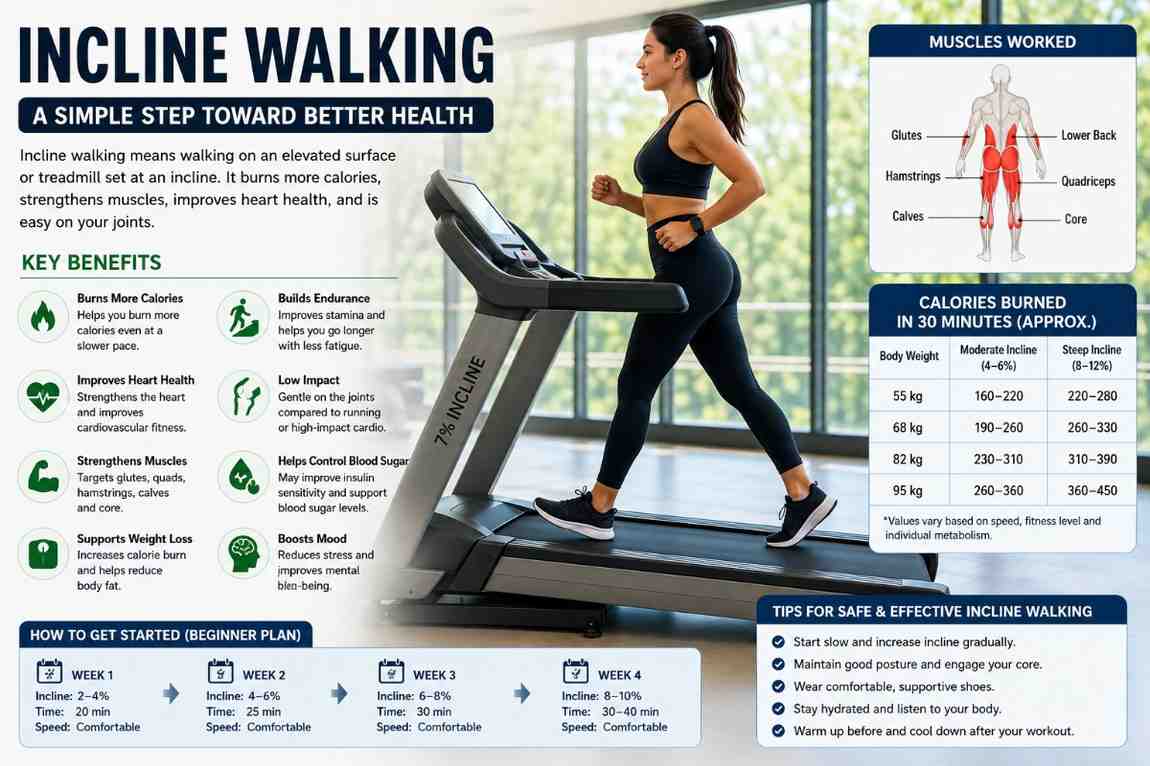
Walking is one of the easiest and most effective forms of exercise, but adding an incline can make your workout far more challenging without requiring you to run. Whether you’re walking on a treadmill with an adjustable incline or climbing hills outdoors, incline walking helps strengthen muscles, improve heart health, burn more calories, and boost endurance.
Unlike high-impact workouts that may put stress on the knees and ankles, incline walking offers a low-impact way to increase workout intensity while remaining gentle on most joints. It is suitable for beginners, older adults, people trying to lose weight, and even athletes looking to improve cardiovascular fitness.
In this guide, you’ll learn what incline walking is, how it works, its science-backed benefits, muscles worked, calories burned, safety tips, and how to create an effective incline walking routine.
What Is Incline Walking?
Incline walking simply means walking uphill or walking on a treadmill set at an elevated incline. Instead of walking on a flat surface (0% incline), the treadmill is raised anywhere from 2% to 15% or higher.
The steeper the incline, the harder your muscles work. This increases your heart rate, calorie expenditure, and muscle activation without requiring faster walking speeds.
Outdoor incline walking includes:
- Hiking uphill
- Walking on sloped roads
- Climbing hills
- Walking on mountain trails
- Walking on inclined park paths
How Incline Walking Works
When you walk uphill, gravity forces your body to work harder. Your lower body muscles generate greater force to propel you upward, while your cardiovascular system delivers more oxygen to working muscles.
Compared to walking on flat ground, incline walking:
- Increases heart rate
- Improves oxygen consumption
- Burns more calories
- Activates more muscles
- Builds muscular endurance
- Improves balance and coordination
Muscles Worked During Incline Walking
Incline walking activates nearly every major muscle in the lower body while engaging your core for stability.
Major muscles include:
- Gluteus maximus
- Hamstrings
- Quadriceps
- Calves (gastrocnemius and soleus)
- Hip flexors
- Core muscles
- Lower back stabilizers
- Shin muscles
The glutes experience particularly high activation during steeper inclines, making incline walking an excellent exercise for strengthening the hips and buttocks.
20 Proven Benefits of Incline Walking
1. Burns More Calories
Walking uphill requires more energy than walking on level ground, helping increase calorie expenditure even at slower speeds.
2. Supports Weight Loss
Higher calorie burn makes incline walking an excellent addition to a healthy weight-loss plan.
3. Builds Stronger Glutes
Inclines activate the glute muscles much more than flat walking, helping improve strength and muscle tone.
4. Strengthens Leg Muscles
Your quadriceps, calves, hamstrings, and hip muscles all work harder to move your body uphill.
5. Improves Heart Health
Incline walking raises your heart rate, strengthening the cardiovascular system over time.
6. Increases Endurance
Regular uphill walking gradually improves stamina and allows longer periods of physical activity.
7. Improves Lung Capacity
The increased workload challenges your respiratory system, helping improve breathing efficiency.
8. Low-Impact Cardio
Unlike running, incline walking places less impact on joints while still providing an effective cardiovascular workout.
9. Helps Control Blood Sugar
Regular walking improves insulin sensitivity and may help regulate blood glucose levels.
10. Supports Healthy Blood Pressure
Consistent aerobic exercise contributes to healthier blood pressure in many adults.
11. Improves Balance
Walking uphill requires greater coordination and stability, enhancing balance over time.
12. Strengthens Core Muscles
Maintaining proper posture on an incline naturally engages the abdominal and back muscles.
13. Improves Bone Health
Weight-bearing exercise supports bone strength and may help reduce age-related bone loss.
14. Increases Metabolic Rate
Your body continues using energy after challenging exercise, contributing to overall calorie expenditure.
15. Reduces Body Fat
Combined with healthy nutrition, incline walking can help lower overall body fat.
16. Improves Athletic Performance
Many runners and athletes use incline walking to build leg strength without excessive joint impact.
17. Supports Mental Health
Walking outdoors or exercising regularly may help reduce stress while improving mood and mental well-being.
18. Improves Posture
Proper incline walking encourages better body alignment and core stability.
19. Helps Maintain Healthy Cholesterol Levels
Regular aerobic activity may increase HDL (“good”) cholesterol while supporting overall cardiovascular health.
20. Easy to Customize
Incline walking can be adjusted by changing speed, incline, duration, or workout intervals, making it suitable for nearly every fitness level.
Related Articles:
- Jogging: 20 Benefits, Types, Weekly Plan, Risks & How to Start
- Rucking: 20 Benefits, Risks, Equipment, Plan & How to Start
- Power Walking: 20 Benefits, Technique, Risks & How to Start
How Many Calories Does Incline Walking Burn?
Estimated calories burned in 30 minutes:
| Body Weight | Moderate Incline | Steep Incline |
| 55 kg | 160–220 | 220–280 |
| 68 kg | 190–260 | 260–330 |
| 82 kg | 230–310 | 310–390 |
| 95 kg | 260–360 | 360–450 |
These values are estimates and vary based on walking speed and fitness level.
How to Start Incline Walking?
Beginners should increase intensity gradually.
Week 1
- Incline: 2–4%
- Time: 20 minutes
- Speed: Comfortable
Week 2
- Incline: 4–6%
- Time: 25 minutes
Week 3
- Incline: 6–8%
- Time: 30 minutes
Week 4
- Incline: 8–10%
- Time: 30–40 minutes
Increase only one variable (speed, incline, or duration) at a time.
Best Incline Walking Workout for Beginners
| Time | Incline |
| 5 min | 1% Warm-up |
| 5 min | 4% |
| 5 min | 6% |
| 5 min | 8% |
| 5 min | 4% |
| 5 min | 1% Cool-down |
Proper Incline Walking Form
To reduce injury risk:
- Keep your head up.
- Look straight ahead.
- Relax your shoulders.
- Engage your core.
- Swing your arms naturally.
- Avoid holding treadmill handrails unless necessary for balance.
- Take shorter, controlled steps.
- Land softly with each step.
Common Mistakes to Avoid
- Starting with a very steep incline
- Leaning heavily on treadmill handles
- Looking down continuously
- Wearing worn-out shoes
- Increasing speed and incline simultaneously
- Skipping warm-up and cool-down
- Ignoring pain
Potential Risks and Side Effects of Incline Walking
Incline walking is generally safe, but overdoing it may cause:
1. Muscle Soreness
Because incline walking places greater demand on your glutes, calves, hamstrings, and quadriceps, it’s common to experience muscle soreness, especially if you’re new to this type of workout.
2. Knee Pain
Steep inclines can increase stress on the knees, particularly if you have poor walking form, weak leg muscles, or pre-existing knee conditions.
3. Calf and Achilles Tendon Tightness
Walking uphill requires your calves and Achilles tendons to work harder, which may cause tightness or soreness if you don’t stretch or warm up properly.
4. Lower Back Strain
Leaning too far forward or maintaining poor posture while walking on an incline can strain the lower back muscles and lead to discomfort.
5. Foot and Ankle Fatigue
Long or intense incline walking sessions may cause tired feet, ankle soreness, or discomfort, especially if you’re wearing unsupportive footwear.
6. Increased Risk of Falls
Very steep inclines or uneven outdoor trails can affect balance, increasing the risk of slips, trips, or falls.
7. Overuse Injuries
Doing incline walking every day without enough recovery may contribute to overuse injuries such as tendon irritation, shin splints, or muscle strains.
8. Elevated Heart Rate
Incline walking is more demanding than walking on flat ground. People with heart disease, uncontrolled high blood pressure, or other cardiovascular conditions should consult a healthcare provider before starting an incline walking routine.
How to Reduce the Risks?
- Start with a gentle incline (2–4%) and increase it gradually.
- Warm up for 5–10 minutes before increasing the incline.
- Wear supportive walking or running shoes with good cushioning.
- Maintain an upright posture and avoid leaning heavily on the treadmill handrails.
- Stretch your calves, hamstrings, and hips after your workout.
- Stay hydrated before, during, and after exercise.
- Take rest days if you experience excessive soreness or fatigue.
- Stop exercising and seek medical advice if you experience severe pain, dizziness, chest pain, or shortness of breath.
Who Should Avoid or Modify Incline Walking?
Consult your healthcare provider before beginning incline walking if you have:
- Severe arthritis
- Recent surgery
- Serious heart disease
- Uncontrolled high blood pressure
- Significant balance problems
- Acute foot or ankle injuries
Pregnant individuals or people with chronic medical conditions should follow personalized medical guidance.
Incline Walking vs Flat Walking
| Feature | Incline Walking | Flat Walking |
| Calories Burned | Higher | Lower |
| Heart Rate | Higher | Moderate |
| Glute Activation | High | Moderate |
| Leg Strength | Greater | Moderate |
| Joint Impact | Low | Low |
| Difficulty | Moderate to High | Easy |
Tips to Maximize Results
- Walk at least 150 minutes per week.
- Increase incline gradually.
- Wear supportive walking shoes.
- Stay hydrated.
- Include strength training 2–3 times weekly.
- Eat a balanced diet with adequate protein.
- Prioritize sleep and recovery.
- Track your progress to stay motivated.
FAQs
Is incline walking good for weight loss?
Yes. Incline training burns more calories than walking on a flat surface, making it an effective exercise for weight loss when combined with a healthy, calorie-controlled diet.
Which muscles does incline walking work?
Incline training primarily targets the glutes, hamstrings, quadriceps, calves, hip flexors, core muscles, and lower back stabilizers.
What is the best incline for beginners?
Beginners should start with a 2–4% incline and gradually increase it as their strength and endurance improve.
Is incline walking better than running?
It depends on your goals. Running generally burns more calories per minute, while Incline training provides a lower-impact workout that is easier on the joints and still offers excellent cardiovascular and muscle-strengthening benefits.
Can incline walking help reduce belly fat?
Incline training cannot target belly fat specifically, but it helps burn calories and reduce overall body fat, including abdominal fat, when paired with a balanced diet.
Is incline walking safe every day?
Yes, most healthy adults can do moderate Incline training daily. However, it’s important to listen to your body, vary workout intensity, and allow time for recovery if you experience soreness.
Does incline walking build muscle?
Incline training helps strengthen and tone the glutes, calves, hamstrings, and quadriceps. While it improves muscular endurance, it is not designed to build large muscle mass.
How long should I do incline walking?
For general fitness, aim for 20–45 minutes per session, at least 150 minutes per week, depending on your fitness level and goals.
Is incline walking bad for your knees?
When performed with proper form and a moderate incline, Incline training is generally safe. However, very steep inclines may increase knee stress, especially for people with existing knee problems.
Should I hold the treadmill handrails while incline walking?
No. Unless you need them for balance, avoid holding the handrails, as doing so reduces workout intensity and may affect your natural walking posture.
What should I wear for incline walking?
Wear supportive walking or running shoes with good cushioning, comfortable workout clothing, and moisture-wicking socks to reduce the risk of blisters and discomfort.
Is incline walking better than flat walking?
Yes, for many fitness goals. Incline training burns more calories, engages more muscles, and provides a greater cardiovascular challenge than walking on a flat surface.
Is incline walking good for knee pain?
Some people find Incline training more comfortable than running, but steep inclines can increase stress on certain knee structures. If you have knee pain, consult a healthcare professional or physical therapist before starting.
Is 30 minutes of incline walking enough?
Yes. Thirty minutes of Incline training can improve fitness, burn calories, and support weight loss when done regularly.
What happens if I walk on an incline every day?
Daily incline walking can strengthen your legs, improve heart health, boost endurance, and increase calorie burn. Take rest if you feel overly sore.
How many calories does 10,000 steps burn on an incline?
On average, 10,000 incline walking steps burn about 450–800 calories, depending on your weight, speed, and incline.
How many steps is 30 minutes of incline walking?
Most people take 3,000–4,000 steps in 30 minutes of incline training.
How can I burn 500 calories with incline walking?
Most people need 45–75 minutes of incline training, depending on their weight, speed, and incline level.
Final Thoughts
Incline walking is one of the most efficient ways to increase the benefits of a regular walking routine without significantly increasing joint impact. Whether your goal is weight loss, stronger legs, better cardiovascular fitness, or improved endurance, walking uphill offers a practical and accessible solution.
The key to success is consistency. Start with manageable inclines, focus on good posture, wear supportive footwear, and gradually increase the challenge as your fitness improves. Combined with a balanced diet and healthy lifestyle, incline walking can become an effective long-term habit for improving overall health and well-being.
Sources / References:
- American College of Sports Medicine (ACSM)
- Centers for Disease Control and Prevention (CDC) – Physical Activity
- American Heart Association – Walking for Exercise
- National Institute on Aging – Exercise and Physical Activity
- World Health Organization – Physical Activity Guidelines
- Harvard T.H. Chan School of Public Health – Nutrition Source
About the Author:
Written by: Kirti Solanki (Health Content Researcher)
Kirti Solanki is a health content researcher dedicated to creating evidence-based, reader-friendly articles on nutrition, fitness, pregnancy, wellness, and preventive healthcare. Her goal is to translate complex medical and scientific information into practical advice that helps readers make informed lifestyle choices. Every article is thoroughly researched using trusted medical organizations, peer-reviewed studies, and public health resources to ensure accuracy, credibility, and relevance.
Disclaimer:
This guide is intended for educational and informational purposes only and should not be considered medical advice, diagnosis, or treatment. The information provided is based on current research and reputable health sources but may not apply to every individual. Always consult a qualified healthcare professional before starting a new exercise program, especially if you have a medical condition, are pregnant, are recovering from an injury, or have concerns about your health.
Also Read: